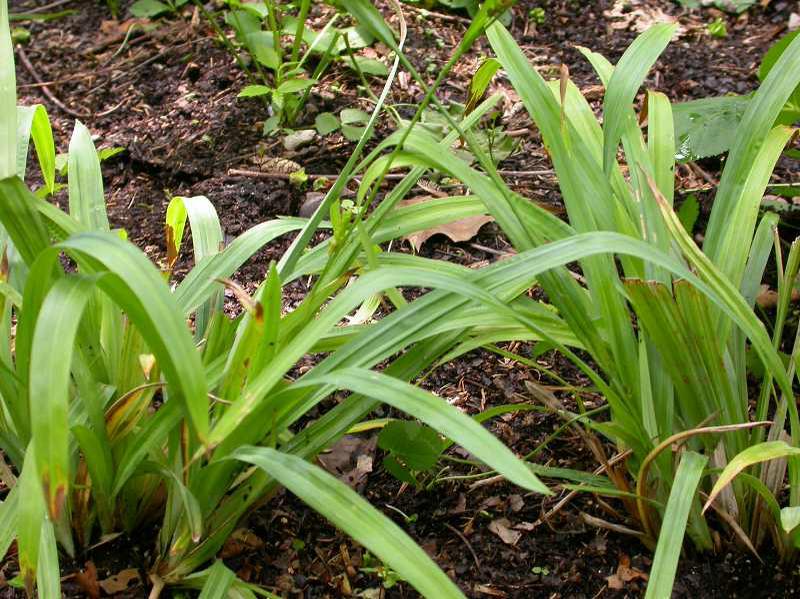
Latin name: Carex flaccosperma
Common name: Blue Wood Sedge
Flowers: Non showy flowers9
Fruit: Insignificant9
Height & Width: 1’ x 1’9
Type: Sedge9
Wetland indicator category**: FAC+(2)17
Habit: Upright clumps9
Texture: Medium16
Growth rate: Slow16
Light: Part shade16
Moisture: Medium to wet16
Soil: Fine or medium16
Zones: 5 to 89
Origin: Southeast9
Features: This is a low laying herb that grows in attractive clumps up to a foot tall. Typically found in wetter conditions it frequents wet woodlands and swampy areas. The leaves are blue-green, glaucous, and slender in appearance. The flowers are small, greenish, and not noticeable when they flower in the spring.9
Siting: Carex should be planted in moister areas that receive some shade. They are full shade tolerant but perform better when some direct sunlight is received each day. The soil should be slightly acidic and finer in texture. Too coarse of a soil does not retain enough moisture and could lead to plant death.9, 18
Care: Plant in suitable site with adequate soil organic matter so that the crown of the plant is at the soil surface18. Ensure the soil is adequately moist immediately after planting. Keep soil moist but not soggy until plant is established. Once plant is established water deeply but infrequently whenever the soil surface is dry or almost dry 2” below the soil surface.18
Pests: No serious insect or disease problems.
Author: Susie Lombardo, Editor: Alexander Smolka
Sources:
- Armitage, A. (2001). Armitage’s manual of annuals, biennials, and half-hardy perennials. Portland, OR: Timber Press.
- Armitage, A. (2006). Armitage’s native plants for North American gardens. Portland, Oregon: Timber Press.
- Armitage, A. (2008). Herbaceous perennial plants: A treatise on their identification, culture, and garden attributes.Athens, GA: University of Georgia.
- Clemson Cooperative Extension Home and Garden Information Center.(2011). Flowers fact sheets. Retrieved from https://hgic.clemson.edu/category/flowers/
- Clemson Cooperative Extension Home and Garden Information Center.(2011). Groundcovers & vines fact sheets.Retrieved from https://hgic.clemson.edu/category/groundcovers/
- Clemson Cooperative Extension Home and Garden Information Center.(2011). Trees. Retrieved from https://hgic.clemson.edu/category/trees/
- Clemson Cooperative Extension Home and Garden Information Center.(2011). Shrubs. Retrieved from https://hgic.clemson.edu/category/shrubs/
- Dirr, M. A. (2009). Manual of woody landscape plants. Champaign, IL: Stipes Publishing.
- Gilman, E. F. (1997). Trees for urban and suburban landscapes. Albany, NY: Delmar Publishers.
- Lady Bird Johnson Wildflower Center University of Texas at Austin. (2012). Native plant information network. Retrieved from http://www.wildflower.org/explore/
- McMillan, P., Plant taxonomist Clemson University, personal communication.
- Missouri Botanical Garden Kemper Center for Home Gardening. Plant finder. Retrieved from http://www.mobot.org/gardeninghelp/plantfinder/Alpha.asp
- North Carolina State University (2005). Plant fact sheets. Retrieved from http://www.ces.ncsu.edu/depts/hort/consumer/factsheets/index.html
- Strother, E. V., Ham, D. L., Gilland, L. (2003) Urban tree species guide: Choosing the right tree for the right place. Columbia, SC: South Carolina Forestry Commission.
- University of Florida, IFAS Extension. (2011). Southern trees fact sheet. Retrieved from http://edis.ifas.ufl.edu/department_envhort-trees
- USDA . Plant profile. (n/d).Retrieved from http://plants.usda.gov/java/
- USDA. Plant wetland indicator status. (n/d). Retrieved from http://plants.usda.gov/wetland.html
- Vincent, E., Environmental horticulturist Clemson University, personal communication.
*Soil pH is determined using a professional soil test. Contact your Clemson University County Extension service for assistance www.clemson.edu/extension/. Click on “local offices”.
**2012 Plant Wetland Indicator categories (quantitative derived) http://plants.usda.gov/wetinfo.html
| Indicator Code | Indicator Status | Comment |
| OBL | Obligate Wetland | Almost always is a hydrophyte, rarely in uplands |
| FACW | Facultative Wetland | Usually is a hydrophyte but occasionally found in uplands |
| FAC | Facultative | Commonly occurs as either a hydrophyte or non-hydrophyte |
| FACU | Facultative Upland | Occasionally is a hydrophyte but usually occurs in uplands |
| UPL | Obligate Upland | Rarely is a hydrophyte, almost always in uplands |
