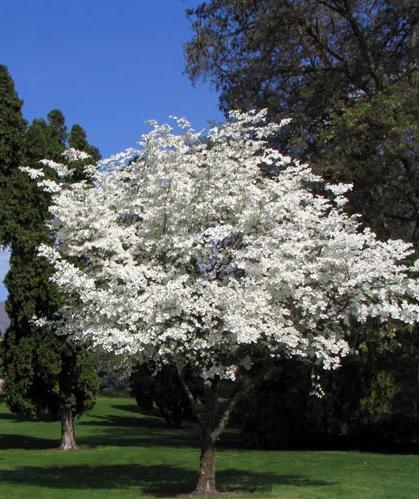
Latin name: Cornus florida ‘Weaver’s White’
Common name: White Flowering Dogwood
Flowers: Handsome large white bracts at end of stems1
Fruit or cones: Glossy red drupe7
Height & Width: 30′ x 20’7
Type: Deciduous13
Wetland indicator category**: FACU14
Habit: Low branched tree,with horizontal spreading lines with layering producing a low topped crown.7
Texture: Medium7
Growth rate: Initially slow, medium when established1
Light: Partial shade, full shade can be acceptable1
Moisture: Well drained soil7
Soil: Slightly acidic7
Zones: 57
Origin: Northern Florida7
Features: This native tree has year round pleasurable characteristics. Flowers appear April to May before the leaves develop allowing the viewer see a dotted white landscape. The bark has the texture of an alligator’s back adding interest to the winter landscape, as well as having red drupes fruiting in the fall to add to this. These drupes also attract native birds increasing the biodiversity of the surrounding area. Weaver’s White is a cultivar that performs especially well in the Deep South with notably larger foliage and more colorful white bracts than most other Cornus cultivars7.
Siting: It can be a very adaptable plant tolerating full sun and moist conditions, however it performs best in partial shade and well drained soils. When planted in water laden soils or in inadequately watered full sun areas the tree may die7.
Care: Plant the tree in the hole so that the root flare is visible at the soil surface. The hole should be only as deep as the root ball and two to three times as wide as the root ball11, 15. At planting, water the root ball daily with two gallons of water per inch of trunk diameter for two weeks, every other day for two months and then weekly until established15. Modify water recommendations to reflect site drainage and rainfall. Apply 3” of mulch over the planted area. Do not allow mulch to touch the trunk.11, 15
Pests: This species is susceptible to a number of pests like the borer and other petal and leaf spots. It can be noted that symptoms of disease and insects appear when the plant is already being stressed by undesirable conditions.7
Author: Alexander Smolka
Sources:
- Armitage, A. (2001). Armitage’s manual of annuals, biennials, and half-hardy perennials. Portland, OR: Timber Press.
- Armitage, A. (2006). Armitage’s native plants for North American gardens. Portland, Oregon: Timber Press.
- Armitage, A. (2008). Herbaceous perennial plants: A treatise on their identification, culture, and garden attributes.Athens, GA: University of Georgia.
- Clemson Cooperative Extension Home and Garden Information Center.(2011). Flowers fact sheets. Retrieved from https://hgic.clemson.edu/category/flowers/
- Clemson Cooperative Extension Home and Garden Information Center.(2011). Groundcovers & vines fact sheets.Retrieved from https://hgic.clemson.edu/category/groundcovers/
- Clemson Cooperative Extension Home and Garden Information Center.(2011). Trees. Retrieved from https://hgic.clemson.edu/category/trees/
- Clemson Cooperative Extension Home and Garden Information Center.(2011). Shrubs. Retrieved from https://hgic.clemson.edu/category/shrubs/
- Dirr, M. A. (2009). Manual of woody landscape plants. Champaign, IL: Stipes Publishing.
- Gilman, E. F. (1997). Trees for urban and suburban landscapes. Albany, NY: Delmar Publishers.
- Lady Bird Johnson Wildflower Center University of Texas at Austin. (2012). Native plant information network. Retrieved from http://www.wildflower.org/explore/
- McMillan, P., Plant taxonomist Clemson University, personal communication.
- Missouri Botanical Garden Kemper Center for Home Gardening. Plant finder. Retrieved from http://www.mobot.org/gardeninghelp/plantfinder/Alpha.asp
- North Carolina State University (2005). Plant fact sheets. Retrieved from http://www.ces.ncsu.edu/depts/hort/consumer/factsheets/index.html
- Strother, E. V., Ham, D. L., Gilland, L. (2003) Urban tree species guide: Choosing the right tree for the right place. Columbia, SC: South Carolina Forestry Commission.
- University of Florida, IFAS Extension. (2011). Southern trees fact sheet. Retrieved from http://edis.ifas.ufl.edu/department_envhort-trees
- USDA . Plant profile. (n/d).Retrieved from http://plants.usda.gov/java/
- USDA. Plant wetland indicator status. (n/d). Retrieved from http://plants.usda.gov/wetland.html
- Vincent, E., Environmental horticulturist Clemson University, personal communication.
*Soil pH is determined using a professional soil test. Contact your Clemson University County Extension service for assistance www.clemson.edu/extension/. Click on “local offices”.
**2012 Plant Wetland Indicator categories (quantitative derived) http://plants.usda.gov/wetinfo.html
| Indicator Code | Indicator Status | Comment |
| OBL | Obligate Wetland | Almost always is a hydrophyte, rarely in uplands |
| FACW | Facultative Wetland | Usually is a hydrophyte but occasionally found in uplands |
| FAC | Facultative | Commonly occurs as either a hydrophyte or non-hydrophyte |
| FACU | Facultative Upland | Occasionally is a hydrophyte but usually occurs in uplands |
| UPL | Obligate Upland | Rarely is a hydrophyte, almost always in uplands |
