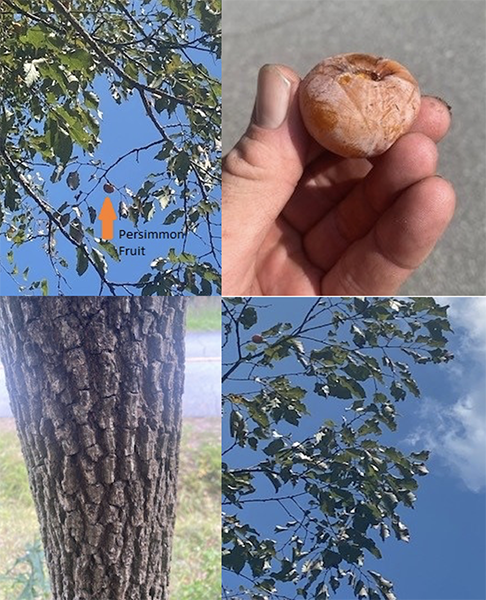
Latin name: Diospyros virginiana
Common name: American persimmon, common persimmon, eastern persimmon
Flowers: Green, yellow, white, averaging ½ inch, that bloom April through June 10
Fruit or cones: Globe-shaped fruit 1 inch in diameter or larger, orange-yellow color ranging to bluish, with a sweetish astringent pulp 10
Height & Width: Height of 35 to 60 feet with a spread up to 35 feet 6
Type: Deciduous 10
Habit: Irregular 16, slender, rounded 23, tree 10
Wetland indicator category**: FAC, FAC 16
SC regions include (1) Atlantic and Gulf Coastal Plains & (2) Eastern Mountain Piedmont Texture: Coarse 23
Growth rate: Slow 16
Light: Part-shade 10, full sun 21
Moisture: Medium 10
Soil*: Variable, growing best in moist, rich soil 10 with a pH of 6.0 to 8.0 21
Zones: 4a, 4b, 5b, 5a, 6b, 6a, 7b, 7a, 8a, 8b, 9b, 9a 21
Origin: Primarily southeast U.S. 23, L48 16
Ecosystem benefits: The fruit attracts a variety of wildlife (birds and mammals), and the flowers are of special value to honeybees 10
Image 1
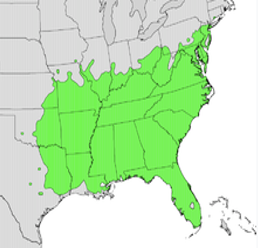
Image 2
Features: The genus name Diospyros, from the Greek, means “Fruit of the god Zeus”, the immature fruit contains tannin and is strongly astringent10.The astringency renders the fruit somewhat unpalatable, but after it has been subjected to frost or has become overly ripe, its flavor is improved20. When ripe, the sweet fruit of Persimmon somewhat recalls the flavor of dates, persimmons are consumed fresh and are used to make puddings, cakes, and beverages, American Indians made persimmon bread and stored the dried fruit like prunes, opossums, raccoons, skunks, deer, and birds also feed upon the fruit 10.
Siting: This is a great acreage tree because it suckers well and can form a large stand. In addition, it makes a great urban tree, because it tolerates city soils and urban growing conditions. Understory tree, accent tree or shrub, fall conspicuous 22. The root system makes it useful in erosion control 10. When blooming the flowers are aromatic so, placing upwind of lounging/sitting areas can be beneficial 23.
Care: Plant so root flare is visible at soil surface 14. At planting, water the root ball daily with two gallons of water per inch of trunk diameter for two weeks, every other day for two months and then weekly until established. Modify water recommendations to reflect site drainage and rainfall. Apply 3” of mulch over the planted area. Do not allow mulch to touch the trunk 14. Germinates easily from stratified seeds; seedlings grow slowly. Bury root cuttings in moist sand over winter and lift when the shoot is well developed. Difficult to transplant because of a deep, coarse root system. This plant may be grafted like other fruit. Clean fruit immediately to prevent mold and fermentation. Air-dry seeds and store them in sealed, refrigerated containers. Stratify seeds in moist peat for 30-60 days at 36-41 degrees. Scarification does not seem to improve germination but clipping the caps can result in higher germination by encouraging radicle emergence 10.
Pests: Insect pests of persimmons include scale, persimmon psyllid, leaf-rolling, defoliating caterpillars, and persimmon borer. It is important to monitor the persimmon borer. If borer damage is noted on the trunk or exposed roots, treatment may be required. Diseases include fungal leaf spots, twig dieback, and powdery mildew 6.
This plant does not appear on the following invasive plant lists on 9/21/22:
USDA SC Invasive Plant Species
SC Exotic Plant Pest Council
Author: W. Brian Kirby
Image source:
1) W. Brian Kirby – HORT 4080 – Clemson University 23
2) Map: Wikipedia 24
Sources:
- Armitage, A. (2001). Armitage’s manual of annuals, biennials, and half-hardy perennials. Portland, OR: Timber Press.
- Armitage, A. (2006). Armitage’s native plants for North American gardens. Portland, Oregon: Timber Press.
- Armitage, A. (2008). Herbaceous perennial plants: A treatise on their identification, culture, and garden attributes. Athens, GA: University of Georgia.
- Clemson Cooperative Extension Home and Garden Information Center.(2011). Flowers fact sheets. Retrieved from http://www.clemson.edu/extension/hgic/plants/landscape/ flowers/
- Clemson Cooperative Extension Home and Garden Information Center.(2011). Groundcovers & vines fact sheets.Retrieved from http://www.clemson.edu/ extension/hgic/plants/landscape/groundcovers/
- Clemson Cooperative Extension Home and Garden Information Center.(2011). Trees. Retrieved from http://www.clemson.edu/extension/hgic/ plants/landscape/trees/
- Clemson Cooperative Extension Home and Garden Information Center.(2011). Shrubs. Retrieved from http://www.clemson.edu/extension/hgic/plants/landscape/shrubs/
- Dirr, M. A. (2009). Manual of woody landscape plants. Champaign, IL: Stipes Publishing.
- Gilman, E. F. (1997). Trees for urban and suburban landscapes. Albany, NY: Delmar Publishers.
- Lady Bird Johnson Wildflower Center University of Texas at Austin. (2012). Native plant information network. Retrieved from http://www.wildflower.org/explore/
- McMillan, P., Plant taxonomist Clemson University, personal communication.
- Missouri Botanical Garden Kemper Center for Home Gardening. Plant finder. Retrieved from http://www.mobot.org/gardeninghelp/plantfinder/Alpha.asp
- North Carolina State University (2005). Plant fact sheets. Retrieved from http://www.ces.ncsu.edu/depts/hort/consumer/factsheets/index.html
- Strother, E. V., Ham, D. L., Gilland, L. (2003) Urban tree species guide: Choosing the right tree for the right place. Columbia, SC: South Carolina Forestry Commission.
- University of Florida, IFAS Extension. (2011). Southern trees fact sheet. Retrieved from http://edis.ifas.ufl.edu/department_envhort-trees
- USDA . Plant profile. (n/d).Retrieved from http://plants.usda.gov/java/
- USDA. Plant wetland indicator status. (n/d). Retrieved from http://plants.usda.gov/wetland.html
- Vincent, E., Environmental horticulturist Clemson University, personal communication.
- Clemson Extension. Carolina Yards Plant Database. Retrieved from https://www.clemson.edu/extension/carolinayards/plant-database/index.htm
- Chisholm, Hugh, ed. (1911). “Persimmon”. Encyclopedia Britannica. Vol. 21 (11th ed.). Cambridge University Press. p. 252.
- NC State University, Extension Gardener, Plant Toolbox. Retrieved on 9/20/2022 Retrieved from https://plants.ces.ncsu.edu/plants/diospyros-virginiana/
- University of Nebraska–Lincoln, Horticulture, Landscape, and Environmental Systems. (2022) Retrieved from https://communityenvironment.unl.edu/plant-month-persimmon
- Kirby, W. Brian, Clemson University, Horticulture 4080 Fall 2022.
- Diospyros virginiana. (2022, September 2). In Wikipedia. Retrieved from https://en.wikipedia.org/wiki/Diospyros_virginiana
- Esquivel, Rudy G.. 2001. Propagation protocol for production of Container (plug) Diospyros virginiana L. plants USDA NRCS – James E. “Bud” Smith Plant Materials Center Knox City, Texas. In: Native Plant Network. URL: https://NativePlantNetwork.org (accessed 2022/09/22). US Department of Agriculture, Forest Service, National Center for Reforestation, Nurseries, and Genetic Resources.
*Soil pH is determined using a professional soil test. Contact your Clemson University County Extension service for assistance www.clemson.edu/extension/. Click on “local offices”.
**2012 Plant Wetland Indicator categories (quantitative derived) http://plants.usda.gov/wetinfo.html
| Indicator Code | Indicator Status | Comment |
|---|---|---|
| OBL | Obligate Wetland | Almost always is a hydrophyte, rarely in uplands |
| FACW | Facultative Wetland | Usually is a hydrophyte but occasionally found in uplands |
| FAC | Facultative | Commonly occurs as either a hydrophyte or non-hydrophyte |
| FACU | Facultative Upland | Occasionally is a hydrophyte but usually occurs in uplands |
| UPL | Obligate Upland | Rarely is a hydrophyte, almost always in uplands |