Latin name: Magnolia macrophylla
Common name: Bigleaf Magnolia
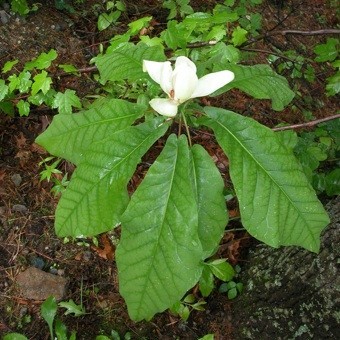
Flowers: White flowers with purple bases, bloom in May 12,19
Fruit or cones: Showy fruit, mature to red color 12
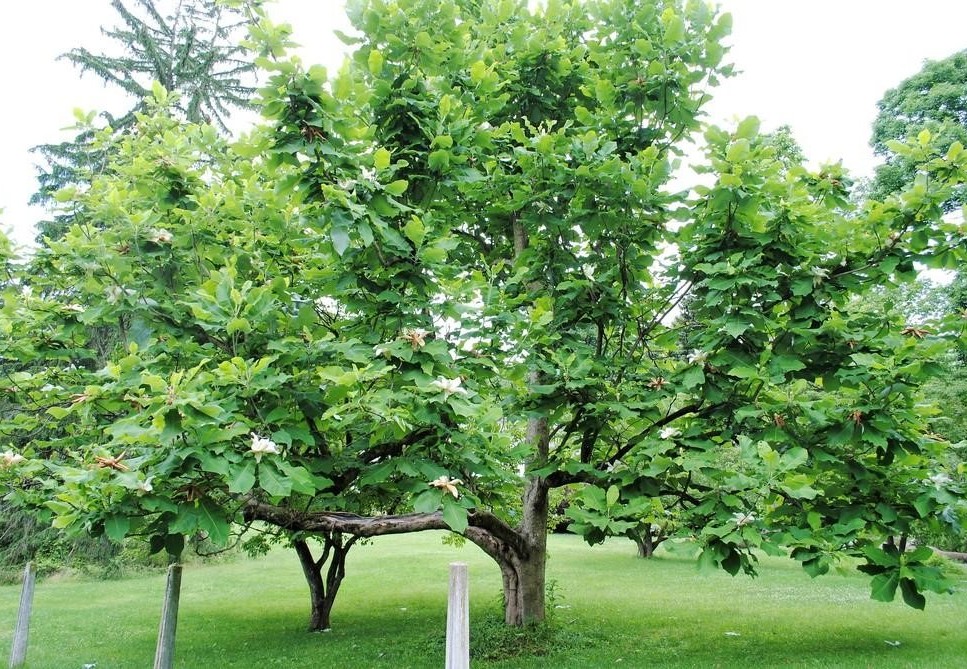
Height & Width: 30’-40’ tall, 30’-40’ wide12, 19 12,19
Type: Deciduous 19
Habit: Upright, wide crown 12
Wetland indicator category**: FACU 17
Texture: Coarse 12
Growth rate: Medium 19
Light: Part sun – full sun 12,19
Moisture: Well drained 12,19
Soil*: Sand, clay, loam; acidic-alkaline 19
Zones: 5-18 12
Origin: Lower 48 states 17
Ecosystem benefits: Attracts butterflies, bird and hummingbirds 19
Features: This tree has attractive flowers for wildlife 19. It also is an attractive addition to lawns 19. Magnolia macrophylla has the largest simple leaves of any tree native to North America and can get up to 30 inches in length 12.
Siting: Used in lawns for its attractive flowers 12. This magnolia should be used in areas away from urban pollutants as it is sensitive to them and it should also be placed in a location protected from strong winds to protect its large leaves 12.
Care: Plant so root flare is visible at soil surface 14. At planting, water the root ball daily with two gallons of water per inch of trunk diameter for two weeks, every other day for two months and then weekly until established. Modify water recommendations to reflect site drainage and rainfall. Apply 3” of mulch over the planted area. Do not allow mulch to touch the trunk 14.
Pests: Plants are relatively pest resistant if cultural preferences are met 12.
This plant does not appear on the following invasive plant lists on (3-1-21):
- USDA SC Invasive Plant Species Web site at http://www.invasivespeciesinfo.gov/plants/main.shtml
- SC Exotic Plant Pest Council Web site at http://www.se-eppc.org/southcarolina/
Author: Kayla Pratt
Image source:
1) https://www.clemson.edu/extension/carolinayards/plant-database/index.html#cypdb/details/52ee9eb1740e8cad593e5217/
2) https://garden.org/plants/photo/484385/
Sources:
- Armitage, A. (2001). Armitage’s manual of annuals, biennials, and half-hardy perennials. Portland, OR: Timber Press.
- Armitage, A. (2006). Armitage’s native plants for North American gardens. Portland, Oregon: Timber Press.
- Armitage, A. (2008). Herbaceous perennial plants: A treatise on their identification, culture, and garden attributes.Athens, GA: University of Georgia.
- Clemson Cooperative Extension Home and Garden Information Center.(2011). Flowers fact sheets. Retrieved from https://hgic.clemson.edu/category/flowers/
- Clemson Cooperative Extension Home and Garden Information Center.(2011). Groundcovers & vines fact sheets.Retrieved from https://hgic.clemson.edu/category/groundcovers/
- Clemson Cooperative Extension Home and Garden Information Center.(2011). Trees. Retrieved from https://hgic.clemson.edu/category/trees/
- Clemson Cooperative Extension Home and Garden Information Center.(2011). Shrubs. Retrieved from https://hgic.clemson.edu/category/shrubs/
- Dirr, M. A. (2009). Manual of woody landscape plants. Champaign, IL: Stipes Publishing.
- Gilman, E. F. (1997). Trees for urban and suburban landscapes. Albany, NY: Delmar Publishers.
- Lady Bird Johnson Wildflower Center University of Texas at Austin. (2012). Native plant information network. Retrieved from http://www.wildflower.org/explore/
- McMillan, P., Plant taxonomist Clemson University, personal communication.
- Missouri Botanical Garden Kemper Center for Home Gardening. Plant finder. Retrieved from http://www.mobot.org/gardeninghelp/plantfinder/Alpha.asp
- North Carolina State University (2005). Plant fact sheets. Retrieved from http://www.ces.ncsu.edu/depts/hort/consumer/factsheets/index.html
- Strother, E. V., Ham, D. L., Gilland, L. (2003) Urban tree species guide: Choosing the right tree for the right place. Columbia, SC: South Carolina Forestry Commission.
- University of Florida, IFAS Extension. (2011). Southern trees fact sheet. Retrieved from http://edis.ifas.ufl.edu/department_envhort-trees
- USDA . Plant profile. (n/d).Retrieved from http://plants.usda.gov/java/
- USDA. Plant wetland indicator status. (n/d). Retrieved from http://plants.usda.gov/wetland.html
- Vincent, E., Environmental horticulturist Clemson University, personal communication.
- Clemson Extension. Carolina Yards Plant Database. Retrieved from https://www.clemson.edu/extension/carolinayards/plant-database/index.html
*Soil pH is determined using a professional soil test. Contact your Clemson University County Extension service for assistance www.clemson.edu/extension/. Click on “local offices”.
**2012 Plant Wetland Indicator categories (quantitative derived) http://plants.usda.gov/wetinfo.html
| Indicator Code | Indicator Status | Comment |
| OBL | Obligate Wetland | Almost always is a hydrophyte, rarely in uplands |
| FACW | Facultative Wetland | Usually is a hydrophyte but occasionally found in uplands |
| FAC | Facultative | Commonly occurs as either a hydrophyte or non-hydrophyte |
| FACU | Facultative Upland | Occasionally is a hydrophyte but usually occurs in uplands |
| UPL | Obligate Upland | Rarely is a hydrophyte, almost always in uplands |