CECAS Professional Development and Retreat Committee (Stephanie Evans, Taylor Rosenberger, Madison Carter, Sarah Pruitt, John-Austin Wyatt, Dana Simpson)
“This team has done an incredible job of planning, developing, and deploying the 2026 CECAS Graduate Student Services retreat! On top of their actual jobs of advisors, directors, and coordinators, they spent months meeting, brainstorming, surveying, gathering presenters, and demoing presentations (some of which they even did themselves!) all in order to give CECAS Student Services staff a day to come together, team build, and learn skills in software and programs that will assist them in their jobs. They did all of this while navigating budget guidance and still delivered the most comprehensive retreat yet!” – Jeremiah Farmer, Director of Graduate Student Services, College of Engineering, Computing and Applied Sciences
Stephen Peele, Jennifer Van Dyken; Registration Coordinators for MATH and STAT, Mathematical Sciences
“The Mathematics Registration Coordinators consistently go above and beyond in assisting students and advisors. Their high-quality service deserves recognition!” – Joe Wilson, Program Manager, Exploratory Studies Advising
Amanda Duncan and CAFLS Post Award Team
“The CAFLS Post Award Team has consistently delivered excellence and professionalism, even through a changing landscape and ongoing uncertainty around federal grants. Their steady support of faculty, unwavering service, and attention to detail have provided confidence and stability.” – Anonymous
The Clemson Libraries recently secured a grant from Clemson’s Information Technology Student Advisory Board (ITSAB) to support an open-source online homework system called WeBWork.
Many instructors in lower-division math, science, engineering and business classes that are heavy in mathematical calculations, use online homework platforms that collect and grade student assignments. Unlike traditional written homework that is graded and returned to students a week later, these platforms give them instant feedback on whether their answers are right or wrong. This helps students identify their mistakes, strengths and weaknesses, which can greatly improve their learning.
But commercial systems can be very expensive, costing as much as $100 per student per course. Produced by large publishers, their questions are tied to expensive publisher textbooks, which often do not fully meet the needs of instructors and forbid them from selecting other textbooks, some of which are free for students to use.
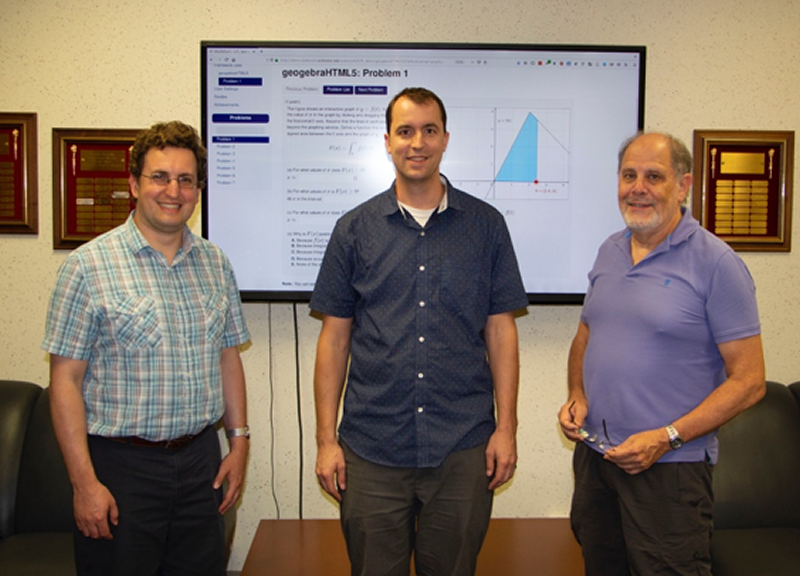
Michael Burr (left), Matt Macauley and Matt Saltzman, professors in the School of Mathematical and Statistical Sciences, are using open source WeBWork in their courses.
Matt Saltzman, Matt Macauley and Michael Burr, professors in the School of Mathematical and Statistical Sciences, began searching for a solution. They discovered WeBWork, an open source system which was originally developed for a physics course at the University of Rochester and has since been upgraded with many grants, including some from the Mathematical Association of America.
Saltzman installed WeBWork on a server provided by the College of Engineering, Computing and Applied Sciences’ Information Technology Services, and Macauley and Burr use it to teach their fall 2019 courses.
WeBWork is free for both faculty and students and can be used in any lower-division STEM and business courses that require students to do homework involving mathematical calculations. “It can provide homework for students in dozens of classes simultaneously,” Salzman said.
“The system also has many advantages over commercial platforms,” according to Burr. “WeBWork is built using a more robust programming language and has more flexibility in generating questions. It also collects data beyond student grades, such as the number of attempts per question, which can be used by instructors to better analyze student performance, determine areas where a student is struggling and assist them.”
The professors hope to use WeBWork again next semester if the current trial of the server is successful. However, there are still a few challenges. Though there are new commercial services that host WeBWork for a fee, Saltzman, Macauley and Burr are hosting it locally to keep costs low. For now, Saltzman is serving as a volunteer administrator, but scaling up and developing a long-term sustainable approach to hosting and maintaining the system will require support from IT staff or students.
Yang Wu, the open resources librarian at Clemson Libraries, worked to find financial assistance to get the project started during the summer of 2019 by contacting Undergraduate Student Government for help.
Reducing the cost of learning materials is a major priority for Logan Young, Undergraduate Student Body president, who worked to secure the grant from the IT Student Advisory Board, a governance group that manages 10 percent of student IT fees and uses it to fund initiatives benefitting students.
Zachary Pate, chairman of ITSAB, welcomed the WeBWork project, noting that cash-strapped students often try to finish a course without required materials.
“I’ve heard so many different stories of students who will calculate how well they can do in a class without purchasing certain items,” Pate said.
Clemson Libraries Clemson Libraries is Clemson’s first place for information. Clemson Libraries’ collection boasts 1.2 million print volumes, complemented by over 500,000 eBooks and 82,000+ electronic journal subscriptions. The Libraries’ faculty, staff and student assistants are dedicated to ensuring student success by providing the information resources and services needed to complete assignments, attain degrees and excel in the workplace.