Climate-Smart Forestry (CSF) is a new terminology for forestry management that meshes traditional practices with practices that address climate change realities. The approach has helped forest landowners realize that traditional forestry practices that encourage revenue also can encourage climate change adaptation and mitigation.
CSF is not a precise recipe that can be applied uniformly to southern forests. Not every stand is suited for adaptation nor is every stand suited for mitigation. Therefore, every stand and forest requires careful thought and management to realize adaptation and mitigation objectives. The good news is that change is likely within southern forests. Familiar strategies such as thinning, prescribed fire, and planting can help landowners prepare for change. To incorporate CSF, landowners can rely on trusted silvicultural tools while being mindful of adaptation and mitigation objectives.
CSF is more involved than just planting more trees or issuing carbon credits. Stakeholders should be mindful of carbon storage quality, carbon tunnel vision, financing needs, and the need for CSF incentives. Of course, topics like carbon storage quality and land use optimization create ample opportunity for additional investigation. From a forest-science perspective, there is an urgent need for improved carbon accounting methodologies and ecosystem and socio-economic specific enhanced forest productivity. CSF has potential to be a useful tool for climate change mitigation but without scientific innovation, it will be difficult for CSF to be a trustworthy mitigation strategy. It is now the responsibility of forest researchers, policymakers, investors, and forest industry to implement CSF effectively.

GOAL OF THIS GRANT/PROJECT
Goals of this project are to:
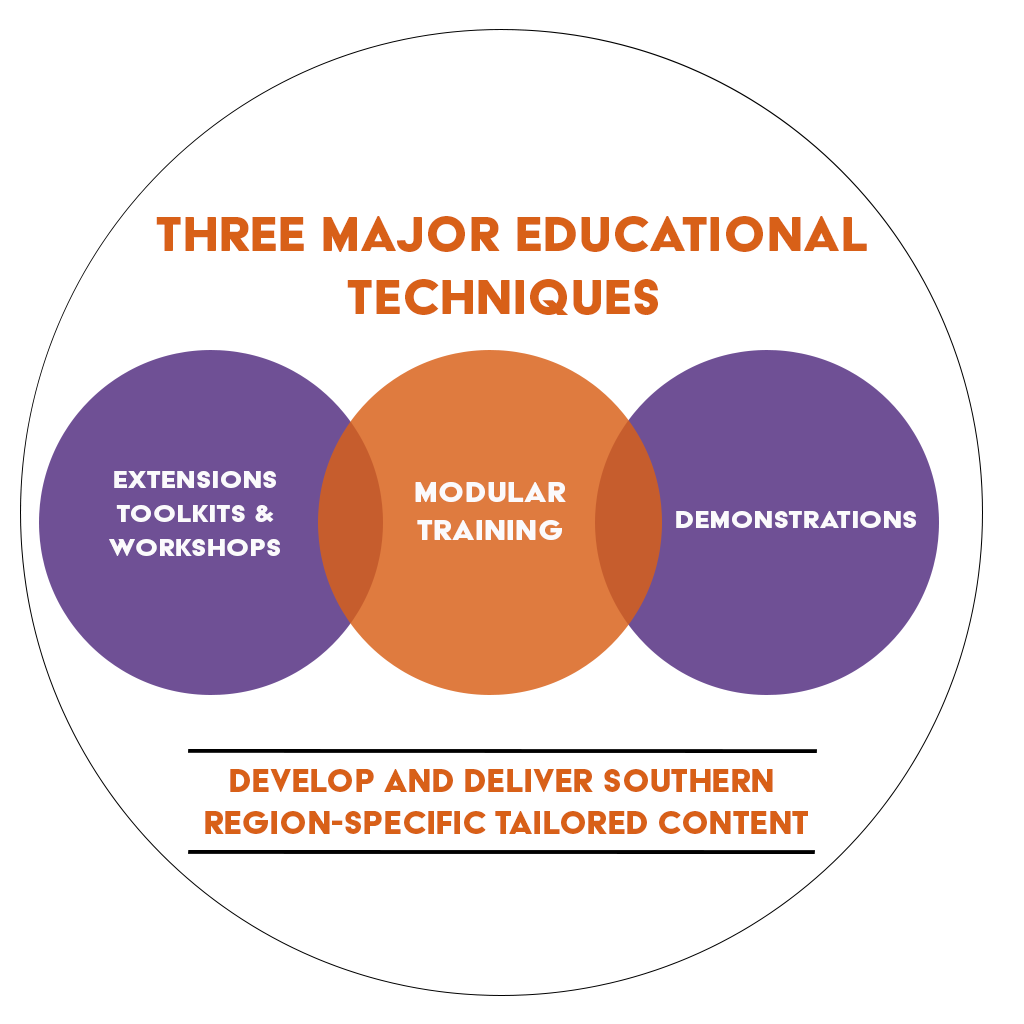
- Develop a need-based extension program on CSF in the southern region. Using innovative methods for stakeholder input, learning, and messaging.
- Create educational resources and module-based training programs for professionals in the southern region to increase access to tailored content.
- Provide educational workshops and demonstration tours to showcase new management techniques, with later delivery and translation of climate science to forestry stakeholders.