Clemson University’s Wood Utilization + Design Institute (WU+D) was founded during a period of economic disruption, when sharply declining wood prices forced many small sawmills and wood-processing facilities to close. In response, the Institute focused its early work on expanding wood-based construction markets—particularly in the commercial, non-residential sector. A central emphasis was southern yellow pine cross-laminated timber (CLT), with research addressing adhesives, fire resistance, structural performance, manufacturing standards, connections, vibration, and acceptance by engineers and architects.
Market acceptance quickly emerged as a critical challenge. Early research examined what types of buildings were likely to be constructed in the South and nationwide, and the potential scale of those markets. With one of the first grants awarded through the USDA Forest Service’s Wood Innovation funding program, WU+D developed a series of workshops and educational programs to share findings with building owners, developers, architects, and engineers. Decision-makers for public buildings within South Carolina were the primary audience.
Another group soon drew attention: the U.S. Department of Defense (DOD). The Lendlease Hotel project in Huntsville, Alabama, helped catalyze this interest, prompting a series of performance tests demonstrating that mass timber buildings could meet rigorous safety and durability standards. These tests and the research they inspired continue today.
As industry-governmental affairs groups advanced the concept of mass timber construction on military bases, Clemson recognized both the opportunity and the complexity of implementing it. Based on experience securing approval for Clemson’s first mass timber campus building, the Institute knew sustained coordination would be required. Clemson partnered with the U.S. Forest Service and the U.S. Endowment for Forestry and Communities (the Endowment) to propose a comprehensive plan. The Endowment accepted and found funding from the USDA Forest Service Wood Innovation program
A $370,000 grant from the Endowment supported Clemson University’s School of Architecture, the Glenn Department of Civil Engineering, and the Wood Utilization + Design Institute in advancing mass timber design and education through a multi-year, multi-university consortium. The project brought together architecture and engineering faculty and students, mass timber manufacturers, design and construction firms, and representatives from the Department of Defense. The goal was to promote the use of mass timber a sustainable and resilient building technology across the DOD’s more than 800 installations worldwide.
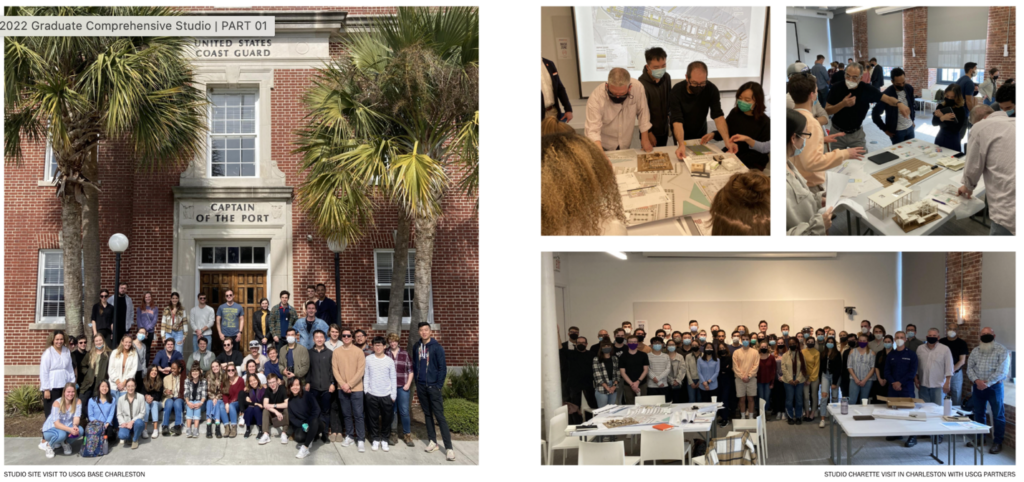
Over two years, collaborative design studios and research seminars were held across four universities: Clemson University, the University of Arkansas, the University of Oregon, and the Tallwood Design Institute at Oregon State University. A total of 104 upper-level architecture students participated in five design studios, developing mass timber proposals for military installations. Faculty and students worked directly with four DOD sites and client groups to create preliminary designs for “archetypal” mass timber buildings aligned with planned DOD projects. Participating installations included Tyndall Air Force Base (Florida); U.S. Coast Guard Atlantic Area (Charleston, South Carolina); Little Rock Air Force Base (Arkansas); and Mountain Home Air Force Base (Idaho).
The Department of Defense was selected as a partner because of its unparalleled scale and influence. With more than 600,000 buildings across thousands of locations, the DOD maintains the nation’s largest real estate portfolio and is a significant driver of sustainable and resilient construction practices. Its demanding project constraints tight schedules, complex logistics, and diverse building types—create conditions that can accelerate innovation. The DOD’s reliance on local materials and labor also supports rural economies surrounding military installations. Mass timber, with advantages in constructability, deconstructability, and integrated design, offers compelling solutions to these challenges.
At the conclusion of the design studios, students and faculty presented their work to representatives from participating installations and the U.S. Army Corps of Engineers. By 2026, the long-term impact of this work is visible in real-world projects that reflect years of research, testing, policy progress, and growing institutional commitment to sustainable construction within the Department of Defense.
On January 6, 2026, a new state-of-the-art mass timber Child Development Center broke ground at Joint Expeditionary Base Little Creek–Fort Story in Virginia Beach. The project designed by Gensler and constructed by Layton Construction in partnership with the U.S. Navy and the Defense Innovation Unit will serve Navy and Coast Guard families across the Hampton Roads region.
Similarly, on December 12, 2025, the U.S. Army Corps of Engineers broke ground at Joint Base Lewis–McChord in Washington on a five-story, 105,000-square-foot mass timber barracks designed to house 200 soldiers. The project represents a significant shift toward construction materials long used in the private sector but newly adopted by the Department of War (formerly Defense).
Collaborations formed over the past 15 years have been instrumental in advancing mass timber in the United States. While challenges remain, many of the issues first examined by WU+DI in 2010 market volatility, small-diameter wood utilization, and forest health are more urgent today, as facility closures continue and wildfire and pest risks increase.
Clemson University’s Wood Utilization + Design Institute is expanding beyond its original focus to address new products and markets for wood of all types and sizes. The guiding principle remains clear: Healthy Forest Markets = Healthy Forests. We invite partners and stakeholders to explore how collaboration continues to turn ambitious ideas into measurable impact.


Pat Layton
WU+D Strategic Advisor
Follow us: Facebook, Linkedin, Instagram, X (Twitter)
