By Kylie Price

Pumpkin Carving Event
This fall, I had the opportunity to work at the Center for Health Facilities Design and Testing as their first undergraduate intern. I am currently a senior here at Clemson University majoring in Health Science with a minor in Architecture. I had always wanted to work in the healthcare industry, so when deciding on a major, I went with the obvious choice. I had yet to learn how architecture is just as big a part of healthcare as anything else.
I decided to add a minor in architecture to my studies when I discovered the program my sophomore year here at Clemson. My roommate at the time was an architecture major and the work that she was doing fascinated me. I have always been interested in design and how our spaces can influence our behavior and how we think. The minor in Architecture introduced me to my love for architecture and completely changed my plans for the future. In order to complete my bachelor’s in health science, we must finish an internship in the field, and I think I was the first to tell my advisor that I wanted my internship to be related to architecture. She did some research and was eventually able to connect me to the Center for Health Facilities Design and Testing (CHFDT), a perfect mix of my two interests. I reached out to Anjali, the Director of the Center, and expressed my interest in working with them and was thrilled to be selected as their first undergraduate intern.
The CHFDT has given me a unique perspective on what a future in healthcare can look like. When I first walked into the Center, I didn’t know what to expect. As the Center’s first undergraduate intern, I was excited to see what I was going to work on and how health and architecture interact. During my internship, I have had the opportunity to assist the team with the EDen room project, which is focused on designing a flexible emergency department room for mental and behavioral health patients, as well as medical patients. My roles have included sitting in on team meetings, collecting data from mental health professionals during simulation-based evaluation of physical mock-ups, and analyzing that data to develop recommendations for design refinement. I have learned about the importance of minimizing ligature risks for mental and behavioral health patients and how lighting, color, and the overall design of the physical environment can improve comfort and support patient dignity.
One of the most rewarding parts of this experience has been being surrounded by such a talented team, including PhD students, researchers, and architecture students. They’ve introduced me to research methods that have deepened my understanding of how healthcare spaces affect patients and staff. I’ve learned how to formulate research questions, analyze data from behavioral observations, and gather feedback through interviews and mock-up simulations. It was interesting to see how insights from staff can affect design and how we can use that data to support patient and staff safety.
Some highlights of my time here at the Center include our pumpkin carving event for Halloween where we all got to showcase our design skills on pumpkin faces and acting the role of a patient being transported in a hospital as part of a training exercise for a research study on intrahospital transport. I was transported around in a wheelchair by PhD students playing the role of nurses with a trashcan as my oxygen unit, while other researchers tested out the tools they were going to use for the actual study at Children’s Healthcare of Atlanta. The team has truly welcomed me as one of their own and have taught me valuable skills that I will take with me wherever I go.
Overall, this internship has helped me discover a new perspective on health and design and how my interests can be combined. I love thinking about how spaces can impact behavior and how design can improve healthcare experiences. I am grateful to have had the opportunity to be the first undergraduate intern with the CHFDT and to have been able to figure out together with the team how undergraduate students can potentially assist in future research projects. As I move forward, I plan to pursue a Master of Architecture and continue to explore how design can support health and create environments where patients and caregivers can feel safe. This experience has helped me decide what I want my future to look like in the healthcare industry and I am excited to see what more I can learn with my time left at the Center.
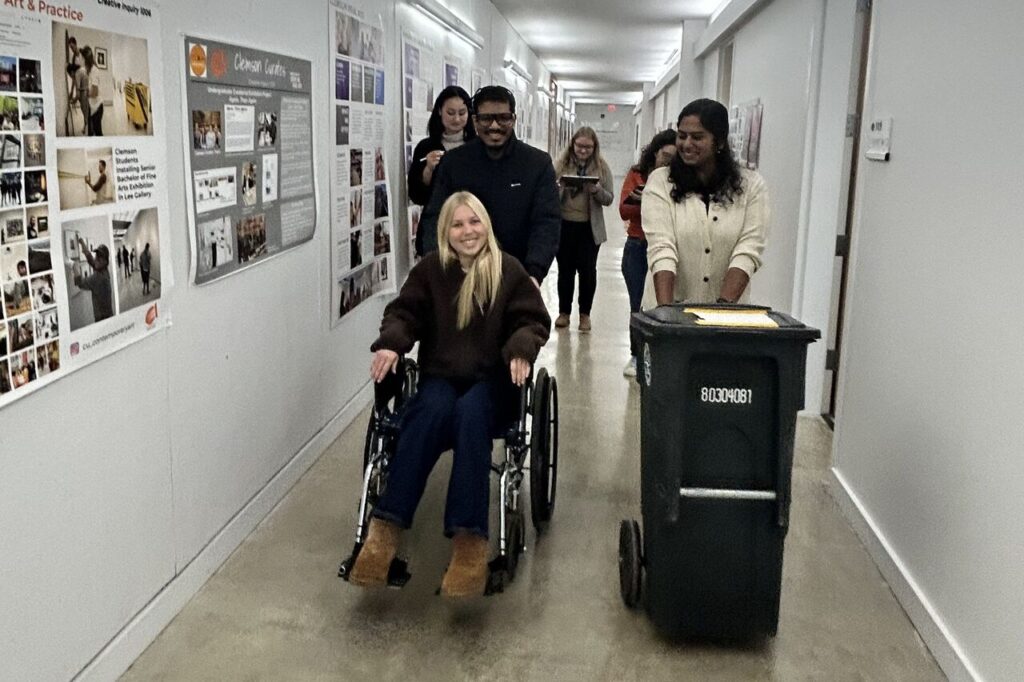
Intrahospital Transport Study Training