Biological Sciences

Trevor Brewington – Q & A With a Grad

Trevor Brewington will graduate this week with his M.S. in biological sciences. We asked Trevor to reflect on his time here at Clemson in the Blob lab through a short Q & A.

Three photos. A man stands over a keyboard, group of people with baseball hats on, a group of people in a restaurant.

Research?
I studied comparative biomechanics and functional morphology. For my thesis I used polydactyl alligators as a model for early tetrapod locomotion. Late Devonian tetrapod lineages were noted to have more than five digits and since those lineages are extinct, alligators with polydactyl can act broadly as modern analogs to infer locomotor patterns and provide insights into evolutionary trends such as, why pentadactyly is the common condition among extant vertebrate lineages.

What’s next?
I will continue to study comparative biomechanics and functional morphology while attending the University of Tennessee, Knoxville for a Ph.D. in Ecology and Evolution starting in August 2026.

What will you miss the most?
I will definitely miss the community the most. I’ll miss chatting with people in the grad office or doing something on a random weekend like going to the rodeo with all these really cool people. The number one piece of community I’ll miss are my lab mates because it always felt like more than a workspace where we helped each other out, it was true friendship and I am going to miss those moments.

Memorable moment
For a selected topics course on comparative biomechanics, we were discussing the challenges of suction feeding on terrestrial environments compared to aquatic environments due to the differing fluid flows of air versus water. As an example, we were given the task to try consuming a Cheeto/Goldfish using suction feeding to observe why that is not an efficient method of feeding on land. Determined (and stubborn) to prove it was possible; I spent 30 minutes after class videoing multiple “trials” of myself trying to ingest Cheetos of varying sizes using suction feeding. Proud of this accomplishment I went up to my instructor’s office and in disbelief they watched how I successfully showcased terrestrial suction feeding which then led to us just laughing about how ridiculous the videos looked. Then Dr. Parkinson walked into the office with a university guest while I was showing more videos.

Proud moment
One of my first talks at a conference was at the Society for Vertebrate Paleontology. Paleontology is a bit outside of my usual field, but my thesis had elements that could really benefit from the perspective of the conference attendees while also strengthening a bridge between fields from some of my own input. The scientific society is international, so the conference’s venue was in the United Kingdom which required me to get my first passport for my first trip away from the states. With help from my advisor, I was in a different country, at a conference for a different field of study, and I gave one of what I think was one of the best first presentations one can give.

Ramses Alejandro Rosales Garcia – Q & A With a Grad

Ramses Alejandro Rosales Garcia will graduate this week with his Ph.D. in biological sciences. We asked Ramses to reflect on his time here at Clemson in the Parkinson lab through a short Q & A.

Block of 5 photos of Ramses and his lab mates.

Research?
I studied venom evolution, focusing on how gene duplication helps to develop new phenotypes. I focused on the PLA2 toxin family in pitviper venom, as a strong neurotoxin encoded by two PLA2 genes shared among several pitviper species in the Americas and one species in Asia. I used a phylogenomic approach to study how the genes underlying this toxin arose and how the current pitvipers’ venom types evolved through the loss of these genes. We also found evidence of a second origin of one of the genes in the lineage of the horned Mexican pitvipers.

What’s next?
I will be taking a postdoctoral position in the lab of Marjorie Matocq at the University of Nevada, Reno. I will research how gene duplications enable woodrats to resist specific plant toxins in their diet and how this varies across populations.

What will you miss the most?
The people.

Advice for students?
Look for support in others, either for help on your program or to keep your mind healthy, it will help you to succeed.

Sophie Millard – Q & A With a Grad

Sophie Millard will graduate this week with her Ph.D. in microbiology. We asked her to reflect on her time here at Clemson in the Seekatz lab through a short Q & A.

Four photos.  Top left, a woman sits at a microscope; top right, two women stand next to a screen; bottom left, a woman stands next to a scientific poster; bottom right, seven woman pose for a group photo.

Research?
My research looked at how the gut microbiome influences the success of fecal microbiota transplantation (FMT) in clearing C. diff infection using different mouse models. We found that even when similar microbes are present, their activity differs depending on the recipient microbiome and determines whether the infection is cleared. Overall, this work showed that microbial function, not just composition, is important when evaluating the success of microbiome based treatments such as FMT.

What’s next?
I will continue as a postdoctoral fellow in the Seekatz lab while searching for industry positions as a microbiologist.

Advice for students?
Make sure to build relationships with those around you and don’t hesitate to ask for help. The people around you will shape your experience as much as the research itself.

Lessons learned?
Don’t get stuck waiting until you “know enough” to begin. Go ahead and try out an experiment even when it feels uncomfortable. Seek out advice to prepare but recognize that you’ll learn the most by doing, especially when things don’t go as planned.

Jazmine Eccles-Miller — Q & A With a Grad

Jazmine Eccles-Miller will graduate this week with her Ph.D. in biological sciences. We asked her to reflect on her time here at Clemson in the Baldwin lab through a short Q & A.

Research?
I investigated the effects of dietary fatty acid derivatives and the environmental toxicant PFOS on metabolism, mainly focused on fatty liver and skeletal muscle metabolic effects.

What’s next?
Post-doctoral research position at University of Arkansas Fayetteville.

What will you miss the most?
All the wonderful friends I’ve made over the years.

Memorable person?
John Cummings, who was a major supporter of mine as soon as I arrived at Clemson and who I’ve had the pleasure of teaching with during my entire grad school career. I don’t think I could have made it through without him!

Proud moment?
Overall, the growth I was able to achieve with the support of my advisor Bill Baldwin. I have grown not only as a scientist but also as a person in my confidence, and his support in that means the world to me.

Conner Dicks — Q & A With a Grad

Conner Dicks will graduate this week with his M.S. in biological sciences. We asked him to reflect on his time here at Clemson in the Rice lab through a short Q & A.

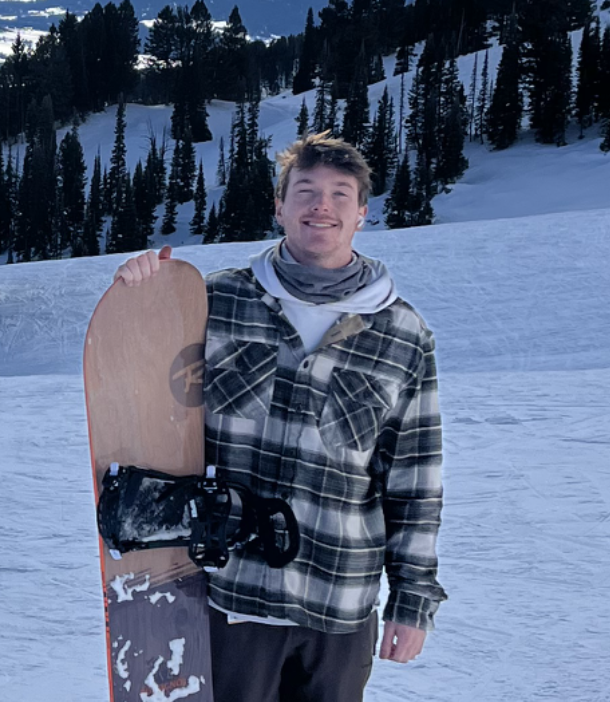
Man standing in snow holding a snowboard.
Conner Dicks

Research?
My research in the Rice lab revolved around the Aryl Hydrocarbon Receptor (AHR). Specifically, characterizing tapinarof as a partial agonist against the aryl hydrocarbon receptor in fish models (both in-vitro and in-vivo). Additionally I developed a monoclonal antibody against zebrafish AHR2.

What’s next?
I am attending the Medical University of South Carolina to get my M.D.

What did you like the most about Clemson and what will you miss the most?
The interaction between peers and professors. (I’ll miss) fun conversations in the lab.

Advice for students?
Read (at least) a paper about your research everyday, even when you are first starting.

Memorable people?
Alyssa Whisel served as a great mentor in the lab.

Favorite local activities?
Hiking and visiting nearby towns.

Lessons learned?
I learned the importance in collaboration and transparency in research.

Memorable/proud moments?
Passing my defense and completing two degrees in five years!

Keiffer Williams — Q & A With A Grad

Keiffer Williams will graduate this week with his Ph.D in biological sciences. We asked him to reflect on his time here at Clemson in the Price lab through a short Q & A.

Research?
My research at Clemson focused on understanding the evolution of tooth complexity in coral reef-associated fishes. Specifically, my dissertation developed a framework for conducting tooth complexity analyses that I then used to test for associations between diet and oral tooth complexity in fishes.

What’s next?
I will be starting a visiting assistant professor position at Berea College in August 2025.

What will you miss the most?
I’m going to miss all the friendships in the department and the broader Clemson community that I established during my time here. I will also miss all the local restaurants and coffee shops that I frequented, especially Bangkok Street Foods and Jitters Brewing Company in Central. I’ll also just miss the daily routine of graduate student life at Clemson.

Advice for students?
Dedicate time for your hobbies and don’t forget to stay in touch with your family and friends outside of Clemson. Prioritize your physical and mental health, and make sure to get enough sleep. Try not to do any school-related work for at least one day on the weekend. Graduate school is challenging and at times stressful, but you don’t need to be stressed out all the time from it. Make sure to do fun things on and take time off as needed.

Favorite local activities?
Taking daily walks through the Central frisbee golf course with my dog, fishing, hiking, and running on local trails. Also visiting and exploring all the local areas and cities around Clemson. I especially enjoyed visiting Greenville, especially downtown during the farmer’s market.