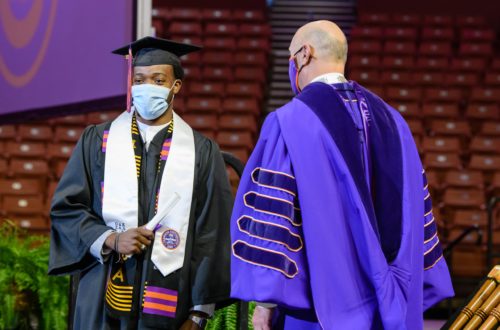
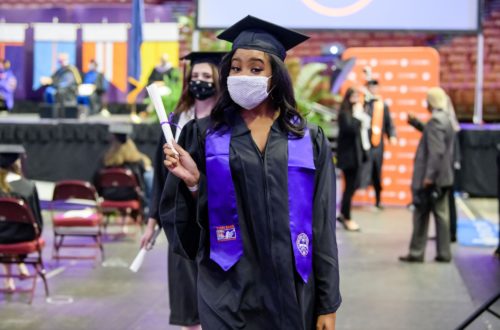
Few milestones can compare with college graduation. Image Credit: Clemson University Relations
After a long and grueling year, we just celebrated commencement in person. It was shorter than the usual ceremony, and safety made the look and feel a bit different, but the occasion was marked, and that is important. Ritual is integral to the human experience; it is a means for us to orient ourselves and share an experience with those close and distant.
As I watched our students completing their Clemson journey, there was so much I wished to say. Although I didn’t have the chance to share my thoughts in a speech, I have a column! If I could speak to our each of our new graduates, this is what I would say:
Dear Graduates and new Clemson Alumni,
Congratulations on your achievement! You have just celebrated a milestone among many your lives, but this one is special for most of you because it marks the end of your formal education. Life is filled with milestones, but few signify as definitive an ending and beginning as this one. I can imagine that you are feeling various things right now: joy, sadness, nostalgia, anxiety, numbness, and all the mixed emotions that come with freedom.
A special congratulations to our hard-working Tiger Band grads! Image Credit: Clemson University Relations
While your formal education may be over, your process of learning is not. In many ways it is also just beginning. To a certain extent, learning is unavoidable. Our senses and our brains are perpetually receiving input and processing. But I encourage you to think about learning actively. Sign on to a life of learning, and learning for life.
If you were educated in our College, you were trained to make conscious learning a way of living and interacting with the world. Learning how to see and to think historically, conceptually, artistically. Learning how to read and observe, not just accepting at face value, but examining critically, scrutinizing between the lines, peering behind the scenes. The College has introduced you to the human condition in all its dynamic extremes and complexity.
Take all this with you and apply it to the world as you encounter it. Seek to learn and understand just a little bit more every day. And when you interact with people, try never to forget the individual human being behind the façade. That’s why we read literature and go to the movies—to be reminded about our common humanity in powerful and memorable ways.
And when you get the chance, travel. See the world, the people in it, what they have built over time, and the ways they live and interact.
And always take the time to go some place quiet to reflect and to think about what you have learned.
Congratulations again. Now spread your wings, and fly…
“Go Tigers!”
Nicholas Vazsonyi, Dean
College of Architecture, Arts and Humanities
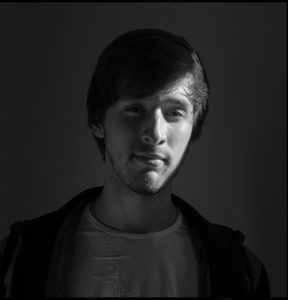
Devyn Byrd is a performing arts major at Clemson with a concentration in audio technology and a minor in music. His alternative rock band American Theory has a 2018 album, and a song immortalized as part of a video game soundtrack.
As the frontman of the Charlotte-based band American Theory, Devyn Byrd accomplishes great things on the stage and in the classroom. Byrd, a junior from Clover, South Carolina, is a performing arts major with a concentration in audio technology and minor in music. Even as a full-time student, he still managed to tour and write new songs with his bandmates.
In 2018, American Theory released its 10-track album, “Your Local Politics,” following the debut single, “Colors.” Since then, he and his bandmates (Eric Barrera, Michael Luce and Nick Saj) garnered over 51,000 streams on Spotify and nearly 22,000 views on YouTube (as of April 2020). They won “Best Rock Music Video” at the 2019 Carolina Music Video Awards and have opened for several national acts including Saving Abel, Eve to Adam and Danny Worsnop of Asking Alexandria.
“NASCAR Heat 4,” a racing video game, featured American Theory’s song “The Lion and the Liar” on the official soundtrack.
To find out more, Starnes interviewed Byrd on his backstory, music and Clemson experience.
When and how did you get into music?
Music has been a significant aspect of my life for as long as I can remember. As a child, I enjoyed singing along to songs played on the radio. I didn’t sound good, but that didn’t stop me from torturing the eardrums of my poor parents while they drove me to and from school every day. I was intrigued by singing and its many moving parts. Why does everyone’s voice sound different? How do some singers inject so much emotion into their performances? As I grew older, I became interested in baseball, school and video games. Music took a back seat and remained a hobby for most of the remainder of my childhood and teenage years.
Devyn Byrd
When I entered high school, I had the privilege of being a member of the Choraliers, the elite choir at Clover High School. I met many talented singers, musicians and songwriters who exhibited a passion for music I had not witnessed elsewhere. Intense preparation, a feeling of pressure from the success of previous years and an immeasurable amount of talent allowed the group to perform spectacularly. I started practicing singing regularly in an attempt to catch up to my peers and contribute to the group. I had forgotten how much I loved to sing in the car as a kid. In the process of trying to not be deadweight to the group, I rediscovered my childlike wonder for singing and became obsessed with it yet again.
I auditioned for a solo my junior year for our Christmas show. To my amazement, I was selected to sing the solo. Parents aside, I had never sung in front of people before, so you can probably imagine how scared I was when I realized I was going to sing in front of thousands of people! I miraculously made it through the performance alive, and I was shocked at how much fun I had on stage. In fact, I had never felt a sense of purpose and belonging in my life like I felt during that performance. It was then that I realized I wanted to pursue music and performance for the rest of my life. Around that time, I started recruiting musicians to start a band together. After a few lineup changes over the years, American Theory became what it is today: Eric Barrera, Devyn Byrd, Michael Luce and Nick Saj.
How did you get into songwriting?
Songwriting is a very fascinating art, and, although I enjoy singing and performing, I consider myself more of a songwriter than a singer. I’ve always been interested in the mechanics of songwriting and how melody and groove collaborate to create catchy hooks and impressive soundscapes.There is a journey of discovery and self-reflection with each marriage of lyric and melody, and I enjoy the adventure of taking simple musical ideas and fleshing them into complete songs. Sometimes you know what you want the end result to sound like, and other times you have to figure it out along the way. For this reason, it’s a tricky and mysterious art, but it can also be therapeutic and rewarding.
I’ve always dreamed of having people listen to my songs and enjoy them the way I enjoyed the songs written by my biggest inspirations, but I didn’t get serious about songwriting until high school when I took AP Literature. Before that, I was primarily a math student who dreaded reading. Once I started analyzing poetry and prose, I began to appreciate the creativity and commentary of the authors and poets we studied in class. I drew inspiration from certain works for lyrical writing, aiming to evoke emotion and create conversation using poetry and music as equally powerful tools, as opposed to using lyrics merely as a guide for vocal melodies.
Why did you choose to attend Clemson?
My brother attended Clemson, so I was already familiar with the area. I wanted to major in something related to music production, and the producer/mixing engineer of American Theory’s first album told me about Clemson’s audio technology program. That engineer is actually an alumnus of the audio technology program, Drew Cyphers, and he does fantastic work.
Do you have any favorite classes so far in the performing arts department?
My favorite classes thus far are CU Singers and the studio-based audio classes. I enjoy singing with a group of people, and I appreciate how Dr. Bernarducci teaches us about the meaning of the pieces we perform. He’s a great composer himself, and I look up to him as a songwriter. I enjoy both studio and live sound, but I feel more comfortable behind a computer working with recording and producing as opposed to mixing a live performance. Both environments are difficult and there’s always the pressure of time, but the live environment is far more stressful for me. I guess that’s a bit ironic, considering I plan on being a performer for a living.
How have your classes at Clemson helped you as an individual and as part of your band?
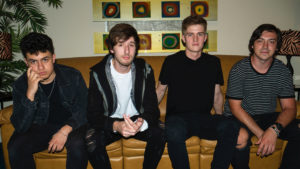
Devyn Byrd, second from left, and his American Theory bandmates Eric Barrera, Michael Luce and Nick Saj.
I took the music business class in Fall 2019, and it provided perspective on how the industry operates and how difficult it is to be successful. I learned about mechanical and performance royalties, sync licensing, networking and negotiation, copyright laws and the horrors of recording contracts. By incorporating this knowledge into our business operations as a band, we’ve already increased our following, our profits and our stability. Making music isn’t necessarily about those things, but they’re important for finding a way to make a living while working in the industry. Plus, my goals as a songwriter and performer are to meet people, communicate to people and form new relationships with people. If I want to accomplish those things, I have to have the resources to grow my brand and reach as big and broad of an audience as possible.
Tell us about your song “The Lion and the Liar” being on the NASCAR Heat 4 soundtrack.
American Theory has been blessed with good fortune quite a few times in its brief existence. With regard to finding success in the music industry, people often hear the phrase, “It’s all about who you know.” Although it usually isn’t that simple, it was in this case. We were lucky our album producer and mixing engineer knew someone who worked for 704Games, the developer of “NASCAR Heat 4.” The developer was looking for music to fill out the rest of the soundtrack, so we submitted “The Lion and the Liar” and they approved it. It’s a huge honor!
What’s coming up for American Theory?
Unfortunately, the pandemic has put most of our plans on hold, and most of the industry has shut down for the time being. Many artists have resorted to going live on social media and asking for donations to continue their existence, and many event planners, audio engineers, agencies and promoters are all out of work. The local entertainment industry is hurting, so I encourage everyone to support local artists by streaming their music and buying their merch[andise] if they can afford it. We recognize most industries are facing bleak outlooks at the moment, so just donate and support as you’re able. As for American Theory, we are making the most of the situation by recording and producing new music with the help of Scott Wilson, the bass guitarist for Saving Abel and former bass guitarist for Tantric. Once we make more progress, we’ll be putting out more information concerning new releases.
…
With all that comes with being a performer, Byrd remains humble. “I’m blessed to be a part of American Theory, and I take pride in our accomplishments however great or small,” he said. After graduation, he has a simple but ambitious goal: “I want to write and/or help write some of the greatest songs ever written.”
Byrd still has plenty of time to take in all that he can while at Clemson. We hope to see more of Byrd and American Theory at Clemson very soon.
Piper Starnes’ article first appeared in Expression, a print publication produced for Friends of the Brooks Center.
Dear students, faculty, staff, alumni and friends of CAAH:
With another academic year beginning and the campus bustling with life, it is my privilege to greet you as the interim dean of the College of Architecture, Arts and Humanities.
As I get to know the College and its people, I’m struck by the warmth, camaraderie and sense of purpose that surrounds me.
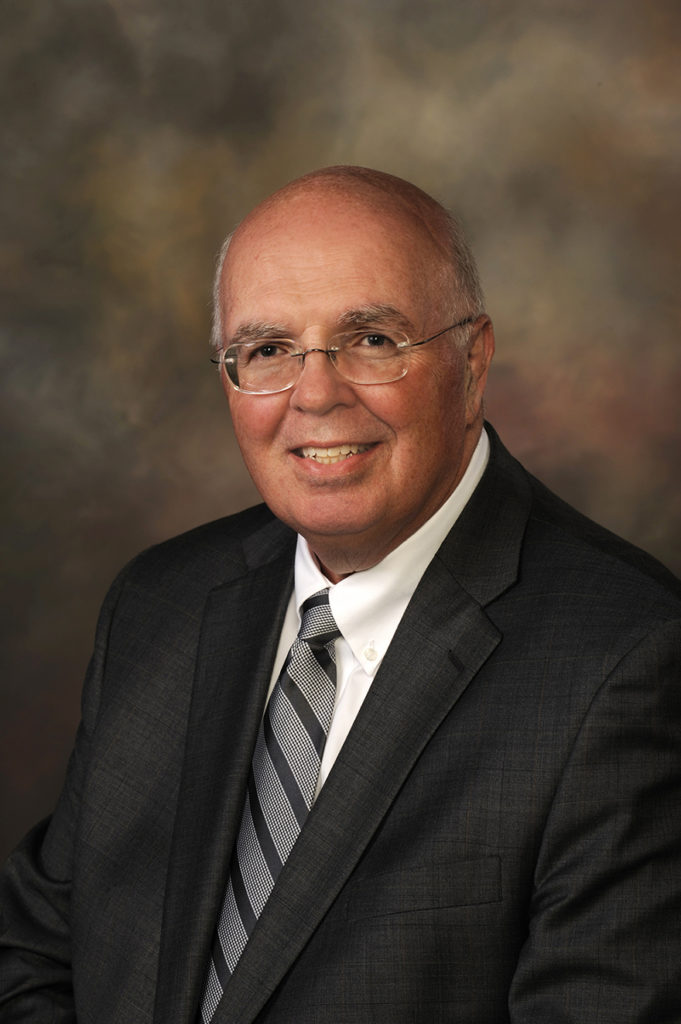
Tim Boosinger is a former provost and vice president for academic affairs at Auburn University.
I’ve met students who are ambitious, poised and intellectually curious.
I’ve witnessed the dedication and commitment of our staff.
And I’ve been impressed by the level of scholarship I see among the faculty in our College’s diverse departments – and all across Clemson University.
I look forward to meeting many more of you in the coming months.
This is a special College at a great University and I am proud to serve as its steward as we continue our growth, build upon our successes and keep moving forward.
My close acquaintance with Clemson began in 2018 when I served for several months in a similar capacity at the College of Agriculture, Forestry and Life Sciences.
I’ve also gotten to know Clemson leaders through my involvement with the Tigers United Consortium, which began during my time as provost and vice president for academic affairs at Auburn University. Together with our peers at Louisiana State University and the University of Missouri we share a mascot and a mission – to save the world’s remaining wild tigers.
This week on campus, I had the chance to meet with the Tigers United group and to convene with my new team.
I, too, had the unexpected pleasure of speaking with several families from Charleston who chose to spend their time as evacuees visiting Clemson and learning about all we have to offer in CAAH.
We are relieved that for many along the East Coast, the damage from Dorian has been much lighter than anticipated. Our Clemson Design Center in Charleston fared well and our students, most of whom evacuated the area, are safe and back in class. Please keep in your thoughts the members of the extended Clemson Family who have been directly affected by the hurricane and also the people of the Bahamas who have faced unfathomable devastation. They will need our support during a long recovery.
With gratitude,
Tim Boosinger
. . .
Tim Boosinger has been named interim dean for the College of Architecture, Arts and Humanities while the University continues its search for a permanent dean.
His six-month appointment began Sept. 1, 2019. To lead the College, Boosinger will draw from his previous experiences as an interim dean of the Clemson College of Agriculture, Forestry and Life Sciences and as vice president and provost of Auburn University. His area of expertise is veterinary pathology and he served previously as dean of Auburn’s College of Veterinary Medicine. Boosinger is tasked with continuing the positive momentum of the College of Architecture, Arts and Humanities.
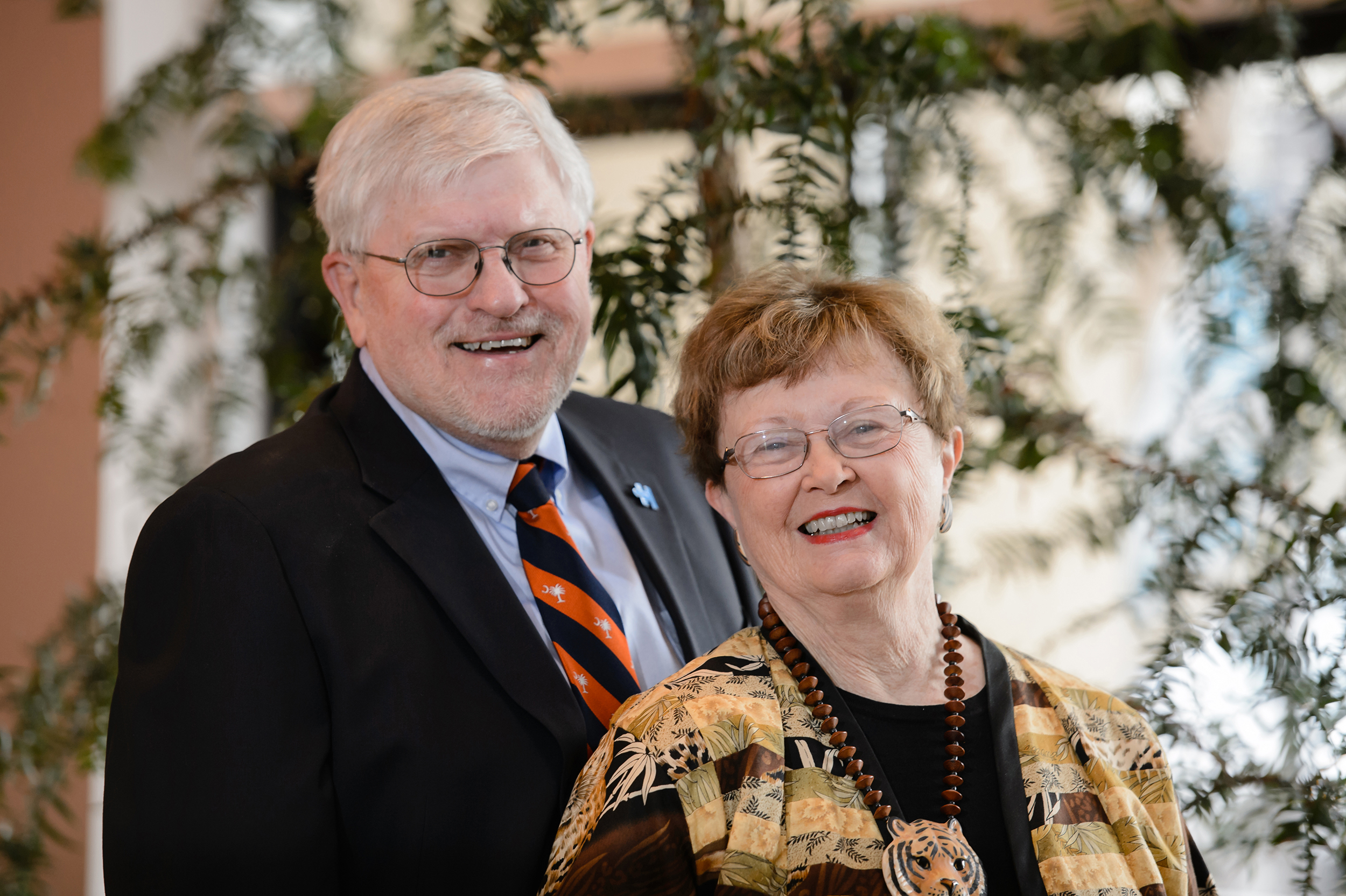
Clemson professor emeritus Larry Bauer and his wife Betty have endowed a new scholarship in support of students in performing arts.
“We are proud to establish this student scholarship which will permit students to attend the department of performing arts who may not otherwise be able to come,” Betty Bauer said.
In addition to the endowment, the Bauers have also pledged a multi-year annual gift, which will allow the scholarship — known as the Bauer Family Endowment — to become active immediately.
“We are thrilled about this new scholarship,” said Richard Goodstein, dean of the College of Architecture, Arts and Humanities. “Larry and Betty Bauer’s generosity and vision will make it possible for deserving students to pursue their dreams when otherwise they may not have been able to.”
Larry Bauer taught for 28 years in Clemson’s department of agricultural and applied economics. He was a devoted and effective teacher, winning the University’s prestigious Alumni Master Teacher award in 1992. During his tenure at Clemson, he and Betty frequently served as chaperones of Tiger Band — a role that came naturally to two very musical people.
Like his father before him, as well as his son (both named George), Larry played the Conn trombone and loves collecting and listening to music. Betty plays the piano and loves singing in the church choir.
Larry and Betty’s son George went on to attain a B.A. in trombone performance from Winthrop and an M.M. in trombone performance from the University of North Texas. His wife Deborah has a B.A. degree from Winthrop and an M.A. from Indiana University, both in organ performance. Their daughter Kathryn is showing propensities toward visual art.
Larry and Betty’s son William played saxophone in high school. He has a B.A. from Wofford and an M.B.A. from Clemson. His wife Margaret has a B.A. in art from Converse. Their sons have studied piano, guitar and violin.
About the Department of Performing Arts
Clemson’s Department of Performing Arts offers an undergraduate degree with separate tracks in music, theatre and audio technology. The program is housed within — and is closely linked academically with — Clemson’s Brooks Center for the Performing Arts. Brooks is home to a state-of-the-art, 968-seat proscenium theatre that was recently ranked eighth on the bestvalueschools.com list of “The 25 Most Amazing University Performing Arts Center.”
For more information about how you can support Clemson’s students in performing arts, contact:
Rachelle Beckner, Director of Development
College of Architecture, Arts and Humanities
rlbeckn@clemson.edu