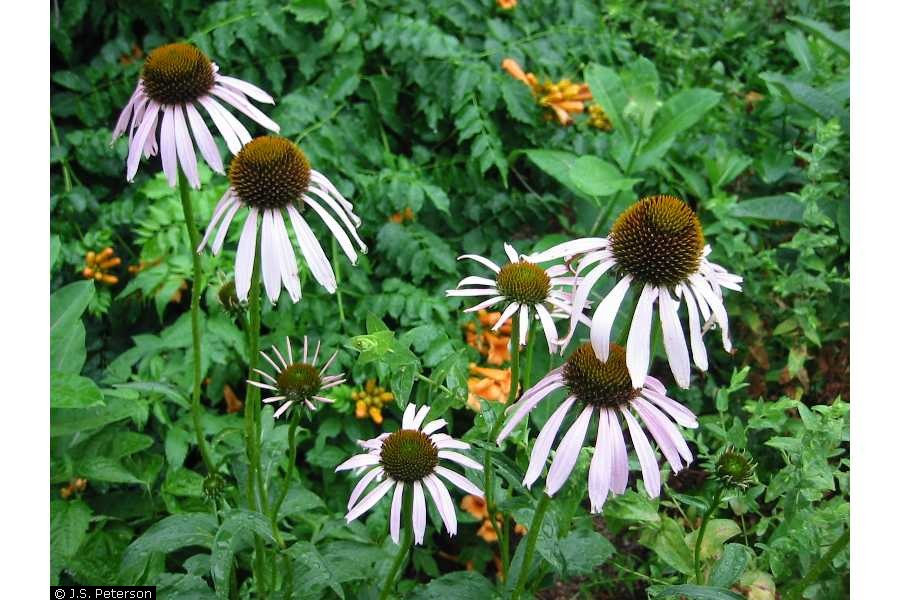
Latin name: Echinacea laevigata
Common name: Smooth Purple Coneflower
Flowers: Purple to pink, showy and delicate drooping purple rays. Blooms June to August 12
Fruit: Not significant 13
Height & Width: 2-5’ x 1.5-2’ 12
Type: Herbaceous perennial 12
Habit: Upright, cascading, mound 16
Wetland indicator category**: No Wetland indicator was available for this plant.
Texture: Fine 16
Growth rate: Moderate 12
Light: Full sun to part shade 12
Moisture: Dry to medium 12
Soil: Tolerates clay soil, dry soil, shallow and rocky soil 12
Zones: 3-8 12
Origin: Southeastern United States 16
Note: This plant is on the United States threatened and endangered species list 16
Features: Beautiful, purple showy flowers are an attractive addition to a planting bed. The long-blooming flowers provide for longer color interest in the native plant garden. It can grow to be 2 to 5 feet tall, so placement must be made accordingly. Butterflies and other wildlife are attracted to the habitat this plant provides. 12
Siting: Easily grown in average, dry to medium, well-drained soil in full sun to part shade. Best in full sun. An adaptable plant that is tolerant of drought, heat, humidity and poor soil. Plants usually re-bloom without deadheading, however prompt removal of spent flowers improves general appearance. Freely self-seeds if at least some of the seed heads are left in place. 12
Care: Plant in suitable site with adequate soil organic matter so that the crown of the plant is at the soil surface 18. Ensure the soil is adequately moist immediately after planting. Keep soil moist but not soggy until plant is established. Once plant is established water deeply but infrequently whenever the soil surface is dry or almost dry 2” below the soil surface. 18
Pests: Plants are relatively pest resistant if preferences are met, but Japanese beetle and leaf spot are occasional problems.
Author: Whitney Blue Fraser, Editor: Alexander Smolka
Sources:
- Armitage, A. (2001). Armitage’s manual of annuals, biennials, and half-hardy perennials. Portland, OR: Timber Press.
- Armitage, A. (2006). Armitage’s native plants for North American gardens. Portland, Oregon: Timber Press.
- Armitage, A. (2008). Herbaceous perennial plants: A treatise on their identification, culture, and garden attributes.Athens, GA: University of Georgia.
- Clemson Cooperative Extension Home and Garden Information Center.(2011). Flowers fact sheets. Retrieved from https://hgic.clemson.edu/category/flowers/
- Clemson Cooperative Extension Home and Garden Information Center.(2011). Groundcovers & vines fact sheets.Retrieved from https://hgic.clemson.edu/category/groundcovers/
- Clemson Cooperative Extension Home and Garden Information Center.(2011). Trees. Retrieved from https://hgic.clemson.edu/category/trees/
- Clemson Cooperative Extension Home and Garden Information Center.(2011). Shrubs. Retrieved from https://hgic.clemson.edu/category/shrubs/
- Dirr, M. A. (2009). Manual of woody landscape plants. Champaign, IL: Stipes Publishing.
- Gilman, E. F. (1997). Trees for urban and suburban landscapes. Albany, NY: Delmar Publishers.
- Lady Bird Johnson Wildflower Center University of Texas at Austin. (2012). Native plant information network. Retrieved from http://www.wildflower.org/explore/
- McMillan, P., Plant taxonomist Clemson University, personal communication.
- Missouri Botanical Garden Kemper Center for Home Gardening. Plant finder. Retrieved from http://www.mobot.org/gardeninghelp/plantfinder/Alpha.asp
- North Carolina State University (2005). Plant fact sheets. Retrieved from http://www.ces.ncsu.edu/depts/hort/consumer/factsheets/index.html
- Strother, E. V., Ham, D. L., Gilland, L. (2003) Urban tree species guide: Choosing the right tree for the right place. Columbia, SC: South Carolina Forestry Commission.
- University of Florida, IFAS Extension. (2011). Southern trees fact sheet. Retrieved from http://edis.ifas.ufl.edu/department_envhort-trees
- USDA . Plant profile. (n/d).Retrieved from http://plants.usda.gov/java/
- USDA. Plant wetland indicator status. (n/d). Retrieved from http://plants.usda.gov/wetland.html
- Vincent, E., Environmental horticulturist Clemson University, personal communication.
*Soil pH is determined using a professional soil test. Contact your Clemson University County Extension service for assistance www.clemson.edu/extension/. Click on “local offices”.
**2012 Plant Wetland Indicator categories (quantitative derived) http://plants.usda.gov/wetinfo.html
| Indicator Code | Indicator Status | Comment |
| OBL | Obligate Wetland | Almost always is a hydrophyte, rarely in uplands |
| FACW | Facultative Wetland | Usually is a hydrophyte but occasionally found in uplands |
| FAC | Facultative | Commonly occurs as either a hydrophyte or non-hydrophyte |
| FACU | Facultative Upland | Occasionally is a hydrophyte but usually occurs in uplands |
| UPL | Obligate Upland | Rarely is a hydrophyte, almost always in uplands |
