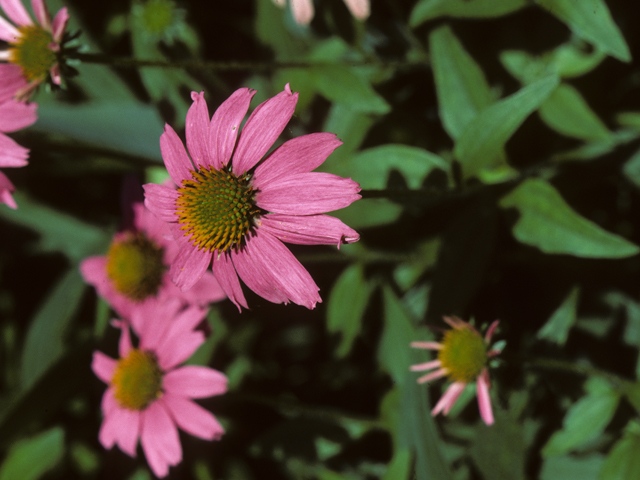
Latin name: Echinacea purpurea ‘Kim’s Knee-High’
Common name: Purple coneflower
Flowers: Purple-pinkish petals surround a raised brown/bronze-colored center disk2, 12.
Fruit: Inconspicuous3
Height & Width: 2’ x 2’3
Type: Herbaceous perennia4, 10
Habit: Upright3, 12
Wetland indicator category**: Not available17
Texture: Coarse4
Growth rate: Medium4
Light: Full sun to part shade
Moisture: Dry to medium10
Soil*: Tolerates clay, sandy to rich soils10, 12
Zones: 3 – 82
Origin: Midwestern to Eastern United States, including South Carolina16.
Features: ‘Kim’s Knee-High’ is a dwarf cultivar of this common garden favorite, purple coneflower. It is beneficial and highly attractive to birds, bees and butterflies2, 12. Flowering begins in mid-summer and continues sporadically until frost3, 4.
Siting: Echinacea purpurea ‘Kim’s Knee-High’ performs best in moist, well-drained soil and full sun conditions4.
Care: Plant crown at soil level18. At planting, water the roots and surrounding area slowly and deeply. Keep soil moist until plant is established, then apply enough water to thoroughly moisten the root zone when the soil is dry or during drought. Modify water recommendations to reflect site drainage and rainfall. Apply 3” of mulch over the planted area. Do not allow mulch to touch the plant stems18. It can be divided every 3 to 4 years to prevent overcrowding4.
Pests: Echinacea are prone to several disease and insect pest problems such as stem rots, powdery mildew, anthracnose, and aster yellows. In addition, there may be damage from aphids, Japanese beetles, and mites; however, the resulting symptoms are usually minimal. Proper plant spacing, well-drained soils and proper sanitation by removing plant debris will help reduce disease problems4.
Author: Allison Kelly
Sources:
- Armitage, A. (2001). Armitage’s manual of annuals, biennials, and half-hardy perennials. Portland, OR: Timber Press.
- Armitage, A. (2006). Armitage’s native plants for North American gardens. Portland, Oregon: Timber Press.
- Armitage, A. (2008). Herbaceous perennial plants: A treatise on their identification, culture, and garden attributes.Athens, GA: University of Georgia.
- Clemson Cooperative Extension Home and Garden Information Center.(2011). Flowers fact sheets. Retrieved from https://hgic.clemson.edu/category/flowers/
- Clemson Cooperative Extension Home and Garden Information Center.(2011). Groundcovers & vines fact sheets.Retrieved from https://hgic.clemson.edu/category/groundcovers/
- Clemson Cooperative Extension Home and Garden Information Center.(2011). Trees. Retrieved from https://hgic.clemson.edu/category/trees/
- Clemson Cooperative Extension Home and Garden Information Center.(2011). Shrubs. Retrieved from https://hgic.clemson.edu/category/shrubs/
- Dirr, M. A. (2009). Manual of woody landscape plants. Champaign, IL: Stipes Publishing.
- Gilman, E. F. (1997). Trees for urban and suburban landscapes. Albany, NY: Delmar Publishers.
- Lady Bird Johnson Wildflower Center University of Texas at Austin. (2012). Native plant information network. Retrieved from http://www.wildflower.org/explore/
- McMillan, P., Plant taxonomist Clemson University, personal communication.
- Missouri Botanical Garden Kemper Center for Home Gardening. Plant finder. Retrieved from http://www.mobot.org/gardeninghelp/plantfinder/Alpha.asp
- North Carolina State University (2005). Plant fact sheets. Retrieved from http://www.ces.ncsu.edu/depts/hort/consumer/factsheets/index.html
- Strother, E. V., Ham, D. L., Gilland, L. (2003) Urban tree species guide: Choosing the right tree for the right place. Columbia, SC: South Carolina Forestry Commission.
- University of Florida, IFAS Extension. (2011). Southern trees fact sheet. Retrieved from http://edis.ifas.ufl.edu/department_envhort-trees
- USDA . Plant profile. (n/d).Retrieved from http://plants.usda.gov/java/
- USDA. Plant wetland indicator status. (n/d). Retrieved from http://plants.usda.gov/wetland.html
- Vincent, E., Environmental horticulturist Clemson University, personal communication.
*Soil pH is determined using a professional soil test. Contact your Clemson University County Extension service for assistance www.clemson.edu/extension/. Click on “local offices”.
**2012 Plant Wetland Indicator categories (quantitative derived) http://plants.usda.gov/wetinfo.html
| Indicator Code | Indicator Status | Comment |
| OBL | Obligate Wetland | Almost always is a hydrophyte, rarely in uplands |
| FACW | Facultative Wetland | Usually is a hydrophyte but occasionally found in uplands |
| FAC | Facultative | Commonly occurs as either a hydrophyte or non-hydrophyte |
| FACU | Facultative Upland | Occasionally is a hydrophyte but usually occurs in uplands |
| UPL | Obligate Upland | Rarely is a hydrophyte, almost always in uplands |
