

October 3, 2024
August 23, 2024
The Department of History and Geography is pleased to welcome three new faculty to our department this year!

Dr. Burd comes to Clemson from Eastern Illinois University. He is a historian specializing in nineteenth and twentieth-century US history, with a particular focus on the intertwined histories of American capitalism and environmental change. His forthcoming book, The Roots of Flower City: Horticulture, Empire, and the Remaking of Rochester, New York, is set to be published by Cornell University Press in Fall 2024. The book examines how a network of plant nurserymen in Western New York connected their businesses to the broader American imperial project of the nineteenth century, using their social prestige and capital to reshape Rochester according to their vision.
Dr. Burd is also engaged in various digital methodologies, including TEI and Digital Mapping, to explore source material in innovative ways and disseminate information to wider audiences. Before joining Clemson University, he served as an Assistant Professor of History at Eastern Illinois University and was an Andrew W. Mellon Postdoctoral Research Fellow at the New York Botanical Garden. His research has been supported by numerous organizations and institutions, including the Newberry Library, the American Antiquarian Society, and the Andrew W. Mellon Foundation.
Dr. Burd will teach classes on digital, U.S., and environmental history.

Professor Steelman is a historian of twentieth-century America with specializations in the legal and political history of American conservatism and evangelicalism. His current book project, Paper Gods: The Bible, the Constitution, and the Evangelical Revolt Against Modernity, 1923-1986, examines the connections between the theological doctrine of biblical inerrancy and the legal theory of constitutional originalism. Relying on archives from across the United States, he looks at the intellectual importance of these two text-based ideologies to the formation, spread, and influence of the evangelical right beginning in the 20th century and continuing to today. Prior to graduating from Stanford, Professor Steelman attended Harvard Law School and worked for two years as an intellectual property litigator.
Dr. Steelman will teach courses on American legal history and US history. He contributes to the department’s growing Legal History Emphasis Area.

Dr. Hsu’s research focuses on Biogeography and Biogeomorphology, utilizing Geospatial analysis to investigate coastal landscape dynamics in the context of climate change. He specializes in barrier dune topographies and mangrove dynamics, offering insights into coastal resilience and protection.
Dr. Hsu received his Ph.D. from the University of Kentucky. At Clemson he will teach courses on Physical Geography, World Regional Geography, and GIS.
May 9, 2024

History department faculty member, Josh Catalano, was honored for his outstanding research at the conclusion of the 2023-24 academic year. At the College of Arts and Humanities Award ceremony on May 8, 2024, Dr. Catalano won the Dean’s Excellence in Research Award. The award recognizes national and/or international accomplishments, distinctions, and awards within the nominee’s discipline in the context of the past three years.

Dr. Catalano was also nominated for Junior Researcher of the Year and attended an awards ceremony with university leadership. The Researcher of the Year awards recognize the efforts of high-achieving faculty whose work is improving society through the generation and dissemination of new knowledge. Each college nominated a senior faculty member and a junior faculty member who received their terminal degree within the past 10 years.
Dr. Catalano joined the history department in 2018 and is a historian of early American history with emphases on digital and public history. He has published an impressive amount during his first five years at Clemson, secured numerous external ($302,228) and internal ($163,325) grants, and is a leader within the field of digital history. Congratulations Dr. Catalano!
May 6, 2024

Second year Ph.D. student Lucas Avelar has been selected as a Mellon Data Fellow for the Freedom on the Move project. As a Fellow, Avelar will spend eight weeks this summer in residence at Cornell University and the experience will count as his internship for the Ph.D. program.
The Freedom on the Move project compiles stories of resistance from fugitive slave ads in newspapers. Through their online database and extensive metadata, the project’s represents “a detailed, concise, and rare source of information about the experiences of enslaved people.”
As a data fellow, Avelar will work with digital humanists and scholars of slavery, resistance, marronage, and emancipation to help deepen Freedom on the Move dataset. He will also work with a faculty mentor to develop a research paper related to the project.
April 29, 2024

Second year Ph.D. student Hallie Knipp has been accepted to attend Columbia University’s Archives as Data Workshop this June in New York City. An exclusive NEH funded institute for Advanced Topics in the Digital Humanities, Knipp will spend two weeks learning to organize and analyze large document collections for textual analysis and will participate in several seminars with scholars in the field. The institute is jointly hosted by Columbia’s History Lab and Columbia’s Library.
The “NEH-funded program will offer practical training for historians and archivists in processing and analyzing textual data… Participants in the Text-as-Data workshop, designed for historians, will learn how to organize and analyze large document collections and use new methods to formulate original arguments. All participants will come together in seminar-style discussions on the novel challenges posed by doing archival research in the age of “big data,” including issues related to community representation, protecting private information in online archives, and the professional and scholarly pitfalls in navigating this new terrain.”
April 25, 2024
As the summer approaches, many of the Digital History Ph.D. students are off to do exciting research thanks to Clemson University’s Humanities Hub! Below is a roundup of some of the exciting research students will be pursuing thanks to the Hub.
Addison Horton’s project is entitled “‘Antebellum Affairs’ in the United States South.” During the summer she will travel to visit the State Archives in South Carolina, North Carolina, and Georgia to collect data, which she will then organize into dataset which she can analyze using digital methods. This is part of a larger project that will contribute to her dissertation.
Megha Khanna’s received funding to travel to India over the summer to conduct research for her project, “Shadows of the Raj” which investigates how British colonialism transformed the societal roles of courtesans in 1857 India. These women, once respected for their artistic and cultural contributions, faced marginalization as British rule took hold.
Hallie Knipp will travel to Berea, Kentucky to conduct research for her project entitled “Mountain Labors: Contraceptives and Eugenics in 1930s Appalachia.” The Humanities hub grant will fund research at Berea College where she will delve into the history of the Mountain Maternal Health League and then will fund the work to process this research into a workable digital database.
April 22, 2024
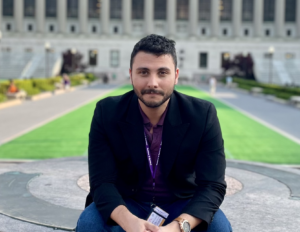
Lucas Avelar, a second year Ph.D. student in Digital History, will present his digital history project entitled “An Imagined Geography of Empire: Mining cultural representations of the American colonial state during the St. Louis 1904 World’s Fair” at the 2024 Digital Humanities Conference in Washington, DC. Avelar’s project uses named entity recognition and word vector analysis to assess how local newspapers produced their own discursive representations of the U.S. and the world in response to the ideologies of American colonialism and exceptionalism embedded on the grounds of the St Louis 1904 World’s Fair.
Avelar’s digital history project was first completed in the Ph.D. program’s Digital History Seminar – a research seminar that allows graduate students the opportunity to develop significant digital history projects based on primary source research.
The Digital Humanities conference, hosted by the Alliance of Digital Humanities Organizations, is one of the largest DH conferences in the field. Held once a year in the summer, this year’s host in George Mason University in Washington, D.C. It will be the the first time the conference has been held in the United States since 2013.
April 11, 2024
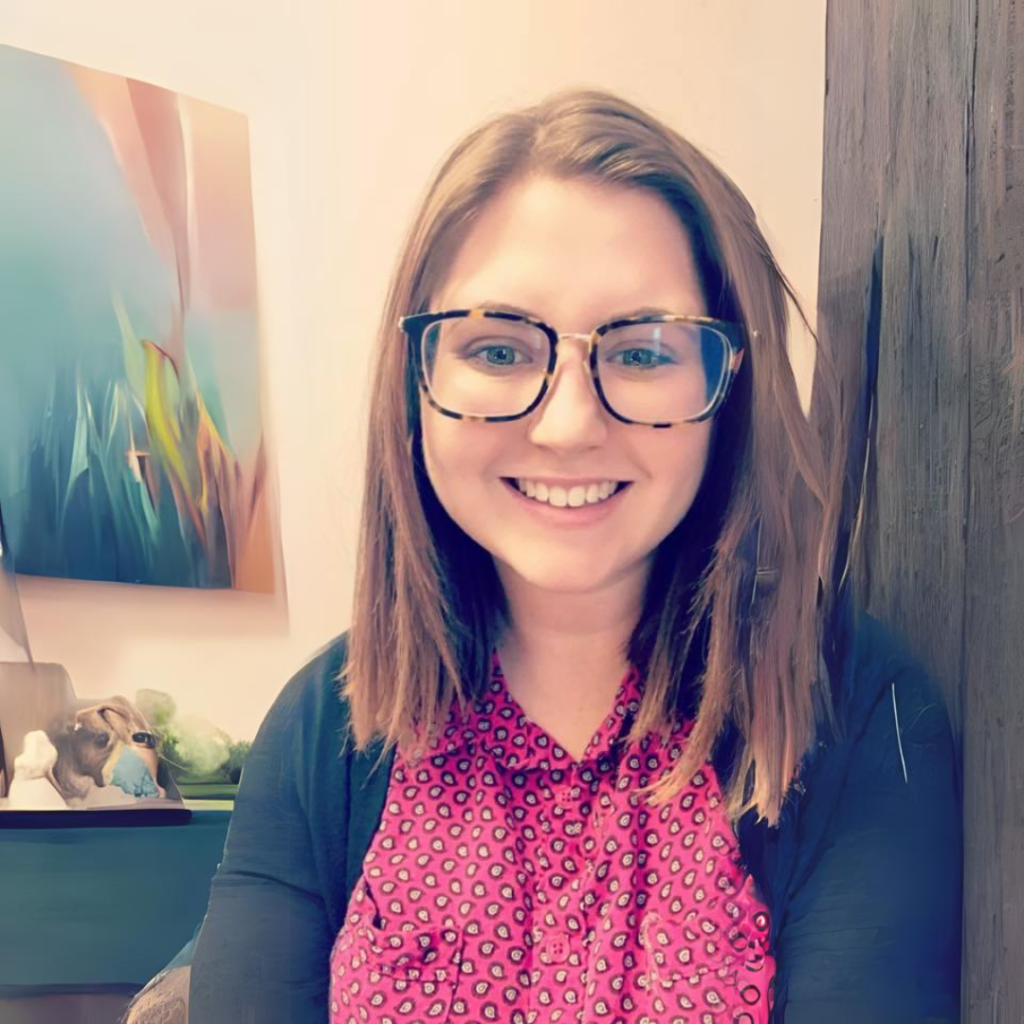
The Kentucky Historical Society has awarded Ph.D. student Hallie Knipp a Research Fellowship. The fellowship will support travel and residency at the KHS for a period of one week in Summer 2024. The fellowship will support initial research for Knipp’s dissertation prospectus, tentatively titled “Mountain Labors: Contraceptives and Eugenics in 1930s Appalachia.”
Knipp’s research is focused on the history of contraceptives and eugenics in Appalachian coal mining communities during the 1930s. Specifically, Knipp is interested in the experiences of women who were unwittingly used as test subjects in the complex efforts of contraceptive research. While histories of Puerto Rican, Black, and incarcerated women unknowingly used as test subjects have been documented, the contraceptives and eugenics practices tested on so-called “mountain women” has been woefully underrepresented in the historiographical record. This absence, Knipp explains, is not surprising, as both histories of women in coal mining communities and the contraceptive and eugenics movement in Appalachia have been largely ignored.
December 6, 2023
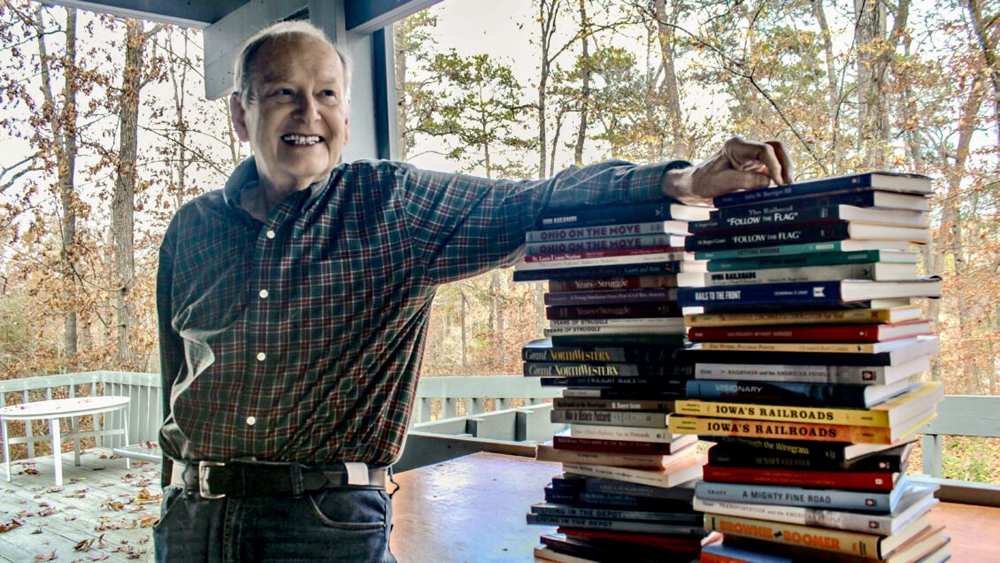
Roger Grant, Kathryn and Calhoun Lemon Professor of History, died on November 17, 2023. A native of Albia, Iowa, Roger graduated summa cum laude from Simpson College in Iowa in 1966, and went on to earn his Ph.D. from the University of Missouri only four years later. His first academic position was at the University of Akron before he moved to Clemson in 1996, where he served as chair of the Department of History for five years. One of the nation’s foremost railroad and transportation scholars, Roger was the author, co-author, or editor of a remarkable forty academic books, including most recently Sunset Cluster: A Shortline Railroad Saga (Indiana University Press). His book Railroads in the Midwest will be published posthumously, also by Indiana University Press. “Roger was one of the leading historians of American railroads with an amazing record of publications, but what his colleagues will remember is his kindness and generosity, especially to new faculty,” Stephanie Barczewski, Chair of the Department of History and Geography, said. “Beyond his academic accomplishments, Roger was instrumental in building community within the department and university. He will be greatly missed.”
July 15, 2023
Join us via Zoom for information sessions. To register, select a date below:
Faculty will be available to discuss:
