Inside Clemson

Xu named director of institutional research

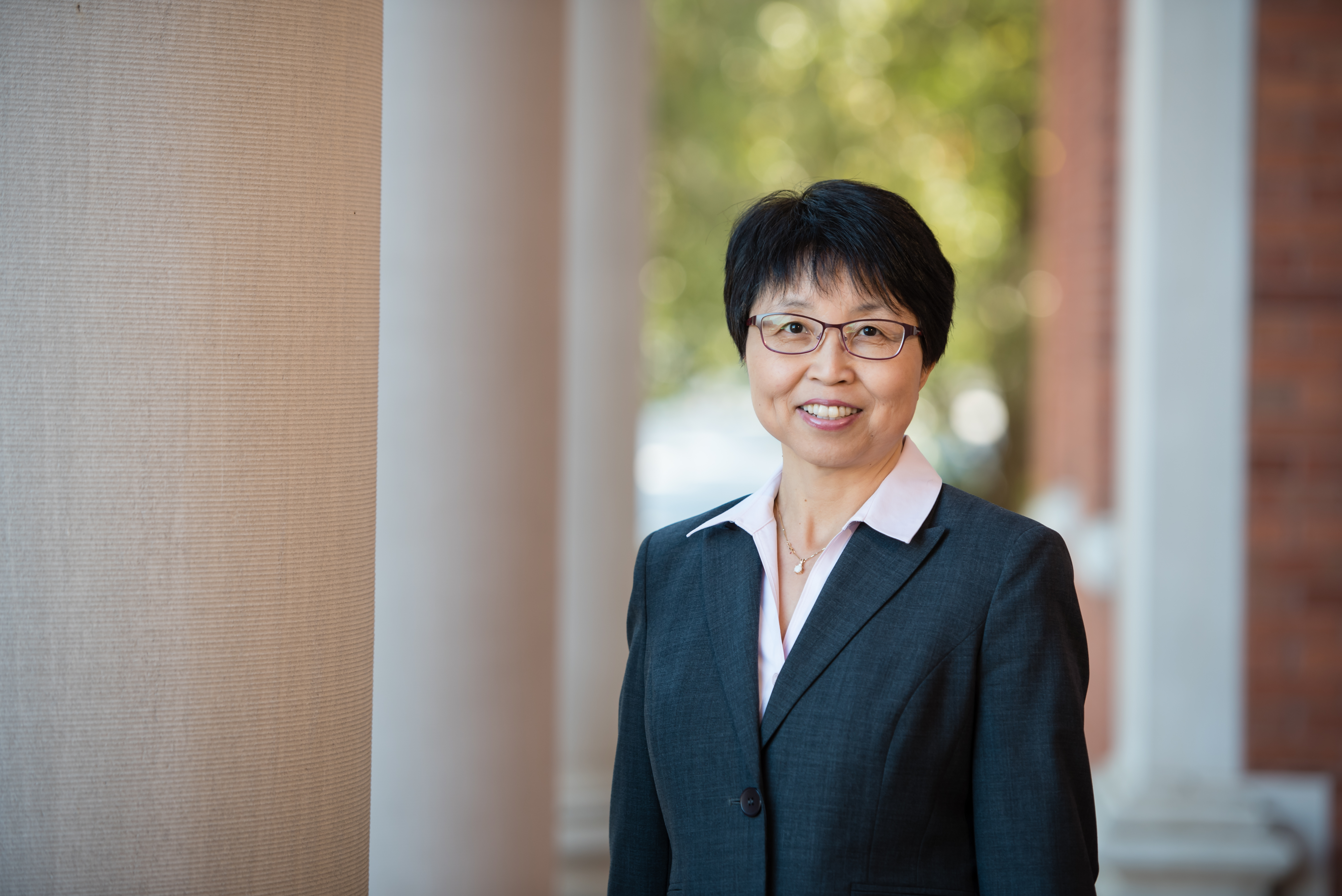
Pic of Juan XuBy Jackie Todd, Clemson University Relations

An accomplished leader with 25 years of experience in higher education research and analytics, statistical data analysis and key performance metrics has joined Clemson as the university’s director of Institutional Research (IR).

Juan Xu, Ph.D. will manage the workflow of critical reporting, compliance and accreditation projects, and lead the IR staff to enhance processes, tools and insights to support the university’s mission and ClemsonForward.

“It is a sincere delight to welcome Juan and her family to the Clemson Family,” said Jeremy King, associate provost for institutional effectiveness. “She brings an impressive blend of interpersonal skills, collaborative posture, institutional research experience and a fastidious commitment to student and faculty success that will all be needed to meet the aspirational goals of Clemson Forward for the benefit of our students, their families and the State of South Carolina.”

King said that Xu’s experience as director of student research in the Office of University of Analytics and Institutional Research at the University of Arizona focused on student success, a key element of the ClemsonForward plan. He added that her understanding of the elements of traditional institutional research as well as the value of business intelligence, predictive analytics and data visualization made her a good fit for the position.

Xu also brings international perspective… personally and professionally.

The youngest child of farmers in a rural Chinese village, Xu knew firsthand the rigors of farming life. She watched her parents work very hard just to make ends meet. But farming wasn’t in her blood. Her dream was to go to college and live in a city.

She did just that. The first-generation college student earned her bachelor’s and master’s degrees at the Harbin Institute of Technology – a top nine university in China. During that time, she gained a strong interest in higher education while working in the higher education division of the Heilongjiang province’s state department of education.

American higher education, according to Xu, is the best system in the world. With that thought, Xu moved to the United States and earned her Ph.D. in leadership and higher education from the University of Nebraska at Lincoln.

After graduation, Xu worked in institutional research at the State University of New York and became manager and then director of the office of Institutional Analysis at Brock University in Ontario, Canada.

At Clemson, the new Institutional Research director will first focus on getting the lay of the land and connect with colleagues.

“I’m so glad to be here,” said Xu. “I was drawn to Clemson University because of its reputation as an outstanding academic reputation, its stated strong commitment to individual student success and the people I got to know during the search process.”
 

April is Research & Innovation Month: Submit your events

April is Research + Innovation Month (RIM) at Clemson. During the entire month of April, RIM showcases the research and scholarly activity of faculty, staff, and students university-wide, on both the main campus and at Clemson’s innovation campuses. This year’s celebration promises to be particularly exciting with the university’s new designation as a Carnegie R1 – Doctoral University – Highest Research Activity.

RIM provides everyone the opportunity to showcase their research via interactive posters, energetic presentations, lively performances, awe-inspiring art, sculpture, and models. Everyone is encouraged to participate! Marquee events for this year’s RIM include:

  • Team Science Workshop featuring Dr. Michelle Bennett, Deputy Scientific Director for the National Heart, Lung and Blood Institute of the National Institutes of Health
  • Graduate Research and Discovery Forum (GRADS) and Three-Minute Thesis Competition
  • Focus on Creative Inquiry
  • Grant Application Workshop presented by the National Endowment for the Humanities
  • Fulbright Scholar Program presentation by the Council for International Exchange of Scholars

You can participate

Does your program have an annual wrap-up or display event in April that you would like to include on the RIM calendar? It might be a poster session, symposium, performance, exhibition, or any other format displaying research and scholarly accomplishments. Please visit www.clemson.edu/rim to add your event to the RIM calendar!

Research + Innovation Month is sponsored by Creative Inquiry, Undergraduate Studies, The Graduate School, The Division of Research, and The Watt Family Innovation Center.

Follow Research + Innovation Month on Facebook for updates and event information. Make sure to share your events on Twitter using the hashtag #ClemsonRIM.


Flooding in South Carolina

2015 Storm damage-Hurricane UoaquinBy Jackie Todd, Office of Media Relations and Jonathan Veit, PSA Media Relations

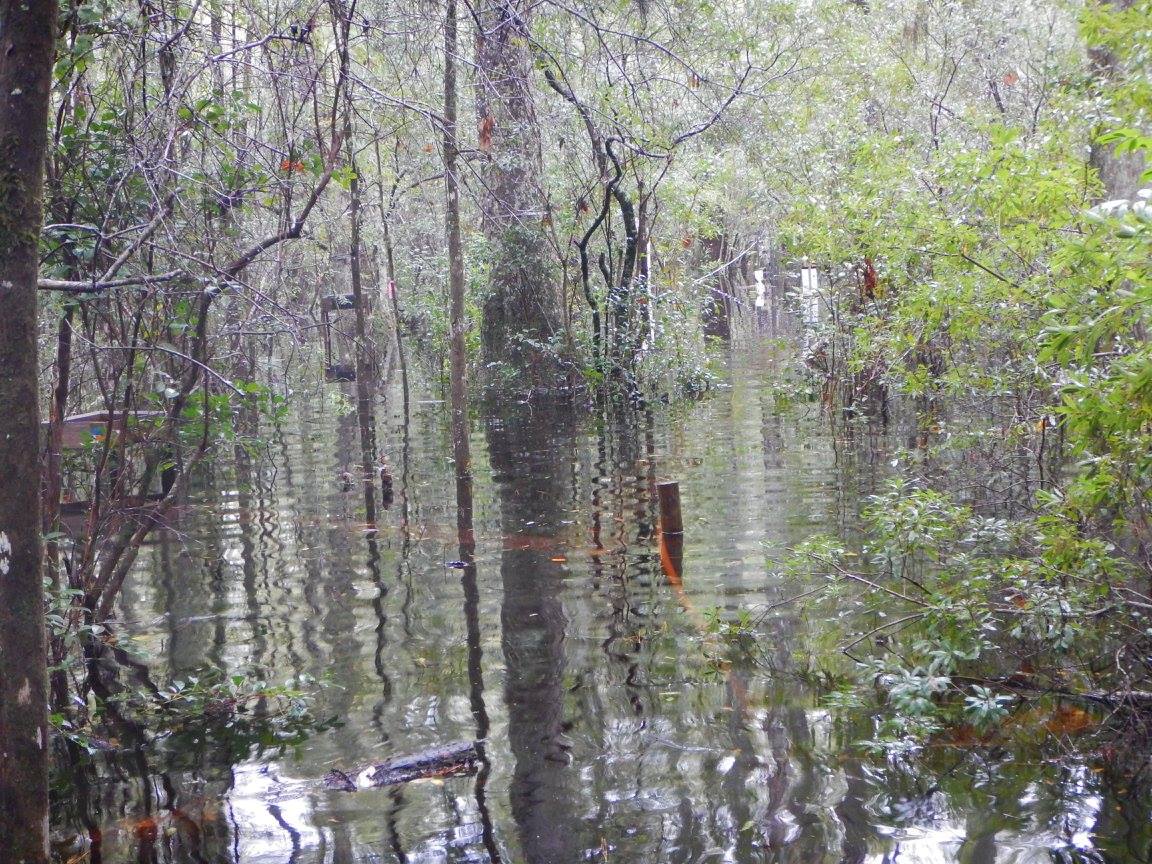
Although Clemson properties across the state remained largely unscathed, some research centers in the Lowcountry were heavily impacted.

It seemed like the rain would never end. Miraculously, the storms caused by Hurricane Joaquin left Clemson’s main campus and Upstate facilities—including the South Carolina Botanical Garden—relatively unscathed.

In North Charleston, the Clemson University Restoration Institute (CURI), had minimal water intrusion. Officials at 292 Meeting Street, home of Clemson’s historical preservation program in Charleston, reported some loose ceiling tiles, but no damage to electronics or equipment. Classes were cancelled at Clemson’s Architecture Center in Charleston, but are now back in session.

Crops, centers and research impacted

Some of the university’s research education centers (REC), however, sustained major damage to the fields and research equipment. The Edisto REC in Blackville remains inundated with water and much of the research equipment and field experiments have been compromised.

Despite the damage, Edisto REC will hold its annual Cotton and Soybean Field Day with a modified program intended to help South Carolina farmers cope with flood devastation. Topics include the effects of flooding on hay and cattle production; harvesting damaged cotton and peanuts and impacts on grades; advice from cotton ginners and peanut processors on what to do with damaged crops; and reports from NRCS, FSA, Farm Bureau, and the S.C. Department of Agriculture on how they can help growers after the flood.

Located in Georgetown, the Belle W. Baruch Institute of Coastal Ecology and Forest Science (BICEFS) reported no major damage to buildings but possible damage to instrumentation infrastructure on several research and coastal wetlands monitoring projects, including Intelligent River, Intelligent Forest and Strawberry Swamp.

Clemson University Public Service and Agriculture (PSA) reported that a number of Cooperative Extension offices closed for a short time and a few may remain closed for an extended period.

While the Extension offices were temporarily closed, agents’ ability to help local farmers was not. Clemson PSA has posted information about flood disaster resources online and Clemson forestry agents continue their work helping with cleanup efforts, assessment and care for tree damage, and strategies to help local farmers feed their livestock.

PSA created a website with up-to-date information about its offices and facilities. The website also offers links to resources and advice on dealing with flood damage and associated issues.

A number of main campus organizations are working on relief and fundraising efforts to help flood victims. Look for a Special Inside Clemson to be sent to campus today with more details.


Clemson displays its clean energy, advanced manufacturing achievements during DOE visit

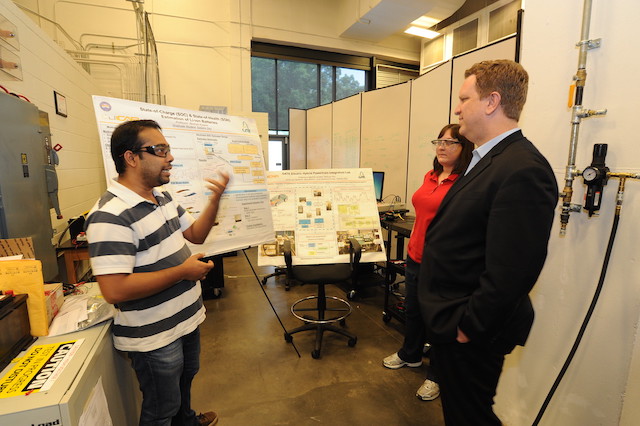
Danielson_CUICAR1By Jackie Todd, Office of Media Relations

Clean energy and advanced manufacturing seem like future concepts. But the future is now at Clemson where research and development of new technologies are attracting the attention—and respect—of those who seek to invest in those innovations.

One of those “investors” is the United States Department of Energy (DOE). And its representative had great things to say about Clemson.

“The whole region is on fire in terms of advanced manufacturing and clean energy and you’re a big part of that,” said David Danielson, assistant secretary for energy efficiency and renewable energy. “I think you’re at the epicenter of that.”

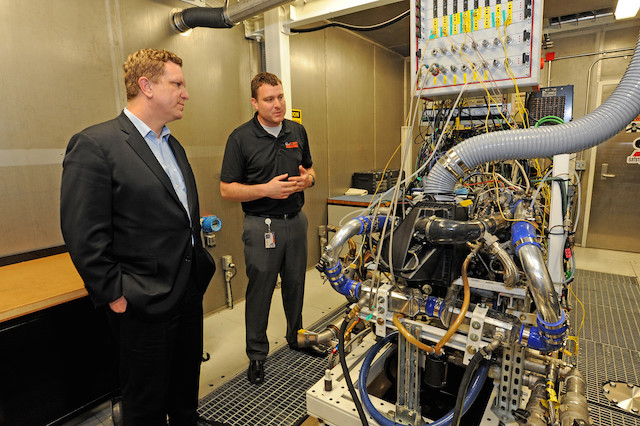
Danielson stopped at CU-ICAR last week as part of his Clean Energy Manufacturing Initiative Southeast U.S. tour to learn more about Clemson’s involvement in this area and to seek input on how the DOE can assist the region in developing technologies to push what he called “our clean energy economy” forward in the nation.

And Danielson liked what he saw.Danielson_CUICAR2

“If I look at what you’re doing with the eGrid, with CU-ICAR and other efforts, I really think that you’re mapping a path forward that we’re going to see the rest of the nation take on in a very short order,” he said. “Walking around here at CU-ICAR, I’m blown away. I’m so excited by the work you’re doing and I couldn’t be prouder that the DOE is one of your sponsors.”

According to Danielson, there’s a growing appreciation of advanced manufacturing and clean energy. The clean energy market, which the DOE assistant secretary said was in the billions last year, is expected to increase into the billions in the next five to ten years.

With rising labor costs overseas, a focus on reduced CO2 emissions and a growing appreciation of advanced manufacturing technologies, it’s a prime time for the U.S. to bring back the manufacturing jobs that it lost in past years.

Melur Ramasubramanian thought it was important for the DOE to understand Clemson’s commitment to this research. Ramasubramanian, the D. W. Reynolds Distinguished Professor and Department Chair of the university’s Department of Mechanical Engineering, helped to organize Danielson’s visit.

“This is a national priority,” Ramasubramanian explained. “Large scale federal funding is being directed to this area. DOE has awarded large National Network for Manufacturing Innovation (NNMI) Institutes and plans to invest in three additional institutes.

Ramasubramanian said that it is strategically important for Clemson to be at the forefront of this area and position itself to win one of these institutes.

“Clean energy-related manufacturing offers the best chance for us to win, given our strengths.”

Faculty and staff sought for collaborative research

The US Play Coalition is a non-profit housed within the Department of Parks, Recreation and Tourism Management (PRTM). The Play Coalition is a partnership of individual, organizations and corporations that promote the value of play throughout life. Our membership is diverse – park and recreation professionals, educators, researchers, health scientists, landscape architects, business leaders, psychologists, physicians, parents, artists and many more.

Currently we are looking to broaden our research efforts by creating a working group for play research at Clemson University. We are looking for a cross-section of faculty and staff across all disciplines to approach play research from a variety of perspectives. We currently have faculty involved from both PRTM and the School of Education, and we would love to broaden our scope. If you would be interested in joining our play research working group, please send an email highlighting your relevant research interests to Dr. Fran McGuire, chair of PRTM at lefty@clemson.edu. We will have our first official convening in the coming months.

Tiger Tuesday celebrates Clemson-GHS collaboration

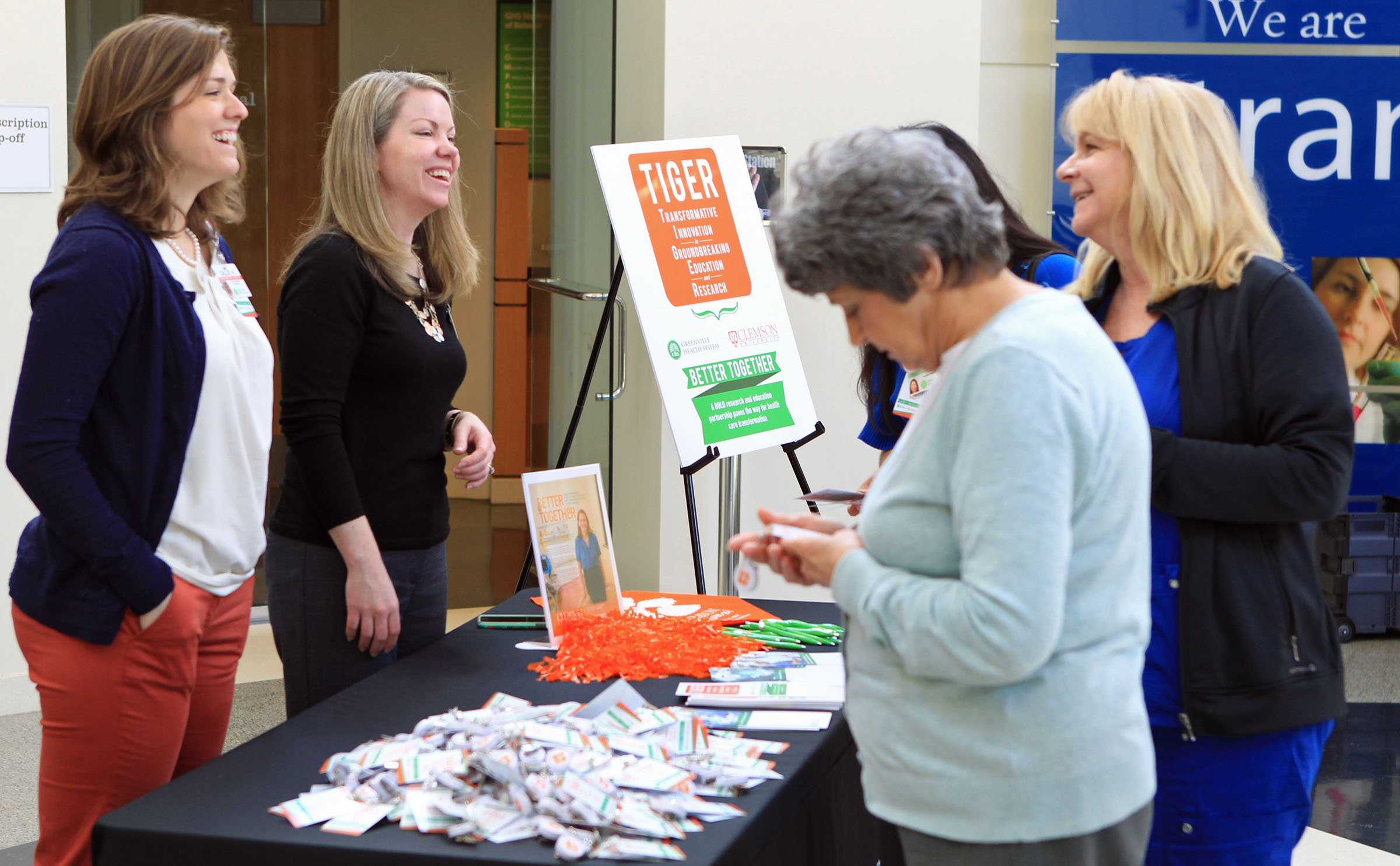
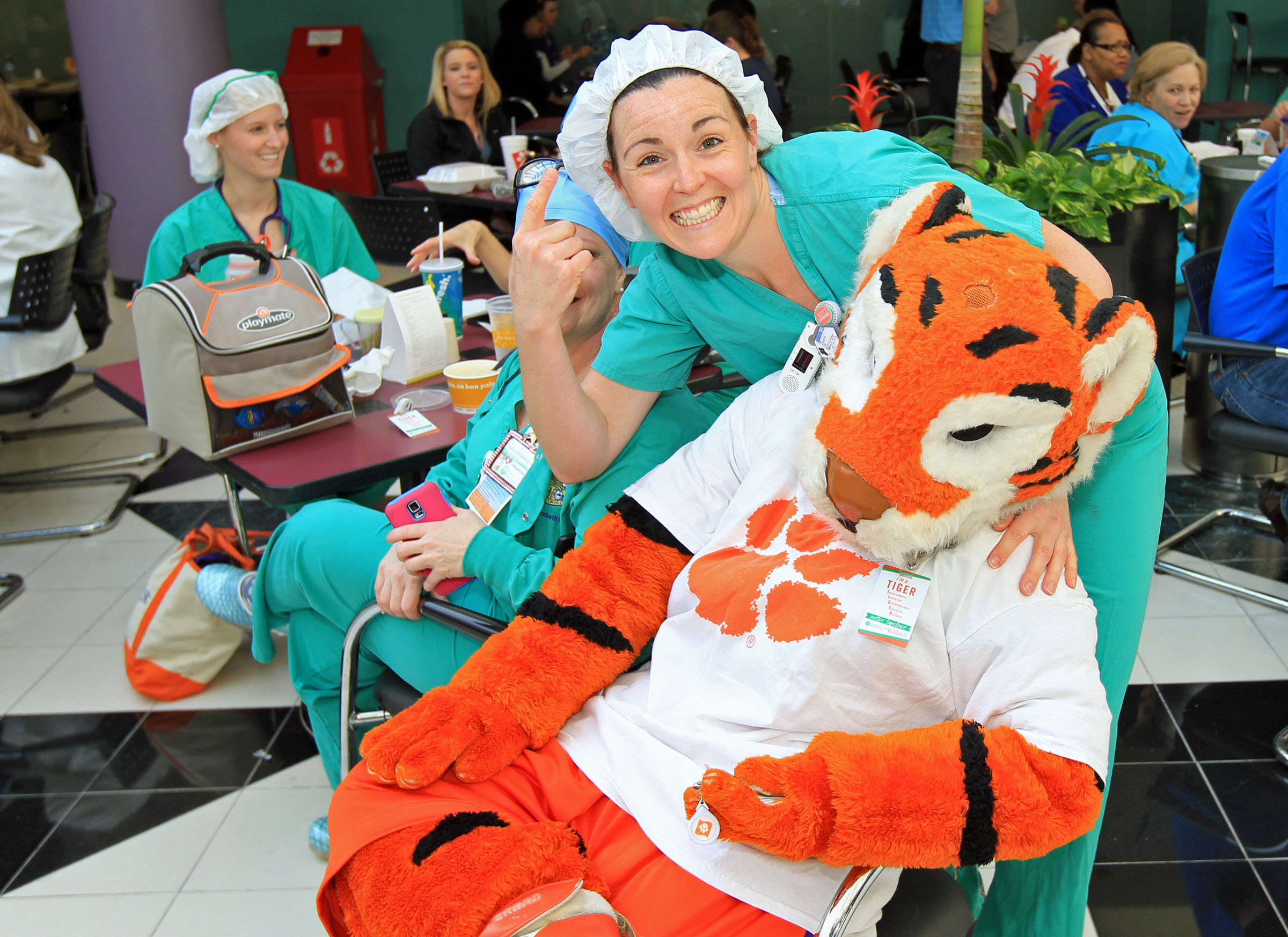
GHS-Clemson collaborationClemson and Greenville Healthcare System’s (GHS) celebrated its growing research and education partnership on Tuesday, March 24, encouraging people to get involved. Today, a growing number of researchers are active in this collaboration.

Tiger paw badge holders and information about the research opportunities and special programs offered through the Clemson-GHS collaboration were shared with Clemson employees, alumni and fans at each of the GHS campuses.

Clemson brings to the table a host of research capabilities, while GHS offers students and researchers the clinical opportunities and partnerships they need to put ideas into action.

“We’re better together,” says Windsor Sherrill, chief science officer at GHS and Clemson associate vice president for health research.

Clemson and GHS entered into a partnership in June 2013 to establish a healthcare research powerhouse that will fuel growth in medical research and GHS-Clemson collaboration2breakthroughs; create opportunities for faculty, physicians and students; and accelerate the flow of research funding into the Upstate. Under the landmark agreement, both organizations work to leverage existing research and educational expertise at Clemson, a top-20 national public university, with the clinical opportunities offered by GHS, one of the largest healthcare systems in the Southeast.

To learn more, contact:

Janet Evatt
Clemson University School of Health Research
406 Edwards Hall
jevatt@clemson.edu
864-656-0779

Future Clemson: Watt Family Innovation Center construction reaches milestone

Turner Construction topping out beamBy Jackie Todd, Office of Media Relations

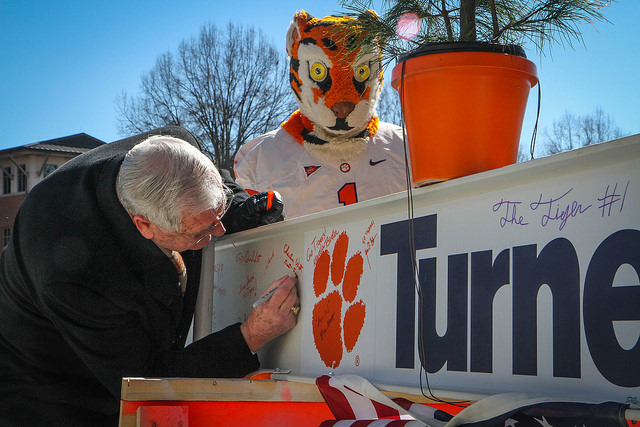
The Watt Family Innovation Center reached a construction milestone when the final exterior steel beam was installed in a “topping out” ceremony on Feb. 19.

In keeping with tradition, a steel beam that completes the building frame was hoisted hundreds of feet into the air. As the beam made its ascent toward the blue sky, three flags unfurled. The American flag, a fixture in most construction sites, was joined by a banner bearing the Clemson University paw print and a banner from Turner, the construction company that was engaged to erect the four-story, 70,000-square-foot building.

Catching a ride on the steel beam was a small evergreen tree, courtesy of the South Carolina Botanical Garden. The tree will be planted on the grounds of Botanical Gardens at a later date. No one knows for certain the origin of including a tree in a topping out ceremony. But Turner Construction’s project engineer, Allison Ford, shared that the tradition was thought to have come from either Native Americans who believed that nothing should ever be taller than nature, or ancient Scandinavia where home builders used a tree or greenery to celebrate the setting of the final highest wood beam.

Regardless of the tradition, Ford, a former civil engineering student who graduated from Clemson in 2008, was excited about the event and the building.

“It’s just going to be a very innovative space,” she explained. “Architecturally it’s going to stand out and set the stage for projects to come on campus in the future. With it being a research and technology-focused center, it’s going to take Clemson into the next generation in terms of research and technology and innovation.”

Dr. Charles Watt, whose family pledged $5.25 million toward the center, was equally excited. And he gave high praise to thoseTurner Construction topping out-Charles Watt signs beam who made it possible for the construction to reach this milestone.

“To all you workers: you’ve done a phenomenal job,” he said. “You can know that what you’re doing is going to last a long, long time and make a fundamental change to higher education and the world we live in. This is the first building in America, and maybe even the world, to have the capabilities this building has.

As part of the topping out ceremony, Turner Construction Company presented a $5,000 check to Safe Harbor, a nonprofit organization that assists victims of domestic violence. Company officials indicated donations to local charities are considered tradition with every construction project.

Now that the Watt Family Innovation Center’s exterior frame is complete, workers will begin construction on the building’s exterior walls. The project is expected to be complete in spring 2016.