We want to keep you informed about the Asian longhorned beetle (ALB) infestation in South Carolina, as supportive community relationships are essential to the success of eradicating the beetle. This update is being issued to established collaborators, communities, and stakeholders, and we invite you to share this information with anyone who may be affected by our operations.
Program Photo of the Month: Joint survey team consisting of Clemson, USDA, Customs and Border Protection (CBP), SC Forestry Commission, Town of Sullivan’s Island, and Town of Mount Pleasant representatives for “Operation Maple Harbor” in Mount Pleasant, SC. Different areas in Mount Pleasant assessed for signs of ALB damage.

Hole-y City Headline
On August 24th, 2025, off-duty inspectors with Clemson University’s Department of Plant Industry (DPI) detected the presence of Asian Longhorned Beetle (ALB) in Mount Pleasant, South Carolina. In response, a new state quarantine was established on October 15th, 2025, to help contain and manage the infestation. Please visit the link below to view the new quarantined area.
Background
What happened? In May 2020, Anoplophora glabripennis, Asian Longhorned Beetle (ALB) was detected in South Carolina for the first time in Hollywood, SC by a local homeowner. Shortly after, a collaborative program between Clemson University’s Department of Plant Industry (DPI) and USDA Animal Plant Health Inspection Services (APHIS) was formed with the goal of detection and eradication of ALB. Since 2021, South Carolina state and federal quarantines have been established in the known areas of ALB infestation encompassing portions of Charleston and Dorchester counties.
Why do we care? As an invasive species, ALB negatively impacts the local environment, economy, and poses a risk to public health through infesting a number of hardwood species, expediting the rate of tree mortality.
What are we doing? Clemson’s DPI and USDA APHIS are conducting tree inspection surveys within the quarantines and the surrounding areas to determine the size and scope of the infestations. Davey Resource Group is contracted to carry out survey and tree removal services on behalf of the ALB Program.
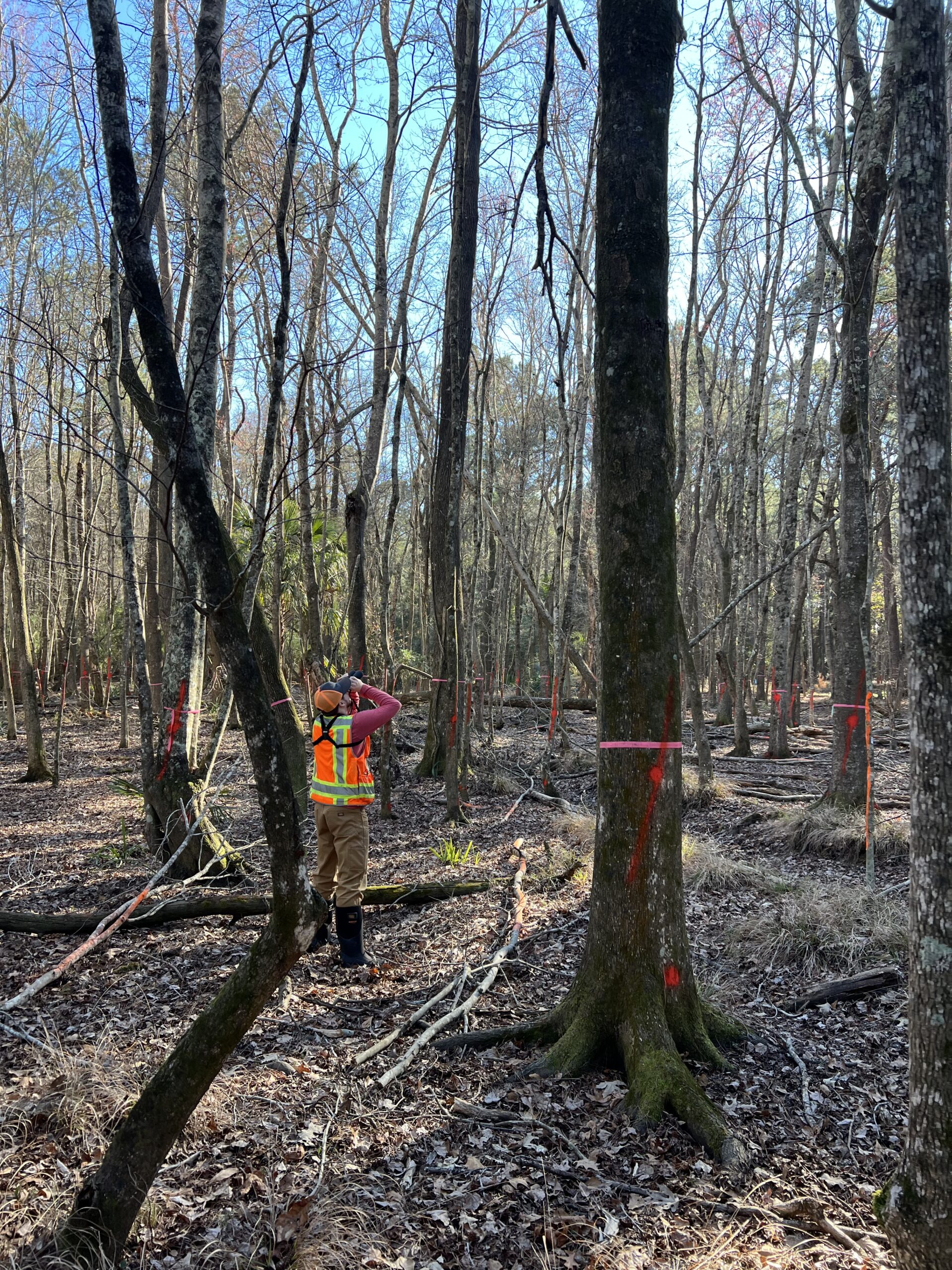
Photo Description: ALB program surveyor conducting tree survey to detect beetle damage. Surrounding trees with orange spray paint have been marked as infested by the program.
What does ALB look like?
- Body length:
- Ranges from 0.7 – 1.6 inches
- Colorations:
- Body: Mostly black with 10-20 irregular white spots on its wing covers
- Antennae: Alternating black and white, ranging from 1.5 to 2 times its body length
- Legs: Black with slight bluish hue


Egg to Exit: Life Cycle
ALB lives inside of the tree from the egg to pupa stages. Once the beetles develop into adults, they begin to emerge from within the tree from early May until late September. Their generation time is highly dependent on climatic conditions; in South Carolina’s climate, one generation is estimated to be completed in as little as 10 months.

Host Trees
A “host” tree is any tree that ALB can successfully infest and complete its lifecycle in. There are only 12 genera of trees (listed below) that have been confirmed as hosts for the beetles.

- Maple (Acer)
- Willow (Salix)
- Elm (Ulmus)
- Poplar (Populus)
- Sycamore/ London Plane Tree (Platanus)
- Birch (Betula)
- Ash (Fraxinus)
- Buckeye/ Horse Chestnut (Aesculus)
- Mimosa (Albizia)
- Mountain Ash (Sorbus)
- Golden Raintree (Koelreuteria)
- Katsura (Cercidiphyllum)
Photo Description: Close-up of an infested Red Maple; ALB’s most preferred host species in SC.
Damage
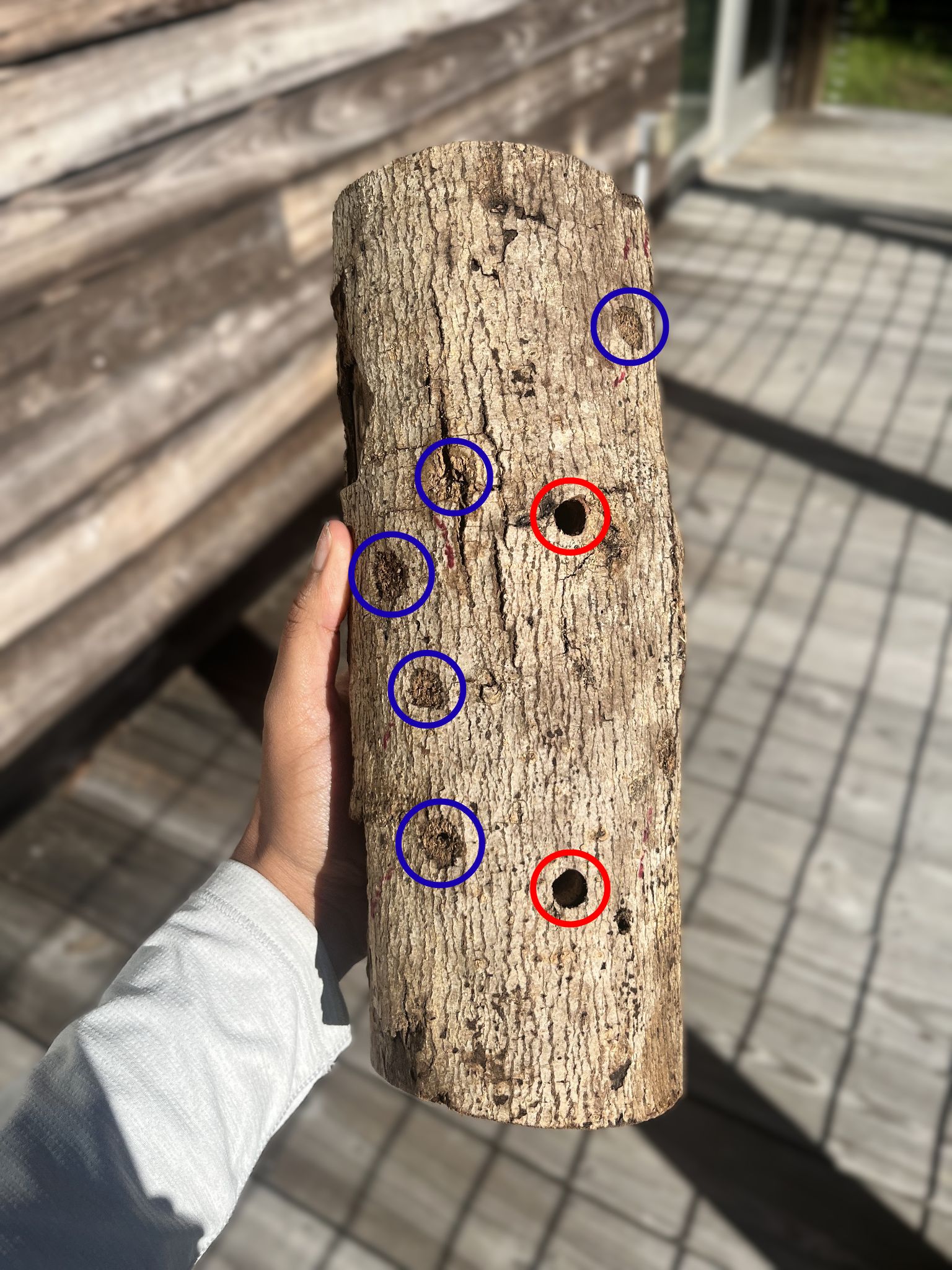
The best way to detect an ALB infestation is by looking for the characteristic damage they create on host trees throughout their lifecycle.
Photo Description: Egg sites (circled in blue) and exit holes (circled in red) on an infested maple log.
If you suspect that you have seen ALB or find suspicious damage on a tree species included in any of the host genera listed above, you can make a report to the program through our reporting tool.
QUARANTINE & REGULATIONS:
Federal and state quarantines are established for Charleston County and a small portion of Dorchester County. The state quarantine legislation was enacted with publication in the State Register on June 25, 2021. See SC ALB regulations here and view the Electronic Code of Federal Regulations here.
For property owners who will have infested trees requiring removal, they should receive official notification via certified mail from DPI and, whenever possible, will be notified by a Davey Resource Group official before tree removal work begins.
ALB by the Numbers – 2025 ALB Stats as of 12/05/2025
- Tree Surveys: 566,357
- Infested Detections: 12,816
- Infested Removals: 7,853
- High Risk Removals: 20,860
In accordance with SC’s State Crop Pest Commission, a regulated article is considered as anything that poses a risk of spreading ALB, including the beetle at any life stage, firewood and any woody host material half an inch or more in diameter. Regulated articles must be processed appropriately per state and federal regulations before leaving the quarantine.
Regulated material may also be disposed of at an approved disposal site inside the quarantine areas. Approved dumpsites include Bees Ferry Road Convenience Center, 1344 Bees Ferry Road, 29414 or the Hollywood Convenience Center, 5305 Highway 165, 29449. Please contact the SC ALB Program for additional questions regarding proper handling and disposal of woody debris in Charleston County, Dorchester County and Town of Mount Pleasant.
The ALB Program is proactively contacting businesses operating within the quarantine for guidance in how to adhere to the quarantine requirements. To sign up for free compliance training where you can learn more about how to handle regulated articles, please contact the SC ALB Program at stopALB@clemson.edu or leave a voicemail to our office at 843-973-8329.
OUTREACH:
This past month, DPI program staff attended the SC Forestry Association Meeting in Greenville, SC. Around 200 interactions were made with meeting attendees where different invasive species including ALB, spotted lanternfly (SLF), cogongrass, and yellow-legged hornet (YLH) were discussed. Thank you to all who attended and interacted with us!
The Clemson University Invasive Species Program often shares updates and information on ALB (as well as other invasive species of concern in South Carolina) on its Facebook page – like and follow to get updates in your social media feed!
Special thanks to those who signed up for our newsletter to stay up to date on the progress of the program; it’s only through a diligent public are we able to more easily detect and eradicate ALB and protect South Carolina’s trees!
If your community organization is interested in hosting an ALB outreach event or would like printed copies of our brochure, please contact the program at stopALB@clemson.edu. Additional educational invasive species materials are also available at www.clemson.edu/alb.
REMINDERS:
It is important to know the beetle is not harmful to people or pets. DPI and USDA tree inspectors will notify residents of survey activities on private properties before they conduct surveys whenever possible. Tree inspectors are dressed in Clemson, USDA, or Davey Resource Group uniforms and will provide identification if asked. We are asking residents to look for the beetle and to examine their trees for any damage that may be caused by the beetle. Residents can report the beetle or tree damage through the reporting tool, by emailing stopALB@clemson.edu, or by calling the SC ALB Program Office at 843-973-8329.
CLOSING:
We aim to provide consistent, transparent communication with all those affected in the Charleston area. Please let us know how we can assist in the wider sharing of this information in your communities and with all stakeholders. Our program is made possible through a collaborative effort between Clemson University’s Department of Plant Industry, The College of Charleston and The College of Charleston Foundation, and the USDA’s Animal and Plant Health Inspection Service. We appreciate your support. Thank you!
Want to stay in the loop?
Tune in for our monthly newsletter! Get the newsletter to your inbox each month. To subscribe scan this QR code or follow the instructions below:

- Create a new email message to listserv@lists.clemson.edu
- In the body of the message, type the following: subscribe listname First Last Example: subscribe SCALBNEWSLETTER Jane Doe
- If there is an email signature in the body of the message, you must remove it so it does not interfere with Listserv reading the subscription command.
- Send the email.
- Subscriber should receive an email confirmation it was successful.
