May 2025 Yellow-legged Hornet Update: Yellow-legged Hornet Queens and Embryo Nests
Our goal is to keep you informed about the Yellow-legged Hornet (YLH) infestation in South Carolina. Supportive community relationships are essential to the success of detecting, tracking, and removing this pest. This update is being issued to collaborators, communities, and stakeholders, and we invite you to share this information with anyone who may be affected by our operations.

A fertilized queen emerges after surviving the winter. She enters a brief pre-nesting stage. The queen feeds on sap while her ovaries develop, and she looks for a suitable nesting site. She starts constructing an embryo nest, also known as ‘Stage 1’ nest. This nest is between the size of a ping-pong ball and tennis ball and is usually found in protected places such as the eaves of homes and other structures.
Photo credits: Brad Cavin, Clemson DPI
Background
What happened? In August 2023, Vespa velutina, Yellow-Legged Hornet (YLH) was detected in the United States for the first time near Savannah, GA, less than five miles from the South Carolina-Georgia border. In Spring 2024, several YLH queens and one embryo nest were found in Beaufort County. YLH worker detections continued through summer 2024.
Why do we care? Yellow-Legged Hornets prey on honeybees, causing reduced foraging and colony failure. This impact would result in reduced honey and other honeybee products and reduced crop production due to decreased pollination by honeybees and native pollinators.
What are we doing? With the support of USDA APHIS, Clemson’s Honeybee Protection Program surveys for YLH focuses on detecting workers and finding nests within a wide area around the initial detection. Baited traps are used to initially detect hornets, followed by tracking live hornets to narrow down the nest search area. Eradication of this species focuses on locating and destroying nests and eliminating queens. Nests should ideally be located and destroyed by late summer or very early fall before new queens are actively mating and dispersing, and nest destruction should continue throughout the fall and early winter. From mid-summer through the end of 2024, Clemson’s Honeybee Protection Program found 16 YLH nests and removed or destroyed 15 of those nests. In 2025, the 16th and most recent nest detected so far was removed. Currently in 2025 there have been 9 Embryo nests reported and removed. There are 1,142 traps being monitored with 258 YLH Queens caught and removed from the environment.
What does it look like?
- Body length:
- Ranges from 0.7 – 1.0 inches
- Colorations:
- Head: Mostly black with some front-facing yellow/orange; Black eyes
- Thorax: Mostly solid black/dark brown
- Abdomen: Alternating bands of dark brown/black and yellow/orange
- Legs: Brown or black near the body, ending in yellow segments

Photo credits: Guillame Souvan/AFP/Getty Images
Latest Buzz
The Clemson Department of Plant Industry (DPI) inspectors and USDA personnel in South Carolina have Yellow-Legged hornet traps placed throughout Beaufort County, Jasper County, Colleton County, Charleston County, and Hampton County of South Carolina. These traps are monitored regularly for YLH activity. The locations have been established in the South Carolina low country near known YLH detections and, where possible, near known honeybee colonies.
A main objective this Spring was to increase the survey area and traps deployed in the Low Country of South Carolina. The intent for this objective was to remove as many YLH Queens from the environment as possible.
During the Spring season the YLH Queen emerges from overwintering. Early detection of the first stage of nest called an “Embryo Nest” is critical in preventing the third and final stage called a “Secondary Nest”. During this time the queen constructs the nest in which she rears the first set of workers.
The embryo nest varies in size from a ping-pong ball to a tennis ball. Nesting sites typically are found in a protected area that is sheltered from environmental conditions. Some examples are outdoor structures underneath roof lines and eaves of buildings.


Please DO NOT attempt to remove an embryo nest on your own. Report it to the Clemson® DPI’s reporting tool. Someone from the YLH Response Team will contact you and arrange the removal. We will make sure to remove the nest and queen, this will ensure the queen does not fly off and start a new nest location
YLH By the Numbers – 2025 YLH stats as of 05/13/2025
- 1,142 traps set in Beaufort County, Jasper County, Colleton County, Charleston County, and Hampton County
- 2,562 YLH trap services completed in Beaufort County, Jasper County, Colleton County, Charleston County, and Hampton County
- 258 YLH Queens have been caught and removed from the SC environment
2024 Data Summary
- 796 traps set in Beaufort & Jasper Counties
- 4,998 YLH trap services completed in Beaufort & Jasper Counties
- 4,219 total YLHs trapped
- 16 YLH nests successfully located and removed from Beaufort County
- YLH reporting tool received 820 citizen reports across South Carolina and surrounding states
- 18 YLHs & 3 YLH nests were reported in Beaufort County
- To report a suspected YLH individual or nest sighting, click here
- Top 5 mis-reported YLH lookalikes were: Cicada Killers, European Hornets, Paper Wasps, Yellow Jackets, & Yellow Jacket Queens
- For more information on YLH lookalikes, click here
YLH Queen & Nest Maps


Image Description: The above map is the current YLH Survey response area. The red number in the zone is how many YLH Queens have been captured in YLH traps. To view the live map, please follow this link to Clemson® DPI’s GIS map of known YLH nest locations in South Carolina.
Image Description: The above map reflects YLH nests located and removed in 2024 and 2025. In 2024, 1 Embryo nest was removed and 15 Secondary nests were removed. In 2025, 9 Embryo nests have been located and removed thanks to the public in the Low Country of South Carolina.
What you can do
- Beekeepers: Beekeepers play a vital role in monitoring apiaries and colonies for YLH activity and reporting YLH sightings to Clemson® DPI’s reporting tool. Reporting activity helps DPI deploy traps if needed and attempt to identify the nest location in a timely manner.
- Citizens: All South Carolina citizens can familiarize themselves with hornet and nest identification and assist with reporting. A citizen trapping program for the YLH is now live. The program includes instructions & videos on constructing traps, baits, and reporting YLH findings.
PHOTOS ARE REQUIRED FOR REPORTS. AN IDENTIFICATION CANNOT BE MADE WITHOUT ONE.
YLH Life Cycle
South Carolina citizens can familiarize themselves with the YLH lifecycle to assist with year-round identification. By recognizing the YLH in different life stages, and understanding the different nests constructed throughout the YLH lifecycle, citizens can assist in the early detection and eradication of YLH infestations.
Currently YLH Embryo nests have been constructed by the queen. We are now entering the phase where YLH workers should begin hatching and start to switch into the primary nest phase.
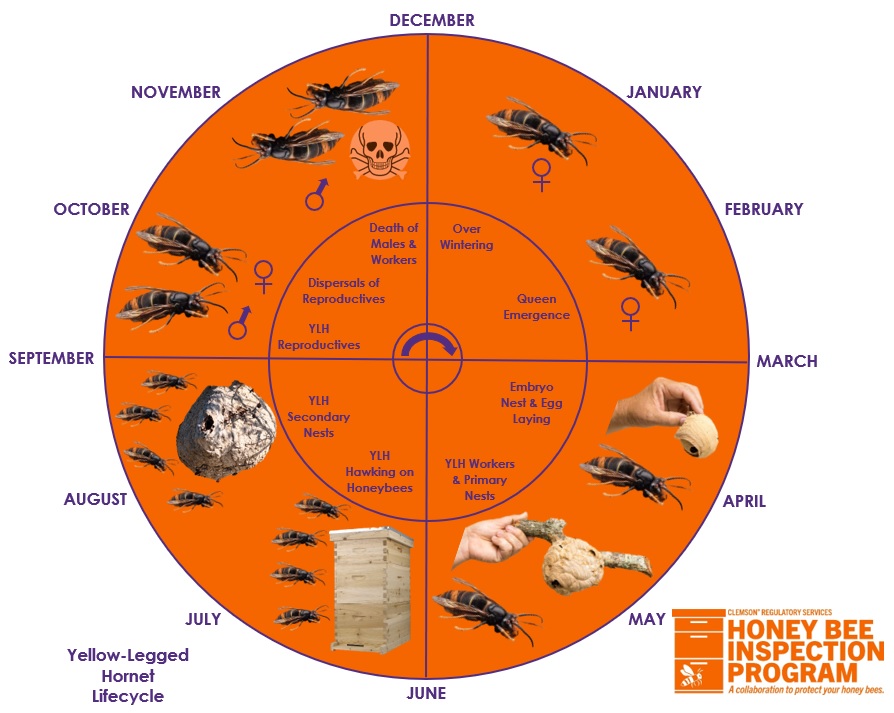
Image credits: Brad Cavin, Clemson DPI
Closing
The mission of Clemson University Department of Plant Industry (DPI) is to protect South Carolina’s agricultural resources and natural ecosystems from the introduction and spread of invasive species and to enhance the efficiency of South Carolina’s agriculture. South Carolina faces major concerns from biosecurity issues and exotic pests. Without federal assistance, South Carolina would not be able to maintain early detection, provide maximum affordable laboratory capability, and maintain a field force to conduct surveys and identify, quarantine, and dispose of introduced pests at effective levels.
Clemson DPI would like to recognize the funding and support received from the USDA, without which YLH trapping efforts would not be possible. We would also like to thank the Georgia Department of Agriculture for their invaluable expertise and collaboration on YLH eradication in South Carolina.
Helpful Links
- Clemson® DPI Resources
- USDA APHIS on YLH
- Georgia Department of Agriculture on YLH
- Clemson Extension’s Apiculture and Pollinator Program
- Article on Exotic Hornet Threats to Apiculture
- Coastal Kingdom | Exotic Introductions of the Lowcountry Part 1 | Season 5 | Episode 3 | PBS
Want to stay in the loop?
Tune in for our monthly newsletter! Get the newsletter to your inbox each month.
To subscribe:
1. Create a new email message to listserv@lists.clemson.edu
2. In the body of the message, type the following: subscribe listname First Last
Example: subscribe SCYLHNEWSLETTER Jane Doe
3. If there is an email signature in the body of the message, you must remove it so it does not interfere with Listserv reading the subscription command.
4. Send the email.
5. Subscriber should receive an email confirmation it was successful.
