To date, no soybean rust has been found in South Carolina. Regular samplings are being conducted across the state by agronomic agents, led by Jonathan Croft and funded by the SC Soybean Board. Jonathan sends out updates regularly through email with updates if rust is found, contact him if you wish to be on that email list.
Most of the soybean crop is actively filling pods now. We are still in the susceptible window for drought stress, pest injury (both insect and disease), and nutrient deficiencies, so keep scouting through R6 (full seed) at a minimum.
Early planted maturity group soybeans are being desiccated and harvested now in small pockets across the state. Our research has shown no yield loss when desiccating soybeans at R6.5 or later; however, if you desiccate too early (R6), we have seen significant yield losses. If you plan to desiccate have questions about when to make the spray application please reach out to your local agent or myself to ensure that we do not trigger a spray too early.
Some national research that we were involved with over the last few years showed that we did not hinder yield or quality from R6.5 to R7 and some states in the South have modified existing recommendations to spray indeterminate soybeans at R7 rather than R6.5 to help with ensuring we are not spraying too early.
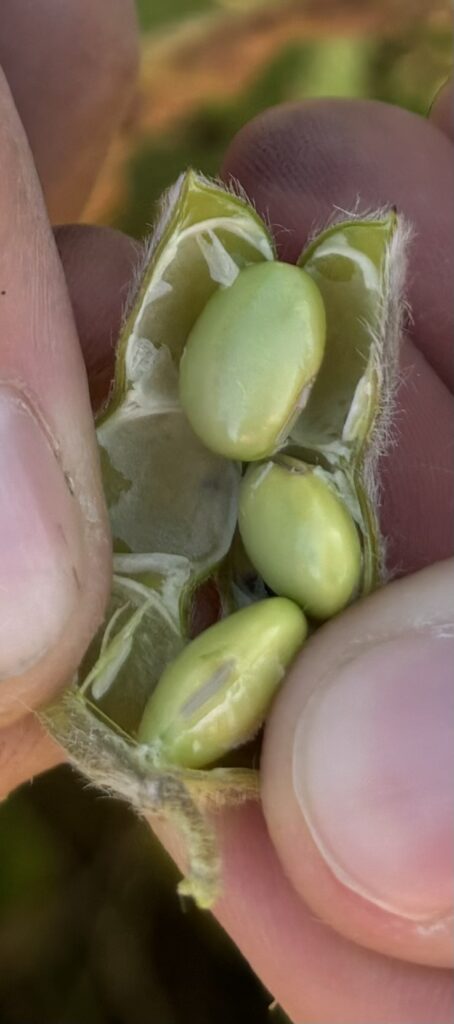
My current recommendation is to spray between R6.5 (full seed and seeds pull away from the membrane in the pod easily – in the top 4 nodes of the plant) and R7 (one brown pod on the mainstem). At this growth stage, you should be able to see the foliage of the plants begin to change colors prior to spraying (the plants will not be dark green and lush).
Reminder – check pre-harvest intervals (PHI) on desiccation products to ensure that the label is being followed.
Below is an example of a pod that is at the R6.5 growth stage. The beans are “squared off” in the pod and easily fall from the membrane within the pod walls.