Clemson Summer Programs

Thinking About Changing a Major?

Did you know that about 50% of Clemson students will change their major?  The good news is that you are not alone, and there are several majors at Clemson that you can get a jumpstart with over the summer to help you not delay your graduation.   Here are 13 majors that you can take courses in this Summer 2026 to help you transition well, especially if you are a Freshmen going into your Sophomore year this fall:

  • Pre Business
  • Packaging Science
  • Psychology
  • Criminal Justice
  • Communication
  • Sports Communication
  • Genetics
  • Biology
  • Chemistry
  • Bio Chemistry
  • Health Science
  • Human Capital
  • Animal and Veterinary Science

Next Steps:

  1. Open Degree Works and use the “What If” tool to see how changing your major will impact the courses that you will need to take and what requirements you have already met.  You can even see if you select the summer term what courses are also being offered this summer.  If there is a required course that is not being offered this summer, talk with your advisor as there may be a substitute course that is being offered over the summer that will satisfy the requirement. 
  2. Look at the requirements by college for Changing Your Academic Program. Each college has a set of requirements needed to declare that major. Some majors are also currently closed meaning that you cannot change or add them at this time.  Others require a certain GPA or a required pre-requisite course in order to declare the major. It is important for you to look at those requirements to ensure that you meet them. 
  3. Sign up for an Exploratory Appointment with an advisor from the college that you are wanting to change into.   Each college has a specific academic advisor who is assigned to help students look at the possibility of transitioning.  In the Advisor Directory you can search by Advisor Type and find the advisor assigned to help you look at changing your Academic Program. 
  4. Finally work through the official steps of changing your Academic Program and registering for courses this summer. 

Use Degree Works to Find Summer Courses

Degree Works can help students quickly identify Summer Term courses that fit their degree plans. It can also support academic planning by showing completed and remaining requirements. In addition, the “What If” feature allows students to explore how their credits would apply to a different major, a second major, or a minor.  

To access a Degree Works audit, students should log in to iROAR, open Student Self-Service, and select Degree Works. In the audit, required courses appear in bold. When a student hovers over a highlighted course, Degree Works displays whether that course is offered during the summer, when it is available, and whether seats remain open.

Students who would like additional guidance can visit the Registrar’s website for tips and training on how to use Degree Works effectively.

How to Utilize the Academic Forgiveness Policy

Repeating Courses Passed

A student may repeat a course passed with a grade lower than B. Repeating a course graded or C does not erase the original or C grade. If a student elects to apply Academic Forgiveness to a course graded D, the Academic Forgiveness Policy below will apply. Otherwise, both grades appear on the record and are computed in the cumulative grade-point average. A course graded C cannot be forgiven. Credit for the same course will be counted only once toward the number of hours required for graduation. For academic eligibility purposes, duplicate credits do not count as credits passed. For financial aid purposes, duplicate credits do not count as credits completed for satisfactory progress. If a student repeats a course passed with grade of B or better, the credits and grade points earned in the repeat attempt will be removed from the cumulative summary.

Repeating Courses Failed

A student who has failed a course cannot receive credit for that course until it has been satisfactorily repeated hour for hour in a class; except that in the case of co-related laboratory work, the number of hours to be taken shall be determined by the instructor.

Where separate grades for class and laboratory work are given, that part of the subject shall be repeated in which the failure occurs. Successfully repeating a course previously graded F does not erase the original F grade from the student’s record. If a student elects to apply Academic Forgiveness to a failed course, the Academic Forgiveness Policy below will apply. Otherwise, both grades appear on the record and are computed in the cumulative grade-point average.

Academic Forgiveness Policy

The Academic Forgiveness Policy (AFP) allows an enrolled student seeking a Clemson University degree to eliminate from the GPA calculation up to two courses in which a D or F was earned. Further information on specific questions related to the use of Academic Forgiveness can be found on the Registrar’s website.

Academic Forgiveness can improve a student’s GPA while reducing their earned credit hours, so students must be aware of all consequences before requesting that a grade be forgiven. Students are encouraged to speak with the Office of Student Financial Aid if they have questions about how Academic Forgiveness may affect their scholarship eligibility. If students are seeking to regain a scholarship for an upcoming academic year, they must invoke the AFP before the first day of class of the fall semester. For financial aid purposes, courses repeated under this policy resulting in duplicate credit do not count for satisfactory academic progress.

The following conditions apply:

  • The AFP shall apply only to courses taken at Clemson University.
  • The AFP may not be applied to a course taken on a Pass/No Pass basis.
  • Courses taken prior to fall semester 2003 may not be considered for Academic Forgiveness.
  • Students may apply Academic Forgiveness to a particular course only once.
  • The AFP may not be applied to any course in which the student was previously found in violation of the academic integrity policy.
  • Once applied, Academic Forgiveness cannot be reversed.
  • D or F grades in required courses may be eliminated from the GPA before the course is repeated.
  • A forgiven course cannot be used to satisfy any prerequisite.
  • Course substitutions are not permitted in situations where Academic Forgiveness has been previously applied.
  • Any course used to meet a graduation requirement must be repeated satisfactorily at Clemson University. Both grades will remain on the transcript, degree progress report and other official documents.
  • Students must contact their academic advisor to discuss Academic Forgiveness prior to submitting the request for approval.
  • Students cannot receive transfer credit for the same course that received Academic Forgiveness.

Students may not invoke the AFP after they have graduated. After graduation, students may repeat coursework, but both grades will be calculated in the grade-point average.

Thinking About Adding a Minor?

Some Clemson minors can be completed in as little as one full summer term. In these programs, courses are sequenced across the summer in a way that allows students to finish the entire minor in one summer.

Minors in One Summer

These minors include:

  • Business Administration
  • Criminal Justice
  • Political Science
  • Construction Science and Management
  • Architecture (one prerequisite must be completed in the fall)
  • Historic Preservation

Many of these minors pair well with a variety of majors, and some of the required courses may also count toward major requirements. For students who are considering changing a major, adding a minor can also be a practical way to explore a new field of study before declaring a full major.

Minors Over Several Summers

Summer can also be a helpful option for students who have already declared a minor or want to begin one but have limited course availability during the fall and spring semesters. Some minors can be completed through a combination of summers. While all required courses for these minors are typically offered during the summer, prerequisite requirements may prevent students from finishing them in a single summer term. These minors include:

  • Accounting
  • Animal and Veterinary Services
  • Biological Sciences
  • Communication Studies
  • Computer Science
  • Financial Management
  • Historic Preservation
  • Psychology
  • Sociology
  • Brand Communication
  • Sports Communication
  • Cybersecurity
  • Economics
  • Human Resource Management
  • Political and Legal Theory
  • Public Policy
  • Wildlife and Fisheries Biology (students should take WFB 3000 during the summer)

Students who are interested in declaring a minor or changing their major should first speak with their academic advisor to make sure the plan fits their overall degree requirements. After that, they can submit an Undergraduate Change of Program request through the Student Records tab in iROAR to declare the minor and register for summer courses.

Popular Summer Courses

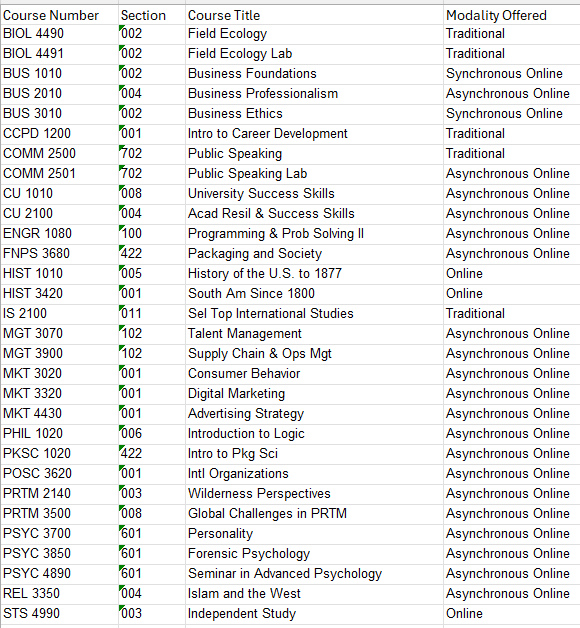
Have you had a hard time getting into some of the high demand Clemson courses in the Fall and Spring semesters? The following are high-demand courses that are being offered this summer. Many of these courses are also being offered online to provide maximum flexibility for your summer schedules. 

So how do you know if you need one of these courses?  Degree Works is a great place to start!  (For more information about Degree Works check out the blog on Degree Works or check with your academic advisor.)

Course Format Guide

Each course listing below includes the term in which it is offered and the course format for that term.

  • Async: Fully online with no required meeting time
  • Online Sync: Online with scheduled class meetings, often held through Zoom or Teams
  • In Person: Face-to-face instruction on campus
  • Hybrid: A combination of online and in-person instruction

Popular Summer Courses

Accounting

  • ACCT 2010 — Summer I: Async, In Person; Summer II: Async
  • ACCT 3030 — Summer I: Async; Summer II: In Person
  • ACCT 3110 — Summer I: Async; Summer II: Async
  • ACCT 3120 — Summer II: Async
  • ACCT 3130 — Summer II: Async
  • ACCT 4040 — Summer I: Async

American Sign Language/Languages

  • AL 3490 — Summer II: Async

Anthropology

  • ANTH 2010 — Summer I: Async; Summer II: Async
  • ANTH 3280 — Summer I: Async

Art

  • ART 2100 — Summer I: Async; Summer II: Async or In Person

Astronomy

  • ASTR 1010 — Summer I: Async
  • ASTR 1030 — Summer I: Async

Aviation Studies

  • AVS 1500 — Summer I: Async
  • AVS 1510 — Summer I: Async
  • AVS 4150 — Full Summer: Async

Biology

  • BIOL 1010 — Summer II: Async
  • BIOL 1030 — Summer II: Async
  • BIOL 1050 — Summer II: In Person
  • BIOL 2220 — Summer II: In Person
  • BIOL 2221 — Summer II: In Person

Business

  • BUS 1010 — Minimester B: Online Sync; Minimester D: Online Sync
  • BUS 2010 — Minimesters A, B, C, and D: Online Sync
  • BUS 3010 — Minimesters B and D: Online Sync

Chemistry

  • CH 1010 — Summer I: Async, In Person
  • CH 1011 — Summer I: In Person
  • CH 2230 — Summer I: In Person, Async
  • CH 2270 — Summer I: In Person

Computer Science

  • CPSC 1050 — Full Summer: Async
  • CPSC 1051 — Full Summer: Async
  • CPSC 2920 — Full Summer: Online Sync

Economics

  • ECON 2120 — Summer I: Async; Summer II: Async

Education

  • EDF 4800 — Summer I: Async; Summer II: Async
  • EDF 4801 — Summer I: Async; Summer II: Async, Sync Online
  • EDSP 3700 — Summer I: Async

English

  • ENGL 2020 — Summer I: In Person; Summer II: In Person, Async; Minimesters A, B, and C: Async
  • ENGL 2140 — Summer I: Async; Summer II: Async
  • ENGL 2150 — Summer I: Async; Summer II: In Person, Async; Minimester B: Async

Engineering

  • ENGR 1020 — Summer II: Async, In Person
  • ENGR 1021 — Summer II: Async, In Person
  • ENGR 1410 — Summer II: Async
  • ENGR 1411 — Summer II: Async

Environmental Science

  • ENSP 2000 — Summer I: Async; Summer II: Async

Finance

  • FIN 3070 — Summer I: Async
  • FIN 3110 — Summer I: Async; Summer II: Async

Geology

  • GEOL 1010 — Summer I: Async; Summer II: Async

Health

  • HLTH 2980 — Summer I: Sync Online; Summer II: Hybrid, Sync Online

Justice Studies

  • JUST 2880 — Summer I: Async; Summer II: Async

Law

  • LAW 3220 — Summer I: Async, In Person; Summer II: In Person

Mathematics

  • MATH 2070 — Full Summer: Async; Summer I: Async; Summer II: Async
  • MATH 2071 — Full Summer: Async; Summer I: Async; Summer II: Async
  • MATH 2800 — Summer I: Async
  • MATH 3650 — Summer I: Async

Management

  • MGT 2010 — Minimester A: Async
  • MGT 2180 — Minimester B: Async
  • MGT 3030 — Summer II: In Person
  • MGT 3070 — Summer I: In Person; Minimester D: Async
  • MGT 3100 — Minimester A: Sync
  • MGT 3120 — Summer II: Async; Minimester C: Async
  • MGT 3180 — Summer II: Async
  • MGT 3900 — Minimester D: Async
  • MGT 4000 — Summer I: In Person; Minimester B: Async
  • MGT 4150 — Summer I: In Person; Summer II: Async; Minimester B: Async

Microbiology

  • MICR 2050 — Summer I: In Person
  • MICR 2051 — Summer I: In Person
  • MICR 3060 — Summer I: In Person

Marketing

  • MKT 3010 — Summer II: Async; Minimester A: Async
  • MKT 3030 — Summer II: Async
  • MKT 3250 — Minimester A: Async
  • MKT 3310 — Minimester B: Async
  • MKT 4270 — Summer I: In Person
  • MKT 4310 — Minimester B: Async
  • MKT 4500 — Minimester B: Async

Packaging Science/Interdisciplinary

  • PCID 3040 — Full Summer: Async; Summer I: Async; Summer II: Async
  • PCID 3140 — Full Summer: Async; Summer II: Async

Philosophy

  • PHIL 1010 — Summer I: Async; Minimesters A and B: Online Sync
  • PHIL 1020 — Full Summer: Online Sync; Summer I: Async; Summer II: Async
  • PHIL 1030 — Summer I: Async; Summer II: Async; Minimester A: Online Async; Minimesters B and C: Async

Parks, Recreation, and Tourism Management

  • PRTM 2000 — Summer II: In Person

Psychology

  • PSYC 3330 — Minimester B and C: Async
  • PSYC 3830 — Minimester B: Async

Sociology

  • SOC 2010 — Summer I: Async; Summer II: Async, In Person; Minimesters A and C: Async

Statistics

  • STAT 2300 — Summer II: Async
  • STAT 2301 — Summer I: Async; Summer II: Async

Theatre

  • THEA 2100 — Full Summer: Async; Summer II: Async; Minimesters A and B: Async