White Grubs
Species & Identification
White grubs are the larvae of scarab beetles. In South Carolina, white grubs of the May and June beetles (Phyllophaga spp.) and the masked chafers (Cyclocephala spp.) are the most common. White grubs of the Japanese beetle, green June beetle, and black turfgrass ataenius can be occasional pests. Scarab beetles (the adults) are easy to identify, but white grub identification is more important in pinpointing the species that is causing the damage.
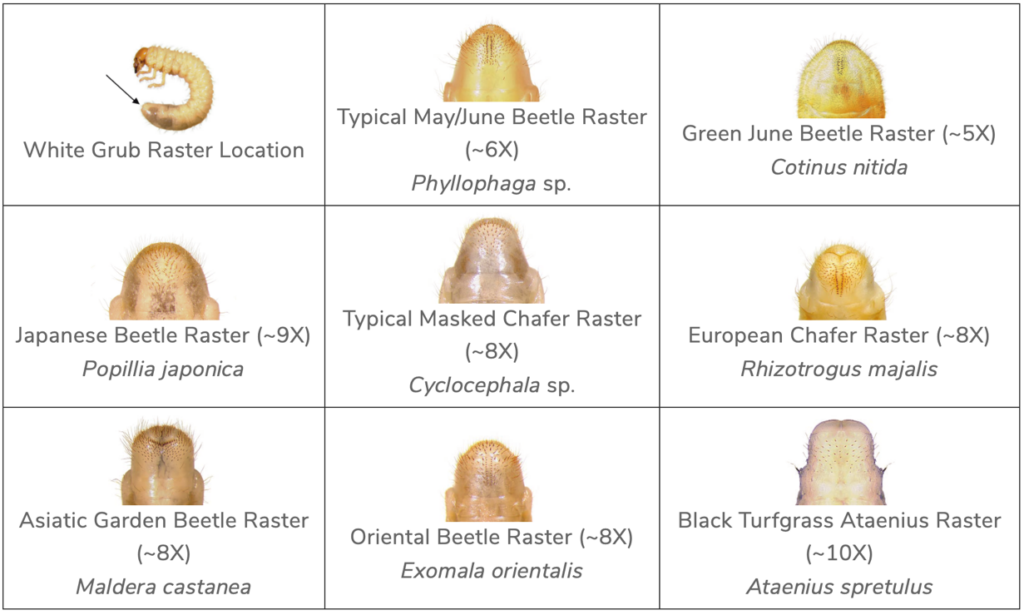
All white grubs have creamy white bodies, yellow‑brown heads, and three pairs of legs. The raster pattern—the arrangement of bristles or hairs on the underside of the abdomen near the anal opening—is the best way to differentiate white grub species. See Figure 1 for a comparison of the raster patterns among white grub species or genera. Correct identification is key to understanding their life cycles and developing a successful management program.
Damage & Symptoms
White grubs feed on the roots of all turfgrass species and cultivars. Their damage tends to occur in concentrated patches, necessitating scouting in multiple spots at a site. Initial damage appears as unhealthy, chlorotic turf and may go unnoticed. A large white grub population can destroy the root system, causing the turf to be easily lifted from the soil. Severely affected turf may be slow to green up, feel spongy underfoot, appear chlorotic, and wilt easily. In many cases, animals digging for white grubs cause more damage than the grubs themselves.
Life Cycle
Figure 2 provides a general overview of the life cycles of various white grub species. Black turfgrass ataenius has two generations per year, with adults laying eggs in late spring and late summer. Japanese beetle, masked chafers, and green June beetle have one-year life cycles—eggs are typically laid in early summer, with adults emerging the following spring or early summer.
May and June beetles may take two or three years to complete development, spending nearly an entire year in the third instar stage, which can cause significant damage to turfgrass roots. Adult beetles emerge in May or June, depending on the species.

Scouting
Long residual insecticides are most effective when applied at the time of adult beetle activity, so knowing when adults are active is important for management. Japanese beetle traps baited with pheromones are widely available. Most scarab beetle species are nocturnal and can be collected with blacklight or ultraviolet traps—though these traps may also catch many non‑target species, requiring extra processing time. Another method is to monitor adult activity on landscape plants they feed on. Egg hatch often occurs 10 days to two weeks after peak adult activity.
White grubs are best detected through soil sampling. Collect soil samples (up to 6 inches deep), break them apart, and extract the grubs. Identification is then made based on raster patterns.
Cultural Control
The best cultural defense against white grubs is maintaining a healthy lawn by following best management practices for your turfgrass. Healthy, well‑maintained turf can withstand moderate grub infestations. Avoid excessive irrigation during peak adult activity—eggs survive better in moist soil. Also, avoid planting preferred scarab food plants near turfgrass areas. Turning off lights at night from May through June can reduce the attraction of scarab beetles and subsequent grub infestation.
Biological Control
The most commonly touted biological control is milky spore disease (Bacillus popilliae), though replicated studies have not consistently demonstrated its efficacy against white grubs. Other beneficial bacteria available for grub control include Bacillus thuringiensis subspecies galleriae and Chromobacterium subtsugae. Beneficial nematodes have also shown success against early larval stages. Note that beneficial bacteria and nematodes perform better in moist soil and typically require repeated applications to build up effective populations.
Many native natural enemies feed on scarab beetles and white grubs; however, these are not commercially available. The best approach is to protect these natural enemies by avoiding broad‑spectrum insecticides such as carbamates, organophosphates, and pyrethroids (see IRAC Groups 1 and 3 in Table 1).
Chemical Control
Action thresholds for white grub control vary by species and site. General thresholds per square foot are eight to ten masked chafer grubs, three to five May and June beetle grubs, eight to ten Japanese beetle grubs, and 30 to 50 black turfgrass ataenius grubs—with stressed turf showing symptoms at lower thresholds.
Preventative insecticide applications target newly hatched nymphs. The insecticide is absorbed by the turf and ingested as grubs feed on the roots. These applications should be made soon after peak adult flight is observed in the spring and early summer (see Figure 2). Since most scarab beetle species have similar emergence times, the emergence of the Japanese beetle—easily observed with traps—can serve as an indicator for treatment timing.
Curative applications are often less effective. When needed, they work best when grubs are feeding near the soil surface. Under dry conditions, grubs migrate deeper; thus, irrigating one to two days before a curative application can help move grubs upward. Apply insecticides as late in the afternoon as possible and water in with ¼ to ½ inch of water.
Selected insecticides for White Grubs control
| Active Ingredient(s) | Trade Name(s) | Rate (per 1000 ft²) | Use Site(s) | IRAC Code(s) |
|---|---|---|---|---|
| Azadirachtin | AzaGuard; Molt-X; Ornazin | 8-21 fl oz | A C G L R S | UN |
| Azoxystrobin + thiamethoxam | Caravan G | 2-2.8 lb | A G L R | 4A |
| Bacillus popilliae | Milky Spore Powder; Milky Spore Granular | 0.25 lb; 2.86 lb | L | UC |
| B. thuringiensis subsp. galleriae | grubGone! G; Lawnbox GrubOut; Organic Grub Control | 2 lb 5 oz – 3 lb 7 oz | A C G L R S | |
| Beauveria bassiana | Botanigard 22 WP; Mycotrol WPO | 1-4 oz | A C G L R S | UNF |
| Heat-killed Burkholderia | Zelto | 8-16 tbsp | A C G L R S | UNB |
| Carbaryl | Carbaryl 4L; Sevin SL | 1.5-6 fl oz | A C G L R S | 1A |
| Carbaryl + bifenthrin | ATP Duocide | 4-8 lb | A L R | 1A + 3A |
| Chlorantraniliprole | Acelepryn; Acelepryn G | 0.18-0.37 fl oz | A C G L R S | 28 |
| Chromobacterium subtsugae | Grandevo PTO | 4-8 oz | A C G L R S | UNB |
| Clothianidin | Arena 0.25G; Arena 25 WDG; Guillotine | 1.8-2.3 lb | A C G L R S | 4A |
| Clothianidin + bifenthrin | Aloft LC G; Aloft GC SC; Aloft LC SC | 2.3-3.6 lb | A C G L R S | 4A + 3A |
| Clothianidin + pyripoxyfen | Sumari | 1-2 fl oz | A C L R | 4A + 7C |
| Cyantraniliprole | Ference | 0.184-0.367 fl oz | A C G L R S | 28 |
| Dinotefuran | Zylam Liquid | 1.8 fl oz | A C G L R S | 4A |
| Dinotefuran + alpha-cypermethrin | Alucion 35 WG | 0.44 oz | G L R | 4A + 3A |
| Heterorhabditis bacteriophora | NEMAforce HB | 25-100 million units | A C G L R S | UC |
| Imidacloprid | Bandit; Malice; Mallet; Merit | 1.4-1.8 lb | A C G L R S | 4A |
| Lambda-cyhalothrin | Demand G; Avesta; Scimitar CS | 3-4 lb | A C L R | 3A |
| Lambda-cyhalothrin + novaluron + pyriproxyfen | Proflex | 12.8 ml | A C G L R | 3A + 15 + 7C |
| Novaluron | Suprado | 2.2-3.0 fl oz | A C G L R S | 15 |
| Tetraniliprole | Tetrino | 0.367-0.735 fl oz | A G L | 28 |
| Thiamethoxam | Meridian 0.33G; Meridian 25WG | 1.4-1.8 lb | A C G L R S | 4A |
| Thiamethoxam + lambda-cyhalothrin | Tandem | 0.6 fl oz | A C L R | 4A + 3A |
| Trichlorfon | Dylox 6.2 Granular Insecticide; Dylox 420 SL | 3 lb | A C G L R | 1B |
| Zeta-cypermethrin + bifenthrin + imidacloprid | Triple Crown Golf; Triple Crown T&O | 0.8 fl oz | A C G L R S | 3A + 3A + 4A |
