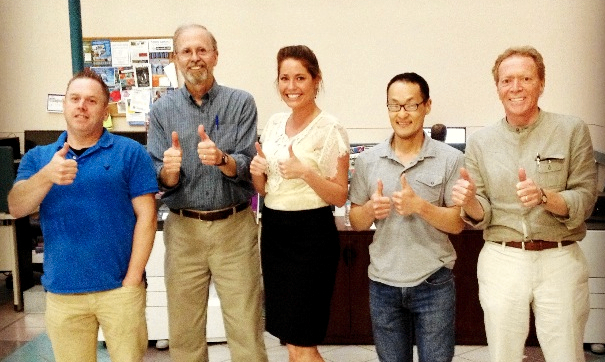
Dr. Nicole Fink successfully defends her dissertation
April 17, 2013
April 17, 2013
January 28, 2013
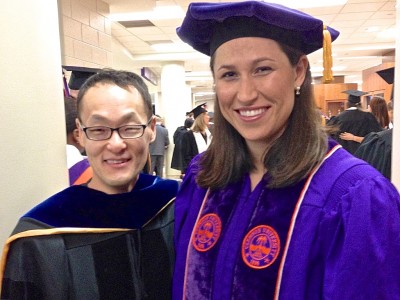
Congratulations to Margaux Price PhD and Jeremy Mendel PhD on graduating in the Fall 2012 with their PhDs in Human Factors! Margaux is now at Deere and Company while Jeremy is now at Google.
November 5, 2012
Title: Understanding the Relative Attentional Demands of the Dimension of Interface Consistency
Jeremy Mendel
Dissertation Defense
1:00 PM, Wednesday, November 14th, Room 419 Brackett Hall
Dr. Rich Pak (advisor)
Dr. Leo Gugerty (committee member), Dr. Chris Pagano (committee member), and Dr. Joel Greenstein (committee member)
Abstract:
A consistent interface is thought to be beneficial because it allows users to draw on previous training and experience when operating a new interface. Design guidelines like the eight golden rules of interface design argue that a highly consistent interface improves system usability (Shneiderman, 1987). However, interface consistency is not monolithic; instead it is a complex, multidimensional construct. I refer to the two dimensions of interface consistency as perceptual consistency (the “appearance”) and conceptual consistency (the “functionality”) of an interface. Perceptual consistency considers aspects like interface layout and orientation; conceptual consistency considers how the system operates or responds. I sought to understand how combinations of these dimensions might affect performance and user perceptions of a system. For example, what if a system looks the same but operates differently? Results indicate that both an inconsistent appearance and an inconsistent functionality can hurt performance. Forcing consistency, however, may not be beneficial either. When there was a mismatch between dimensions (i.e., one was consistent and the other inconsistent) performance was worse than that of an entirely inconsistent version. Specifically, participants in the conceptual inconsistency and perceptual consistency condition (operates differently but looks the same) performed worse and reported higher workloads. Designers should encourage interface consistency by making systems that function similarly also share a similar appearance; however, when the systems are functionally disparate (i.e., they do different things) designers should take care to avoid implying similarities where they do not exist.
September 24, 2012
Title: Preventing the misuse and disuse of automated systems: Effects of system confidence display on trust and decision performance
Margaux Price
Dissertation Defense
4:00 pm, Friday, October 5th, Room 419 Brackett Hall
Dr. Richard Pak (advisor)
Dr. Leo Gugerty (committee member), Dr. Chris Pagano (committee member), and Dr. Joel Greenstein (committee member)
Abstract:
Complex decision-making may be aided by forms of automation known as decision-support systems (DSS). However, no DSS is completely reliable and so it is imperative that users know when they should and should not trust it (calibration of trust). Previous research has shown that providing users with information about the DSS’s confidence in its own advice (“system confidence”) can help improve the calibration of user’s trust of automation and actual system reliability on a trial by trial basis. The current study examined how the nature of the presentation of system confidence information affected user’s trust calibration. The first study examined the attentional demand of each display, while the second study examined their effect on trust and performance on a decision making task. The results of this study indicate that there was no effect of system confidence display type on subjective or objective trust. The lack of differences in performance or trust between the control condition (no system confidence display) and other displays raises doubts about whether users were utilizing the system confidence information or simply solving the problem on their own. The type of decision task may be crucial in determining whether to provide system confidence and these results suggest that it should be tested prior to implementation against a control group, unlike previous studies. The results of these studies have implications in the design of DSS, especially given the difficulty of providing accurate system confidence information to users. The time and resources that would be required to provide such a display may not be beneficial if it has no effect on user trust or decision performance. However, the use of an anthropomorphic display may be an ideal way to present decision support information because overall calibration between expected system reliability and users’ behavioral trust was more accurate.
March 3, 2012
Picture Superiority effect in prospective memory: Examining the influence of age and attentional load
A dissertation proposal by Nicole Fink
Wednesday, April 11, 2012
3pm in Brackett Hall 419
Committee:
Dr. Richard Pak, Chair
Dr. Giles Einstein
Dr. Leo Gugerty
Dr. Paul Merritt
Abstract: Numerous studies have demonstrated the existence of the picture superiority effect (i.e. better memory for pictures than words) in retrospective memory, but the examination of the picture superiority effect in prospective memory has been severely underrepresented in the literature. Thus, it is the current focus of this paper. Additionally, we examine if there are differences in ongoing task and prospective memory task performance between age groups (old and young) and under different loads of attention (non-divided and divided). We hypothesize that pictures will promote spontaneous retrieval, which will be exhibited by high and stable performance in the picture (not word) conditions across both divided and non-divided attention tasks and equivalent prospective memory performance by younger and older adults in only the picture, not word conditions. Understanding whether or not a picture superiority effect exists in prospective memory has the practical benefit of informing the design of memory aids, and the theoretical benefit of increasing our understanding of whether inherent stimuli distinctiveness (i.e. pictorial distinctiveness) leads to spontaneous retrieval.
