Chemical & Biomolecular Engineering

ChBE Summer 2018 Undergraduate Research Highlights

The Department of Chemical and Biomolecular Engineering strives to go beyond the classroom to provide a hands-on research experience for students. This summer, our department hosted several undergraduate students, students from other departments at Clemson, and students from other universities to conduct research. The ChBE research opportunities provide an enriching learning experience for our undergraduate students and mentor opportunities for our graduate students. The summer culminated with the Summer Undergraduate Research Symposium on July 27, where students were able to present their research findings.

Blenner Research Group

Dr. Mark Blenner’s lab focuses on application-driven fundamental research in microbial and mammalian systems. They use molecular biotechnology and genetic engineering techniques to enable solutions towards sustainable chemical bioproduction, human health, and national defense. The group works with bacterial, yeast, and mammalian cells to develop genetic engineering tools, create protein and metabolic biosensors, and optimize microbial factories to convert non-conventional feedstocks to natural products.

Tara Richbourg- Blenner Group


Calvin Martin- Blenner Group
Meredith Bailey- Blenner Group
Nicole Franaszek- Blenner Group
Adam Beitz- Blenner Group


Davis Research Group

Dr. Eric Davis’s research group is happy to welcome four new undergraduate researchers to the lab: Annalise Bowers, Alesandra Lee, Taylor McDaniel, and Jacob Steele. Annalise and Jacob have undertaken a project investigating the effect of nanoparticles with various surface chemistries on network formation in a number of hydrogel membranes. These nanocomposite hydrogel membranes have shown promise in water purification technologies involving the separation of water/oil emulsions and the removal of heavy metal ions, to name a few. Under the guidance of graduate student Allison Jansto, Alesandra and Taylor are investigating the effect of various nanofillers on water and ion transport in ionomer membranes used in vanadium redox flow batteries. Finally, undergraduate Ross Jasper, working in the Davis lab for over a year, is working to deepen our understanding of water transport mechanisms in 3D printed glassy polymers and how these differ from traditional, solution-cast polymer membranes.

Getman Research Group

This summer, Dr. Rachel Getman’s research group has welcomed several researchers from outside the department.

Max Norman, an undergraduate at Furman University, working with through the COMSET REU program, and Venkata “Anish” Chaluvadi, a Clemson University undergraduate in materials science engineering working through an REU supplement from the SC MADe program, are working on a project involving simulations integrated with experiments in collaboration with Dr. Thompson Mefford’s group from Clemson MSE. Specifically, it is a computationally driven project to learn how to design magnetic nanoparticles for maximum energy delivery by modulating their magnetic moments and anisotropies.

One of the Getman Group’s primary research interests is learning how catalysts (materials that alter the rates of chemical reactions) function at the molecular level to learn how to tailor catalysts for specific responses. One excellent strategy for studying catalysis at the molecular level is to model catalytic performance using simulations based on quantum mechanics.

Noah Klimkowski Arango, a rising senior at the Governor’s School for Science and Mathematics working through the Clemson SPRI program, evaluates different quantum mechanics software to see which works best for the Getman Group.

The Getman Group is interested in a primary class of reactions catalyzed by noble transition metals (e.g., platinum) under liquid water. Benjamin Hodges, also a rising senior at GSSM working with the group through SPRI, is performing experiments with the catalytic decomposition of glycerol to observe the liquid and gaseous products and learn about the mechanism of this reaction.

Ian Ruohoniemi, a recent graduate of Daniel High School who will attend Stanford University this fall and is supported by Dr. Getman’s NSF CAREER grant, is evaluating the possibility and usefulness of developing a force field that can be used to estimate the energy of interaction between the methanol molecule and a platinum surface. Specifically, he is using quantum mechanics to calculate the bond strength of a methanol molecule as it approaches a platinum surface. He uses Python coding to parameterize a function that describes the energy as a function of the distance between the methanol molecule and the platinum surface. Based on the ease of this parameterization, he will make a recommendation to help the group determine how to run future simulations of this system and similar systems.

Venkata Chaluvadi- Getman Group

Additionally, the Getman Group has two interns from the EUREKA! Program: Kenzie Grumbles, a rising Clemson first-year student engineering major who has been working on the quantum mechanics software with Noah, and Annika Samuel, a rising Clemson first-year student chemistry major who has been using quantum simulations in collaboration with experimenters at the Massachusetts Institute of Technology to investigate how lignin monomer compounds complex with a vanadium oxide single-atom catalyst.

Max Norman, Furman University- Getman Group
Ian Ruohoneimi- Getman Group
Husson Research Group

Dr. Scott Husson’s research group has observed that alcohol pretreatment on desalination membranes can lead to higher water production without using more power. Still, the exact role of alcohol in this process is unknown. This summer, undergraduate Micheal Lemelin is researching this process by evaluating different desalination membranes to determine how much their water permeability and salt rejection change after the pretreatment. Later, the group will explain Michael’s experimental observations by using ellipsometry and atomic force microscopy (force volume mode) to evaluate the thickness and stiffness of the membrane.

Kitchens Research Group

Dr. Chris Kitchens’ research group studies the design of advanced materials for clean and efficient energy application through technological developments in nanotechnology, renewable resources, membranes and smart materials. The research implements designed functionality of nanomaterials and surfaces using tailored chemical functionalities, material processing using tunable fluids, development of smart materials with switchable properties, and state-of-the-art characterization techniques.

Larsen Research Group

Dr. Jessica Larsen’s summer research group focuses on biomimetic and polymeric materials for drug delivery applications in neurodegenerative disease and other brain disorders.

Sara Edgecomb and Chris Rovero are working to encapsulate gene-editing proteins into polymeric nanoparticles. By encapsulating these proteins, they will ensure they are protected in the body and delivered into neurons as a treatment for genetic neurodegenerative disease. They are co-advised by Dr. Mark Blenner.

Austin Evers and Cheyenne Brady are working on a project collaborating with Dr. Jeff Twiss at the University of South Carolina. Dr. Twiss has isolated the acidic domain of a protein G3BP1 which has been shown to promote nerve regeneration after injury. For this peptide to be the most successful, it needs to get into the brain. Cheyenne and Austin are encapsulating this peptide into nanoparticles and will be traveling to USC to test the effect of this treatment on a cell line established in Dr. Twiss’s lab.

Sarah Smith- Larson Group

Sarah Smith works with cells isolated from a feline model of a childhood neurodegenerative disorder, GM1 gangliosidosis. She is studying the timeline of neurodegeneration and correlating this timeline with disease biomarkers. Through her research, she will help develop new in vivo diagnostic tools for these elusive disorders.


Sarupria Research Group

The Sarupria Research Group uses molecular simulations to study the assembly of materials, including liquid-to-solid transitions in water and aqueous solutions. ChBE undergraduate Garrett Buchmann and Eliel Akinbami, a Chemical Engineering senior visiting Dr. Sarupria’s group from Howard University, are using molecular dynamics simulations to study the effect of various additives on liquid-to-solid transitions in water. They will study additives such as amino acids to understand how additives can be used to control the self-assembly process. The group hopes to use these techniques and insights in the future to study more complex processes such as nanoparticle self-assembly under magnetic fields.
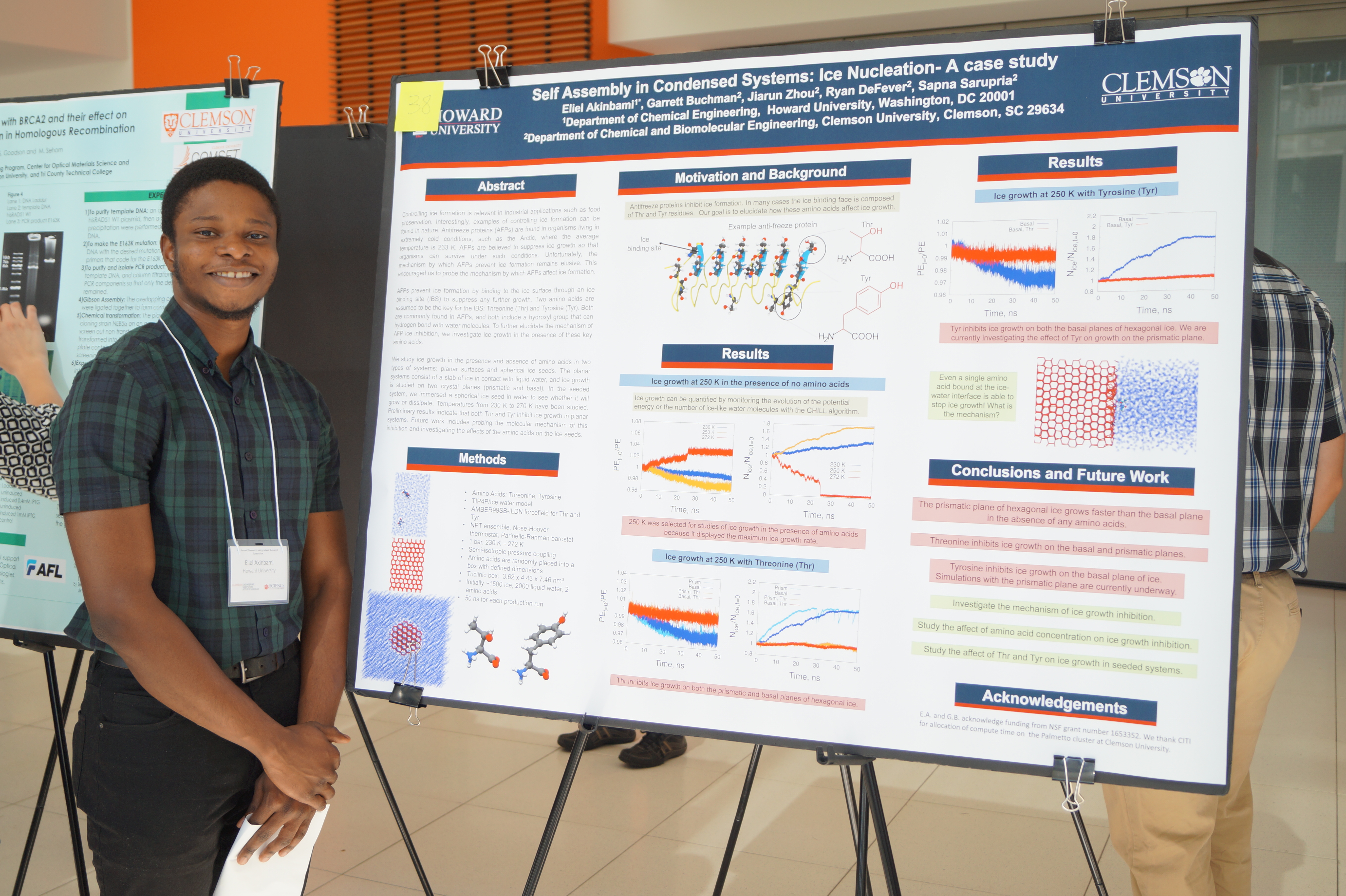
Eliel Akinbami, Howard University- Sarupria Group


ChBE Alum Thang Nguyen Featured in Greenville Business Magazine

A Greenville Business Magazine article about engineering in the Upstate of South Carolina features ChBE class of 1999 alumnus, Thang Nguyen. As a chemical engineer working at a sprawling plant at FUJIFILM Manufacturing USA, Inc. in Greenwood, Nguyen discusses the importance of engineers to the Upstate. The Greenville area ranks at the top of the US for concentration of engineering talent, which has contributed to the Upstate’s quality of life and stimulated economic development by bringing major manufacturers to the area. Nguyen also shares his perspective on what makes a successful engineer. To learn more about Nguyen and how the Upstate became such an engineering hub, follow this link to the Greenville Business Magazine article: http://www.greenvillebusinessmag.com/2018/05/31/174403/engineering-the-upstates-braintrust. 

April 26, 2018 ChBE Seminar Speaker – Dr. Nripen Singh from Bristol-Myers Squibb, Cruiserath, Ireland

The Department of Chemical and Biomolecular Engineering welcomes Dr. Nripen Singh, Associate Director in Manufacturing Sciences and Technology from Bristol-Myers Squibb, Cruiserath, Ireland, as a part of the ChBE Spring Seminar series. His seminar, titled “Next generation manufacturing facilities for expanding portfolio of biologics” will take place on Thursday, April 26th 2018 from 2:00-3:00pm in Earle 100.

Demand for innovative medicines that address serious diseases continues to grow for a number of therapeutic areas,
including oncology, fibrosis and immunoscience. Bristol-Myers Squibb (BMS) is working to tap global potential through its expanding portfolio of biologics, bringing treatments to patients across the globe. However, manufacturing biologics is avery complex and difficult task as it involves working with living cells. In addition, this is countered by challenges of an expanding pipeline and rapid development timelines that necessitate looking beyond the current platform philosophy for how to modify the process with the goal to increase overall productivity in a flexible manner. To address these challenges, BMS is integrating concepts of hybrid, modular and single-use technologies in recently constructed biologics manufacturing facilities in the Cruiserath, Dublin and Devens, Massachusetts campuses. The facilities combine latest technology in terms of flexible fed-batch cell culture and high-performance purification that will allow manufacturing of at various scales. With respect to the upstream process, use of multiple seed trains, single-use bioreactors, and perfusion culture would enable flexible high-titer processes. With respect to the downstream processes, numerous new technologies such as in-line dilution, high capacity membranes, multicolumn continuous chromatography, automated viralinactivation, and SPTFF are being incorporated to handle the increased titers being generated in the bioreactors. Through these advancements, BMS will accommodate both traditional as well as hybrid model for continuous manufacturing interchangeably to support multiple clinical and commercial products.

Nripen is an Associate Director in Manufacturing Sciences and Technology group within Global Product Supply organization in Cruiserath, Ireland at Bristol-Myers Squibb. He leads a team of downstream scientists to provide process improvements and identify new technologies for current and next generation products. Nripen first joined BMS in 2014 and led process development, characterization, technology transfer and commercial support work of mid to late stage biologics within Biologics Development Organization in Devens, MA. Nripen was also responsible for developing next generation manufacturing platform using concepts of continuous processing to increase specific productivity. Prior to joining BMS, Nripen worked for Merck Millipore for 5 years where he led a team of engineers for the development of chromatography and clarification products, including resins, depth filters, and membrane filters for protein purification. Nripen received his B.S. from Panjab University in 2002, and his PhD from the Clemson University in 2007, both in Chemical Engineering. He has co-authored over 25 publications, book chapters and patents. He is in the editorial board of mAbs Journal and serves as the guest editor for Current Opinion in Biotechnology and reviewer for several top-tier journals.

April 19, 2018 ChBE Seminar Speaker – Dr. Nick Sahinidis from Carnegie Mellon University

The Department of Chemical and Biomolecular Engineering welcomes Dr. Nick Sahinidis, John e. Swearingen Professor from Carnegie Mellon University, as a part of the ChBE Spring Seminar series. His seminar, titled “ALAMO: Machine Learning from Data and First Principles,” will take place on Thursday, April 19th 2018 from 2:00-3:00pm in Earle 100.

We have developed the ALAMO methodology with the aim of producing a tool capable ofusing data to learn algebraic models that are accurate and as simple as possible. ALAMO relies on (a) integer nonlinear optimization to build low-complexity models from input-output data, (b) derivative-free optimization to collect additional data points that can be used to improve tentative models, and (c) global optimization to enforce physical constraints on the mathematical structure of the model. We present computational results and comparisons between ALAMO and a variety of learning techniques, including Latin hypercube sampling, simple least-squares regression, and the lasso. We also describe results from applications in CO 2 capture that motivated the development of ALAMO.

Nick Sahinidis is the John E. Swearingen Professor and Director of the Center for Advanced Process Decision-making at Carnegie Mellon University. He joined Carnegie Mellon in 2007 after a sixteen-year long career at the University of Illinois at Urbana, where he taught in Industrial Engineering and Chemical Engineering. His research has included the development of theory, algorithms, and the BARON software for global optimization of mixed-integer nonlinear programs. Professor Sahinidis’ research activities have been recognized by the INFORMS Computing Society Prize in 2004, the Beale-Orchard- Hays Prize from the Mathematical Programming Society in 2006, the Computing in Chemical Engineering Award in 2010, the Constantin Carathéodory Prize in 2015, and the National Award and Gold Medal from the Hellenic Operational Research Society in 2016. Professor Sahinidis is a fellow of INFORMS and AIChE. He is the current Editor-in- Chief of Optimization and Engineering.

AIChE Student Chapter recently attends AIChE conference at LSU in Baton Rouge

Clemson University’s AIChE Student Chapter recently attended the 2018 Southern Regional AIChE Conference held at LSU in Baton Rouge, Louisiana. Conference highlights included regional ChemE car competition, jeopardy, and a student paper and poster competition.

Upcoming President Andrew Ney represented our chapter at a Presidents Breakfast, where presidents from other AIChE student chapters were invited to attend. Ney learned valuable information about increasing attendance and the organization’s usefulness, as well as learning about a “sister school” program that other chapters are involved in. With this, our AIChE chapter can be paired with an international AIChE chapter.

“I think this is a very good opportunity, and will be something I plan to work on over the summer to have ready for next school year,” says Ney. He believed this event was the most beneficial to him, and the knowledge he gained will positively impact our organization.

One day of the conference was comprised of plant tours. Ney spoke on behalf of the BASF and brewery tours, “The BASF site was absolutely massive, and also quite modern in comparison to the plant I work at in Seneca.  We had to be split up into groups of five, and scattered around the plant because it was so big.  The brewery was a much smaller operation, but it was very interesting to see the start to end process of making beer.”

Our student chapter also took part in a Jeopardy competition. Of the two teams representing Clemson, one of them won the first round, beating two schools from Kentucky. Though eliminated during the next round, the team represented Clemson well. Following the Jeopardy competition was a ChBE career fair and social.

Additionally, research presentations and a ChemE Car competition took place. The Chem-E-Car team was able to compete in the competition, even after running into some technical difficulties. “Though we didn’t win, we did beat USC.” Says Hansen Mou. The car was made of aluminum and corrugated plastic, and powered by a magnesium-copper battery.

In all, Ney feels as if the trip turned out to be incredibly valuable to everyone.  “I can only speak to my experiences, but one of my favorite parts of the conference was the ability to talk to other Chemical Engineers that I would not normally be able to talk to. For example,  some other Clemson students and I had the privilege of sitting at a table with a group from Puerto Rico.  It was great to be able to ask questions about how other chapters operate as well as networking with industry professionals.” Our ChBE undergraduates were inspired by the Louisiana State AIChE members who sacrificed  their time to put together a great conference for all of the attending chapters.

Our AIChE student chapter looks forward to being able to bring another large group to Mississippi State next year.

Jaime Idarraga-Mora awarded Honorable Mention at Clemson University’s Science as Art Exhibit

Science as Art 2018 was held on Friday, April 6th from 12 PM – 6 PM in the Hendrix Center Atrium and was accompanied by a Meet the Artist reception. This year, 55 entries were submitted by hardworking students, faculty and staff at Clemson.

ChBE graduate student Jaime Idarraga-Mora participated in Clemson University’s Science as Art Exhibit and was awarded an Honorable Mention for his submission, titled “Water-Filtering Microtrees.”

The image of the trees that Jaime chose was originally a micro-scale scanning-electron microscopy picture of a membrane filter. This membrane hopefully will be used at high pressures to filter seawater to get drinkable water. It is composed of a porous polymer structure (the leaves of the tree), and robust vertically-aligned carbon nanotubes (the trunks). Similarly to the trunk of a tree, the goal of the carbon nanotubes is to provide mechanical resistance to the porous filter during use.

Science as Art is a challenge among Clemson University students and faculty, as well as secondary school students across the state. The goal of the challenge is to create and share a piece of visual art based on the contestant’s work in science, technology, engineering, and mathematics (STEM). Visual representations of these fields bring scientists, artists and the general public together. Science as Art, which began in 2006, has attracted powerful and inspirational entries over the years. Previous winning entries are displayed around Clemson’s campus, and some have actually been featured in the Clemson exhibit at Artisphere in Greenville.

Students, faculty and staff are invited to submit works to Science of Art every year. These entries can be produced by individuals or teams. Entries are judged based on visual impact, effective communication, and innovation.


Donation from retired Cryovac executive breaks record for Clemson chemical engineering

CLEMSON — A retired Greenville executive who has donated to organizations ranging from the Peace Center to First Presbyterian Church is turningWilliam and Martha Beth Sturgis are creating a distinguished professorship with the largest donation in history to the Department of Chemical and Biomolecular Engineering. his philanthropic attention to Clemson University, where he is providing the largest donation in history to the chemical and biomolecular engineering department.

William Sturgis and his wife, Martha Beth, are contributing $600,000 to create a distinguished professorship in the department. They plan to double their contribution in their will.


.

A faculty member who is selected for the professorship will be able to use funds generated by an endowment to support graduate and undergraduate students as they do research, learn about entrepreneurship and travel to national meetings where they can present their research to leaders in their field.

In a 37-year career, Sturgis served as executive vice president of worldwide packaging operations at W.R. Grace and president of its North American Cryovac Division.

Upon his retirement  in 1997, Sturgis received the Order of the Palmetto, the state’s highest honor, and a commendation from the state House of Representatives. He and his wife stayed in Greenville after his retirement.

Sturgis said he and his wife established the professorship because they wanted to do something for chemical engineering at Clemson, where he got his start studying under influential professor Charles E. Littlejohn Jr.

“The quality of the professors really makes the quality of the graduates,” he said. “If you’ve got the money to attract the top professors, you’re going to attract a lot of people who want to major in that particular area and go on and do well.”

David Bruce, chair of the department, said it is important to bring in great faculty who will inspire students.

The Sturgis contribution “will let us retain great faculty that we already have and be a beacon to bring in new faculty to the department,” Bruce said.

An announcement on which faculty member will receive the professorship is expected soon.

Sturgis, who grew up on a dairy farm in Rock Hill, has a long history with Clemson. His class started with 41 chemical engineering majors and he remembers that 12 graduated.

He received his Bachelor of Science from Clemson in 1957 and later graduated from the Advanced Management Program at Harvard University.

Sturgis returned to Clemson as an alumnus, where he is an emeritus member of the College of Engineering, Computing and Applied Sciences advisory board.

He previously served as president of the Clemson University Foundation at a time when the big issues were construction of the Madren Conference Center and the John E. Walker Sr. Golf Course.

He has also been a big supporter of packaging science at Clemson. In 1995, he was inducted into the Packaging Education Hall of Fame for starting the Clemson program. Sturgis donated lots of his time to launching the program and played a key role in steering a $2 million contribution for scholarships from Cryovac.

Sturgis began his engineering career by doing government contract work on airplane and rocket engines with Pratt & Whitney. What he really wanted at the time was a job in the paper business, which fit with the work he did in his senior thesis at Clemson, Sturgis said.

But he never got the paper job.

After about two years at Pratt & Whitney, Sturgis left and took a job with Cryovac when the company just was getting started.

“I said, ‘Well, I’m going to go to work with them and I’ll wait until I find the paper job that I want, then I’ll make a move,’” he said. “Well, I ended up staying with them for 37 years. Every time I thought it was about time to make a move, I’d get a raise and a promotion, and I just kept going.”

By the time Sturgis retired in 1997, he oversaw 16 plants around the world and about 18,000 employees, including 900 in Simpsonville alone, he said.

William and Martha Beth Sturgis have known each other since they were in the first grade. They started dating in the 11th grade at Rock Hill High School.

Martha Beth went to Winthrop University, majoring in elementary education, when William went to Clemson. They graduated on the same day in 1957.

“She has always been my partner,” William said. “When we needed to move somewhere, she was ready to pick up and go. She has always been 100 percent supportive.”

The couple has traveled the world together, setting foot on every continent except Antarctica. They have three sons, including twins, Randy and Rick, who are both Clemson graduates, and the youngest, Mark. Altogether, the couple has five grandsons and two granddaughters.

Martha Beth said she admires many traits in her husband, including that he is fair and that he had an open-door policy at Cryovac.

“We just celebrated our 60th wedding anniversary, so obviously I admire everything about him that I can admire,” she said. “He has been a wonderful husband, a wonderful provider, a wonderful father, a wonderful grandfather and, in June, he’s going to become a wonderful great-grandfather.”

They attribute the longevity of their relationship to commitment, understanding and communication.

In his philanthropic pursuits, Sturgis has been most involved at First Presbyterian Church in downtown Greenville, where he has served as deacon, elder and trustee, a position he has turned over to one of his sons.

He has also contributed to the Peace Center for the Performing Arts and served on its executive board. He has been involved in the Greenville Chamber of Commerce and been a member of the Downtown Rotary Club.

JoVanna King, senior associate vice president for development at Clemson, has worked with Sturgis for years and helped advise him on his latest contribution, officially titled the William B. “Bill” Sturgis, ‘57 & Martha Elizabeth “Martha Beth” Blackmon Sturgis Distinguished Professorship in Chemical and Biomolecular Engineering.

“Bill understands the value of giving his time and treasure to his alma mater,” King said. “I am truly grateful and consider it a privilege to have worked with him all these years.”

The latest contribution includes a $500,000 endowment that is expected to generate investment returns that can be spent in accordance with the professorship. The remaining $100,000 provides five years of funding while the returns are accumulating.

Anand Gramopadhye, dean of the College of Engineering, Computing and Applied Sciences, said William and Martha Beth Sturgis are an inspiration.

“The college owes a heartfelt debt of gratitude to this couple for their tremendous generosity and visionary thinking,” Gramopadhye said. “In helping strengthen our faculty, they are helping shape the lives of students for generations to come.”

Written by Paul Alongi

March 29, 2018 ChBE Seminar Speaker – Dr. Steve Abel from the University of Tennessee, Knoxville

The Department of Chemical and Biomolecular Engineering welcomes Dr. Steve Abel, Assistant Professor from the University of Tennessee, Knoxville, as a part of the ChBE Spring Seminar series. His seminar, titled “Antigen Recognition at Immune-Cell Surfaces: Probing the Role of Mechanical Forces,” will take place on Thursday, March 29th 2018 from 2:00-3:00pm in Earle 100.

One of the central problems in immunology involves molecular recognition at cell-cell interfaces. T cells and B cells directly engage other cells and use surface receptors to identify molecular signatures of pathogens. Fascinating recent experiments have revealed that mechanical forces regulate processes by which T cells and B cells distinguish between self and foreign ligands, but a unifying theoretical framework is missing. In this work, we develop hybrid computational models that account for key biophysical properties of immune-cell interfaces, including stochastic receptor-ligand binding kinetics, membrane mechanics, and actin-mediated forces on the membrane. We use these models to investigate how mechanical forces modulate the interactions of T cells and B cells with surface-presented antigens. In the case of T cells, we characterize how receptor-ligand bond formation drives dynamic changes in membrane organization and shape, how these changes affect forces experienced by the bonds, and how these forces affect bond lifetimes. In the case of B cells, we show that the bending rigidity of the antigen-presenting membrane influences the affinity at which antigens are internalized through a mechanism involving receptor clustering and membrane invagination. We conclude by discussing our results in the context of antigen discrimination by T cells and B cells, and by highlighting open questions in mechanoimmunology that theoretical approaches can help to address.

Steve Abel received his undergraduate education at Rice University, where he earned a B.S. in Chemical Physics, a B.A. in Mathematics, and a B.A. in Physics. He received a Ph.D. in Chemical Engineering from Stanford University and was a postdoctoral associate in the Department of Chemical Engineering at the Massachusetts Institute of Technology. His graduate research focused on developing theoretical methods to describe the highly correlated motion of molecules in dense liquids. His postdoctoral work applied theory and computation to understand how T cells, the primary orchestrators ofadaptive immunity, identify and respond to pathogens. This work was carried out in close collaboration with experimentalists, with a particular emphasis on understanding how the membrane environment influences signal
transduction in cells. Dr. Abel’s group currently investigates fundamental problems in cell biology and immunology using theoretical and computational methods. They study processes involving signal transduction networks, cell membranes, and the cytoskeleton, with specific interests including antigen recognition and lymphocyte activation, motor-driven intracellular transport, stochasticity in biochemical reaction networks, and soft biological materials.

March 15, 2018 ChBE Seminar Speaker – Dr. Reginald Rogers from the Rochester Institute of Technology

The Department of Chemical and Biomolecular Engineering welcomes Dr. Reginald Rogers, Assistant Professor from the Rochester Institute of Technology, as a part of the ChBE Spring Seminar series. His seminar, titled “Got Clean Water? How Carbon Nanomaterials Play a Role in Achieving this Grand Challenge,” will take place on Thursday, March 15th, 2018 from 2:00-3:00pm in Earle 100.

Water is considered to be the most precious commodity on the planet, and one that needs to be treated with respect. With the ever growing world population, there is an increasing need to develop new materials and systems that can potential improve the quality of water on longer time scales. Newly emerged nanomaterials, such as graphene or carbon nanotubes, are of increasingly widespread importance in environmental remediation, especially in their ability to remove undesirable chemicals from hydrological systems. In this presentation, an in-depth overview of the use of next generation carbon-based nanomaterials for adsorption applications will be discussed. Aqueous-phase adsorption of multiple organic compounds and heavy metal ions at environmentally relevant concentrations by granular activated carbon and graphene-single- walled carbon nanotube free-standing hybrid papers will be presented. Results show that the hybrid nanocomposites have superior adsorption capacities compared to bulk carbonaceous materials with up to 35% and 170% larger uptakes towards aromatic and ionic compounds, respectively. In addition, the use of highly porous, lightweight aerogels as adsorbents of high bonding affinity for a large variety of chemicals provide opportunities for enhanced separation processes. In particular, the nature and the amount of nanostructures (graphene, multi-walled or single-walled carbon nanotubes) along with their dispersion state throughout the carbonaceous matrix strongly influence the adsorption properties of the aerogel. Finally, an outlook on the use of sorted carbon nanotubes for adsorption applications will be shared.

Dr. Reginald E. Rogers is an Assistant Professor in Chemical Engineering at the Rochester Institute of Technology.  He is head of the Nanoscale Energy and Separation Materials Laboratory (NESML).  Dr. Rogers and his group have been involved in a variety of projects investigating the separation of organic and inorganic compounds from aqueous environments using carbon-based nanomaterials.  Dr. Rogers also has projects focused on the development of cathode materials for sodium ion batteries. He has served as a co-author on over 25 research papers and has presented at many national conferences. Dr. Rogers has been recognized for his teaching, research, and service contributions with numerous awards and recognitions. Notable awards include the 2016 Richard and Virginia Eisenhart Provost’s Award for Excellence in Teaching from RIT, the 2017 Henry C. McBay Outstanding Teacher Award from the National Organization for the Professional Advancement of Black Chemists and Chemical Engineers, the 2017 Emerging Investigator honor by Environmental Science: Water Research Camp; Technology from the Royal Society of Chemistry, and most recently, the 2018 Dr. Janice A. Lumpkin Educator of the Year Award from the National Society of Black Engineers.

NOBCChE Student Chapter holds Inaugural Meeting

The Department of Chemical and Biomolecular Engineering and the Office of Inclusion and Equity sponsored travel grants for students to attend the 2017 NOBCChE Conference, which was held in Minneapolis.    After attending the conference, undergrad students, Deidra Ward and Mikhala Cooper, believed that a student chapter of the organization would be beneficial for Clemson’s campus. NOBCChE, or the National Organization for the Professional Advancement of Black Chemists and Chemical Engineers, is an organization dedicated to building an eminent cadre of people of color in science and technology. The formation of a student chapter at Clemson would serve as a means for fostering diversity and minority retention in chemistry, chemical engineering, and related fields at the university.

Recently, the organization held their first general body meeting where they highlighted the goals of the organization and how this organization will benefit those who decide to join. They also elected members for their executive board. NOBCChE will serve as a catalyst for networking, leadership development, and professional development. It will also allow for minority students studying chemistry, chemical engineering, and related fields to fellowship.

For more information on NOBCChE, contact Deidra Ward, President deidraw@g.clemson.edu or Mikhala Cooper, Vice President khasahc@g.clemson.edu

Executive Board Members:   Jasmine Pringle (Treasurer), DeJanique Bradshaw (Social Media Coordinator), Deidra Ward (President), Mikhala Cooper (Vice President), Johnathan O’Neil (Secretary), and Rashaun Rush (Campus Representative).
