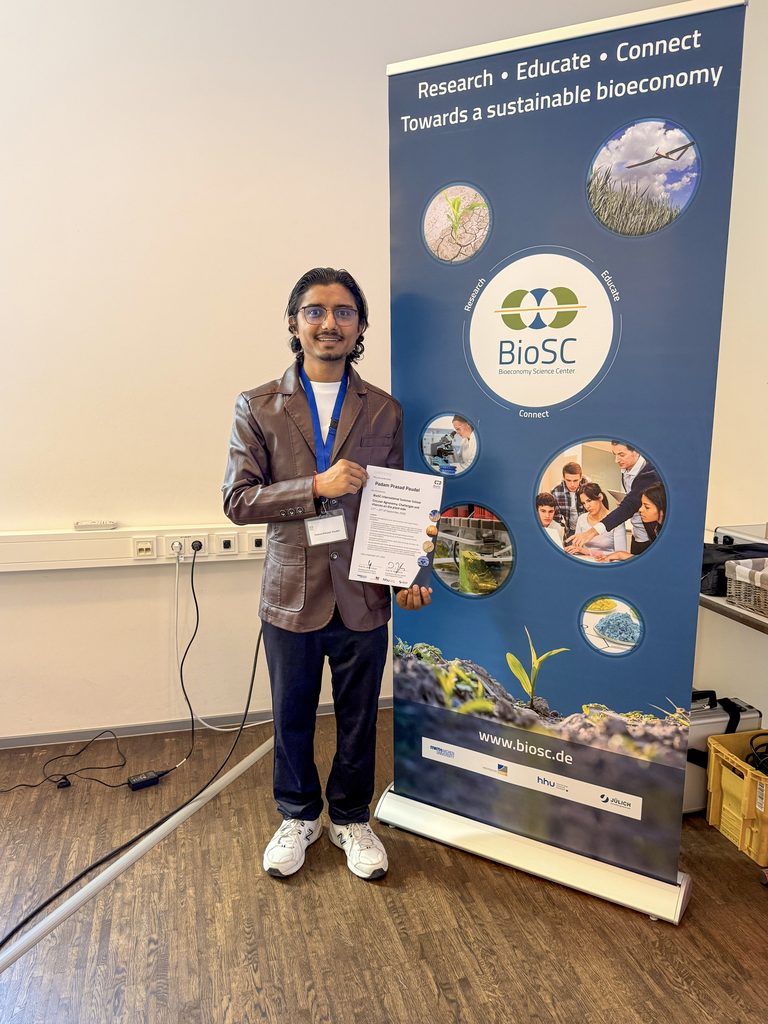
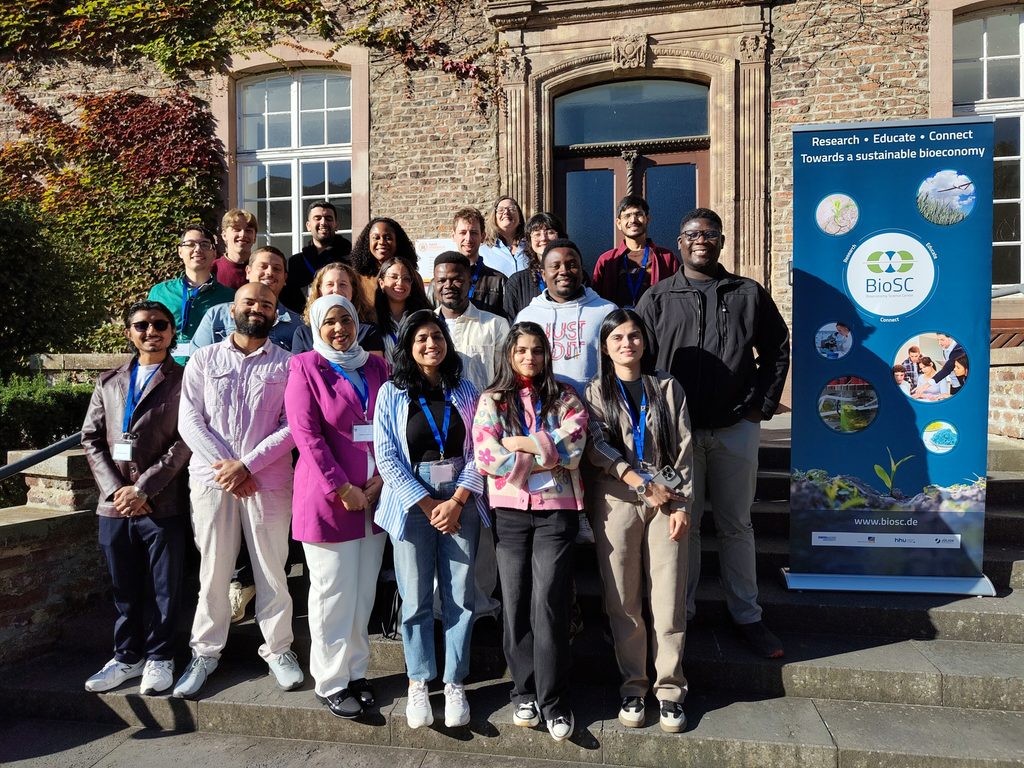
At BioSC’s 2026 International Summer School, Padam Prasad Paudel connected biomass conversion with questions about soil health, crop systems and farm practice.
Padam Prasad Paudel, a Ph.D. student in Biosystems Engineering and Graduate Research Assistant in Clemson University’s Department of Environmental Engineering and Earth Sciences, attended the Bioeconomy Science Center (BioSC) International Summer School 2026 in Jülich, Germany, September 21–25. He was selected as a cohort of 20 participants from worldwide applications by graduate students.
The school’s theme, “Circular Agronomy: Challenges and Chances on the Plant Side,” framed a week of expert talks, case-based group work and discussion with researchers, industry representatives and farmers. Participants explored circular agronomy, how circular economy principles apply to agricultural systems by reusing resources, keeping nutrients to productive use, reducing waste and supporting soil health
Sessions addressed regenerative agriculture, soil health, crop systems and recycled biochar for marginal soils affected by mining and flooding. A field visit to the University of Bonn’s research campus at Klein-Altendorf connected those questions with agricultural research in practice, including arable farming, crop production and horticultural trials.
Paudel’s background includes the sustainable conversion of crop and agroforestry residues, as well as interests in biochar and other biomass-derived products. He also brings experience with process analysis, techno-economic analysis (TEA) and life-cycle assessment (LCA). In his opening-day introduction, he described how plant-side challenges can shape circular-system design and where residue valorization may support soil and crop systems. He also contributed to the school’s closing group presentation.
At BioSC, Paudel connected his conversion-focused background with the agronomic questions that follow: how do biomass-derived products perform in soil and crops, and what makes a pathway workable for growers? The experience gave him a broader framework for evaluating a biomass pathway from feedstock and process performance through agronomic outcomes and practical fit.
This participation was made Possible through a $1,000 Clemson Graduate Student Government’s Graduate Travel Grant, which supported Paudel’s travel to Germany. BioSC covered program participation, accommodation and meals.