Humanities Hub

A meeting of the minds on Brexit, at Clemson

Fintan O’Toole, prominent Irish author and journalist, writes for the Irish Times, among other venues. In the Fall, several of his IT columns concluded with reference to his new book, Heroic Failure: Brexit and the Politics of Pain. The title had a familiar ring. It turns out that O’Toole’s 2018 book’s title is a variation on a 2016 book written Clemson History colleague, Stephanie Barczewski, Heroic Failure and the British.

At the time, O’Toole’s book was not available in the US, but I believed that he was metaphorically in a conversation with Professor Barczewski. For example, he cites her positively in a 2017 piece. Among other things, the citation shows the influence of Professor Barczewski’s analysis, and points to the positive relationship between historians and journalists.

On Monday, the two of them meet and speak to each other publicly for the first time, about Brexit, here, at Clemson University.

The event is free and open to the public: 4PM, Hardin 232.

Newsflash: Lies Spread Faster than Truth

In recent articles, the NY Times and the Washington Post cite new surveys which show that lies spread faster than truth.  (See also this NY Times article on the same topic.)  No disagreement here!  In fact, or instead, I am reminded of Samuel Johnson making the same point, in 1751, as I detailed in my 2008 book, The Constitution of Literature: Literacy, Democracy, and Early English Literary Criticism.  As I put it then, Samuel Johnson contended that “Truth always moves ahead in a straight line and is therefore easily outmaneuvered ‘by the oblique and desultory movements, the quick retreats and active doubles which Falsehood always practised'” (184).  It is surprising, although perhaps it should not be, that earlier generations’ confrontations with the differentiated diffusion of truth is unknown to so many informed readers today.  But it is also yet another reason for the continued importance of the humanities–historical awareness, literary history, and thoughtful reflection on representation are as important today as they have ever been, maybe even more so in that they seem to be accessible, unfortunately, to fewer.  Three centuries ago, I argue in The Constitution of Literature, print was the new, politically destabilizing technology of representation.  Rather than seeing that era as finished, closed, and over, we ought, it seems to me, see it as a precedent for how to develop now criteria for seeking and establishing truth.  Unfortunately, that protocol process took decades and decades for print, from the mid seventeenth until the second half of the eighteenth century, I think. Maybe with today’s accelerated publication timetables, and our historical awareness and experience, we might be able to get there more quickly.  One can hope.

“Teachers as Human Shields”?

Tuesday’s NY Times had an article with this bracing title: “School Shootings Put Teachers in New Role as Human Shields.” When I got into this profession, my parents worried about what they thought were its limited job prospects and low salaries. In those tense conversations, none of us factored in the prospect of a premeditated attack with automatic weapons on my future school, college, university, office, or classroom. But that, unfortunately, was a long time ago, and, back then, there was really no good reason to imagine students wandering the halls firing automatic weapons at their classmates and teachers. To some younger readers this might sound strange, but that sort of thing did not used to happen back in the old days, i.e., not so very long ago really. Somewhere out there in the US, there are probably parents talking to those of their children who are interested in teaching now and asking them whether they are sure they want to combine a low teacher’s salary with the prospect of having to step in front of a gun. Let me be clear: it is not something I anticipated doing when I embarked on this career, nor is it something I want to do going forward.

I am a teacher, and I am teaching talented young people, who are, among other things, potential future teachers. I doubt I am alone in preferring not having to worry about on-the-job or in-the-classroom mass murders or how to run with one’s arms above one’s head. Now, my university, like so many others, has upgraded the deadbolts inside every classroom door in the building, and, like so many others, offers “active shooter training” to its faculty. These are both sensible responses to the world that we—Americans—live in, but I propose we do all we can to make it so that people—usually white males—don’t collect guns and train them on their fellow humans. I wonder whether Americans can imagine how much positive human potential might be unleashed if we were not all living with the constant threat of violence, mechanized violence. If so, then I wonder why we prefer the current, repeated losses of that great human potential, precisely what we teachers strive to develop. If I understand the current discussion correctly, people who have these sorts of questions today are considered “liberal.” But I do not think that anything could be more conservative than believing that young people in a country at peace should be able to develop their abilities without the threats of dying in, being injured in, witnessing, or running from an attempt to murder them, their classmates, and their teachers.

Kevin Barry, February 19th, 5:30, Daniel Hall 100B

Kevin Barry is, as Roddy Doyle (author most famously of The Commitments) claims, “unique, a one-man school. His work is hilarious.” In Ireland, Kevin is both a popular and an award-winning author, of short stories, of novels, and most recently of a play, Autumn Royal. For the last three years, he and his partner Olivia Smith have edited an Irish arts anthology, Winter Papers, which has published and advocated for a new generation of Irish authors and artists, including, among others, Lisa McInerney. In the US, Kevin has published in The New Yorker, and has published novels such as The City of Bohane and Beatlebone. Kevin has been a Burns fellow at Boston College, where he described his role as having been their “resident Celt.”

It’s simplifying things, but we could say that there are two modern literary traditions in Ireland—one urbane mode focused on and derived from the country’s capital Dublin, and those who head to the Continent from it (e.g., Joyce, Behan, Beckett, and Doyle), and another rural, maritime one focused on the west coast, its islands, and transatlantic migrations (e.g., Michael O’Sullivan, Colum McGann, Richard Murphy, Joseph O’Connor, and Colm Toibin). The famous exceptions to this pairing are in explorations of the Irish-language stories and lives of the western isles. From Synge in the Aran Islands to Maurice O’Sullivan and Peig Sayers in the Blaskets, the west coast of Ireland offered an alternative, famously oblivious to Dublin; and in Dublin, Flann O’Brien, who also wrote as Myles na gCopaleen, engages this rural tradition, most famously in An Béal Bocht, translated into English as The Poor Mouth. While the urbane tradition of Joyce and Beckett expected readers to know Latin, French, Greek, English, sometimes Irish, and other languages as well, the works of the islanders are usually translated out of the Irish, and not always written by the story tellers themselves. In short, the island literature records an oral Irish-language culture.

Kevin’s work is connected to this westward movement. A 2010 story published in the New Yorker titled “Fjord of Killary” our narrator buys a ramshackle hotel in the west of Ireland, and as it happens is there as a lashing rain leads to a flood which lifts and floats the hotel away, while its drunken patrons continue to debate the finer points of a good coastal storm.

Subsequently, Kevin published The City of Bohane, which merges an Irish town with the generic expectations of an American western. Since The City of Bohane, Kevin has published a novel, Beatlebone, which takes as its inspiration the actual “trip”–a word I use advisedly—that John Lennon undertook to visit the island that he had purchased in Clew Bay, Co. Mayo, Ireland. The novel combines imagining Lennon’s experience upon arriving in rural western Ireland, his desperation to be alone on his island, and a first-person narrator who emerges late in the story talking about investigating this story, and the purported lost tape–the Beatlebone album–supposedly recorded by John Lennon after his return from the field trip to Clew Bay. With its focus on a west-coast island, its nearly-entire reliance on dialogue, and its claiming to offer a recording of the voice of John Lennon, Beatlebone is a twenty-first century entry into a century-long discovery of the oral traditions of rural, western islands Ireland. At the same time, the figure of John Lennon bridges both sides of the Irish emigration experience—born in Liverpool to Irish immigrants, Lennon visits his own island from the island on which he was then living, Manhattan, NYC, in the US, and thus transcends the Atlantic.

Born in Limerick, Kevin Barry lives in Sligo, County Sligo, on the west coast of Ireland, in a former police barracks, in the county seat of the very county that is at the center of Yeats country. And while he might say that he spent his teenage years haunting the cemeteries of his native Limerick (or haunting its libraries), Kevin has also lived in the US and has as a result seen Ireland from this side of the Atlantic, too.

Kevin will be reading at Clemson on February 19th at 5:30 in Daniel Hall room 100B.

Drew Lanham is a poet. And an ornithologist. And he’ll be speaking at 5PM on 2/14 in ASC 118

Now in the interest of full disclosure, I should say that… technically and professionally… Drew is a professor of wildlife ecology at Clemson University.  However, I have read Drew Lanham’s memoir, The Home Place, and I know, as a result, that his writing—even his thinking—is threaded with poetry.

Consider these lines from The Home Place: “There is the brown of spring floods rushing over a Savannah river shoal. There is the gold of ripening tobacco drying in the heat of summer’s last breath. There are endless rows of cotton’s cloudy white. My plumage is a kaleidoscopic rainbow of an eternal hope and the deepest despair and darkness. All of these hues are me; I am, in the deepest sense, colored. . . . I am the rare bird, the oddity: appreciated by some for my different perspective and discounted by others as an unnecessary nuisance, an unusually colored fish out of water.”

One chapter, “Birding While Black,” begins with this _paragraph_: “It’s only 9:06 AM but I think I might get hanged today.”

Another, “Jawbone” starts ”Killing is a dying art. In a shrink-wrapped prepackaged world, most people don’t consider or want to know where their meat comes from.”

These are the timings of a poet, and the descriptions of a poet.

While the Humanities Hub is happy to host poets and other kinds of writers, with Drew we have someone whose poetry raises important questions about the humanities, Including, through attention to birds, how we think about animals, and, because we are animals, how we think about ourselves as humans, as human animals. That is, because we are animals, and have long known that we are animals–after all, it’s been more than two millennia since Aristotle said “man is a rational animal”–what we think about animals means what we think about ourselves.

Moreover, how we treat animals, and the environments that host animals, show us how we are treating ourselves. In this, then, Drew’s interest in the history of the landscape and the lives that both made the landscape possible and are possible only in certain landscapes matches nicely with the humanities interest in preservation, in historical awareness, and in hoping that neither birds nor human suffer the devastations associated with monocultures. Or conversely, we can hope that we might all share in the benefits of ecological diversity, be it biological diversity or cultural diversity, if we can make such a distinction among what are after all just varieties of animals’ lives. Wildlife ecology, that is, meets cultural ecology.

Drew Lanham will be speaking at 5PM on February 14 in Academic Success Center, 118, as part of Black History Month, and on the topic of “Reclaiming our Ecology: A Personal Picture of a Land Ethic.” Those last two words, a poetic phrase in themselves, also come from his memoir, The Home Place.

In Memoriam, Roger Rollin

Although he retired just as I was starting at Clemson, Roger Rollins was a generous colleague and a forceful presence to me, before I even started teaching here.
When I was a graduate student at Columbia, I came to Clemson on a campus visit, as part of the interview process for the job.  It was Roger who drove me around campus–I mean the whole campus, from the y-beach in Seneca to the Experimental Forest in Pendleton.  I learned a lot about living in Clemson, and about moving to it from elsewhere, as Roger had done.  I couldn’t believe that he was recommending buying a house.  It was both inconceivable up north, and also seen as politically damaging on the tenure-track up there, too–presumptuous, implying one assumed one would get tenure.  Here, it was both affordable, and a sign that one liked the place.
When I was offered the position, an advisor on the English faculty was very enthusiastic about Clemson.  “The students are very strong there,” he told me.  When I asked him how he knew that, he said he was good friends with Roger Rollins, and Roger had told him so.  Roger was the first Clemson faculty I knew who was also known to my faculty at Columbia–he had a national reputation, and conveyed positive impressions of Clemson and its students.
When I moved to Clemson, Roger was the first faculty member to invite me to his house–and what a house, perched above the lake, with a dock and a motor boat.  After the meal, we all piled into the motorboat and somehow made our way from his house, past Clemson’s campus and out to 123.  I could never have reconnoitered my way back, but he did so with ease, probably while wearing his vintage bomber jacket with its insignia patches.  To this day, it is the only time I have motored past Clemson on Lake Hartwell.  It was totally generous, and it said, from the beginning, there’s lots to do and see here, and there’s always a way of getting a new perspective on the place.
When I started to teach here, I picked up the Milton course that Roger had long taught.  He gave me a tip–“the Milton class practically teaches itself,” which I hope I haven’t taken too literally, but I have always found it to be the case.
Finally, I remember Roger being the keynote speaker at a University-wide General Faculty meeting.  It was quite a performance from Roger, who always described himself as hamming it up in the classroom; he’d decided to make the case for the life of the mind, for the unencumbered exploration of ideas, without regard to practical application, to an audience that was not uniformly receptive to such a concept.  Everything about it was pure Roger–saying what he wanted to say, taking a stand in saying it, grinning and winking the whole time, showing what it was like to pursue an idea while defending the value of doing so.
We’ve missed him in the English department since he retired, but that won’t make it any easier to know we won’t see him around town, always asking after colleagues, always knowing what was going on.  We’ll miss him even more now.
And it was only a couple of years ago that I learned that Roger had marched at Selma: http://www.greenvilleonline.com/story/news/local/2015/01/08/activists-recall-violence-triumph-selma/21434555/

Frederic Neyrat, Wednesday 11/15, 5PM, Class of 41 Studio, Daniel

Frédéric Neyrat, author of Atopias: Manifesto for a Radical Existentialism, will be speaking at Clemson on Wednesday evening at 5 PM in the Class of 41 Studio in Daniel Hall. Atopias has just been published in English by Fordham university Press in Lit Z, a series co-edited by Clemson English colleague Brian McGrath, and translated into English by Clemson English colleagues Walt Hunter and Lindsay Turner.  I’ve read only the first chapter, titled “Critique of Pure madness,’ but found it a dizzying poetical tour of critical and cultural theory from the late 60s, at least, to the present. The language triggered all sorts of associations to other theoretical and philosophical texts and authors including Alain Badiou, Jacques Derrida, Martin Heidegger, Bruno Latour, Jean Paul Sartre and many others.

Neyrat’s objective, if that’s the right word, is to argue against Object-Oriented Ontology which, he contends, unnecessarily flattens the world. This so-called “speculative realism” tries to imagine life from the perspective of the object rather than from the subject, the (human) subject, that is.  Neyrat quotes a description of OOO: “nothing has special status, but that everything exists equally – plumbers, cotton, bonobos, DVD players, and Sandstone” (6).  Against this flattening, Neyrat turns to an idea of ek-sistence, which can be found in Heidegger, but also appears in Lacan, and argues “each existence obliged to be eccentric in order to be” (8).  It is not that we must stand out (ek-sist) in order to exist; we simply do, and we need an ontology which sees that.  To get there, we need “a positive and creative trans-valuation of values.’  We need, that is, to value valuing.

Neyrat asks “how has ontology gotten to this point? . . . How has eminence … come to mean the grim machine that destroys differences? ” (6). And it seems to me that Neyrat’s answer is that we have forgotten that “hybridization and identity are in no way incompatible” (5). Hybridity had been a popular way of thinking about relationships between others – and Derrida used to say that we are all others. Hybridity can be seen in Homi Bhabha’s important work from the 1990s, and across much of Jacques Derrida’s later work. But hybridity fell out of fashion for reasons I’m not sure I fully understand. Apparently, “conservatives” do not want to see the Other in themselves and would thus now be opposed to hybridity, whereas progressives want to preserve cultural differences and thus would not want to see themselves in the Other. The idea that one’s culture is a hydrid, and that other’s cultures are also hybrids seems at least temporarily to have been ruled out.

The fact that Neyrat is reviving and indeed–as early as page 5–insisting on hybridity and identity makes this work an important intervention in current discussions.

Sotto voce, or just below the surface of Atopias, Neyrat is engaged in a complicated discussion with Bruno Latour, distancing himself on the one hand from Latour while on the other retaining from Latour an idea of hybridity. For Latour, in we have never been modern (translated into English in 1993), the modern constitution accepts hybridity, although Latour then distinguishes between anti moderns who reject modernity and hybridity but use the tools of modernity to do so and postmoderns who don’t realize the degree to which they are accepting hybridity and thus are simply moderns. Finally, Latour posits a-moderns, who both accept hybridity and accept that they accept it. For Latour the amoderns are the only ones who might have been modern to the extent that any of us can be modern for any length of time.

This is one of the many reasons why the “a” in the title Atopias is so striking. An a-Topia is not a place and in that way refers to one of the two punning contradictory meanings of utopia – no place. Neyrat’s A is like Latour’s A. And different than More’s u-topia, whose other meaning is “this place.”

Soon, Neyrat will be at this place and he will be discussing this and other… topics, at Clemson tomorrow at 5 PM. As you can tell, I am looking forward to the discussion.

The 500th anniversary of the Reformation

In 1517, it is said, Martin Luther nailed 95 Theses to the door of a Church, signaling the beginning of the Protestant Reformation. Oh, sure, there’s some debate about whether he did actually nail anything to that door; and, oh sure, it overstates the case if that story  creates the impression that there was something magical about the nails, around which history then somehow pivoted. A lot has been written about that. Here, I am interested in a different question: why did this attempt at Reformation succeed when so many before had failed?  (A related question–why is this called the Reformation, but the emergences of, say, Greek and Russian Orthodox churches are called schisms?–is a matter for a different post.)  One traditional answer focuses on print; I want to address a related angle–reading.

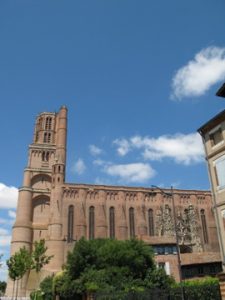
Long before Luther or Calvin, indeed for centuries before what has come to be known as the Protestant Reformation, the Roman Catholic Church (whose name, local–Rome–and universal–Catholic, attests to earlier splits within Christianity) had successfully faced down threats to its unity in Western Europe.  The Cathars, from a region of France centered on the town of Albi,

IMG_0914

wanted to “purify” the Church.  Their name descends from the Greek work for “purification,” a word likely known best in “catharsis.”  They were dualists, something long rejected by the Church (as early as Augustine’s reaction to the Manichaeans),  and vegetarians, and believed there should be only one sacrament (as opposed to the Catholic Church’s seven), and they denied the existence of Purgatory (from which, 800 years later, the Church would also distance itself).  The Cathars were defeated with a Crusade and the original Inquisition in the early thirteenth century.  To mark its victory, the RC Church built an unusual, fortress-like red-brick Cathedral.
IMG_0916

The interior is filled with painted imagery.

IMG_0932

In fourteenth-century England, of course, Wycliffe, who, like Luther, opposed transubstantiation, led the translation of the Bible into English. In the early fifteenth century, Bohemian Jan Hus was executed in Constance after opposing the Roman Catholic Church on theology and, like Luther, on practices such as indulgences.

But none of those earlier reformers had the same splintering impact on the Roman Catholic Church, then the Church of western Europe. It would be a century before Luther and Calvin would have their much greater successes against the Church. There are many reasons why Calvin and Luther succeed where so many others had not. Particularly important, though, is the reformers’ increasing focus on literacy. The Cathars, for example, may have wished to purify the church of iconography, but painting and sculpture were never the Roman Catholic Church’s weakness.  (See, for example, the Sistine Chapel.)

With literacy in Latin highly restricted, and the Bible’s availability in the local languages equally restricted, it was on questions of literacy, though, where the Church was particularly vulnerable. Wycliffe and Luther of course focused on these dual issues, working to translate the Bible while also casting the Church’s position on translation as part of a larger pattern of exclusion.

Groups such as the Cathars, Wycliffe’s Lollards, Hus’s Moravians, etc., had prepared the way for Reformation, it is true, but the focus on literacy in Luther and Calvin not only distinguished them; it is also coincided with the continent-wide spread of the printing press. It was one thing to see in advance the press’s possibilities for getting the Bible to the laity, as Wycliffe did. Later generations, though, were relying on increasingly familiarity with print. Relatedly, these later generations of Reformers were also drawing on what print had made possible for texts written in the vernacular. By the time Luther and Calvin come along, western Europe has established vernacular literary traditions, providing cultural and linguistic resources on which their project of translation could draw. Nonetheless, the poets’ success at printing literature in their native languages would still not have been sufficient for the effects Luther and Calvin had in European history. Part of their success has to do with their attention to literacy itself, i.e., to how to read, a question made all the more pertinent by the translation of the Bible and by the democratization of reading, both of which follow from print.

In short, Luther and Calvin were modernizers of literacy, paying attention to literacy in the condition of print.  If printing modernizes writing, the Protestant reformation modernizes reading. This, it seems to me, is why the Reformation of the sixteenth century succeeded where so many earlier attempts had failed to break the power of the Vatican over the religious life of Western Europe. The Cathars would not be able to defeat the Church on the question of painting and images—one of the Church’s strongest suits. Where the Church was weak was on the question of literacy. Wycliffe arose too early for printing. Luther and Calvin–not far from the region of the Rhine where Gutenberg worked–were not.

For Anthony Giddens, the premodern tends to the oral, and the modern toward the written, or, by the sixteenth century, toward print. In the sixteenth-century, Luther and Calvin brought modernizing skepticism to the analysis of literacy, to different results. Luther, for example, is part of a larger movement attempting to reverse the influence of Aristotle, a movement that affects natural philosophy or early science as well (as can be seen from Copernicus to Francis Bacon). In “An Appeal to the Ruling Class,” Luther regrets that in the universities “little is taught of the holy Scripture or the Christian faith; the blind pagan teacher, Aristotle, is of more consequence than Christ” [[470]]. It is Aristotle’s affect on how the Roman Catholic Church reads Christ’s words from the Last Supper on which Luther focuses in his crucial discussion of literacy, in “The Pagan Servitude of the Church.”  Through Aristotle, Luther claims, the Roman Catholic Church treated “this is my body” as if Jesus had said “This becomes my body.”  For Luther, “is” (rather than becoming or representing) is what “is” means, so there is no need for transubstantiation, which would require, among other things, becoming.  To Luther, the human body did not have to transubstantiated in order to be the corporeal habitation of the divine.  As a corollary, then, divinity is everywhere for Luther–once one reads both the Bible and the world in that way.

Bruce Gordon, Professor at the Yale Divinity School, will be speaking about “The Bible, Authority and the Struggle for History in the Reformation,” at Clemson on November 9th.  The event, which is free and open to the public, will take place at 7 p.m. in Holtzendorff Hall, room 100.

Plantation Modernity

On Friday, October 20th, Clemson will host a symposium on Plantation Modernity, the topic of a recent special issue of a journal, _Global South_ (https://muse.jhu.edu/journal/391). Clemson English colleague Jonathan Beecher Field seems to know nearly everyone who contributed to the volume. (NB: it’s been my experience that he will deny this. Hint: Don’t believe him!)

Readers might wonder what the phrase “Plantation Modernity” means. Without claiming I know all that it might entail I want to consider it here as an intervention in the familiar associations that surround plantations. Often, if not usually, the southern plantation is seen as a relic, something from the past, something antiquated, and, of course, something superseded. This is true even when the plantation is considered in its historical context. In this reading, the plantation is feudal–the lords, ladies, and slaves of the antebellum period mimic a mode of production and political relation then centuries outdated in Europe, or the US north, when at its peak in the US south. We are likely familiar with all the images that flow from this image of the plantation as feudal, e.g., the preservation, for some, of the medieval chivalric codes regarding, for example, the related topics of gender and honor.

However, for a few decades historians have reimagined this image of the plantation as an anachronistic throw-back to the middle ages pulling the modern era backwards. I am thinking of Eric Williams, historian, and Prime Minister of Trinidad and Tobago, whose 1970 book, _From Columbus to Castro_, features a chapter on “Capitalism and Slavery” which speaks to the book’s argument about the Caribbean and modernity. More recently, academics such as Sven Beckert (who spoke at Clemson a couple of years ago) and Edward E. Baptist have resituated plantation slavery as part of the making of American capitalism (as the subtitle of Baptist’s book _The Half has Never Been Told_ puts it). In this reading, the productive plantation has always been a feature of the modern economy, and contributing raw materials need not make the producer of those materials pre-modern. Indeed, it could make the plantation a defining feature of modernity. In that case, then, the off-plantation processors of the raw materials would by extension be implicated in the modernity of the plantation system.

Or, in other words, the question is how to think about a linked global system, when we are accustomed to think of uneven development and differences in production, temporality, and culture (understood broadly, e.g., as habitus). My own sense is that there _is_ a difference between the mode of production in locales that received the plantation’s raw materials and those that produced them, even if both raw materials producer and raw materials processor might be part of the same modern system. Moreover, even if we were to accept that the plantation is part of modernity, a productive cog in a processing machine, we are still left with the question of where the plantation ideal comes from. I have my own ideas about that, but I suspect that the participants in Plantation Modernity: A Global South Symposium will be discussing all this, and more, on Friday (October 20).

https://www.facebook.com/events/154705948463660/?acontext=%7B%22ref%22%3A%223%22%2C%22ref_newsfeed_story_type%22%3A%22regular%22%2C%22feed_story_type%22%3A%22117%22%2C%22action_history%22%3A%22null%22%7D

I hope to see you there.