Humanities Hub

South Carolina’s early history of immigrant religious diversity

In today’s divided political climate, it is easy to forget that South Carolina was committed to religious tolerance from its very origins.  South Carolina began in 1670 as part of a land grant Charles the Second presumptuously made to a group of English men called the Lords Proprietors.  At the time, Carolina spread from the Albermarle Sound to the north through to the Savannah River on the south, and westward as far as the English, back then, could imagine the continental landmass extended.  Carolina takes its name from the Latin for Charles, after Charles the Second, and was later split into its north and south states.  The first head of the Lords Proprietors was Anthony Ashley Cooper, also the first Earl of Shaftesbury.  It is from this Earl that the two rivers beside Charleston, then Charles Town, take their names—the Ashley and the Cooper.  At the time, a young John Locke was basically apprenticed to the Earl, working as something like the Earl’s and the Lords’ secretary.  Later, John would become famous for The Second Treatise of Government (1689), but in 1669, young John helped draft The Fundamental Constitutions of Carolina, the document that would govern the colony through its early years.  In it, Carolina welcomes those who in “any seven or more persons, agreeing in any religion, shall constitute a Church or profession” (§97).  In other words, Carolina is committed from its beginning to welcoming people from elsewhere of whatever religious background.  Any group of seven would be enough to form a religious profession—“in any religion.”  Yes, there are lots of other retrograde and implicitly awful features of the same document, including racialized chattel slavery, and a feudal arrangement then becoming outdated in England.  Some of these features are true of the other thirteen colonies, too, all of which had chattel, racialized slavery, of course.  But Carolina was an early adopter of religious toleration, more than a decade ahead of Penn’s Woods, Pennsylvania.  And The Fundamental Constitutions of Carolina were broadly applicable, even to slaves, for whom “it shall be lawful . . . to enter themselves, and be of what Church or profession any of them shall think best” (§107).  In seventeenth-century Carolina, that is, even slaves were entitled to whatever religious profession any of them shall think best.  And this entitlement was also protected in The Fundamental Constitutions.  Paragraph 106 specified that “no man shall use any reproachful, reviling, or abusive language, against the religion of any Church or profession.”  In other words, seventeenth-century Carolina created a legal space for religious difference, and no man was legally allowed to be pejorative toward another man’s religion.  “Hatred of the professors and that profession” was specifically outlawed in The Fundamental Constitutions.


350 years ago, this state, this colony, was established, to, among other things, welcome arrivals from other places, and to protect what was constructed as their right to believe whatever their religious profession asked of them, and no one was allowed to say anything reproachful, reviling, or abusive about it.  That’s more than a century before the US Constitution’s first amendment said that “Congress shall make no law respecting an establishment of religion, or prohibiting the free exercise thereof,” but I’m sure you can hear in the US Constitution the long earlier Fundamental Constitutions of Carolina. This openness to religious difference, and to the various peoples from elsewhere who bring those religions with them, has long been part of what makes America great.  And South Carolina has long played an important part in that pluralist history.
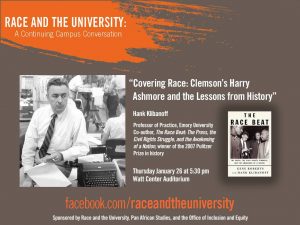
Harry Ashmore, Clemson alum, Pulitzer Prize winning journalist

Over twenty years ago now, your Hum Hub correspondent was on a committee that brought Pulitzer-Prize-winning Clemson alum Harry Ashmore back to speak at Clemson.  Ashmore’s newspaper, The Arkansas Gazette won a Pulitzer for Public Service and Ashmore himself had won a Pulitzer for Editorial Writing, both in 1958, for his newspaper’s stance and his editorials against the segregationist activities in Little Rock, Arkansas, four years after Brown v. Board of Education.

I remember having lunch with him and Clemson History colleague Stephanie Barczewski at Clemson House.  Back then, there was no wikipedia; in fact, we still accessed Clemson’s computers using Unix, telnet, and pine.  Little did I know, then, that I would later be able to see a photo of Ashmore with Carl Sagan, or learn of Ashmore’s reporting trips to Vietnam.  Nor did I know that Ashmore, a native Greenvillian, was living in Santa Barbara.  He was clearly someone able to traverse many kinds of ostensible differences.  A 2007 book review of a history of civil rights journalism told prospective readers of the book to “pay particular attention to Harry Ashmore, the liberal Arkansas editor who gained national attention during the 1957 Little Rock crisis.”

Twenty years after I helped bring him here, ten years after the New York Times told readers to pay attention to his role in the history of the American press, and nearly sixty years after his double Pulitzer, that same Harry Ashmore will be the subject of a lecture at Clemson, by a professor visiting from Emory University, a small private university a couple hours south from here.

To get ready for the upcoming talk, I’ve recently checked out from the Clemson University library a DVD of Ashmore’s 1996 presentation.  A few minutes in, Ashmore says “this place is really I think uniquely situated to give somebody the kind of historic–anybody who thinks about it in the proper terms–the kind of historical memory and perspective that is required to understand the presidential election that is now taking place,” which I think has been true for lots of elections, before and since.

It seems fitting that Ashmore will be the subject of a talk less than a week after another presidential inauguration, as part of a series on Race and the University, on the very campus where he says he learned the historical lessons that served him so well in his successful journalistic career.

We here at the Hum Hub think that the lessons of history are always around us, always worth learning from, and always available for continued application to the present.  What I can’t believe is that I have enough history here myself to have met someone then, here, who will be the subject of a lecture here, now.  As I watched the DVD of Ashmore’s lecture, I realized how much I had learned from his appearance early in my time at Clemson.  Before his remarks, he credited celebrated Clemson English professor John Lane (then deceased, but whose wife was in the audience), for revealing this history and these patterns to him as a student in the 1930s, 60 years before that talk–and, it must be said, 20 years before this upcoming talk.

15591517_1074238872721401_7257408075547604648_o

Zadie Smith on multiculturalism

The 12/22/2016 issue of the New York Review of Books brings news of Zadie Smith’s recent speech on the occasion of her receiving the 2016 Weltliteratur Prize (http://www.nybooks.com/articles/2016/12/22/on-optimism-and-despair/). It is a rich, rewarding read, filled with understandable concern that multiculturalism, for all its flaws, might turn out to have been a historical period, rather than, say, a lasting understanding of and insight into democracy itself. Zadie Smith reports she is told her newer work is now less optimistic than 2000’s White Teeth was about multiculturalism. Smith suspects that, yes, her readers may very well be right. What I find interesting, though, is how this new reading retroactively casts the earlier work as positive in its multiculturalism. Part of what makes White Teeth so interesting is how its many ostensibly multicultural pairings have a tendency to go awry. Samad’s affair; Samad’s solitary pleasures; Samad’s separating his two sons, for a kind of cross-cultural experiment–one in England, one in Bangladesh. Chapter 17 of White Teeth ends with a remarkable set of paragraphs, reflecting on the experience of immigrants. The section begins optimistically with “we often imagine that immigrants are constantly on the move, footloose, able to change at any moment, able to employ their legendary resourcefulness at every turn,” and ends painfully with “they cannot escape the history any more than you yourself can lose your shadow” (384-5 in the 2001 Vintage paperback edition). I don’t know whether or not Smith would be reassured to know that it’s not clear she’s always offered an upbeat assessment of the experience of multiculturalism, but I myself find the complexities of White Teeth more important than a (guileless?) universalist assessment.
