Public Health Science Abroad

Bonjour Avignon

by Kate Luckey

After a week in Aix en Provence we took a day trip to Avignon,France. On our way to Avignon we stopped at the Pont du Garde. The pont du gard is an old roman aqueduct.It was constructed to carry fresh water from a spring to the Roman City of Nimes. I learned that the Romans needed the water supply for public baths,fountains,homes and sewers. The aqueduct was named after the river the Gardon River and Pont is French for bridge, meaning that the name translates to bridge over the gard. We all took advantage of the beautiful sights by stopping for several pictures along the way. After walking by the Pont du Gard we made our way down to the the little beach where we got a group picture and saw swimmers.

After visiting Pont Du Gard we got back on the bus to travel to Avignon. Avignon is a historic city on the Rhone river. It was one of the most important religious and political centers during the Middle ages. The Romans developed it into a major town because of its location on major trade routes and they protected the city by building walls around it,which you still see today. Avignon is most famous for being home to Popes which is evident by the Palais des Papes(“Palace of the Popes”). We were able to tour the Palace
and it was incredible to see the architecture and to get a glimpse of the way of life back then.

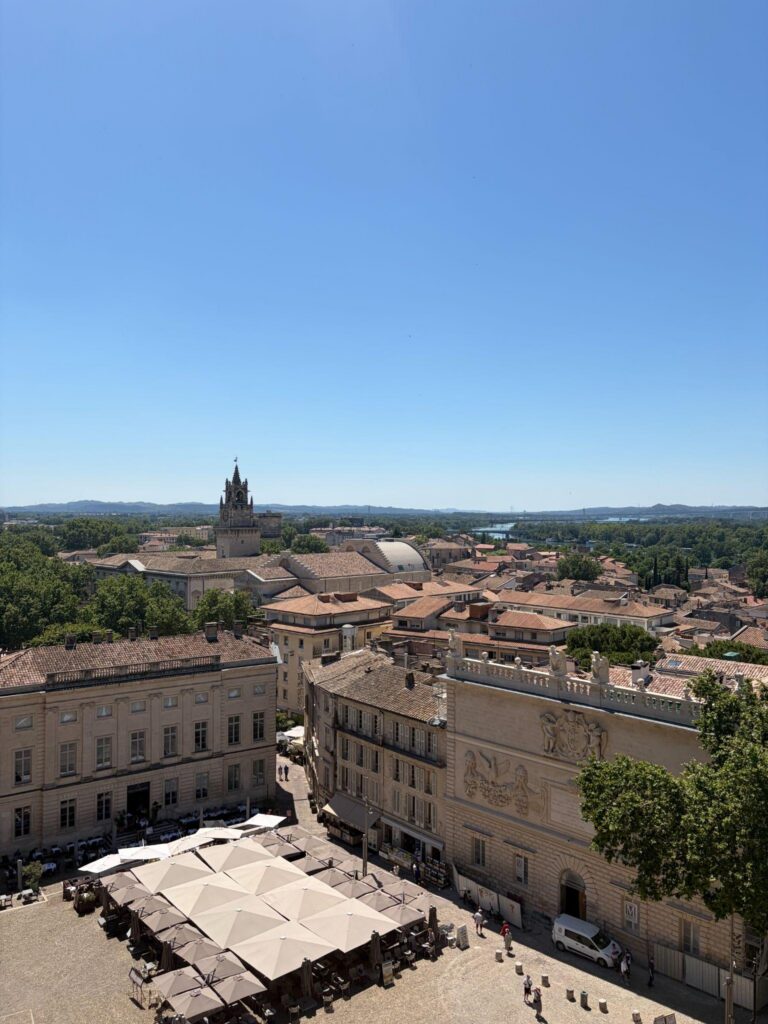
My favorite part of touring the Palace was being able to see the view from the top. We were able to see most of the city from the top and it was amazing to experience all together as a group. The gardens in the back of the palace were beautiful and much larger than I expected. After touring the Palace we had about an hour to explore the city. We found little market stands similar to the markets in Aix en Provence. I was able to get a beautiful painting from a local artist of the Pont du Garde. After spending the day visiting Avignon we got back on the bus and had to go straight to sleep because the next day we headed to Paris for our free weekend.

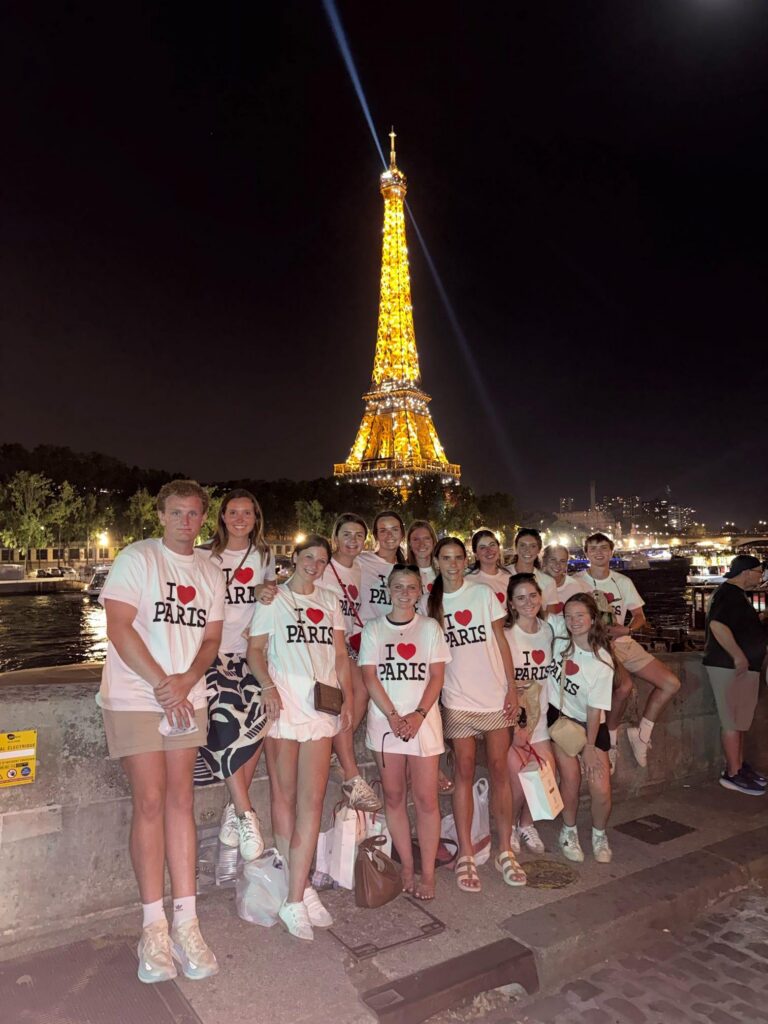
Although we were only in Paris for two days we checked off many of the sights. On our first day we arrived after taking the three hour train around 12 and then made our way to the city from our Airbnb. Of course the first thing we did was head to the eiffel tour where we took many pictures. After that we had lunch on the Seine River. We finished the night off by walking around the city and getting french food. The next day we started bright and early and headed to Notre Dam. The line to get in was so extremely long so we stuck to just getting pictures outside. We then got breakfast at a famous cafe and went to some shops around the restaurant. The two main events of the day were going to the Musee d’Orsay where we saw famous paintings from Van Gogh, Cezanne, and Monet. The second main event was the Seine River cruise where we got to see the city from the water and see the eiffel tower sparkle.

Day Trip to Avignon!

by Lauren Hall

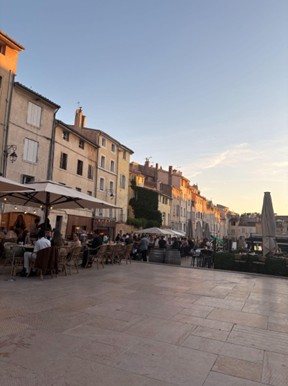
After a week in the south of France, we have really been able to experience most of Aix-en-Provence’s sights and activities. Whether it’s the beautiful markets with fresh produce or a cafe tucked into the corner of a plaza, Aix has proved to be a wonderful city. We have already covered a lot of ground in our understanding of international health systems, beginning with the United States. On our first day in class, we gained a broader understanding of how our system works, including financing, coverage, and medical education. We also learned about the French healthcare system, which strongly prioritizes equitable access for all its citizens. In this lecture, I learned that France provides universal healthcare coverage for all people within its borders, and that additional coverage can be purchased through a mutuelle. We were also able to zoom in specifically to women’s healthcare in the country by listening to our guest speaker, Emmanuelle Hartman. Some of the most shocking differences in the French healthcare system are that women typically get around four months of paid maternity leave, and they are also mandated to get screened for common diseases such as cervical or breast cancer.

To wrap up our first week in France, our group took a day trip to explore some of the other sights the south of France has to offer. We began our day with the typical French breakfast consisting of a cappuccino, fresh jams, and my favorite – pain au chocolate. We then reached our first destination, Pont du Gard. This structure is considered one of the best-preserved Roman aqueducts, dating back almost 2,000 years. As we walked across the main bridge, it was incredible to consider how talented the architects must have been to build something of that size with a fraction of today’s technology. The beaches at the base of the structure provided a great view and opportunity to take some pictures (like these!). The museum that followed provided insight into how aqueducts use gravity to deliver water to an entire city, enabling even indoor plumbing. I would love to come back in future years in July or August, since the river flowing below it becomes warm enough to swim and relax in.

 After this excursion, we made our way to the actual city of Avignon, where we were immediately impressed by the high city walls and the palace that succeeded them. As we initially explored the city, a few of us found a small Japanese restaurant where we got delicious bento boxes. We didn’t stay too long, though, because we were excited to explore the lookouts located at the top of the city. This was hands down the best scenic outlook of the day!

Finally, our tour of the Palace of the Popes began, which I had never heard of until this week. The tour explained that, for a brief period, the papacy’s headquarters were moved from Vatican City to Avignon in the 1300’s. Much of the architecture reflected this time period with gargoyles and sweeping rooms filled with frescoes. Along with the elaborate interior, the gardens and courtyards also provided calm places to sit and chat with friends. Overall, this has been an excellent week filled with new friends, great food, and interesting history!

Making Memories & Learning in Aix

by Avery Fleming

Bonjour!

This first amazing week in Aix-en-Provence has been jam packed with friends, food, and learning.

Our first few days were spent working off jet lag while taking in our new town. My first thoughts were that Aix looked as though it was a storybook town straight out of Beauty and the Beast. Saturday and Sunday were a lot cooler than I was expecting, but it was nice for our walking tours of both the International American University and town as a whole. We also visited and learned about many of the beautiful and historical fountains that make Aix known as “The fountain town.” Over the first weekend, our group honestly clicked fast as we walked everywhere together and bonded over health care.

Throughout the week, we began classes and were joined by three guest speakers. We started by learning about the United States health care system and reinforced general concepts that most of us had learned in various other classes. In comparison, we then learned about the French health care system. I was surprised to learn that some of the concepts were very similar to the United States. However, there were some large differences as well, such as their increased taxes and paid time off, but most notably, the universal health care structure. Our first speaker, Emmanuelle Hartmann, spoke to our female-dominated group about women’s health in France and the overall focus of the French health care system. After this, Nitin Beeharry and Benjamin Gerard, spoke with us about the ins and outs of the French health care system and how this system came to be. In addition to our lecture portion, we spent two days touring parts of Camp de Mille, Pont du Gard, and Avignon. These immersive experiences allowed us to take in more of this beautiful and historic country.

France so far has been nothing short of a dream. Although my French is terrible and I still really have to think if I say “Bonjour” or “Merci,” I have truly loved the culture and life here. The walkable city allows for a different way of life where the streets are not overrun with cars, but instead have people walking, selling flowers, or offering candy samples. Three days a week, there is a large market where locals have stands for textiles, foods, and other goods. I was able to spend time with my friends walking around and discovering many things that are not often available in the United States. We found that our new favorite meal is a focaccia sandwich with truffle spread and prosciutto. I have also had the opportunity to try so many different sweets and fun snacks, but my favorites are definitely the fresh fruit, Nutella crêpe, and a classic chocolate croissant.

Overall, studying abroad and signing up without knowing anyone has paid off already in more ways than I could have imagined. First, with my end goal of being a physician in the United States, I believe that learning about our health care system in comparison to other health systems and societal infrastructure allows for a deeper perspective of medicine globally. Next, this experience has already opened my eyes to places I likely would have never had the opportunity to immerse myself in otherwise. Last, I have met absolutely amazing people that I couldn’t imagine this trip without! I can’t wait for all that is to come in the next three weeks and even though this trip will be over before I know it, these memories will be with me forever!

Art and Culture and Taxes

by Abby Flynn

Bonjour!

This past week in Aix-en-Provence has been nothing short of amazing.

One of my favorite days has been visiting the Toulouse- Lautrec exhibit. We followed along with
his work through individual players, which allowed us to play an audio recording of the piece
after we reached a certain number. It was really nice for everyone to go at their own pace and
appreciate the art. His work was so lovely to see; one of my favorite pieces was of Jane Avril.
She was a French dancer at the Moulin Rouge in Paris. She was known for her jerky
movements and was nicknamed “La Melinite” (meaning “explosive”). In this photo, specifically,
she was sitting in an audience of a theater. Toulouse- Lautrec used abstract elements but
noticeable symbols, like black gloves, to help others recognize what he was painting.

The first two days of classes were focused on the United States healthcare system. Although I
had a bit of prior knowledge, I was really interested in learning why and how this system came
to be, as well as the current problems our country faces. The United States truly is so different
from the rest of the world, and I enjoyed learning more!

Today, we started by learning more about the French healthcare system. It was interesting to
learn how every system prioritizes different areas of improvement and that there’s no correct
way to make a perfect system. We split into groups of three and separately rated 5 categories
(cost, access, outcome, innovation & research, and opinions). After sharing our rankings, there
were no rankings alike. This really highlighted how different countries prioritize different needs
and how there’s no “correct answer”. We also had the privilege of hearing from Professor
Beehary from the IAU this past week about the Healthcare system in France. This has been one
of my favorite speakers, and he made his lecture interactive as well. He shared about the three
key principles of healthcare in France- Equity, Accessibility, and Quality and transitioned into the
history of how the system came to be. One of the most shocking things I learned was how high
taxes are in France. Some of the higher brackets pay 45% of their pay and are okay with it,
mostly because of the care they receive. Another cool thing I learned was that France has a
“Mutuelle,” which is complementary health insurance on top of universal care. Since 2016,
employers have been required to pay at least 50% of this additional healthcare, but most pay
60-70%. It is divided into two sectors. The first sector is the set-fee sector, reimbursed by the
Sécurité Sociale; it is known as the “public” sector. This sector typically has better equipment
and services. The second sector is free to set fees and can charge extra. All workers in this
sector typically start in Sector 1 and move to the “private sector”.

I am so excited to see what the rest of this trip has in store for us! Au revoir!