For more information, contact Dr. Melissa Muñoz (munoz@clemson.edu)
Horticulture Trial at Musser Fruit Research Center
The 2025–2026 strawberry variety trial was conducted at the Clemson Musser Fruit Research Center to evaluate the performance of 16 commercially available cultivars from different breeding lines under South Carolina growing conditions (Table 1). During this first trial, comparisons on the performance of the cultivars for marketable and unmarketable yield, harvest timing, fruit quality, plant vigor, and overall field adaptation were done.
Plants were established on October 15, 2025, and managed using season-long fertility with weekly applications of calcium nitrate (6 lbs/acre) until bloom, then tissue samples informed the fertigation strategies. Additionally, integrated pest and disease management strategies were implemented for the Horticulture plot, while a mirroring Pathology plot with no fungicide applications as used to evaluate cultivar response to Neopestalotiopsis rosae (Neo). Three major cold events, including a freeze, a snow event, and several nights below freezing before and during bloom were experienced, from these events ‘Ember’, ‘Encore’ and ‘Medallion’ shown more frost damage than ‘Camarosa’ and ‘Chandler’. Each time, we used 1.5 oz row covers which helped protect the plants especially when temperatures went below 30 °F. Harvest occurred twice weekly from April 3 through May 22, 2026.
Table 1: Cultivars evaluated, photoperiod and breeding program
Cultivar | Photoperiod | Breeding Program |
Surfline | Short Day | UC Davis |
Monarch | Short Day | UC Davis |
Albion | Day Neutral | UC Davis |
Keystone | Day Neutral | UC Davis |
Encore | Short Day | University of Florida |
Ember | Short Day | University of Florida |
Medallion | Short Day | University of Florida |
Brilliance | Short Day | University of Florida |
Ruby June | Short Day | Lassen Canyon |
Galletta | Short Day | NC State University |
Warrior | Short Day | UC Davis |
GF Belle/X08 | Short Day | Good Farms Genetics |
SB_14_028-025 | Short Day | Strawberry Sciences |
Chandler | Short Day | UC Davis |
Camarosa | Short Day | UC Davis |
Fronteras | Short Day | UC Davis |
Key results
Yield ‘Surfline’ and ‘Fronteras’ were the cultivars with the highest marketable yield while ‘Galletta’ and ‘Medallion’ showed the overall lowest values (Figure 1). The cultivars ‘025’, ‘Camarosa’, ‘Galletta’ and ‘Surfline’ showed a very distinctive pick of harvest after which yield was drastically reduced, other cultivars such as ‘Albion’, ‘Encore’, and ‘Fronteras’ had a more even/spread yield across the season (Figure 2).


Total soluble solids (Brix) ‘Ruby June’, ‘GF Belle’ and ‘Medallion’ showed some of the highest Brix overall (Figure 3), while ‘Monarch’ was on the lower side.

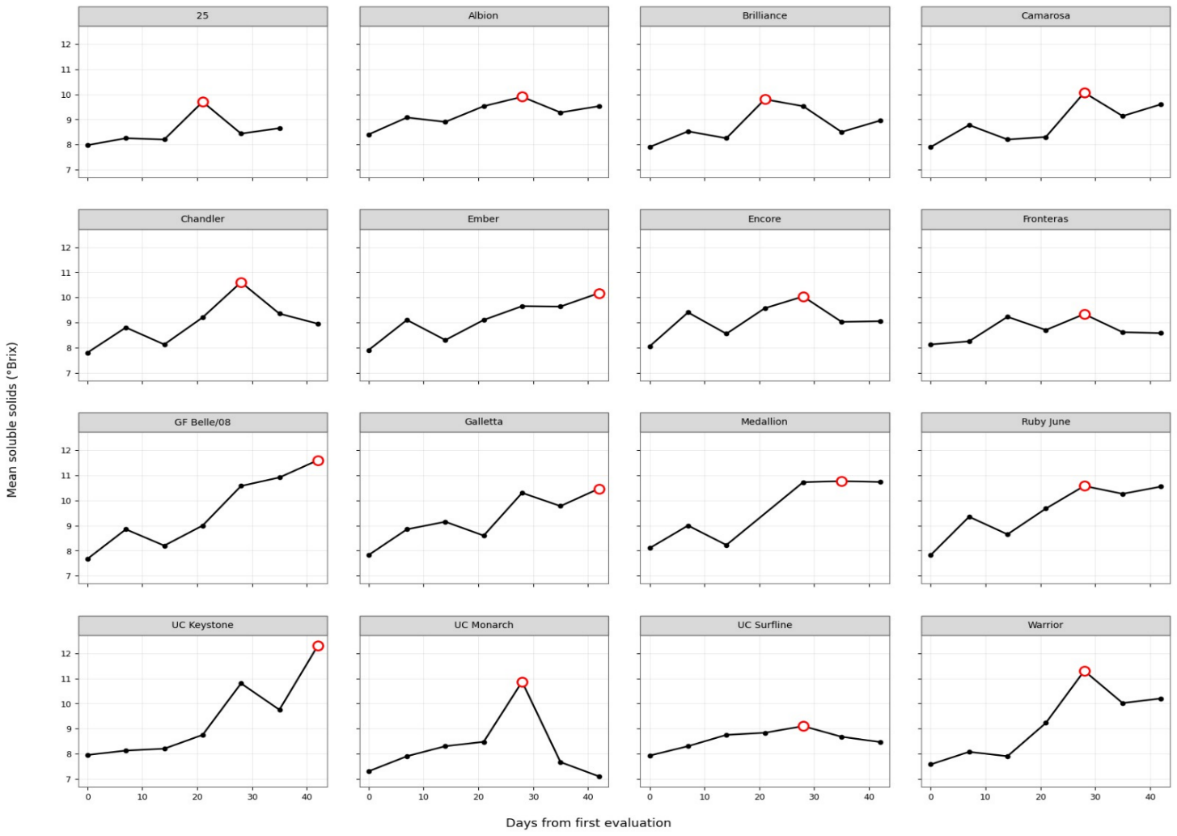
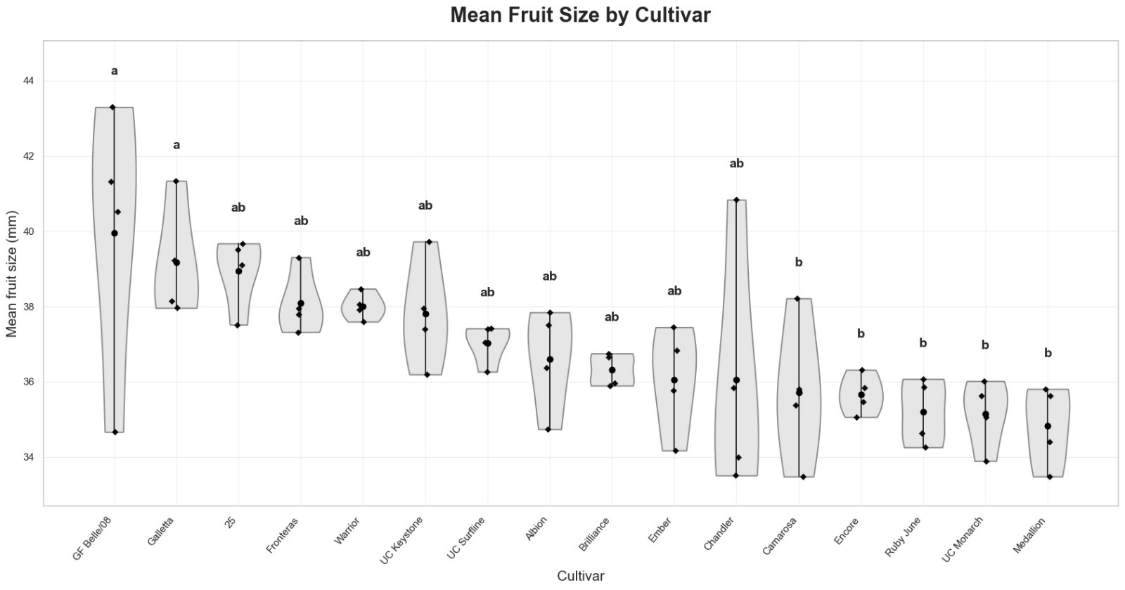
As the days got warmer over the second half of the season, the cultivars showed increased Brix, this was very noticeable in ‘Camarosa’, ‘GF Belle’, ‘Galetta’, ‘Medallion’ and ‘Ruby June’, and less noticeable in ‘Surfline’ (Figure 4). The opposite trend was observed in individual fruit size and weight were most of the cultivars experience a reduction as the season progressed. Overall ‘GF Belle’ and ‘Galletta’ showed large fruit, while ‘Camarosa’, ‘Encore’, ‘Ruby June’, ‘Monarch’ and ‘Medallion’ were smaller (Figure 5).
Fruit firmness In terms of firmness, ‘Surfline’, ‘Ember’, ‘Monarch’, ‘Medallion’, ‘Keystone’ and ‘Encore’ were about twice firmer than ‘Ruby June’ and ‘Chandler’. ‘GF Belle’ had a high variability in firmness but overall ran in the softer side (Figure 6).

General Caveats Keep in mind that the 2025–2026 season was characterized by unusually dry weather, with below-average rainfall and high temperatures at the beginning of the season, therefore some of the responses that we observed might change in future evaluation. These conditions generally favor good fruit quality, although they may have limited the expression of differences among cultivars that are more evident under wetter conditions.
