Clemson Visual Arts

Atelier InSite: A marriage of art and mortar

Art in itself is reflective of the depth and breadth of the human condition. Marry art with an inanimate object like a building, and it can tell its own story and set the tone for collaboration within its walls.

Such is the goal for Atelier InSite, a Creative Inquiry program that focuses on the implementation of public artwork at Clemson University. This student-driven initiative encourages cross-disciplinary collaboration and provides hands-on opportunities for students to conduct research on the nature of public art, investigate the design build process, conduct site analysis and identify site locations for artwork.

Led by Clemson professors David Detrich, Joey Manson and Denise Woodward-Detrich, this initiative got its start more than a decade ago when university funds were set aside in support of the Art Partnership Program, a collaborative effort among the Office of the President, the Department of Art and other academic units on campus. The program solicits and commissions the creation of site-specific works of art, which are permanently featured at various campus locations.

Birth of a Creative Inquiry program

Clemson’s design guidelines for current and future campus projects stipulate, “All capital development projects that are anticipated to exceed two million dollars will consider the benefits of public art and will apply 1/2 of 1 percent of the construction budget for such work.”

Last year, Detrich and his team were invited to a planning session for Clemson’s new $50 million, 100,000-square-foot life sciences facility project. The team was asked to make recommendations about the introduction of art into the facility design. As part of the pitch, the team proposed student participation by way of a Creative Inquiry class, which is Clemson’s undergraduate research program.

“We want to establish a new model for how other universities can implement art,” Detrich explained. “To encourage student participation and engagement, we recommended that the project be implemented through Creative Inquiry and that it be by students, for students.”

By students for students

In August 2012, the Atelier InSite Creative Inquiry program was approved, and Detrich and his team went to work to recruit both art and life sciences students and create a strategy focused on a central theme of research. In addition to implementing artwork for the new building, they were also given the charge to help dedicate the new life sciences facility in a unique way that reflects sciences and the arts.

Instead of a typical ribbon-cutting that marks the opening of a building, students created a sculpture of a plasmid. Used in the study of molecular biology and genetics, a plasmid is a DNA molecule that is engineered to include desired genes. In a process called transformation, the circular plasmid is introduced into a cell where change is wanted and the plasmid effective brings about that change.

“Because the life sciences facility is designed for an open exchange of research among different areas, the plasmid is a symbol of collaboration among those entities,” Detrich said.

Pairing students from diverse disciplines can be challenging. But the process of investigating and understanding unique thought can result in holistic perspectives. Detrich and his team leveraged that by creating “get-acquainted sessions” in which art students presented a “What is art?” program to their life sciences peers. In return, the life sciences students presented “What is life sciences?” to their art student counterparts.

“It was a good exercise to get the students from different academic areas working together,” Detrich said.

So that everyone was on the same page, students devised a glossary of terms that were common to both the arts and life sciences areas and wrote a mission statement and guiding principles.

The students together researched site-specific art, participated in building tours and made recommendations regarding the placement of art in the new facility. The recommendations will become actual works of art in the building and currently appear as placeholders in the form of question marks. The question marks contain images that represent a blend of art and the sciences.

The Atelier InSite Creative Inquiry program will soon focus on the Watt Family Innovation Center and the Lee III building, which recently won a national award for design achievement from the American Institute of Architects (AIA).

“The hope is that students who sign up for a Creative Inquiry come back the next year,” Detrich said. “Because of the success of this interdisciplinary collaboration, every student who participated came back. They now see art as being important to their university experience. It’s a physical, tangible part of the legacy they are leaving behind. That’s what empowers them and keeps them interested.”

——————————————————————————–

Original article can be found here:
http://features.clemson.edu/creative-services/students/2013/atelier-insite-a-marriage-of-art-and-mortar

Spring Ceramics Studio Art Sale

Wednesday, April 24, 2013
10am – 5:30pm
Lee Gallery Hallway

The Clemson Ceramics Association will hold a Spring Ceramics Sale to help fundraise for students’ travel to the NCECA (National Council on Education for the Ceramic Arts) conference this year in Houston, TX and other professional activities. This sale showcases a wide selection of both functional and sculptural artwork by Ceramics undergraduate students, graduate students, faculty, and alumni. The annual Bowl Sale will be held again in late Fall 2013, in time for the holidays.

Gene Ellenberg ’12 Featured in Online Photography Publication

Photography of Gene Ellenberg, CU Art Department alumus, included in the April issue of One, One Thousand

One, One Thousand is an online publication focusing on photography produced in the American South by emerging and established photographers. Founded in 2010 by photographers Daniel A. Echevarria and Natalie Minik, One, One Thousand features new photographic works both from and about the South. Notable photographers previously featured from past years are Leslie Burns, Lucas Foglia, Tammy Mercure, Kathleen Robbins, Eliot Dudik, etc.

The Sleeping Giant. Gene Ellenberg.

Says Ellenberg (BFA 2012, Art / photography), “The work featured is an ongoing project, ‘In My Father’s House’, that began back in 2010 as a personal investigation about the private introspections of my father and later became an exchange between myself and my family. The process was at times deftly quiet and unnerving but looking back on the images now I see a mutual understanding, a trust. Through straight documentation as well as the constructed image, I am attempting to blur the lines of what I recall, what I want to admit, and perhaps what I want to see.”

http://oneonethousand.org/photography/ellenberg/

Gene Ellenberg is currently a creative consultant for the Center for Visual Arts at Clemson University in South Carolina where he also received his BFA in 2012. He served as the Chair of the Annual Student Invitational at the Click646 Photographic Collective between 2009-2012. Ellenberg has been published in Untitled Cereal and exhibited at the Workhouse Arts Center in Lorton, VA, the Pickens County Museum, Pickens SC and Lee Gallery, Clemson, SC.

More of my work can be found here: www.geneellenberg.com
One, One Thousand website: www.oneonethousand.org

Boomerang: BFA Student Exhibition

By Joshua Kelly Published Article in The Tiger Newspaper

Boomerang Subsistence is one B.F.A. show you do not want to miss this April. Sculpture by Gracie Lathrop, pastel drawings by Amber Rody, photography by Alice Wannermaker, and prints (and a video game!) by Travis Wood will be on display in the Lee Gallery from April 22nd–26th, and the reception – where you can get some free food and talk with the artists about their work – will be that Friday, the 26th starting at 6pm. These artists chose the show title “Boomerang Subsistence” because although most seniors in the Clemson B.F.A. program modify or completely abandon their concept at least once throughout the year of preparation and art-making that precedes their showcase, these four artists have been investigating the same themes through their work for over a year.

For sculptor Gracie Lathrop, the topic that has been at the forefront of all her work for over a year is a focus on tradition, particularly the investigation of and attempt to preserve her own southern heritage. The body of work that she will be showing uses furniture typical to what our generation may consider the antiquated south to bring viewers to a place that recalls not only southern heritage, but a nostalgia for a lifestyle that is rapidly disappearing. Her process of covering furniture with packaging materials such as tape or cloths, combined with a hardening agent like latex or glue, and then presenting us with these form “covers” in the gallery, transforms a solid piece of furniture into a shell of what it once was. While viewing her work, gallery goers are reminded of belongings perhaps similar to those seen in the houses of their grandparents, and because of the delicacy with which they are presented, Gracie’s work asks the viewer to consider the fragility and struggle of the act of the preservation of one’s own heritage.

Amber Rody’s pastel drawings address a topic that, more than likely, has been on the minds of about 98% of Clemson student’s minds for more than just the past year – sex. However her work is far from anything that you could consider pornography. Her drawings highlight the positive aspects of being in a sexually active relationship; the intimacy, the trust, and the struggle of growing together as a couple. Amber focuses on these aspects of sex to draw contrast to the view embraced by popular media that there is something about sex that should make us feel shameful for enjoying it. Her work is a reaction to the phenomenon that although popular culture idolizes the image of sex, social conventions make it “unacceptable to speak about and expected to be a hidden component of our personal lives.”

Another topic sure to be on the minds of college students is that of organic and natural foods. Alice Wannamaker’s documentary style photography tackles this issue by highlighting members of the local community that are also engaged and passionate about organic food. Her photojournalistic approach presents viewers with a glimpse into the lifestyle, mindset, and environment that these local farmers and growers live and work in. She draws attention to the various relationships between grower, preparer, and consumer; emphasizing that concern for where your food comes from is not only something that more and more people are caring about, but something that everyone should care about as well.

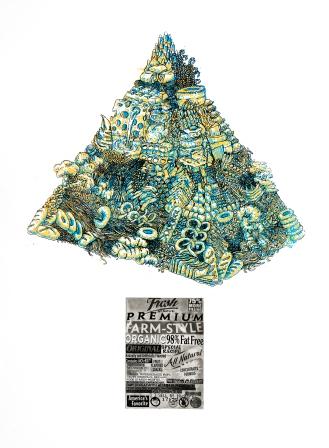
Through a variety of media including printmaking, painting, drawing, and even a video game, Travis Wood engages with the issues surrounding the ever increasing use of genetically modified organisms (GMOs) in mass produced/consumed foods – a concept that is on the other side of the organic food coin. Through the use of satire, Travis attempts “to blur the fine line between the progression of science and science fiction to the point of uncertainty.” His work asks viewers to consider their use of GMOs in their everyday life and strives to push the viewer to research GMOs more in-depth. Travis’ work features the faces of friendly farm animals, with super animal/human abilities due to their modified genes, in an attempt to provoke the viewer into questioning the ethical and health related issues raised by humankind’s attempt to control and perfect domesticated animals.

Wunderkammer: BFA Student Exhibition

By Jackie Kunst Published in The Tiger Newspaper

“Wunderkammer.” It is a term coined in 16th century translating as a “cabinet of wonder,” and a very fitting title for the upcoming B.F.A. gallery opening. The show, open April 8th-12th is the first of a series of senior showcases for the largest graduating class the Art Department has yet to yield. The pieces are the culmination of a year’s dedicated thematic research and four years of technical artistic maturation. The work in the show supersedes the binds of societal conventions in sculpture, revels in the ambience and intricacies of layered paint and graphite, highlights the personally unique nuances found through a camera lens, and brings to the table the visual breadth and varied texture of the printmaking process. The senior work consists of sculptures created by Mariana Hay, prints by Kirsten Asplund, drawings by Jessica Carey, paintings by Natalie Rushing, and photography by Lindsey Harris.

The playful dichotomy found in Mariana Hay’s sculptures will spark the gallery goers’ interest. Her work exploits gender constructs, presented in the conventions of gender specific hobbies, home décor, and aesthetic preference. She highlights how the competing characteristics inherent to hearty masculinity and delicate beauty mesh, clash, relate to, and inevitably complement one another, achieving a natural harmony. The sculpted, “gender-pleasing” objects are meant to function cohesively in the gallery but stand alone honorably on their own as well- each a picture of the greater social construct man and woman – relevant to ever viewer, no matter the role they play.

The thematically laden content in the works of Kirsten Asplund will evoke a visceral response in the viewer. Through the laborious printmaking technique, she seeks to delineate the “struggle to stabilize and cohere, interpersonal relationships, and identity” in respects to the complex and ever changing concept of home and place. Her obscured and transmutated figures challenge physical reality in order to represent the visceral and emotional response of being and identity.

Expect to be floored by the photo realistic craft and mastery with which drawing concentration, Jessica Carey brings an ephemeral portrait to fruition. With a delicate hand, she explores her past, drawing both traditional portraits and still life representatives of the human essence. She draws with the intuitive drive and longing to understand who her mother and grandmother were and the enduring relationship that transcends linear time and seeps through the veil separating life and the beyond.

Natalie Rushing uses every hue and texture achievable in the medium of paint to build up thick, hatched, gestural brushstrokes that collectively harmonize in patterns and blocks to form a portrait. Large scale and realistic, the eyes of the female subjects confront the viewer, presenting a question of shocking uncertainty of who is actually viewing who. From the beginning of her process, her works seem to exhibit a raw, inherent glow that either warms or haunts the viewer. She hopes the audience will share in the subject’s “out-of-body” and “reverent psychological state” as she uses the expressive medium to better understand the world and culture around her.

A glimpse at one of Lindsey Harris’s photographs and the viewer feels as if it is them, following a girl through a field- hearing the rustling of the grass, senses the goose bumps from a breeze, quietly trailing behind the guide to an unknown destination. The photographer seems to revere and evoke the essence of her captured subjects. As the viewer experiences the captured moment of the model in their element or sifts through a collection of keepsakes, one can almost hear the private silence that drifts in like pollen on a breeze, suspended between the subject and camera. The Lindsey’s soft lighting and style, rich in nuances tint the lens through which the viewer sees the world.

Contingencies: BFA Student Exhibition

by Joshua Kelly Published in The Tiger Newspaper

Featured Artists: Nick Baldwin, Jena Heaton, Sierra Kramer, Stephanie Post, Natalie Rainer

The second BFA show in the month of April will be Contingencies, and from the 15th through the 19th, photographs by Nick Baldwin and Jena Heaton, sculpture by Sierra Kramer, ceramic work by Stephanie Post, and prints by Natalie Rainer will be on display. The artists in this show work in a variety of media, but formally they all deal with processes that are subject to chance and a high rate of unpredictability, while at the same time each artist takes careful measures to ensure that their hand is evident in the final piece.

Nick Baldwin prides himself in being somewhat of an unorthodox photographer. His work for the show will feature a series of portraits, taken by iPhone, that have been run through various glitch-causing programs (which visually distort and corrupt the image). After altering the portraits randomly he takes them into photoshop to fine-tune the visual mutations, sometimes augmenting the damage to the original image and sometimes bringing back parts of the initial portrait. This gives each finished work a unique character; some end up referencing famous artworks from history while some portraits become so abstract the viewer is left wondering how what they see could have at one point been a portrait of anyone. Through this method of abstraction, Nick’s work provokes his viewers into asking questions like just how reliable is technology, and how much faith should we have in these electronic tools we rely so much on when they can often glitch and corrupt our data with no provocation at all?

Sierra Kramer’s instillations challenge the viewer’s perception of their surrounding world by transporting them to fanciful landscapes populated conspicuously with color and shape. Her sculptures, which seek to examine the relationship between a person and their individual memories of experiences and life stories, are inspired by an interest in perceptual psychology. Aesthetically her work ranges from illusory and mystic to effervescent; and much is still on display across the new Lee 3 Architecture Building. For Contingencies, Sierra will be reinstalling several of her pieces from Lee into the Lee Gallery as well as providing documentation of some of her previous work from the past year.

Natalie Rainer’s prints are a marriage of her unorthodox “throw-ink-on-plexiglass-and-electrocute-it” monoprinting method and uber-precise plexiglass etching technique producing works that are hypnotically transcendent and reminiscent of fantastical landscapes and nature scenes. Her intent with her work is to build a visual vocabulary to describe her personal mythology, adapting some imagery from established mythological traditions but primarily creating a personal codex as she goes along.

The ceramic busts of Stephanie Post are one-part planning, one-part semi-planned destruction, and one-part “hope this doesn’t fall apart when I put it in the fire.” The end product? Voluminous humanoid-like organic forms that appear to be preserved in a state of mid-decay. Referencing the pain and struggle of the growth that comes from the human experience, her work captivates the viewer by peaking their curiosity (her forms are very intricate and close inspection is required to fully appreciated their complexity) and invoking an emotion of compassion and concern for the weathered pieces.

Although formally her work does not resemble Nick’s, conceptually Jena Heaton’s photography asks a similar question: how much can I trust what I see in front of me? By arranging mirrors within various landscapes, usually during or right before dusk, Jena contrasts the naturally occurring lack of light within the landscape itself with human manipulated artificial light sources captured by both the mirrors placed in the landscape and by the camera as a result of the time-lapse photography process she employs to make her pieces. The resulting work is both whimsical and solemn. Upon first glance, many of her photographs appear to show the viewer a fairy-like being inhabiting these various spaces in nature, yet the careful positioning and framing of the mirrors which she has placed within these landscapes asks us to contemplate the reality and truthfulness of the image we see; where does our existence lie? Here on this (out)side of the frame, within the frame alongside the fanciful, or deeper still within the various mirrored worlds reflected back at us from within the image itself?

Student Feature: Jason Adams


by Joshua Kelly Published in The Tiger Newspaper

Upcoming Masters of Fine Arts showcase “Yours Mine Ours” will feature the work of three artists who will be receiving their graduate degree in studio arts from Clemson University this coming May. Dealing with themes of intrapersonal interaction as well as the affiliation that our actions towards each other share with our treatment of the world at large, a large scale sculptural instillation by Jason Adams will be on display after almost three months of round the clock construction. The piece, both interactive playground and work of art, will urge the viewer to meditate on what it means to love and care about someone, and think about how that is shown through our day-to-day interaction.

One of the primary focuses of Jason’s work is on making art more than just a passive experience. His instillations cannot simply be approached and consumed by a cursory glance over the work. In order to really grasp the concepts that he is exploring, Jason constructs his work in a way that causes the participants to also directly engage those themes. Much of his work not only deals with ideas involving relationships and human connection, but actually employs the viewers as part of the realization of the piece. His last large scale work that was on display in the Lee Gallery was a hot tea bar where attendees could work together in order to make hot tea or coco for others. His newest piece deals with human interaction in a more personal, though similar, way while simultaneously asking the viewer to meditate on their relationship with their natural surroundings.

But making nifty interactive instillations isn’t the only thing that Jason does with his time. Besides the long list of responsibilities and tasks he has to complete as a graduate TA, Jason finds the time to be a personal mentor to the department’s undergrads, has shown work across the nation, including exhibits in Texas and California, and is completing his M.F.A. in two years rather than the normal two and a half. For these reasons, I sat down with him this week for an interview to see how he handles it all.

Perspective: Why did you come to Clemson for Art?

Jason Adams: Clemson’s strongest asset is the community, and the art department is no different. The faculty and students that make up the program are truly amazing and the faculty operates under a team teaching model that requires them to work together. Having professors that work so well together provides the students with rich and well-informed sets of feedback on creative work.

P: What does your art focus on formally and conceptually?

JA: My work is centered around the provision of simple gestures that subvert dominant cultural values surrounding selfishness and materialism. It’s about generating an attitude of love through performances and interventions, as well as through installations that give others the opportunity to serve someone. I often reference bodily organs and utilize the function of that organ as a basis for the conceptual framework to a given project. For example, the digestive system can be translated into a system of exchange between the body and the world. In a sense, it is about intake, processing, energy, and waste. These elements can be turned into a participatory experience that broadens our understanding of how we interface with the world, simply by looking at how we receive, how we process, and what we do with the “nutrients.”

P: You have your thesis show coming up in later this month, can you describe a little what your featured work will be like?

JA: I have fabricated a large scale tent in the form of a human heart that operates as a visitors center for adventurers. The installation brings attention to the overlapping qualities of “leave no trace principles” within wilderness ethics, and the life-giving potential of interacting with each other. To avoid leaving a trace in the wilderness is to enact humility through care and respect. In the same way, refusal to negatively impact another person exemplifies the same care and respect. In order to act in life-giving ways towards those we encounter, it is necessary to embrace an adventure of love as a critical tool against destructive relationships, operating in humility and concern for the well-being of others.

P: What do you hope the viewer takes away from the show?

JA: I hope that people will start to consider their daily lives a sequence of opportunities for loving people. I also hope that by framing the idea of love as an adventure, people will recognize the challenges of this pursuit, and be prepared to make the changes necessary for taking such a path.

So, although you won’t be hearing from me again until after spring break, remember that Jason will be showing work in a group exhibition also featuring fellow graduate students of the Carly Drew and Ann Pegelow Kaplan entitled “Yours Mine Ours” opening in the Lee Gallery on March 25th. Jason’s instillation, Carly’s large scale drawings, and Ann’s photographs all deal with a theme of intrapersonal interaction and the relation our actions towards each other have in context with the world at large. “Yours Mine Ours will be on display until April 5th.

Student Feature: Chipper McCall

By Joshua Kelly Published in The Tiger Newspaper

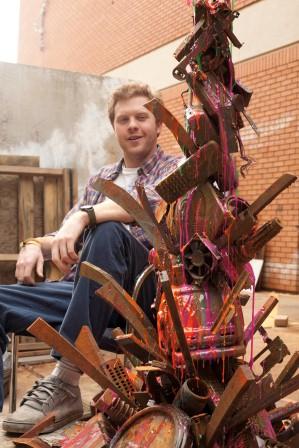
When you go to this spring’s upcoming BFA Student Exhibition entitled “Metamorphosis: A Natural Embellishment” (on display at the Lee Gallery from April 29th to May 3rd – mark our calendars now!) you might find yourself looking at the work of senior Chipper McCall and thinking, “This…this is garbage.” And, what you may find surprising, is that you would be completely right.

“I have always been intrigued by the vast scale, and seemingly unstoppable development of humanity,” Chipper told me this week when I sat down to interview him about his studio practice. “Specifically, I have been drawn to the byproducts of [human] growth; the waste that it produces.”

Despite the fact that the majority of his sculptural work is constructed from found trash and his paintings focus on neglected areas and subjects of human development, Chipper’s work is far from something you would find in a city dump. His sculptures demonstrate a keen attention to detail and an effective combination of humor and wit that challenge the viewer to think critically about the impact human society has made on our world in the name of development. Best of all, Chipper’s work has a captivating aesthetic that does not leave you with the feeling that you are being preached at; it merely encourages you to ponder the relationship between our expansion as a species and the environment we are displacing as a result.

This is what he had to say when I sat down with him to talk about his work:

Perspective: Why come to Clemson for art?

Chipper McCall: I originally came to Clemson to study architecture. Although I realized after about a semester that my real interest, and talent, was in studio art. I guess it helped that I couldn’t pass math or physics to save my life, and those are essential tools to constructing a building.

P: What is your concentration, and why?

CM: Technically I’m concentrating in sculpture, although I also spend a fair amount of time painting. As simple as this sounds, I’ve always enjoyed making things. As a sculptor, one has the ability to use literally any material available, and make just about anything you can think of. That level of freedom is hard to come by these days, and the thought of spending my life turning ideas into physical reality is very appealing to me.

P: What is the main concept behind your current work?

CM: My current work addresses the somewhat untamed nature of our societies’ growth, and the many physical byproducts that are a result of that growth. As pessimistic as this sounds, I try to draw similarities between our growth and that of a mold or virus.

P: Do you have any special methods or techniques you use when making your art?

CM: Haha, I wouldn’t say there’s anything special about my methods. I generally spend very little time planning, and just try to see where my work ends up taking me. It is easy to waste a lot of time sitting around thinking about how something could turn out, so I usually try to make decisions as I go along and just see what happens.

P: Why do you work in several mediums?

CM: Well my passion lies in sculpture, but that is not always the best way to get across an idea you know? With sculpture you can make a physical object, but things get a bit complicated when you attempt to create an entire scene or landscape. With painting, drawing, and printmaking you can create or depict an entirely new world. Where as sculpture is often placing an imagined object into our reality, other mediums allow you to make a window into another reality altogether. I like to think its good to be flexible when it comes to making art, so I try to mix things up every so often. It really just depends on the idea I’m trying to get across as to what medium I work in.

P: You work a lot with trash/found objects, why is it that you find yourself drawn to these materials?

CM: It all sorta goes back to this idea of growth I have recently been interested in. You see, some of the best evidence of our expansion lies in the physical waste we leave behind. To put it simply, more people more trash. I am not trying to come across as a society hating tree-lover, but it is simply the facts of life. What I am really trying to critique is how much of this stuff we take for granted; something that is an “absolute must own object” one day ends up in the dump the next. I like to use these discarded items in my work in order to bring them back into the public view. Plus, I think there is something manly and barbaric about digging through the trash.

P: Are you showing work anywhere?

CM: I’ve blessed the public by putting my junk all over the place. I currently have a piece installed on the outside of Lee Hall, as well as all over my front porch and living room. Seriously though, I have a print in a show at the Patrick Square Gallery, and at the end of this semester ill have my senior thesis work on display in the Lee Hall Gallery. I have also enter a number of pieces in competitions throughout the southeast, and with a shred of luck may actually get an email back from one of them.

Student Feature: Stephanie Post

By Joshua Kelly Published in The Tiger Newspaper

Hammers, large blunt objects, knives, and large boxes of fire that react temperatures upwards of 2200 degrees Fahrenheit – these are just a few of the tools BFA senior Stephanie Post uses in her studio to make fractured life-size portrait busts and giant organic shapes out of ceramics.


Ceramics have a long history in the art world. First used to make religious and cultic figurines by the earliest human societies over 30,000 years ago, the ceramics is still one of the most widely utilized mediums in fine art culture today. And although you may first think of fine porcelain teacups and plates when you think of ceramics, many clay artists build large sculptural figures that weigh many hundreds of pounds.


Stephanie’s work explores fractured human and organic forms that reference the process of natural decay and artificial mending. This week I sat down with her in her studio to get a better insight to her process and artistic practice:


Perspective: What is your main goal with your current body of work?


Stephanie Post: I hope to draw parallels between these imperfect forms and pain and growth in the human experience. I intend to reference the human figure, if only conceptually, in every form I create. I want to explore how they function both as frozen in motion and as showing evidence of extended wear of decay.


P: How long have you been studying art?


SP: I took art classes throughout elementary and middle school, but first realized it was a field I was interested in pursuing in high school. I took all the art classes my school offered and began as a visual arts major my freshman year of college. I am now a second semester senior in the BFA program.


P: Why come to Clemson for Art?


SP: I actually transferred to Clemson from a private liberal arts school after my freshman year. I chose Clemson because of its spirit and vitality. Put simply, it is a happy place to be. I knew I didn’t want to limit myself by going to a school solely for art (I am interested in psychology as well), so I picked Clemson for its environment.


P: What is your favorite part of the Clemson Art Program?


SP: I love the community of the Clemson Art Program. I have classes with a lot of the same students, enabling us to form unique camaraderie and friendships. We are a family: staying up all night together, helping each other problem solve, and keeping each other going.


P: What is your concentration/ why?


SP: I decided to concentrate in ceramics initially because it was the area I could work in for long periods of time without getting burnt out. As I have worked with clay more, I have grown to love the tactility of it. I can push, pull, hit, tear, scrape, and stretch it and it responds. There is a very physical and personal interaction that happens, involving me on a much more intimate level with my work.


P: What does your art focus on formally and conceptually?


SP: My most recent work has explored ideas of brokenness and healing. Clay has a unique quality of remembering what has been inflicted on it and retaining evidence of that action. I have been creating forms that reference the human figure, then breaking and mending them. This work is a physical representation of emotional trauma and psychological healing.


P: Can you tell me a little about how you go about creating your work?


SP: After I build the forms with coils, I take any tools I can find in the studio (hammers, saws, knives, screwdrivers, large blunt objects) and beat them. I break off chunks and allow the forms to be disfigured by the beating. I then use a glaze/clay mixture to piece the forms back together. The final works show scars of where they have been broken.


P: Showing work anywhere?


SP: I am not currently showing work anywhere, but am creating a body of work that will be ready for my show in the Lee Gallery that opens April 15th.

Art Faculty, Andrea Freeser Named Creativity Professor

On Monday, April 10 at the CAAH Honors and Awards Ceremony, Dean Rick Goodstein, of the College of Architecture, Arts & Humanities, announced that associate professor Andrea Feeser was named Creativity Professors in the college. Feeser joins assistant professor Christina Hung as the second member of the art department to receive this prestigious distinction.

The Creativity Professorship specifically recognizes faculty members engaged in exemplary, creative teaching and/or research activities. António Damásio, professor of neuroscience and head of the Brain and Creativity Institutes at the University of Southern California stated, “anytime we produce something new, be it an architectural drawing, classroom curriculum, or a new approach to a business problem, the creative process is at work.”

The college intends to reward creativity in the classroom or studio, scholarship, artistic activity and/or multidisciplinary work. Since creativity can be defined differently according to each of the college’s diverse disciplines, the definition remains purposely broad and abstract. Each Creativity Professorship is a two-year appointment and is non-renewable. Each faculty member receives a $2,500 salary supplement and a $2,500 professional development stipend annually for the two-year period.

Feeser plans to use the award to consult specialized libraries, notably the Charles W. Moore Center for the Study of Place at UT Austin as well as to visit Freud’s House in London and Ireland’s often-idealized County Leitrim. She said the result of this research will help her classes to “benefit from what I learn from the libraries, locales and colleagues the professorship will enable me to engage.” Ultimately, she noted, that she will return from her journeys “vitalized as a scholar… [and] as a teacher.”

Feeser received a B.A. from Williams College in 1984, with a double major in history and art history. In 1996, she received a Ph.D in modern and contemporary art history, theory and criticism from the City University of New York Graduate Center. Jack Flam and Linda Nochlin supervised her dissertation on Picasso’s art and politics from 1942-1962. Feeser has taught courses at SUNY-Purchase, at California State University, East Bay and at the California College of Arts and Crafts. She was assistant and associate professor of art history at the University of Hawaii at Mānoa from 1996-2002, and is currently associate professor of art history at Clemson University. Feeser has published widely on modern and contemporary art and visual culture and is the editor for the Parlor Press book series, Aesthetic Critical Inquiry. In 1998, Feeser and artist Gaye Chan founded DownWind Productions — a collaborative of activists, artists and educators — to explore the past and present effects of colonialism and capitalism in Waikiki. DownWind Productions distributes information through the public art project Historic Waikiki, and the book Waikiki: A History of Forgetting and Remembering (University of Hawaii Press, 2006). Historic Waikiki was featured in the 2004 New York Asia Society exhibition Paradise Now? Contemporary Art from the Pacific.


(Indigo plants in South Carolina, image copied from an eighteenth century South Carolina map courtesy of Perkins Library, Duke University)
Her latest publication, Red, White, and Black Make Blue: Indigo in the Fabric of Colonial South Carolina Life (Athens, GA: University of Georgia, 2013. Print) is forthcoming later this year and may be pre-ordered on Amazon’s and Barnes and Noble’s web sites.

International Visiting Artist, Suzanne Bellamy 4/8 – 4/12

Under Southern Skies, An Australian Perspective on the World
International Visiting Artist, Suzanne Bellamy

Exhibition
Acorn Gallery in Lee Hall
April 8 – April 12, 2013

Artist Lecture
Lee Hall Room 1-100
Monday, April 8, 6 p.m. to 7 p.m.

Reception
Monday, April 8, 7 p.m. to 8 p.m.

International artist, writer and scholar, Suzanne Bellamy will be exhibiting her works of art as well as providing a lecture sponsored by the Center for Visual Arts at Clemson University beginning Monday, April 8.

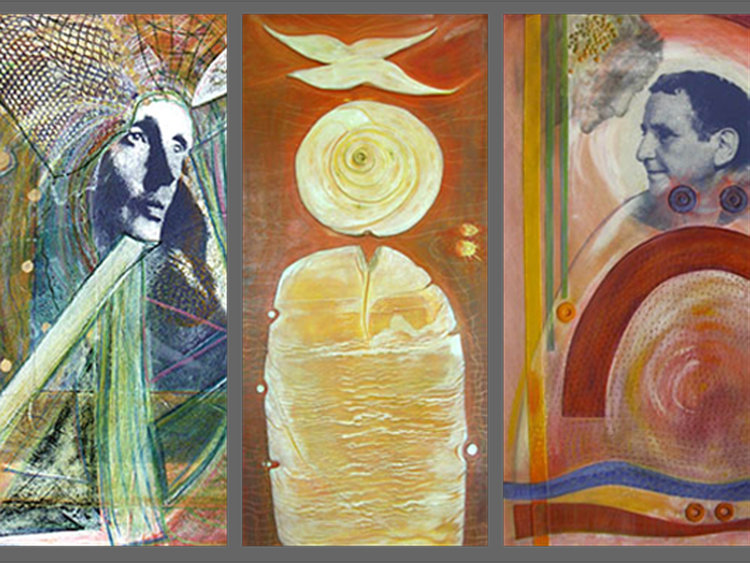
Bellamy began her career in her home country of Australia. She received the prestigious title of Virginia Woolf Scholar and continues to be invited to exhibit internationally. Her works infuse text and image with multimedia, print and painting.

She received a PhD from the University of Sydney focusing her doctorate work on Woolf Modernism and Australian literature.

The exhibition can be viewed in the Acorn Gallery located in Lee Hall at Clemson University Monday, April 8 – Friday, April 12, 9 a.m. – 4:30 p.m. Bellamy’s lecture will be Monday, April 8, 6 p.m. to 7 p.m. in Lee Hall room 100. A reception for the artist will follow this event.

Admission is free to the exhibition, lecture and reception.

Artist Photography Lecture – Jianming Zhong 4/1

Clemson University’s Art Department presents Visiting Artist: Jianming Zhong, Department of Photography, Nanjing University of the Arts, China

Date: Monday, April 1st, 2013
Time: 5:30 – 7:00 p.m.
Place: 1-100 Lee Hall, Art Department, Clemson University
Cost: Free and open to the public

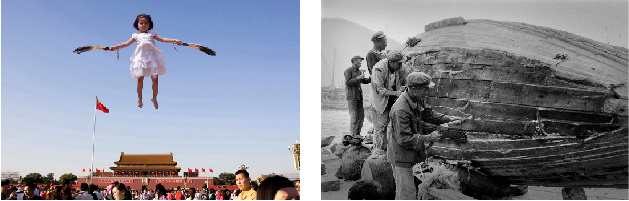
Economic reforms in China in the past decades have brought fundamental changes and comprehensive modernization to the Chinese culture and society. The profession of photography as well as popular interests in it is of no exception. In a recent regional photography competition, 180,000 photographs were submitted for an exhibition of 800 pieces. This speaks for the intense interest in photography among the Chinese today. Each photograph could offer thousands of words of rich stories. In this context, our distinguished guest speaker, Professor Jianming Zhong, will deliver a talk that covers the background behind such interests and its significance in the nation’s future.

JIANMING ZHONG is a professor of photography and Chair of the Department of Photography at the Media College, Nanjing University of the Arts, Nanjing, China. He has held prestigious positions as a fellow of China Photographers Association and a member of its China Commercial Photographic Committee. Professor Zhong is also a standing board member of Photography Education of the China Association for Higher Education and the Photographers Association of Jiangsu Universities and Colleges. In the last decade, Professor Zhong has been active in promoting international exchanges on photography, including organizing international photography exhibitions, organizing photography missions bringing in internationally renowned photography professors to China, and offering lectures in the United States, South Korea and other countries. His own work has been exhibited in China, South Korea, and the United States.

This event is co-sponsored by The Department of Art and Chinese Students & Scholars Association