Clemson Visual Arts

Student Feature: Katy Butler

by Joshua Kelly Published in The Tiger Newspaper

Welcome back everyone, or perhaps I should say please welcome me back — I have been gone a few weeks dealing with everything I still have to do before graduation, but I couldn’t leave y’all undirected on where to get your culturious fix for long. Over the last few weeks of the semester, we will be looking at a slew of artists about to graduate from the Clemson Art Department, and I can assure everyone that the MFA/BFA gallery season this fall will be one that you won’t want to miss. Last week I sat down with Katy Butler, a MFA candidate in Visual Arts focusing in print-making, to talk with her about a body of work two years in the making.

We all remember learning the letters of the alphabet in kindergarten, from some form of flashcards giving the message that A is for Apple, B is for Banana and so on. Have you ever wished that someone would make a version explaining all the memes and aspects of communication that take place on the Internet? Well, wish no further!

Katy Butler has been working on such a project for the last two years. “The overall theme of the work is the potential dangers involving issues of identity and community building in the online realm, especially pertaining to adolescence and the eventual commodification of self that often results from extended online exposure,” Butler said. But the alphabet series is not a simple didactic tool exploiting common themes and motifs of the Internet. Butler’s work goes beneath the surface of simple online interaction. “What spurned me on to make this work was an irritation about people assuming that anything that happens online has no weight in the actual world.” According to Butler, the suicide of the Canadian teen Amanda Todd in October 2012 was a very influential event for the series. “[The suicide of Amanda] clearly indicated that any action you have online does matter, whether emotional, physical or otherwise.”

Katy Butler’s “Alphabet Series” is not only informative for those who have not spent a lot of time creeping in the darker corners of the Internet, but there are also a bounty of other reasons to go see her work. Her command of screen-printing and use of graphic elements and saturated colors make her work visually captivating. Viewers are able to follow along with the “avatar” of the series, a teenage girl in conservative dress with pigtails and hairy legs, harkening back to Butler’s own adolescence and motifs of innocence and youth, as she navigates the intricacies of online communication. “Language is a really interesting tool because it really informs your space,” Butler said. According to her, the set of words that occur over and over in discussions about community building on the Internet are “often recurring for a reason; they are illustrating something that is happening online and some way that the communication is changing that is significant.”

Although her work may appear lighthearted upon first glance, Butler’s “Alphabet Series” ultimately explores the darker side of Internet existence — the commodification of the self. “As the series progresses it is more of a critique that addresses what happens to the identity after extended online exposure in that it becomes more warped, it becomes about gaining attention, so the identity is commodified or somehow changed from the [original] personal identity that you enter the online realm with.”

Katy Butler’s work was on display in the Lee Hall gallery in her thesis exhibit “Command Shift.” The other featured artist in this show, David Armistead, dealt with abstract representations of sports (mainly football), so this show was everything a college-age student could ask for in an art show. Really, memes and football in one place?

Student Feature: Alyssa Reiser-Price

by Joshua Kelly Published in The Tiger Newspaper

“I have always been interested with why we remember certain things and not others. So [my work] has a lot to do with these every day, mundane moments that tend to stick with us rather than these really big events in our lives,” MFA painting student Alyssa Reiser-Prince explained to me when I sat down with her this week to talk about her upcoming thesis show, “Being There” (which will be on display in the Lee Gallery from Nov. 15-22). Her work deals with the very phenomenon which gives rise to our own self-awareness — the act of remembering — in a way that allows the viewer to not only better understand the act of remembering itself, but also gives insight into why we may remember certain things rather than others.

Certainly there is a great deal of literature, both in philosophy as well as psychology, that explores the concepts behind human memory in great detail. However, the work of Alyssa Reiser-Prince (as well as the fellow MFA candidates featured in the “Being There” exhibit) attempts to tackle this experience from a visual standpoint.

Starting with a vague memory from childhood, or merely a simple concept like “clean,” Rieser-Prince takes that memory and truncates it, reducing a specific recollection to an abstract visual that anyone can approach. This process of diminishing personal memories to the point of a semi-recognizable composition is meant to evoke a variety of associations and memories in the viewer, paralleling the actual process of remembering what we go through every day.

She prefers to focus on memories that we may tend to think of as small and insignificant. When asked why this is her preferred subject matter, she responded, “We end up basing our identities off of these seemingly mundane moments, and it is through the process of remembering that we engage with them … But the process of remembering is an active process. You are constantly reinterpreting what you remember based on your present situation, so it is a very subjective process. [Your memories are] constantly changing and shifting.” By bringing attention to how many different associations and recollections any individual can have when viewing a vaguely familiar visual, Resier-Prince underscores one of the most mundane facets of how our memory works. It isn’t always the huge events in our past that form who we are, but rather the many small details we often don’t realize we will remember that shape our identity and dictate how we react to the

larger life events.

In her process she translates the qualities of particular memories — rather than the specifics — into the process of making the paintings themselves. “Childhood memories are often very visceral and immediate,” Resier-Prince said of a series of smaller paintings that she worked quickly with little to no preplanning. “There is not a lot of time spent between thinking about the memory and making the painting; they are very direct.”

In making this body of work, the process was very important to Reiser-Prince. Because the paintings were worked in the style of the process of remembering, they become “very emotionally subjective spaces” and are not intended to be representations of any specific event. There is an inherent questioning within the process as well that hopes to point out that the line between truth and fallacy within our own self is sometimes (more often than not) more murky than we actively think. With this consideration, her paintings sometimes contain an internal failure and seem to lack a realized or fully resolved composition. Reiser-Prince explained that this is intentional. “My paintings are fleeting and incomplete because these moments depicted are themselves fleeting and incomplete,” she said. These works leave the viewer at first wanting more than they are presented with on the canvas, and then it is the task of the viewer’s memory to fill in those blank spots and experience an internal examination of the process of remembering.

So if you are into learning more about memory and how your brain works (or how it doesn’t work like you would normally think), or if you are just into becoming more cultured — that is what all the cool kids are doing these days — be sure to see the works of Alyssa Reiser-Prince. Stay culturious Clemson.

Nationally Known Artist Dana Saulnier Exhibits at Clemson

by Jackie Kuntz Published in The Tiger Newspaper

DecadePaintings

I sat in the Lee Gallery watching as visitors approached the work of Dana Saulnier.  Each was curious, some almost uncomfortable, as they appeared to struggle with their emotions. The images may have appeared dangerous which elicited feelings of vulnerability.  While the textured ridges on the painting’s surface tempt a closer examination, the viewers keep their distance, held their breath, waiting for this writhing, carnal mass to come tumbling out of the frame.

Dana Saulnier lives and works in rural Ohio.  The influence of his environment–its deep colors, elemental texture, and pulsating passing of time in nature–swell and seep from the canvas.  Every fiery hue of red, every sappy deep green, references the organic while subtle flesh tones peek from beneath the buildup of texture; the gestural hand of the artist is the work’s dominant trait. Though the color scheme seems to most reference the romantic palette of the Hudson River Valley landscapes, the application of paint and expressively bold strokes almost answer to Goya influences.  This is just one of the many paradoxes this body of work manifests. Is the subject matter visceral or landscape oriented? Is it a depiction of some tragic decomposition or something full of life? Is it confrontational and threatening or the culmination and destruction of something that can no longer bear its own weight? Upon closer examination, one might be able to make out a hand, a storm, a cup, a sail, or arguably a human spine, but the overall aesthetic is abstracted grandeur.

An interview with the artist cast light on the subject nature of this ten year visual thesis, “The ‘night paintings’ began with my attempt to structure, within painting, the personal loss experienced as one that I love slipped away into an illness that erased memory, thereby collapsing the relation we had and sending it into darkness.” This is no thematic simplicity of cause and effect. So much is embedded into the reference of time and mass and loss; both figure and ground are established and paramount–the earnest conversation between the two is left up to the viewer to grasp and unravel.  The work “impels presence” though referencing the inevitably ephemeral through its undeniably “carnal” imagery. The flesh tones, their warmth, its weight, become an abstracted tumbling and struggling heap of life that rises and falls like the breath in one’s chest.  The painting possess no deliberate context: the arbitrary scenery, lost for placement or time, becomes the perfect stage for this cyclic struggle. The braided forms mushroom and build without rational or regard to stability before folding in on themselves in a cataclysmic implosion. The grief of the artist’s loss weighs heavy in the air. A raw human reverence is shared.

The show will be open until September 25t.  An informative lecture by the visiting artist will be held on September 16th in Room 100 Lee Hall from 5:30-6:30 p.m.  This guest lecture will be followed by a reception for the artist in the Lee Gallery and light refreshments will be served.


Boomerang: BFA Student Exhibition

By Joshua Kelly Published Article in The Tiger Newspaper

Boomerang Subsistence is one B.F.A. show you do not want to miss this April. Sculpture by Gracie Lathrop, pastel drawings by Amber Rody, photography by Alice Wannermaker, and prints (and a video game!) by Travis Wood will be on display in the Lee Gallery from April 22nd–26th, and the reception – where you can get some free food and talk with the artists about their work – will be that Friday, the 26th starting at 6pm. These artists chose the show title “Boomerang Subsistence” because although most seniors in the Clemson B.F.A. program modify or completely abandon their concept at least once throughout the year of preparation and art-making that precedes their showcase, these four artists have been investigating the same themes through their work for over a year.

For sculptor Gracie Lathrop, the topic that has been at the forefront of all her work for over a year is a focus on tradition, particularly the investigation of and attempt to preserve her own southern heritage. The body of work that she will be showing uses furniture typical to what our generation may consider the antiquated south to bring viewers to a place that recalls not only southern heritage, but a nostalgia for a lifestyle that is rapidly disappearing. Her process of covering furniture with packaging materials such as tape or cloths, combined with a hardening agent like latex or glue, and then presenting us with these form “covers” in the gallery, transforms a solid piece of furniture into a shell of what it once was. While viewing her work, gallery goers are reminded of belongings perhaps similar to those seen in the houses of their grandparents, and because of the delicacy with which they are presented, Gracie’s work asks the viewer to consider the fragility and struggle of the act of the preservation of one’s own heritage.

Amber Rody’s pastel drawings address a topic that, more than likely, has been on the minds of about 98% of Clemson student’s minds for more than just the past year – sex. However her work is far from anything that you could consider pornography. Her drawings highlight the positive aspects of being in a sexually active relationship; the intimacy, the trust, and the struggle of growing together as a couple. Amber focuses on these aspects of sex to draw contrast to the view embraced by popular media that there is something about sex that should make us feel shameful for enjoying it. Her work is a reaction to the phenomenon that although popular culture idolizes the image of sex, social conventions make it “unacceptable to speak about and expected to be a hidden component of our personal lives.”

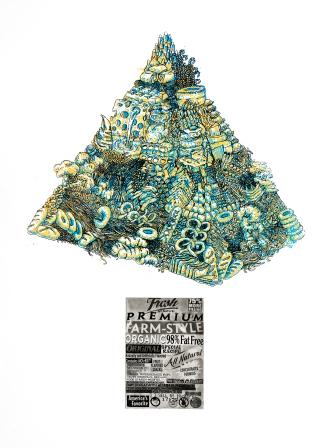
Another topic sure to be on the minds of college students is that of organic and natural foods. Alice Wannamaker’s documentary style photography tackles this issue by highlighting members of the local community that are also engaged and passionate about organic food. Her photojournalistic approach presents viewers with a glimpse into the lifestyle, mindset, and environment that these local farmers and growers live and work in. She draws attention to the various relationships between grower, preparer, and consumer; emphasizing that concern for where your food comes from is not only something that more and more people are caring about, but something that everyone should care about as well.

Through a variety of media including printmaking, painting, drawing, and even a video game, Travis Wood engages with the issues surrounding the ever increasing use of genetically modified organisms (GMOs) in mass produced/consumed foods – a concept that is on the other side of the organic food coin. Through the use of satire, Travis attempts “to blur the fine line between the progression of science and science fiction to the point of uncertainty.” His work asks viewers to consider their use of GMOs in their everyday life and strives to push the viewer to research GMOs more in-depth. Travis’ work features the faces of friendly farm animals, with super animal/human abilities due to their modified genes, in an attempt to provoke the viewer into questioning the ethical and health related issues raised by humankind’s attempt to control and perfect domesticated animals.

Wunderkammer: BFA Student Exhibition

By Jackie Kunst Published in The Tiger Newspaper

“Wunderkammer.” It is a term coined in 16th century translating as a “cabinet of wonder,” and a very fitting title for the upcoming B.F.A. gallery opening. The show, open April 8th-12th is the first of a series of senior showcases for the largest graduating class the Art Department has yet to yield. The pieces are the culmination of a year’s dedicated thematic research and four years of technical artistic maturation. The work in the show supersedes the binds of societal conventions in sculpture, revels in the ambience and intricacies of layered paint and graphite, highlights the personally unique nuances found through a camera lens, and brings to the table the visual breadth and varied texture of the printmaking process. The senior work consists of sculptures created by Mariana Hay, prints by Kirsten Asplund, drawings by Jessica Carey, paintings by Natalie Rushing, and photography by Lindsey Harris.

The playful dichotomy found in Mariana Hay’s sculptures will spark the gallery goers’ interest. Her work exploits gender constructs, presented in the conventions of gender specific hobbies, home décor, and aesthetic preference. She highlights how the competing characteristics inherent to hearty masculinity and delicate beauty mesh, clash, relate to, and inevitably complement one another, achieving a natural harmony. The sculpted, “gender-pleasing” objects are meant to function cohesively in the gallery but stand alone honorably on their own as well- each a picture of the greater social construct man and woman – relevant to ever viewer, no matter the role they play.

The thematically laden content in the works of Kirsten Asplund will evoke a visceral response in the viewer. Through the laborious printmaking technique, she seeks to delineate the “struggle to stabilize and cohere, interpersonal relationships, and identity” in respects to the complex and ever changing concept of home and place. Her obscured and transmutated figures challenge physical reality in order to represent the visceral and emotional response of being and identity.

Expect to be floored by the photo realistic craft and mastery with which drawing concentration, Jessica Carey brings an ephemeral portrait to fruition. With a delicate hand, she explores her past, drawing both traditional portraits and still life representatives of the human essence. She draws with the intuitive drive and longing to understand who her mother and grandmother were and the enduring relationship that transcends linear time and seeps through the veil separating life and the beyond.

Natalie Rushing uses every hue and texture achievable in the medium of paint to build up thick, hatched, gestural brushstrokes that collectively harmonize in patterns and blocks to form a portrait. Large scale and realistic, the eyes of the female subjects confront the viewer, presenting a question of shocking uncertainty of who is actually viewing who. From the beginning of her process, her works seem to exhibit a raw, inherent glow that either warms or haunts the viewer. She hopes the audience will share in the subject’s “out-of-body” and “reverent psychological state” as she uses the expressive medium to better understand the world and culture around her.

A glimpse at one of Lindsey Harris’s photographs and the viewer feels as if it is them, following a girl through a field- hearing the rustling of the grass, senses the goose bumps from a breeze, quietly trailing behind the guide to an unknown destination. The photographer seems to revere and evoke the essence of her captured subjects. As the viewer experiences the captured moment of the model in their element or sifts through a collection of keepsakes, one can almost hear the private silence that drifts in like pollen on a breeze, suspended between the subject and camera. The Lindsey’s soft lighting and style, rich in nuances tint the lens through which the viewer sees the world.

Contingencies: BFA Student Exhibition

by Joshua Kelly Published in The Tiger Newspaper

Featured Artists: Nick Baldwin, Jena Heaton, Sierra Kramer, Stephanie Post, Natalie Rainer

The second BFA show in the month of April will be Contingencies, and from the 15th through the 19th, photographs by Nick Baldwin and Jena Heaton, sculpture by Sierra Kramer, ceramic work by Stephanie Post, and prints by Natalie Rainer will be on display. The artists in this show work in a variety of media, but formally they all deal with processes that are subject to chance and a high rate of unpredictability, while at the same time each artist takes careful measures to ensure that their hand is evident in the final piece.

Nick Baldwin prides himself in being somewhat of an unorthodox photographer. His work for the show will feature a series of portraits, taken by iPhone, that have been run through various glitch-causing programs (which visually distort and corrupt the image). After altering the portraits randomly he takes them into photoshop to fine-tune the visual mutations, sometimes augmenting the damage to the original image and sometimes bringing back parts of the initial portrait. This gives each finished work a unique character; some end up referencing famous artworks from history while some portraits become so abstract the viewer is left wondering how what they see could have at one point been a portrait of anyone. Through this method of abstraction, Nick’s work provokes his viewers into asking questions like just how reliable is technology, and how much faith should we have in these electronic tools we rely so much on when they can often glitch and corrupt our data with no provocation at all?

Sierra Kramer’s instillations challenge the viewer’s perception of their surrounding world by transporting them to fanciful landscapes populated conspicuously with color and shape. Her sculptures, which seek to examine the relationship between a person and their individual memories of experiences and life stories, are inspired by an interest in perceptual psychology. Aesthetically her work ranges from illusory and mystic to effervescent; and much is still on display across the new Lee 3 Architecture Building. For Contingencies, Sierra will be reinstalling several of her pieces from Lee into the Lee Gallery as well as providing documentation of some of her previous work from the past year.

Natalie Rainer’s prints are a marriage of her unorthodox “throw-ink-on-plexiglass-and-electrocute-it” monoprinting method and uber-precise plexiglass etching technique producing works that are hypnotically transcendent and reminiscent of fantastical landscapes and nature scenes. Her intent with her work is to build a visual vocabulary to describe her personal mythology, adapting some imagery from established mythological traditions but primarily creating a personal codex as she goes along.

The ceramic busts of Stephanie Post are one-part planning, one-part semi-planned destruction, and one-part “hope this doesn’t fall apart when I put it in the fire.” The end product? Voluminous humanoid-like organic forms that appear to be preserved in a state of mid-decay. Referencing the pain and struggle of the growth that comes from the human experience, her work captivates the viewer by peaking their curiosity (her forms are very intricate and close inspection is required to fully appreciated their complexity) and invoking an emotion of compassion and concern for the weathered pieces.

Although formally her work does not resemble Nick’s, conceptually Jena Heaton’s photography asks a similar question: how much can I trust what I see in front of me? By arranging mirrors within various landscapes, usually during or right before dusk, Jena contrasts the naturally occurring lack of light within the landscape itself with human manipulated artificial light sources captured by both the mirrors placed in the landscape and by the camera as a result of the time-lapse photography process she employs to make her pieces. The resulting work is both whimsical and solemn. Upon first glance, many of her photographs appear to show the viewer a fairy-like being inhabiting these various spaces in nature, yet the careful positioning and framing of the mirrors which she has placed within these landscapes asks us to contemplate the reality and truthfulness of the image we see; where does our existence lie? Here on this (out)side of the frame, within the frame alongside the fanciful, or deeper still within the various mirrored worlds reflected back at us from within the image itself?

2012 Clemson Ceramics National Juried Exhibit

This inaugural biannual exhibition asks artists to explore “containment” through the lens of functional ceramics. The goal of this year’s exhibition is to showcase a diverse collection of ceramic tableware and functional objects, while attracting a broad range of contemporary voices from across the country.

Each artist may submit up to three images. Entries must be submitted on a CD in jpg format at 300dpi, 4”x6”. Please name each image file with the artist’s last name, entry number, and artwork title (i.e. Smith_01_Bowl.jpg). Please save all images with the correct orientation. No slides will be accepted. Any work that does not match the digital image in quality will be rejected from the exhibition. No substitutions will be accepted. Please send CD of images, entry form, stamped notification card and entry fee to:

Lee Gallery, Clemson University
G-02A Lee Hall, Box 340510
Clemson, SC, 29634-0510.

No artwork may exceed 36” in any dimension.

Full details for submissions here.