 Since October is a popular month for visual arts undergraduate students to begin researching and applying for graduate schools, I’d like to share some reflections from current MFA sculpture candidate, Kimberly Day as to why she chose Clemson University over a big city school.
Although many students are drawn to Clemson University because of its reputation for having a highly ranked football team, this was not on Kymberly Day’s list of criteria when looking for a strong MFA program. After graduating with her BFA, Kymberly joined a Greenville independent studio. During this time she applied to “big city” graduate art schools, two Portland universities and Clemson University. Some of Kymberly’s main concerns were affordability, living proximity, the program’s reputation, and the pace. Clemson’s MFA program ranked highly in each of these categories, making Clemson University Kymberly’s first choice.
The year-round paid teaching assistant position was a huge influence in Kymberly’s monetary minded decision. Clemson is in a rural location and has a lower cost of living comparative to some bigger city schools she was considering. Working in large three-dimensional sculptures and not having to rely on public transportation was a huge advantage as well. Clemson’s program is also known for placing graduates in teaching positions which is a rarity with other schools. Lastly, Kymberly found that the pace and social environment of the program was very supportive, a refreshing reality to more cut throat programs.
If you are looking to apply to the Clemson MFA program, search for dates and application requirements at http://www.clemson.edu/caah/departments/art/academics/graduate/applying.html or contact our MFA Program Coordinator, Dave Detrich, ddavid@clemson.edu.
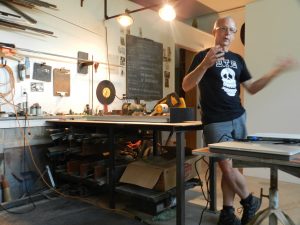 Earlier this month, Center for Visual Arts-Lee Gallery at Clemson University interns visited the studio of sculpture professor and the Master of Fine Arts (MFA) graduate program coordinator, Dave Detrich. All of the art department professors are not only teachers, but they are working artists. Interns were able to view his sculpture in person and they had an opportunity to ask him questions. Here is a summarized account of his answers.
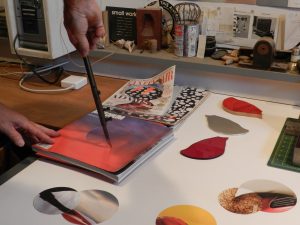 Is there a reason you have been using wall sculpture versus sculpture in the round in your current work?