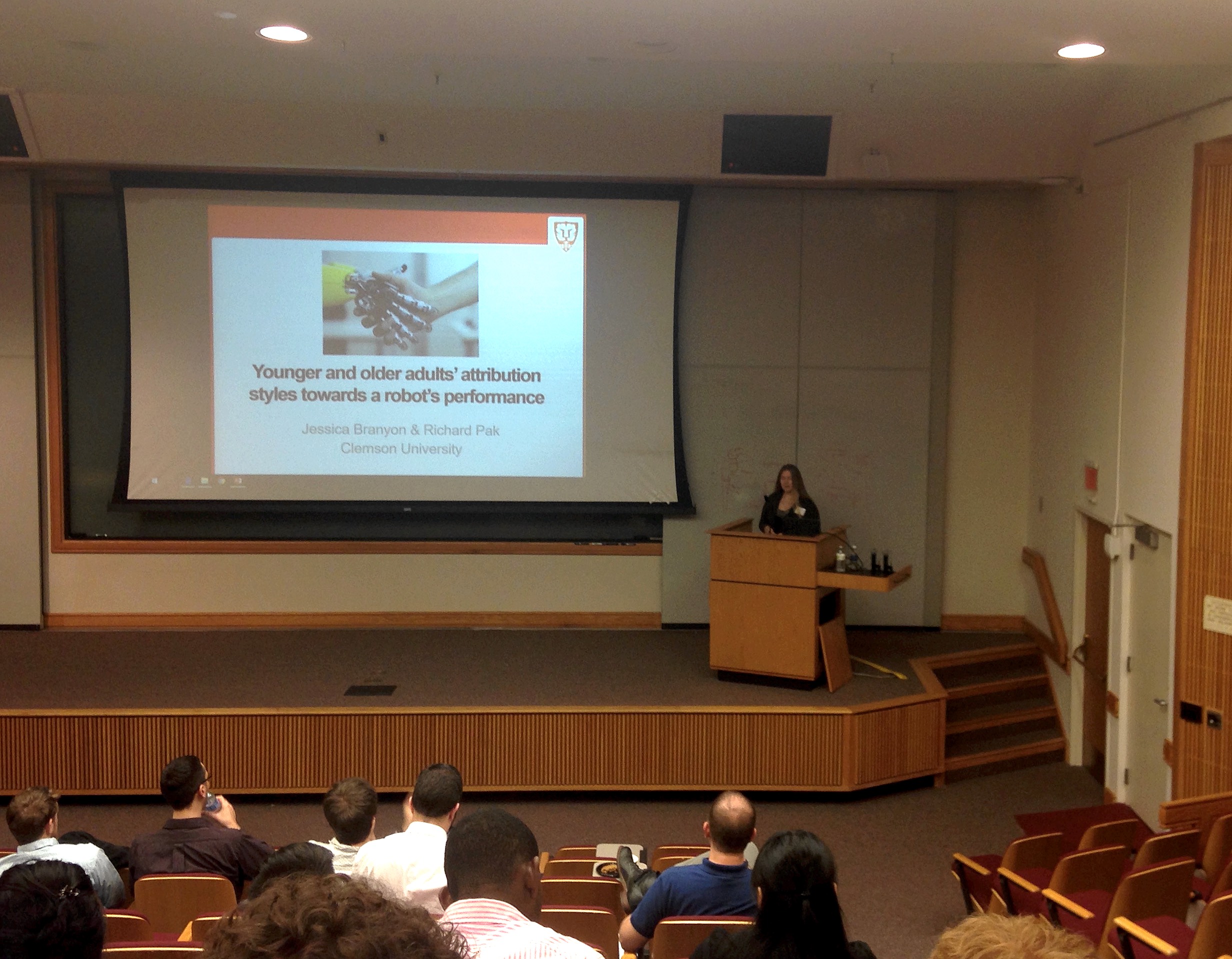
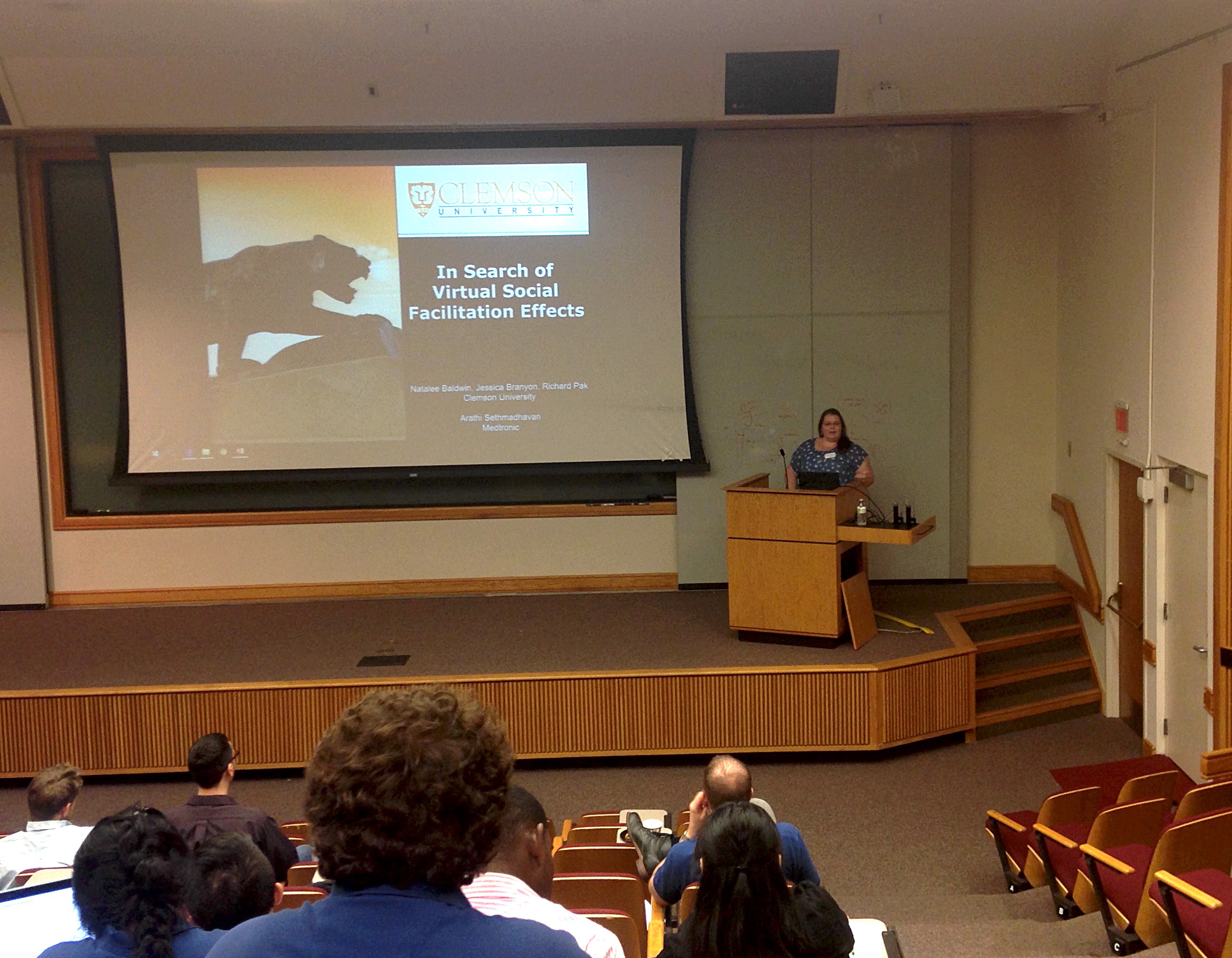
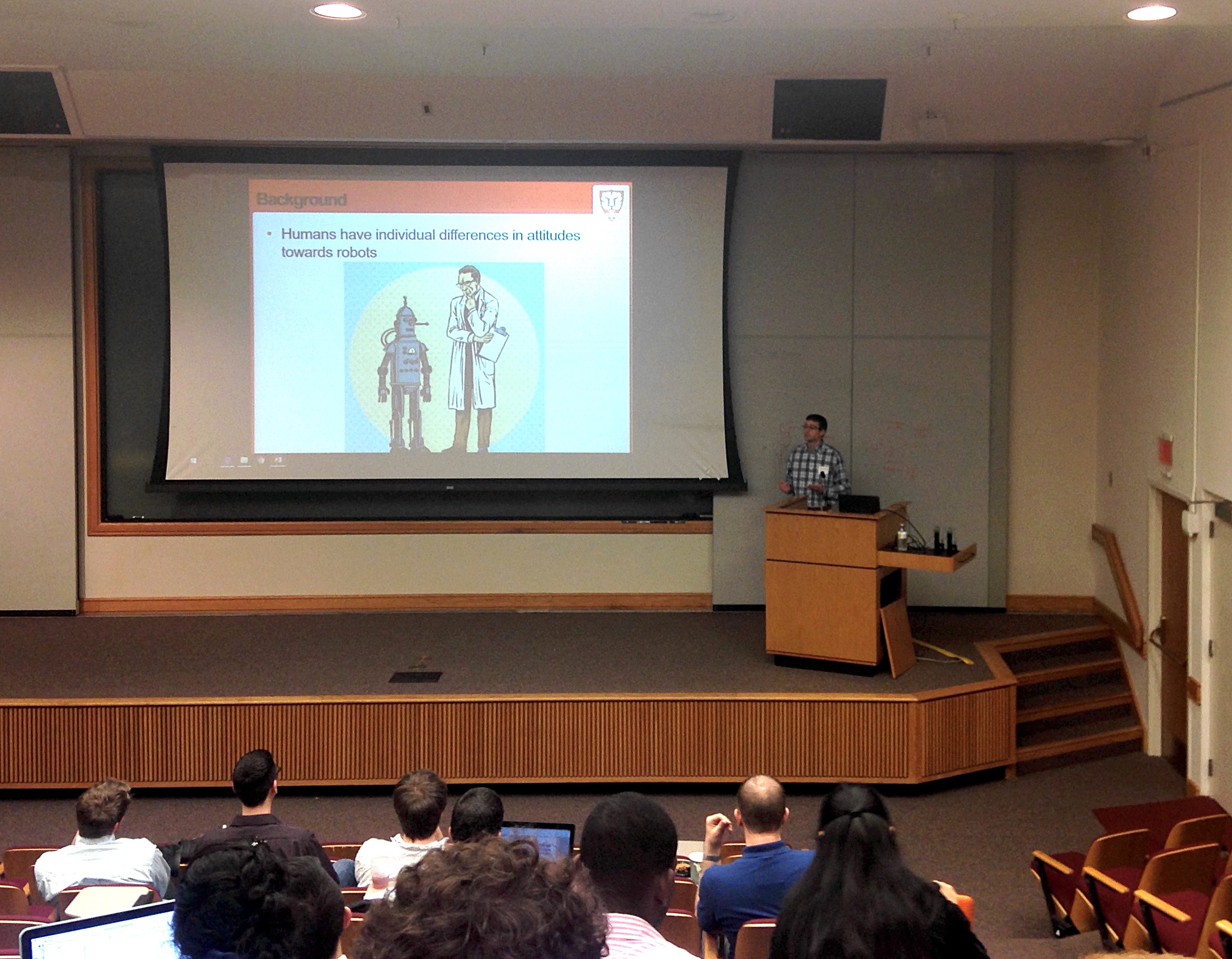
The students recently presented their work at the Duke Robotics Student Symposium, held at Duke University on March 28th.
March 28, 2016
The students recently presented their work at the Duke Robotics Student Symposium, held at Duke University on March 28th.
March 16, 2016
Title: Investigating Older Adults’ Trust, Causal Attributions, and Perception of Capabilities in Robots as a Function of Robot Appearance, Task, and Reliability
Committee: Dr. Richard Pak (Chair), Dr. Kelly Caine, and Dr. Patrick Rosopa
When: Thursday, March 24, 2016 at 10:30am
Where: Brackett Hall, Room 419
Abstract: The purpose of the current study was to examine the extent to which the appearance, task, and reliability of a robot is susceptible to stereotypic thinking. Stereotypes can influence the types of causal attributions that people make about the performance of others. Just as causal attributions may affect an individual’s perception of other people, it may similarly affect perceptions of technology. Stereotypes can also influence perceived capabilities of others. That is, in situations where stereotypes are activated, an individual’s perceived capabilities are typically diminished. The tendency to adjust perceptions of capabilities of others may translate into levels of trust placed in the individual’s abilities. A cross-sectional factorial survey using video vignettes was used to assess young adults’ and older adults’ attitudes toward a robot’s behavior and appearance. Trust and capability ratings of the robot were affected by participant age, reliability, and domain. Patterns of causal reasoning within the human-robot interaction (HRI) context differed from causal reasoning patterns found in human-human interaction.
August 12, 2015

February 27, 2015
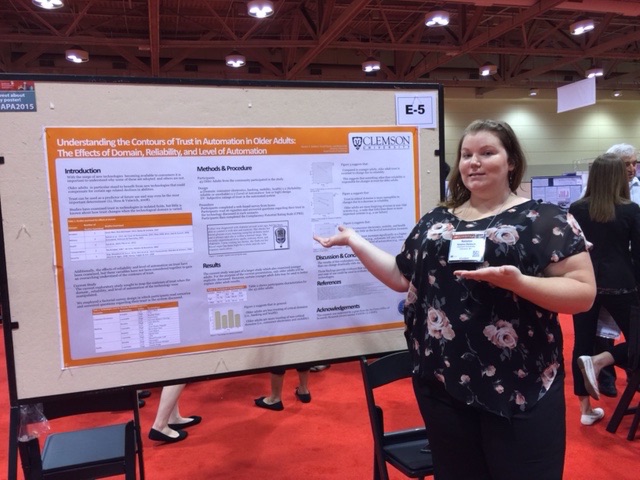
Congratulations to Jessica for receiving the 2015 Hoechst Celanese Graduate Student Research Award from the Department of Psychology!
The Hoechst Celanese Graduate Student Research Award honors a first- or second-year graduate student who has demonstrated exceptional productivity in the area of psychological research. A significant cash prize is awarded to the winner and is contributed by the Hoechst Celanese Corp.
February 18, 2015
Jessica Branyon Thesis Proposal
Committee: Dr. Richard Pak (chair), Dr. Patrick Rosopa, and Dr. Kelly Caine
When: Wednesday, February 18th, 2014 at 12 pm
Where: Brackett 419
Title: Investigating Older Adults’ Trust, Causal Attributions, and Perception of Capabilities in Robots as a Function of Robot Appearance, Task, and Reliability
Abstract: The purpose of the current study is to examine the extent to which the appearance, task, and reliability of a robot is susceptible to stereotypic thinking. When interacting with technology, people focus on human-like qualities of the technology more than the asocial nature of the interaction, attributing human-like qualities such as personality, mindfulness, and social characteristics. The attribution of human-like qualities makes technology susceptible to stereotyping based on appearance and etiquette. Stereotypes can influence the types of causal attributions that people make about the performance of others. Just as causal attributions may affect an individual’s perception of other people, it may similarly affect perceptions of technology. Stereotypes can also influence perceived capabilities of others. That is, in situations where stereotypes are activated, an individual’s perceived capabilities are typically diminished. The tendency to adjust perceptions of capabilities of others may translate into levels of trust placed in the individual’s abilities. A cross-sectional factorial survey using video vignettes will be utilized to assess young adults’ and older adults’ attitudes toward a robot’s behavior and appearance. We hypothesize that a robot’s older appearance will result in lower levels of trust, more dispositional attributions, and lower perceptions of capabilities while high reliability should positively impact trust.
