Chemical & Biomolecular Engineering

“Leaving a Legacy” – The Class of 1963 Endowment

The Class of 1963 Standing in front of Earle Hall in 2011 – Wade Ponder, Al Tolson, Jim Rushton, Cliff Hattaway, John Cromer, Jerry Richardson, and John Elsey. Attending but not available for this picture were Larry Murdoch, Terry Kinard, and Dr. Barlage.

In May 2011, the Class of 1963 ventured back to the hallways of Earle Hall for a class reunion. At that time, some of them hadn’t been here since graduation day – 48 years earlier. This first reunion rekindled past friendships and stirred up plenty of memories of their days here at Clemson, and their hard work in Earle Hall. Since 2011, they have tried to come back every year, along with their wives, in order to keep in touch with each other and what is going on in the department. Now 55 years after their graduation day, experiencing successful careers, and raising wonderful families, they now have taken time to reflect on how it all started. They now want to leave an imprint of their footsteps for others to follow and make an impact on future Chemical and Biomolecular Engineering students’ lives. They want to Leave a Legacy with their new Class of 1963 Endowment. They have pooled their resources and created an endowment that will help enhance the educational programs in the department. Here are excerpts of their stories and their careers, as they reflect on what inspired them to create this new endowment . . .

Class of 1963 on a Field Trip to Olin-Mathieson Chemical Company in Brevard, North Carolina. Front Row (left to right): Dr. W.B. Barlarge, T.R. Kinard, A.D. Tolson, J.M. Clark, J. D. Rushton, W.H. Ponder, J.M. Harmon, L.B. Murdoch. Back Row (left to right): D.B. Watt, J.M. Brown, J.A. Goodson, J.B. Webster, J.N. Cromer, ?, W.H. Chelf, C.T. Hattaway, C.G. Hayes, C.H. Caban, G.F. Ruehling. Absent: J. I. Elsey, J.G. Richardson.

James Rushton “Most of my classmates and I came from small towns and farms, and without our opportunity to attend Clemson, our lives would be much less interesting and successful. I grew up under the influence of Greenwood’s textile mills, and without my ChE degree, would most likely have ended up as a “lint head” working in a textile mill. Thank God for Clemson!” Rushton worked at a paper company in Brevard NC several years after graduation until landing a job at J.E. Sirrine in Greenville SC. After 13 years and taking many graduate courses, he decided to go for his PhD in 1976, pursuing his interest in pulp and paper processes. He moved his wife, Judi, and their three small children to Moscow, Idaho, so he could attend the University of Idaho, under the tutelage of Dr. Lou Edwards, the creator of the GEMS pulp and paper simulation program. He finished his Master of Engineering degree in Chemical Engineering at Clemson, while pursuing his PhD in Idaho. After graduation, he joined the Georgia Pacific Corporation as corporate leader of process simulation and spearheaded the use of process simulation as a means to design and optimize pulp and paper processes, teaching and creating simulation models at GP mills across the U.S. After retiring in 2003, Jim created a consulting business, Cambridge Oaks Inc., and continues to serve as a Process Simulation Consultant for the pulp and paper industry.

Wade Ponder “My family could not afford tuition and a dorm room, but my Father (who only completed 8th grade) said if I really wanted to go, I could commute. So I drove six days a week or 34,000 miles for my Bachelor’s degree. I also helped with expenses by driving an ice cream truck in the summer months. After I earned my Bachelor’s Degree in 1963, I got married, and my wife and I moved to Clemson so that I could work on my Master’s degree in Chemical Engineering, which I received in January 1965. I participated in funding the endowment to the Chemical and Biomolecular Department at Clemson University because of the successes I have had as a result of the dedication and service of the professors in that department. They prepared me for a career that turned out to be beyond my fondest dreams. To me, it is just a way to say “Thank You” for what the department prepared me to accomplish.” After earning his degrees at Clemson, Wade Ponder’s work experiences included teaching chemistry, working for a petroleum company, and working 36 years for the U.S. Environmental Protection Agency, which provided opportunities to work with other engineers in England, France, Germany, Poland, and Brazil. He was one of a team of five chemical engineers at the U.S. EPA who developed, demonstrated, and commercialized flue gas desulfurization technology, that is now used worldwide to remove sulfur dioxide, particulate matter, and other pollutants from power plant emissions. Later, he served as a Branch Chief at EPA and as an Assistant to the EPA Administrator for Research and Development in Washington DC.

Lawrence Murdoch “My choice of chemical engineering and Clemson has provided me excellent opportunities throughout my career. The department was recognized for its quality, which was a result of the dedication of Dr. Littlejohn and the entire faculty. For this reason, I wish to repay the department and help in maintaining the quality and reputation that continues to exist. Because of Dr. Littlejohn’s excellent reputation and contacts, I received several offers to continue graduate studies. As a result, I attended Iowa State University and was well prepared for my studies and for receiving my MS in Chemical Engineering. Even though much of my career was in management, the chemical engineering knowledge, discipline, and work ethic developed during my Chemical Engineering education at Clemson was key to my success.” Larry Murdoch was employed for 50 years, starting in chemical plant production, and soon thereafter moved to the engineering and construction industry. During this period, the varied industries served and the global range of his responsibilities always brought interesting and challenging opportunities.

Jerry Richardson “Chemical engineering was hard- very hard. Chemical engineering taught us to think for ourselves. It taught us to face any problems with the total confidence that we could solve them. I worked mostly in the polyester film industry, so I never did classical chemical engineering. Instead I worked on advanced technology to make ultra-thin films, which went into a variety of industrial uses. The work I am most proud of was working on a team to develop a computerized film thickness system to automatically control the thickness profile of thin films to very tight tolerances. It was the first industrial use of computers according to Hewlett Packard. I received a US patent for that work 46 years ago. My degree afforded me the luxury of meeting and working with and becoming friends with some of the most intelligent engineers in the USA, Germany, and Japan. The most important thing that my Clemson experience did for me is what it is doing for me now – Chemical engineering gave me a great gift – “the love of learning.” I retired at age 58. That was 21 years ago. I have spent the past years, giving away most of what I earned, learning many new things, and putting my new knowledge to work. I started three new careers and two companies since retiring. To paraphrase another one of my classmates, I am extremely grateful for what Clemson has done for me. They made me what I am today and is why I give to Clemson. My choice of chemical engineering and Clemson has provided excellent opportunities throughout my career.”

John Cromer “I also have benefited personally and financially from my Chemical Engineering degree from Clemson. My career has afforded me the opportunity to interact with many extraordinary individuals, many of them engineers. The one goal we all shared was to solve or eliminate problems that came our way. During the last few years, several of us from the ChE class of ‘63 have been returning to Clemson each spring for a reunion. I have taken two wonderful revelations from those reunions: My ‘63 classmates stand high on my list of extraordinary people. The list now includes many more of the Clemson Family, especially the ChBE Department staff. I never thought much about a Clemson ChE Class of ‘63 legacy. Last year at our reunion, the group did what we do best, problem solve. We proudly came together to agree on our class legacy and establish an Endowment. In closing I would appeal to all Clemson Alumni to consider establishing similar class Endowments to cement their Clemson Legacy, which lives on long after we’re gone. It’s a great way to give back to the institution that has contributed so much to who we are.”

Cliff Hattaway “I never had a problem obtaining a worthy job with an Engineering degree from Clemson. Back in 1963, I was one of the first ChEs to be offered a job with Gulf Oil in Port Arthur, Texas, prior to entering the Army. Later, it didn’t hurt to have been a Captain in the US Army back in the sixties. I retired from Phillips 66 back in 1994, where I had several different jobs. Besides receiving my Chemical Engineering degree in 1963, I also received a masters in business from the University of Virginia. Basically my employers always figured that a ChE could do anything from Marketing and Engineering to Financial Accounting.”

Alfred Tolson “My Clemson Chemical Engineering Degree first earned me a job. I had five (5) job offers upon graduation. When I started working, I found I was well prepared for the transition to the real world of chemical manufacturing. There was solid knowledge of chemical engineering principles plus practical skills that had resulted from the Unit Operations Laboratory, Plant Design, a Senior Thesis Project, and Senior Seminar experience. My professional career was spent with one company, Tennessee Eastman Company, later Eastman Chemical Company (with a two-year interruption for military duty.) I basically worked up through the ranks in a manufacturing division as an individual contributor, area supervisor, group leader, development section head, to department superintendent of three (3) different departments: one development and support and two manufacturing. There were also a few staff assignments sprinkled in along the way. I did get my Professional Engineers License, which we were encouraged to do at Clemson. Some of our class started gathering annually at Clemson for a few days about six years ago. We were impressed with the welcome and attention we received from the Department. Along the way, realizing what our degrees had meant to us in our careers, someone in the group suggested that we do something to give back to the Department. That something, with the help of the Clemson Staff, became the Chemical Engineering Class of 1963 Endowment. I suggest to all other classes to reconnect with the Department and maybe be inspired to find a way to give back.”

Enoch (Chip) Hurst “My ChE degree opened the door into a much wider world, totally different from my agrarian upbringing. I started Clemson with the class of ’63, but was withdrawn for a year to serve in my National Guard unit because of the Berlin Wall military deployment in 1961-62. While I returned and graduated with the class of ’64, I have always returned to join the more active class of ’63 at reunions. I did eventually get a masters degree in finance from UNC-Charlotte and a Professional Engineering Certificate. I worked in industrial settings for 32 years and retired at age 56 from Bridgestone-Firestone at the same time as my French-teacher wife. My wife and I sold the house, gave our possessions to our three children, and backpacked around the world for 5 years. We settled in Florida, where I taught math online for awhile, and now I am writing my first book. I am currently in my 79th year and expect to publish 3 non-fiction books this summer. My wife and I cruise a few times a year with friends, and I am scheduled to play tennis and golf six times a week if it is not raining. We spend three to four weeks a year with our three kids (all are Clemson grads) and six grandkids (future Clemson grads). We are living the dream!”

Dr. Barlage and John Elsey in 2011
Back at Earle Hall in 2016: John Cromer, Wade Ponder, Al Tolson, Jerry Richardson, Jim Rushton, and Larry Murdoch

“Paying it Forward” – Dr. Stephen and Patricia Melsheimer Endowment

Dr. Steve and Patsy Melsheimer

In 1961, Dr. Stephen Melsheimer started his academic career as a Chemistry major at Louisiana State University in Baton Rouge, Louisiana. However, the Chemistry curriculum did not motivate him, and his grades began to suffer. After his fall sophomore term, Dr. Melsheimer decided to give Chemical Engineering a try and switched his major. It was there in Chemical Engineering that he met his mentor, a professor by the name of Dr. Dale von Rosenberg, who taught the equivalent of ChBE 2110 – Mass and Energy Balances. Dr. von Rosenberg had a rather gruff, caustic manner and was a rigorous grader. As LSU had an “open door” admissions policy, and the first ChBE course is always a challenge, many sophomore ChE students (nearly 50%!) would fail or drop However, he was very interested in his students, especially those who worked hard. This inspired Dr. Melsheimer, who earned an “A” and his subsequent GPR took a significant turn for the better. He took the balance of his sophomore ChE classes in summer school and caught up with his peers as a junior in ChE. After another successful term in his Fall junior term, he received a $250 scholarship (big money in those days!) This scholarship was a big relief, as LSU tuition at that time was $76 per semester and his dorm cost only about $120. Interestingly, his dorm room was located under LSU’s Tiger Stadium, and directly adjacent to LSU’s ChemE building. This scholarship made a world of difference and helped lay the foundation for Dr. Melsheimer’s future career. After receiving his Bachelors in Chemical Engineering in 1965, he decided to pursue a PhD – and, followed his mentor, Dr. von Rosenberg, who had moved on to Tulane University.

After completing his doctorate, he interviewed for a faculty position at Clemson, and was delighted to accept the position of Assistant Professor when offered by Professor C.E. Littlejohn. He and his beautiful wife Patsy, who he met when they were high school seniors in his hometown (Plaquemine, La), moved to Clemson in January, 1969 – a bitterly cold winter, especially for South Louisiana natives! Patsy recalls wondering what her husband had gotten her into! Thus, began the building of his career as well as their family here at Clemson. Needless to say, he and Patsy quickly fell in love with Clemson, and in short order their family had expanded to include three daughters – Gretchen, Wendi and Kirsten.

Dr. Melsheimer’s first semester teaching included a Unit Ops lecture class (two sections!) plus an Analog Computing Lab (4 sections!). Over the next few years he taught almost every undergraduate course, and began his research career, focusing on process control and membrane separations. He was promoted to full Professor in 1975. During his tenure in Chemical Engineering, Dr. Melsheimer was the advisor for our AIChE student chapter from 1973 to 1978. He started the Shrimp Boil in 1971, still an annual tradition for our AIChE chapter. And you can still see him at our current Shrimp Boils, ensuring that everything is cooked to perfection. His professional duties included serving as Clemson’s Faculty Senate President (1981-82), chairing the university SACS accreditation review committee (1989-91), and numerous other college, university and professional assignments. His research and professional activities led to over 27 publications and numerous presentations. He served as the Interim Department Chair from 1986 through 1987. Then, in 1993, he was promoted to Associate Dean of Undergraduate Studies for the College. As Associate Dean, he had a special focus on international programs for engineering students, and was instrumental in setting up Chemical Engineering’s Vienna, Austria, summer study abroad program. He was also instrumental in creating the College’s EPIC International Co-Op program and numerous study abroad opportunities including the summer study abroad program in Trier, Germany. The study abroad opportunities for our ChBE students continue today, notably including a summer program in Denmark. Dr. Melsheimer continued to serve as Associate Dean for the College until his retirement in 2008.

Dr. Melsheimer – Interim Department Chair – 1986-1987

Because the scholarship he received as an undergraduate at LSU made such an impact on his life, his career, and his family, Dr. Melsheimer and his wife Patricia want to Pay it Forward. They have recently established The Stephen and Patricia Melsheimer Endowment. Their endowment will provide a scholarship to a worthy top rising junior, with a possibility of a renewal during their senior year. The goal of this scholarship is to recognize, reward, and encourage the student’s success by relieving them of the financial burden of their tuition, so they can concentrate on their classes and their future.

Dr. Melsheimer supervising an AIChE Shrimp Boil fundraiser in 2013.

Dr. Blenner and Dr. Sarupria Receive Tenure

The ChBE Department would like to congratulate Dr. Mark Blenner and Dr. Sapna Sarupria, who have both received Tenure and been promoted to Associate Professor.


The Blenner Research Group uses biotechnology to solve pressing challenges in sustainable production of chemicals, nutraceuticals,

biopharmaceuticals, and biological sensors. Ph.D. and undergraduate students in the group have worked on problems of importance to basic scientific knowledge, as well as various stakeholders at the Department of Defense and NASA, and to the biotech and rending industries. In addition to teaching students to be critical thinkers through research, Dr. Blenner has taught upper level courses in reaction engineering, mass transfer and separations, and biomolecular engineering. Receiving tenure is an honor that will allow him to add a new focus on mammalian cell biomanufacturing, and allow him to contribute more to departmental leadership.

Sarupria’a group uses and develops computational tools to study a broad range of materials and phenomena that impact industries ranging from water purification to commercial aviation. The Sarupria group uses molecular dynamics simulations to study proteins, polymers and water at interfaces. In addition, the research group develops and uses advanced sampling techniques to study processes that are beyond the reach of straightforward molecular dynamics simulations. Using such techniques, they are studying heterogeneous ice and hydrate nucleation. Other research projects include the development of advanced sampling methods and software, multiscale modeling of fouling on water filtration membranes, and enzyme immobilization on polymer membranes. Dr. Sarupria teaches molecular modeling and statistical thermodynamics to graduate students and thermodynamics to undergraduate students.

Sept. 20, 2018 ChBE Seminar Speaker – Dr. Daniel Linder- Medical College of Georgia Augusta University

The Department of Chemical and Biomolecular Engineering welcomes Dr. Daniel Linder, an assistant professor of biostatistics and data science at the Medical College of Georgia, Augusta University, as a part of the ChBE 2018 Fall Seminar series. Dr. Linder’s research interests are in developing statistical methods for dynamical systems and Bayesian methods for high-dimensional data analysis. He is also interested in sampling techniques for study designs that improve statistical power.

His seminar, titled “Statistical inference in a class of biochemical reaction networks,” will take place on Thursday, September 20 from 2:00-3:00pm in Earle 100.

Statistical inference in stochastic dynamical systems from observed noisy trajectory data is notoriously difficult, primarily due to intractable likelihoods. Such inference methods often require sampling from the dynamical process at parameter values in an attempt to approximate the likelihood. In his seminar, Dr. Linder will discuss methods we have developed to tackle these kinds of challenges; for instance, ones based on algebraic statistics, regularization approaches and synthetic likelihood. Dr. Linder will present results from the method on real data sets, one from a regeneration experiment in the zebrafish, and if time permits, another from the plague outbreak at Eyam, Derbyshire England from 1665-1666.

ChBE Summer 2018 Undergraduate Research Highlights

The Department of Chemical and Biomolecular Engineering strives to go beyond the classroom to provide a hands-on research experience for students. This summer, our department hosted several undergraduate students, students from other departments at Clemson, and students from other universities to conduct research. The ChBE research opportunities provide an enriching learning experience for our undergraduate students and mentor opportunities for our graduate students. The summer culminated with the Summer Undergraduate Research Symposium on July 27, where students were able to present their research findings.

Blenner Research Group

Dr. Mark Blenner’s lab focuses on application-driven fundamental research in microbial and mammalian systems. They use molecular biotechnology and genetic engineering techniques to enable solutions towards sustainable chemical bioproduction, human health, and national defense. The group works with bacterial, yeast, and mammalian cells to develop genetic engineering tools, create protein and metabolic biosensors, and optimize microbial factories to convert non-conventional feedstocks to natural products.

Tara Richbourg- Blenner Group


Calvin Martin- Blenner Group
Meredith Bailey- Blenner Group
Nicole Franaszek- Blenner Group
Adam Beitz- Blenner Group


Davis Research Group

Dr. Eric Davis’s research group is happy to welcome four new undergraduate researchers to the lab: Annalise Bowers, Alesandra Lee, Taylor McDaniel, and Jacob Steele. Annalise and Jacob have undertaken a project investigating the effect of nanoparticles with various surface chemistries on network formation in a number of hydrogel membranes. These nanocomposite hydrogel membranes have shown promise in water purification technologies involving the separation of water/oil emulsions and the removal of heavy metal ions, to name a few. Under the guidance of graduate student Allison Jansto, Alesandra and Taylor are investigating the effect of various nanofillers on water and ion transport in ionomer membranes used in vanadium redox flow batteries. Finally, undergraduate Ross Jasper, working in the Davis lab for over a year, is working to deepen our understanding of water transport mechanisms in 3D printed glassy polymers and how these differ from traditional, solution-cast polymer membranes.

Getman Research Group

This summer, Dr. Rachel Getman’s research group has welcomed several researchers from outside the department.

Max Norman, an undergraduate at Furman University, working with through the COMSET REU program, and Venkata “Anish” Chaluvadi, a Clemson University undergraduate in materials science engineering working through an REU supplement from the SC MADe program, are working on a project involving simulations integrated with experiments in collaboration with Dr. Thompson Mefford’s group from Clemson MSE. Specifically, it is a computationally driven project to learn how to design magnetic nanoparticles for maximum energy delivery by modulating their magnetic moments and anisotropies.

One of the Getman Group’s primary research interests is learning how catalysts (materials that alter the rates of chemical reactions) function at the molecular level to learn how to tailor catalysts for specific responses. One excellent strategy for studying catalysis at the molecular level is to model catalytic performance using simulations based on quantum mechanics.

Noah Klimkowski Arango, a rising senior at the Governor’s School for Science and Mathematics working through the Clemson SPRI program, evaluates different quantum mechanics software to see which works best for the Getman Group.

The Getman Group is interested in a primary class of reactions catalyzed by noble transition metals (e.g., platinum) under liquid water. Benjamin Hodges, also a rising senior at GSSM working with the group through SPRI, is performing experiments with the catalytic decomposition of glycerol to observe the liquid and gaseous products and learn about the mechanism of this reaction.

Ian Ruohoniemi, a recent graduate of Daniel High School who will attend Stanford University this fall and is supported by Dr. Getman’s NSF CAREER grant, is evaluating the possibility and usefulness of developing a force field that can be used to estimate the energy of interaction between the methanol molecule and a platinum surface. Specifically, he is using quantum mechanics to calculate the bond strength of a methanol molecule as it approaches a platinum surface. He uses Python coding to parameterize a function that describes the energy as a function of the distance between the methanol molecule and the platinum surface. Based on the ease of this parameterization, he will make a recommendation to help the group determine how to run future simulations of this system and similar systems.

Venkata Chaluvadi- Getman Group

Additionally, the Getman Group has two interns from the EUREKA! Program: Kenzie Grumbles, a rising Clemson first-year student engineering major who has been working on the quantum mechanics software with Noah, and Annika Samuel, a rising Clemson first-year student chemistry major who has been using quantum simulations in collaboration with experimenters at the Massachusetts Institute of Technology to investigate how lignin monomer compounds complex with a vanadium oxide single-atom catalyst.

Max Norman, Furman University- Getman Group
Ian Ruohoneimi- Getman Group
Husson Research Group

Dr. Scott Husson’s research group has observed that alcohol pretreatment on desalination membranes can lead to higher water production without using more power. Still, the exact role of alcohol in this process is unknown. This summer, undergraduate Micheal Lemelin is researching this process by evaluating different desalination membranes to determine how much their water permeability and salt rejection change after the pretreatment. Later, the group will explain Michael’s experimental observations by using ellipsometry and atomic force microscopy (force volume mode) to evaluate the thickness and stiffness of the membrane.

Kitchens Research Group

Dr. Chris Kitchens’ research group studies the design of advanced materials for clean and efficient energy application through technological developments in nanotechnology, renewable resources, membranes and smart materials. The research implements designed functionality of nanomaterials and surfaces using tailored chemical functionalities, material processing using tunable fluids, development of smart materials with switchable properties, and state-of-the-art characterization techniques.

Larsen Research Group

Dr. Jessica Larsen’s summer research group focuses on biomimetic and polymeric materials for drug delivery applications in neurodegenerative disease and other brain disorders.

Sara Edgecomb and Chris Rovero are working to encapsulate gene-editing proteins into polymeric nanoparticles. By encapsulating these proteins, they will ensure they are protected in the body and delivered into neurons as a treatment for genetic neurodegenerative disease. They are co-advised by Dr. Mark Blenner.

Austin Evers and Cheyenne Brady are working on a project collaborating with Dr. Jeff Twiss at the University of South Carolina. Dr. Twiss has isolated the acidic domain of a protein G3BP1 which has been shown to promote nerve regeneration after injury. For this peptide to be the most successful, it needs to get into the brain. Cheyenne and Austin are encapsulating this peptide into nanoparticles and will be traveling to USC to test the effect of this treatment on a cell line established in Dr. Twiss’s lab.

Sarah Smith- Larson Group

Sarah Smith works with cells isolated from a feline model of a childhood neurodegenerative disorder, GM1 gangliosidosis. She is studying the timeline of neurodegeneration and correlating this timeline with disease biomarkers. Through her research, she will help develop new in vivo diagnostic tools for these elusive disorders.


Sarupria Research Group

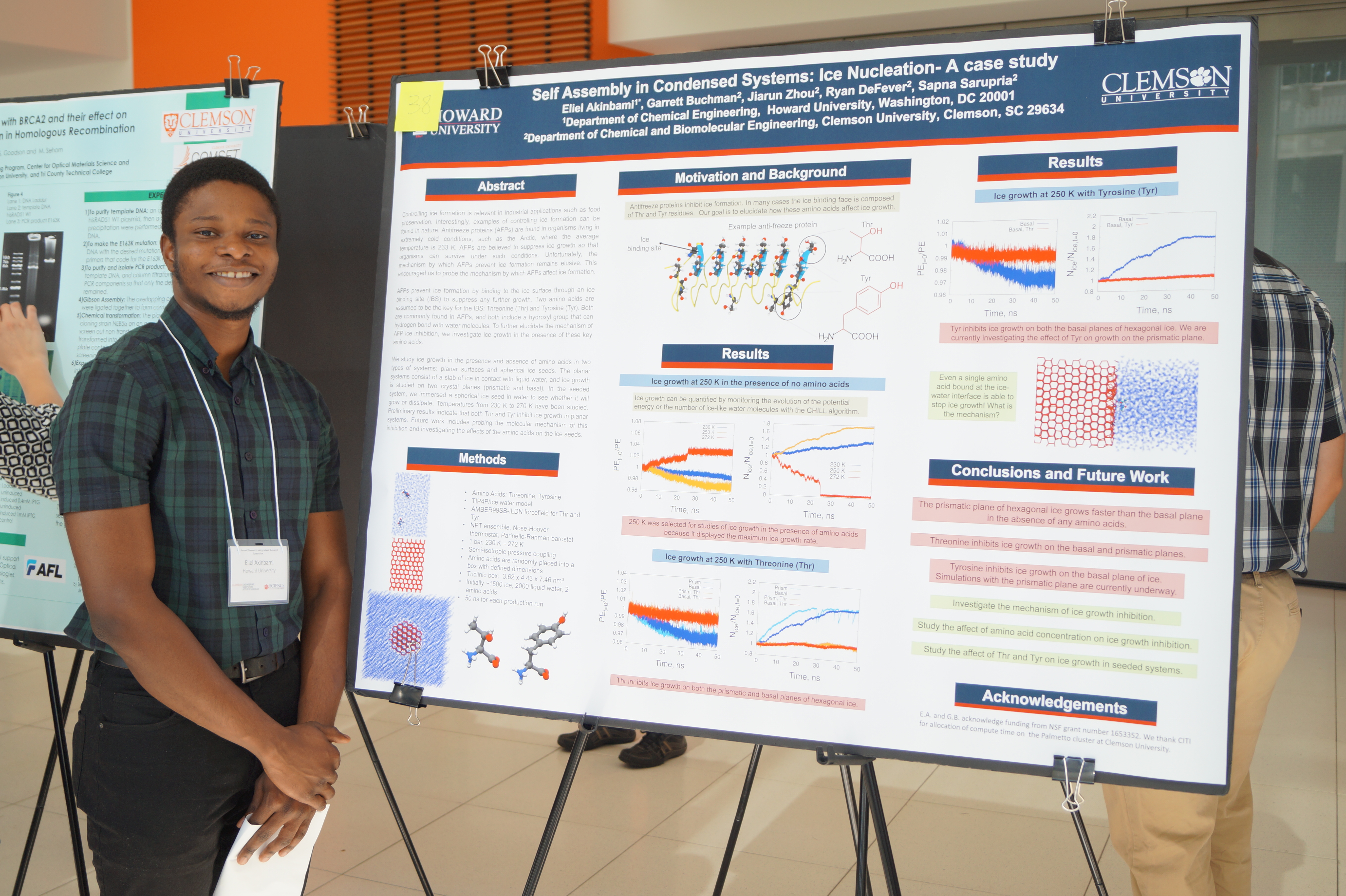
The Sarupria Research Group uses molecular simulations to study the assembly of materials, including liquid-to-solid transitions in water and aqueous solutions. ChBE undergraduate Garrett Buchmann and Eliel Akinbami, a Chemical Engineering senior visiting Dr. Sarupria’s group from Howard University, are using molecular dynamics simulations to study the effect of various additives on liquid-to-solid transitions in water. They will study additives such as amino acids to understand how additives can be used to control the self-assembly process. The group hopes to use these techniques and insights in the future to study more complex processes such as nanoparticle self-assembly under magnetic fields.

Eliel Akinbami, Howard University- Sarupria Group


ChBE Alum Thang Nguyen Featured in Greenville Business Magazine

A Greenville Business Magazine article about engineering in the Upstate of South Carolina features ChBE class of 1999 alumnus, Thang Nguyen. As a chemical engineer working at a sprawling plant at FUJIFILM Manufacturing USA, Inc. in Greenwood, Nguyen discusses the importance of engineers to the Upstate. The Greenville area ranks at the top of the US for concentration of engineering talent, which has contributed to the Upstate’s quality of life and stimulated economic development by bringing major manufacturers to the area. Nguyen also shares his perspective on what makes a successful engineer. To learn more about Nguyen and how the Upstate became such an engineering hub, follow this link to the Greenville Business Magazine article: http://www.greenvillebusinessmag.com/2018/05/31/174403/engineering-the-upstates-braintrust. 

ChBE Alum Kavitha Ganesan Arms Receives Young Alumni Award

ChBE alumna Kavitha Ganesan Arms (ChE 2001) received the Outstanding Young Alumni Award at the Thomas Green Clemson Academy Banquet in April.

Selected by a review committee made up of senior faculty members, alumni, and college advisory board members, The Outstanding Young Alumni Award honors a College of Engineering, Computing and Applied Sciences graduate age 40 or younger whose achievements have been significant to the field, their profession, or the welfare of society.

After completing both her Bachelor of Science in chemical engineering and master’s in bioengineering at Clemson University, Arms joined GE Energy in 2005 as a product safety engineer. Her accomplishments and expertise prompted her promotion to the technical lead position over Human Factors Engineering at GE’s Power and Water Facility and a later promotion to Executive Engineering Manager of Enterprise Risk Management and External Affairs at the same facility, where she oversaw all safety aspects related to anything developed on site. GE’s state-of-the-art Power and Water Advanced Manufacturing Facility in Greenville, SC houses the world’s largest gas turbine manufacturing facility and rapid prototyping for water processing, wind turbines, power gas engines, and nuclear power services. Due to the massive scale and potential hazards of the site, Arms’ job was imperative in ensuring that the engineering designs were safe for employees and the public. This year, Arms accepted her new position as EHS Manager of Chemical and Product Stewardship. During her career with GE, Arms’ safety initiatives have led to over a 60 percent decrease in unsafe events in labs and testing facilities and major improvements to the company’s overall safety culture.

In addition to her work with GE, Arms continues to give back to Clemson by serving on the Department of Chemical and Biomolecular Engineering Professional Advisory Board and assisting with the student chapter of the Society of Women Engineers. The Department of Chemical and Biomolecular Engineering would like to thank Kavitha Arms for her continued support and congratulate her on this well deserved award.


April 26, 2018 ChBE Seminar Speaker – Dr. Nripen Singh from Bristol-Myers Squibb, Cruiserath, Ireland

The Department of Chemical and Biomolecular Engineering welcomes Dr. Nripen Singh, Associate Director in Manufacturing Sciences and Technology from Bristol-Myers Squibb, Cruiserath, Ireland, as a part of the ChBE Spring Seminar series. His seminar, titled “Next generation manufacturing facilities for expanding portfolio of biologics” will take place on Thursday, April 26th 2018 from 2:00-3:00pm in Earle 100.

Demand for innovative medicines that address serious diseases continues to grow for a number of therapeutic areas,
including oncology, fibrosis and immunoscience. Bristol-Myers Squibb (BMS) is working to tap global potential through its expanding portfolio of biologics, bringing treatments to patients across the globe. However, manufacturing biologics is avery complex and difficult task as it involves working with living cells. In addition, this is countered by challenges of an expanding pipeline and rapid development timelines that necessitate looking beyond the current platform philosophy for how to modify the process with the goal to increase overall productivity in a flexible manner. To address these challenges, BMS is integrating concepts of hybrid, modular and single-use technologies in recently constructed biologics manufacturing facilities in the Cruiserath, Dublin and Devens, Massachusetts campuses. The facilities combine latest technology in terms of flexible fed-batch cell culture and high-performance purification that will allow manufacturing of at various scales. With respect to the upstream process, use of multiple seed trains, single-use bioreactors, and perfusion culture would enable flexible high-titer processes. With respect to the downstream processes, numerous new technologies such as in-line dilution, high capacity membranes, multicolumn continuous chromatography, automated viralinactivation, and SPTFF are being incorporated to handle the increased titers being generated in the bioreactors. Through these advancements, BMS will accommodate both traditional as well as hybrid model for continuous manufacturing interchangeably to support multiple clinical and commercial products.

Nripen is an Associate Director in Manufacturing Sciences and Technology group within Global Product Supply organization in Cruiserath, Ireland at Bristol-Myers Squibb. He leads a team of downstream scientists to provide process improvements and identify new technologies for current and next generation products. Nripen first joined BMS in 2014 and led process development, characterization, technology transfer and commercial support work of mid to late stage biologics within Biologics Development Organization in Devens, MA. Nripen was also responsible for developing next generation manufacturing platform using concepts of continuous processing to increase specific productivity. Prior to joining BMS, Nripen worked for Merck Millipore for 5 years where he led a team of engineers for the development of chromatography and clarification products, including resins, depth filters, and membrane filters for protein purification. Nripen received his B.S. from Panjab University in 2002, and his PhD from the Clemson University in 2007, both in Chemical Engineering. He has co-authored over 25 publications, book chapters and patents. He is in the editorial board of mAbs Journal and serves as the guest editor for Current Opinion in Biotechnology and reviewer for several top-tier journals.

April 19, 2018 ChBE Seminar Speaker – Dr. Nick Sahinidis from Carnegie Mellon University

The Department of Chemical and Biomolecular Engineering welcomes Dr. Nick Sahinidis, John e. Swearingen Professor from Carnegie Mellon University, as a part of the ChBE Spring Seminar series. His seminar, titled “ALAMO: Machine Learning from Data and First Principles,” will take place on Thursday, April 19th 2018 from 2:00-3:00pm in Earle 100.

We have developed the ALAMO methodology with the aim of producing a tool capable ofusing data to learn algebraic models that are accurate and as simple as possible. ALAMO relies on (a) integer nonlinear optimization to build low-complexity models from input-output data, (b) derivative-free optimization to collect additional data points that can be used to improve tentative models, and (c) global optimization to enforce physical constraints on the mathematical structure of the model. We present computational results and comparisons between ALAMO and a variety of learning techniques, including Latin hypercube sampling, simple least-squares regression, and the lasso. We also describe results from applications in CO 2 capture that motivated the development of ALAMO.

Nick Sahinidis is the John E. Swearingen Professor and Director of the Center for Advanced Process Decision-making at Carnegie Mellon University. He joined Carnegie Mellon in 2007 after a sixteen-year long career at the University of Illinois at Urbana, where he taught in Industrial Engineering and Chemical Engineering. His research has included the development of theory, algorithms, and the BARON software for global optimization of mixed-integer nonlinear programs. Professor Sahinidis’ research activities have been recognized by the INFORMS Computing Society Prize in 2004, the Beale-Orchard- Hays Prize from the Mathematical Programming Society in 2006, the Computing in Chemical Engineering Award in 2010, the Constantin Carathéodory Prize in 2015, and the National Award and Gold Medal from the Hellenic Operational Research Society in 2016. Professor Sahinidis is a fellow of INFORMS and AIChE. He is the current Editor-in- Chief of Optimization and Engineering.

AIChE Student Chapter recently attends AIChE conference at LSU in Baton Rouge

Clemson University’s AIChE Student Chapter recently attended the 2018 Southern Regional AIChE Conference held at LSU in Baton Rouge, Louisiana. Conference highlights included regional ChemE car competition, jeopardy, and a student paper and poster competition.

Upcoming President Andrew Ney represented our chapter at a Presidents Breakfast, where presidents from other AIChE student chapters were invited to attend. Ney learned valuable information about increasing attendance and the organization’s usefulness, as well as learning about a “sister school” program that other chapters are involved in. With this, our AIChE chapter can be paired with an international AIChE chapter.

“I think this is a very good opportunity, and will be something I plan to work on over the summer to have ready for next school year,” says Ney. He believed this event was the most beneficial to him, and the knowledge he gained will positively impact our organization.

One day of the conference was comprised of plant tours. Ney spoke on behalf of the BASF and brewery tours, “The BASF site was absolutely massive, and also quite modern in comparison to the plant I work at in Seneca.  We had to be split up into groups of five, and scattered around the plant because it was so big.  The brewery was a much smaller operation, but it was very interesting to see the start to end process of making beer.”

Our student chapter also took part in a Jeopardy competition. Of the two teams representing Clemson, one of them won the first round, beating two schools from Kentucky. Though eliminated during the next round, the team represented Clemson well. Following the Jeopardy competition was a ChBE career fair and social.

Additionally, research presentations and a ChemE Car competition took place. The Chem-E-Car team was able to compete in the competition, even after running into some technical difficulties. “Though we didn’t win, we did beat USC.” Says Hansen Mou. The car was made of aluminum and corrugated plastic, and powered by a magnesium-copper battery.

In all, Ney feels as if the trip turned out to be incredibly valuable to everyone.  “I can only speak to my experiences, but one of my favorite parts of the conference was the ability to talk to other Chemical Engineers that I would not normally be able to talk to. For example,  some other Clemson students and I had the privilege of sitting at a table with a group from Puerto Rico.  It was great to be able to ask questions about how other chapters operate as well as networking with industry professionals.” Our ChBE undergraduates were inspired by the Louisiana State AIChE members who sacrificed  their time to put together a great conference for all of the attending chapters.

Our AIChE student chapter looks forward to being able to bring another large group to Mississippi State next year.