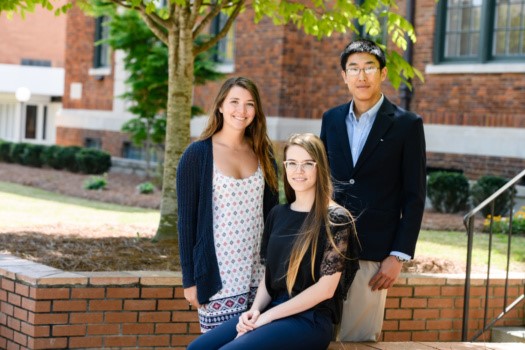
The three seniors who were offered fellowships are: (from left) Sarah Elizabeth Sandler, Sallye Rose Gathmann and Hansen Mou.
Three Clemson University seniors who are headed to graduate school and three alumni who are in graduate school are receiving one of the nation’s top honors for graduate students.
The students have been offered Graduate Research Fellowships from the National Science Foundation, an honor that puts them in the same club as several Nobel laureates and Google founder Sergey Brin.
The fellowships are celebrated in higher education because they are seen as a sign that students are on the way to becoming knowledge experts who can significantly contribute to research, teaching, and innovations in science and engineering.
Fellowships consist of three years of support during a five-year fellowship period. Each Fellow receives a $34,000 annual stipend and a $12,000 cost-of-education allowance that is paid to the institution that will be granting the graduate degree.
These are the Clemson seniors who are receiving the fellowships, their area of study and where they plan to attend graduate school:
Hansen Mou, chemical engineering, Columbia University
Sallye Rose Gathmann, chemical engineering, University of Minnesota
Sarah Elizabeth Sandler, materials engineering, University of California San Diego
These are alumni who have been offered fellowships, their field of study and their current institution:
The three alumni who were offered fellowships are (from left): Patrick Joseph Dynes, Sarah Michell Lowum and Sloan Bradley Nietert.
Patrick Joseph Dynes; mathematical sciences- algebra, number theory and combinatorics; University of Oklahoma
Sarah Michelle Lowum; materials research-ceramics; Pennsylvania State University
Sloan Bradley Nietert; Comp/IS/Eng-Computational Science and Engineering; Budapest Semesters in Mathematics
The Class of 1963 Standing in front of Earle Hall in 2011 – Wade Ponder, Al Tolson, Jim Rushton, Cliff Hattaway, John Cromer, Jerry Richardson, and John Elsey. Attending but not available for this picture were Larry Murdoch, Terry Kinard, and Dr. Barlage.
In May 2011, the Class of 1963 ventured back to the hallways of Earle Hall for a class reunion. At that time, some of them hadn’t been here since graduation day – 48 years earlier. This first reunion rekindled past friendships and stirred up plenty of memories of their days here at Clemson, and their hard work in Earle Hall. Since 2011, they have tried to come back every year, along with their wives, in order to keep in touch with each other and what is going on in the department. Now 55 years after their graduation day, experiencing successful careers, and raising wonderful families, they now have taken time to reflect on how it all started. They now want to leave an imprint of their footsteps for others to follow and make an impact on future Chemical and Biomolecular Engineering students’ lives. They want to Leave a Legacy with their new Class of 1963 Endowment. They have pooled their resources and created an endowment that will help enhance the educational programs in the department. Here are excerpts of their stories and their careers, as they reflect on what inspired them to create this new endowment . . .
Class of 1963 on a Field Trip to Olin-Mathieson Chemical Company in Brevard, North Carolina. Front Row (left to right): Dr. W.B. Barlarge, T.R. Kinard, A.D. Tolson, J.M. Clark, J. D. Rushton, W.H. Ponder, J.M. Harmon, L.B. Murdoch. Back Row (left to right): D.B. Watt, J.M. Brown, J.A. Goodson, J.B. Webster, J.N. Cromer, ?, W.H. Chelf, C.T. Hattaway, C.G. Hayes, C.H. Caban, G.F. Ruehling. Absent: J. I. Elsey, J.G. Richardson.
James Rushton “Most of my classmates and I came from small towns and farms, and without our opportunity to attend Clemson, our lives would be much less interesting and successful. I grew up under the influence of Greenwood’s textile mills, and without my ChE degree, would most likely have ended up as a “lint head” working in a textile mill. Thank God for Clemson!” Rushton worked at a paper company in Brevard NC several years after graduation until landing a job at J.E. Sirrine in Greenville SC. After 13 years and taking many graduate courses, he decided to go for his PhD in 1976, pursuing his interest in pulp and paper processes. He moved his wife, Judi, and their three small children to Moscow, Idaho, so he could attend the University of Idaho, under the tutelage of Dr. Lou Edwards, the creator of the GEMS pulp and paper simulation program. He finished his Master of Engineering degree in Chemical Engineering at Clemson, while pursuing his PhD in Idaho. After graduation, he joined the Georgia Pacific Corporation as corporate leader of process simulation and spearheaded the use of process simulation as a means to design and optimize pulp and paper processes, teaching and creating simulation models at GP mills across the U.S. After retiring in 2003, Jim created a consulting business, Cambridge Oaks Inc., and continues to serve as a Process Simulation Consultant for the pulp and paper industry.
Wade Ponder “My family could not afford tuition and a dorm room, but my Father (who only completed 8th grade) said if I really wanted to go, I could commute. So I drove six days a week or 34,000 miles for my Bachelor’s degree. I also helped with expenses by driving an ice cream truck in the summer months. After I earned my Bachelor’s Degree in 1963, I got married, and my wife and I moved to Clemson so that I could work on my Master’s degree in Chemical Engineering, which I received in January 1965. I participated in funding the endowment to the Chemical and Biomolecular Department at Clemson University because of the successes I have had as a result of the dedication and service of the professors in that department. They prepared me for a career that turned out to be beyond my fondest dreams. To me, it is just a way to say “Thank You” for what the department prepared me to accomplish.” After earning his degrees at Clemson, Wade Ponder’s work experiences included teaching chemistry, working for a petroleum company, and working 36 years for the U.S. Environmental Protection Agency, which provided opportunities to work with other engineers in England, France, Germany, Poland, and Brazil. He was one of a team of five chemical engineers at the U.S. EPA who developed, demonstrated, and commercialized flue gas desulfurization technology, that is now used worldwide to remove sulfur dioxide, particulate matter, and other pollutants from power plant emissions. Later, he served as a Branch Chief at EPA and as an Assistant to the EPA Administrator for Research and Development in Washington DC.
Lawrence Murdoch “My choice of chemical engineering and Clemson has provided me excellent opportunities throughout my career. The department was recognized for its quality, which was a result of the dedication of Dr. Littlejohn and the entire faculty. For this reason, I wish to repay the department and help in maintaining the quality and reputation that continues to exist. Because of Dr. Littlejohn’s excellent reputation and contacts, I received several offers to continue graduate studies. As a result, I attended Iowa State University and was well prepared for my studies and for receiving my MS in Chemical Engineering. Even though much of my career was in management, the chemical engineering knowledge, discipline, and work ethic developed during my Chemical Engineering education at Clemson was key to my success.” Larry Murdoch was employed for 50 years, starting in chemical plant production, and soon thereafter moved to the engineering and construction industry. During this period, the varied industries served and the global range of his responsibilities always brought interesting and challenging opportunities.
Jerry Richardson “Chemical engineering was hard- very hard. Chemical engineering taught us to think for ourselves. It taught us to face any problems with the total confidence that we could solve them. I worked mostly in the polyester film industry, so I never did classical chemical engineering. Instead I worked on advanced technology to make ultra-thin films, which went into a variety of industrial uses. The work I am most proud of was working on a team to develop a computerized film thickness system to automatically control the thickness profile of thin films to very tight tolerances. It was the first industrial use of computers according to Hewlett Packard. I received a US patent for that work 46 years ago. My degree afforded me the luxury of meeting and working with and becoming friends with some of the most intelligent engineers in the USA, Germany, and Japan. The most important thing that my Clemson experience did for me is what it is doing for me now – Chemical engineering gave me a great gift – “the love of learning.” I retired at age 58. That was 21 years ago. I have spent the past years, giving away most of what I earned, learning many new things, and putting my new knowledge to work. I started three new careers and two companies since retiring. To paraphrase another one of my classmates, I am extremely grateful for what Clemson has done for me. They made me what I am today and is why I give to Clemson. My choice of chemical engineering and Clemson has provided excellent opportunities throughout my career.”
John Cromer “I also have benefited personally and financially from my Chemical Engineering degree from Clemson. My career has afforded me the opportunity to interact with many extraordinary individuals, many of them engineers. The one goal we all shared was to solve or eliminate problems that came our way. During the last few years, several of us from the ChE class of ‘63 have been returning to Clemson each spring for a reunion. I have taken two wonderful revelations from those reunions: My ‘63 classmates stand high on my list of extraordinary people. The list now includes many more of the Clemson Family, especially the ChBE Department staff. I never thought much about a Clemson ChE Class of ‘63 legacy. Last year at our reunion, the group did what we do best, problem solve. We proudly came together to agree on our class legacy and establish an Endowment. In closing I would appeal to all Clemson Alumni to consider establishing similar class Endowments to cement their Clemson Legacy, which lives on long after we’re gone. It’s a great way to give back to the institution that has contributed so much to who we are.”
Cliff Hattaway “I never had a problem obtaining a worthy job with an Engineering degree from Clemson. Back in 1963, I was one of the first ChEs to be offered a job with Gulf Oil in Port Arthur, Texas, prior to entering the Army. Later, it didn’t hurt to have been a Captain in the US Army back in the sixties. I retired from Phillips 66 back in 1994, where I had several different jobs. Besides receiving my Chemical Engineering degree in 1963, I also received a masters in business from the University of Virginia. Basically my employers always figured that a ChE could do anything from Marketing and Engineering to Financial Accounting.”
Alfred Tolson “My Clemson Chemical Engineering Degree first earned me a job. I had five (5) job offers upon graduation. When I started working, I found I was well prepared for the transition to the real world of chemical manufacturing. There was solid knowledge of chemical engineering principles plus practical skills that had resulted from the Unit Operations Laboratory, Plant Design, a Senior Thesis Project, and Senior Seminar experience. My professional career was spent with one company, Tennessee Eastman Company, later Eastman Chemical Company (with a two-year interruption for military duty.) I basically worked up through the ranks in a manufacturing division as an individual contributor, area supervisor, group leader, development section head, to department superintendent of three (3) different departments: one development and support and two manufacturing. There were also a few staff assignments sprinkled in along the way. I did get my Professional Engineers License, which we were encouraged to do at Clemson. Some of our class started gathering annually at Clemson for a few days about six years ago. We were impressed with the welcome and attention we received from the Department. Along the way, realizing what our degrees had meant to us in our careers, someone in the group suggested that we do something to give back to the Department. That something, with the help of the Clemson Staff, became the Chemical Engineering Class of 1963 Endowment. I suggest to all other classes to reconnect with the Department and maybe be inspired to find a way to give back.”
Enoch (Chip) Hurst “My ChE degree opened the door into a much wider world, totally different from my agrarian upbringing. I started Clemson with the class of ’63, but was withdrawn for a year to serve in my National Guard unit because of the Berlin Wall military deployment in 1961-62. While I returned and graduated with the class of ’64, I have always returned to join the more active class of ’63 at reunions. I did eventually get a masters degree in finance from UNC-Charlotte and a Professional Engineering Certificate. I worked in industrial settings for 32 years and retired at age 56 from Bridgestone-Firestone at the same time as my French-teacher wife. My wife and I sold the house, gave our possessions to our three children, and backpacked around the world for 5 years. We settled in Florida, where I taught math online for awhile, and now I am writing my first book. I am currently in my 79th year and expect to publish 3 non-fiction books this summer. My wife and I cruise a few times a year with friends, and I am scheduled to play tennis and golf six times a week if it is not raining. We spend three to four weeks a year with our three kids (all are Clemson grads) and six grandkids (future Clemson grads). We are living the dream!”
Dr. Barlage and John Elsey in 2011Back at Earle Hall in 2016: John Cromer, Wade Ponder, Al Tolson, Jerry Richardson, Jim Rushton, and Larry Murdoch
ChBE alumna Kavitha Ganesan Arms (ChE 2001) received the Outstanding Young Alumni Award at the Thomas Green Clemson Academy Banquet in April.
Selected by a review committee made up of senior faculty members, alumni, and college advisory board members, The Outstanding Young Alumni Award honors a College of Engineering, Computing and Applied Sciences graduate age 40 or younger whose achievements have been significant to the field, their profession, or the welfare of society.
After completing both her Bachelor of Science in chemical engineering and master’s in bioengineering at Clemson University, Arms joined GE Energy in 2005 as a product safety engineer. Her accomplishments and expertise prompted her promotion to the technical lead position over Human Factors Engineering at GE’s Power and Water Facility and a later promotion to Executive Engineering Manager of Enterprise Risk Management and External Affairs at the same facility, where she oversaw all safety aspects related to anything developed on site. GE’s state-of-the-art Power and Water Advanced Manufacturing Facility in Greenville, SC houses the world’s largest gas turbine manufacturing facility and rapid prototyping for water processing, wind turbines, power gas engines, and nuclear power services. Due to the massive scale and potential hazards of the site, Arms’ job was imperative in ensuring that the engineering designs were safe for employees and the public. This year, Arms accepted her new position as EHS Manager of Chemical and Product Stewardship. During her career with GE, Arms’ safety initiatives have led to over a 60 percent decrease in unsafe events in labs and testing facilities and major improvements to the company’s overall safety culture.
In addition to her work with GE, Arms continues to give back to Clemson by serving on the Department of Chemical and Biomolecular Engineering Professional Advisory Board and assisting with the student chapter of the Society of Women Engineers. The Department of Chemical and Biomolecular Engineering would like to thank Kavitha Arms for her continued support and congratulate her on this well deserved award.
In November 2017, the 100th anniversary of chemical engineering at Clemson University was marked with a full day of events that began with a campus tour, included lively stories of years past and ended with an alumni dinner.
David Bruce, chair of the Department of Chemical and Biomolecular Engineering, said the anniversary served as an opportunity to thank alumni and celebrate the department’s successes.
Students and alumni gathered in front of Earle Hall during the 100th anniversary celebration of chemical engineering at Clemson University.
“We had a great turnout,” he said. “The celebration underscored that chemical engineering is an important and critical part of the University. We stand on the shoulders of those who came before us and are well positioned for another century of success.”
The days’ events included a tour of campus and Earle Hall and a luncheon in the president’s box at Memorial Stadium featuring a talk by Tony Elliott, co-offensive coordinator and running backs coach for the Clemson Tigers. Later, attendees went to a research seminar at the Watt Innovation Center with Dr. Tony McHugh, the Ruth H. and Sam Madrid Professor at Lehigh University. Dr. McHugh was the inaugural speaker of the Dr. Dan Edie Distinguished Lectureship series. This lectureship was established through an endowment that honors Dr. Dan Edie’s career as a teacher and researcher in the Chemical and Biomolecular Engineering Department.
The 100th anniversary event ended in the evening with an alumni dinner and a presentation at the Madren Center, which highlighted key milestones for the department.
The current department chair, David Bruce, posed for a photo with four of his predecessors during the celebration. They are (from left to right): Bruce (2016-present), Douglas Hirt (2009-2016), Charles Gooding (1996-2006), Dan Edie (1994-1995), and Charles Barron (1987-1994).
Chemical engineering was first introduced at Clemson in the 1917-18 academic year. The course of study died out after the 1924-25 academic year and returned in 1933.
Much has changed since the program’s early days. Chemical engineering has grown from four graduates receiving Bachelor of Science degrees in 1923 to 73 this year, a 1,725 percent increase. Their average starting salary has grown from about $2,100 a year to $70,000 a year, an increase of more than 3,233 percent.
In the same period, the program has gone from zero graduate students to 55 Ph.D. students this year, and research expenditures have grown from zero to more than $4 million per year.
When the program first began, Clemson was a male-only military college. This year, a third of students in the Department of Chemical and Biomolecular Engineering are female.
Susan Glen Herrington, Class of 1970, was the first female Clemson graduate to receive a B.S. in Chemical Engineering, and Beth Gainey Stoner in 1991 became the first female at Clemson to receive a Ph.D. in chemical engineering from the University.
Several alumni attended the celebration from the Class of 1955 through the Class of 2016. Pictured here are Bacil Dickert and Joe Alexander from the Class of 1955.
Dr. Rachel Getman was promoted to associate professor this year, making her the department’s first female professor to receive tenure.
Clemson received $1.175-million from the Olin Foundation in 1958 to construct Earle Hall, and the building remains the home of chemical engineering. The department acquired its current name in 2005 when biomolecular engineering was added to what was then the Department of Chemical Engineering.
The department’s largest grant came in 1998 when the National Science Foundation provided $29 million to establish the Center for Advanced Fibers and Films. Prof. Dan Edie served as center director before handing the reins over to Prof. Douglas Hirt. Dr. Amod Ogale became director in 2009 and remains in that role today.
Dr. Hirt became chair of the Department of Chemical and Biomolecular Engineering in 2009 before stepping aside in 2016 to become associate dean for research and graduate studies in the College of Engineering, Computing and Applied Sciences.
Dr. David Bruce assumed the Chair position after Dr. Hirt. “With a century behind us, we are well positioned for future success,” he said. “I thank all who joined us to celebrate this momentous occasion.”
written by Paul Alongi, College of Engineering, Computing and Applied Sciences
The Department of Chemical and Biomolecular Engineering will be celebrating the 100th Anniversary of the Chemical Engineering degree at Clemson University on November 9, 2017. The celebration will include a campus tour, a tour of Earle Hall, a luncheon in the President’s Box at Memorial Stadium, a research seminar by Dr. Tony McHugh, and an alumni dinner at the Madren Center that evening with presentations and music.
A copy of the schedule of events, the invitation, and RSVP can be found at the link below. All Chemical and Biomolecular Engineering alumni are invited.
For more information, contact Terri McAllister at mcalli3@clemson.edu or 864-656-3056 with any questions.
Written by Paul Alongi, College of Engineering, Computing and Applied Sciences
Few Clemson University alumni illustrate the global impact engineers have on the world as well as Suzanne Roat. She also happens to be a shining example of how a successful alumnus can make a positive impact on her alma mater and future engineers.
Her 26-year career as a chemical engineer working with oil refinery processes has taken her around the nation and world from Mississippi, California and Montana to Kuwait, Singapore and Greece. In her spare time, she has raced competitively in triathlons and ultramarathons, qualified to scuba dive with a rebreather to more than 300 feet down and coached swimming for the Special Olympics.
With such an active life, Roat could have forgotten Clemson, where she earned a bachelors of science in 1985. Instead, she is turning and giving back to her alma mater.
Roat joined the Dean’s Leadership Circle in 2014 and strategically used matching gifts to double the impact of her contributions. She co-hosted a dean’s reception that same year in Houston, where she currently lives, and has made arrangements in her estate to create an endowed scholarship for engineering students in the Calhoun Honors College.
“I feel like I’m paying it forward,” she said. “I was successful thanks to Clemson and the University of Tennessee, so I’m going to make sure other people are successful. I give my funds to use at the dean’s discretion, and he tells me once in a while what he’s doing with the funds.
“I’m pleased with the outcome. It’s helping students who need help. They’re good students but may not be financially well equipped.”
Anand Gramopadhye, dean of the College of Engineering, Computing and Applied Sciences, thanked Roat for her generous support.
“Through her support and example, Dr. Roat is helping create a new generation of engineers and scientists who will be prepared to meet the grand challenges of the 21st century,” he said. “We are fortunate to have her on the team and grateful for all that she has done to support the college.”
Roat is now based in Houston as crude and refining strategy analyst for Chevron Downstream and Chemicals.
She said that her undergraduate experience at Clemson prepared her to continue her education at the University of Tennessee, where she earned a master’s degree and doctorate. All of her degrees are in chemical engineering.
Roat said that one of the valuable lessons she learned at Clemson is that nobody works alone. In Unit Operations Lab, the students had to work as a team with their grades dependent on each other.
“Having those experiences is vital,” she said. “Nothing happens in a large company like Chevron by one person. It’s always teams of people working on things together, bringing together their individual expertise to the project and making the project go forward. Being able to work in a team environment successfully is imperative.”
It’s also important for students to have verbal and written communication skills, Roat said.
“It’s the only way you’re going to get ahead,” she said. “You have to stand up in front of people and tell them your story as succinctly as possible and convince them. If you have a message and you’re asking for something, verbal articulation and written messaging are imperative as well.”
The place where the Blue Ridge yawns its greatness just may be calling Roat back as she plans her retirement.
She has returned to Clemson for visits and is planning a trip in March to Greenville.
We were honored to host our Chemical Engineering Class of 1966 for their 50th Class Reunion on June 10th! They were given a chance to visit, reminisce, and tour Earle Hall. Pictured above are Bob Smith, Bill Price, Leonard Boyd, Victor Lopez, and Bud Bell. Happy 50th – Class of 1966!!
In May we were also honored to host the Class of 1963! Pictured below are John Cromer, Wade Ponder, Al Tolson, Jerry Richardson, Jim Rushton, and Larry Murdoch.
On October 17th, ChBE hosted its annual Homecoming Tailgate. We had classes represented from 1964 through 2015. During the tailgate, the Class of 1985 held their 30th Class Reunion, which was organized with the help of their fellow classmate, Don Cain. Many of them had not been in Earle Hall since they graduated so they enjoyed touring the building and catching up on news with their classmates. Pictured above from the Class of 1985 are Don Cain, Steve Strickland, Brent Bailey, Kim Bowers, Susan Wilson, Brad Gantt, Bob Jones, and Ron Sassard. Other classmates present were Sim Hogan and Tom Monaghan. A special thank you to all of our alumni and their families who attended.
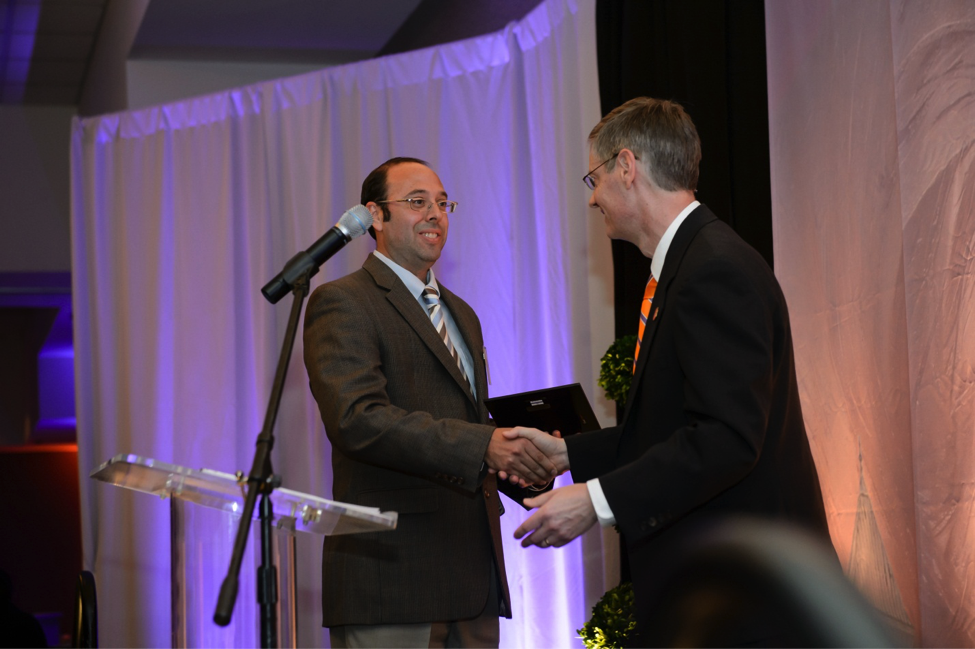
Dr. Kyle Brinkman was honored at the 20th Annual College of Engineering and Science banquet on April 30th with the Outstanding Young Alumni Award. The award was presented to him by Dean Anand Gramopadhye and department chair, Dr. Doug Hirt. At a relatively young age, Prof. Kyle Brinkman has established an impressive track record of multidisciplinary, collaborative research resulting in significant contributions to national and international research initiatives, particularly those between academia and national laboratories. Prof. Brinkman received his B.S. in Chemical Engineering at Clemson in 1998 and his M.S. in Materials Science and Engineering in 2000. In 2004, he received his Ph.D. from the Swiss Federal Institute of Lausanne, Switzerland.
Prof. Brinkman is currently an Associate Professor at Clemson in the Materials Science and Engineering Department. In the ten months he has been active at Clemson as a professor, he has already secured more than $1 million dollars in sponsored research. Prior to Clemson, he was a Program Manager for Energy Efficiency and Renewable Energy at the Savannah River National Laboratory, where he worked from 2008 through 2014. He has been the P.I. or co-P.I. on more than $5 million dollars in sponsored research and has authored or co-authored over 70 peer-reviewed technical publications and government reports. He has made significant advances in various focus areas including hydrogen storage and purification, electronic ceramic materials for solid oxide fuel cell systems, and crystalline ceramics for applications in nuclear energy. His successful collaborations have produced quality results, and he has been recognized by various professional societies and the Department of Energy for his research achievements. Prof. Brinkman’s most recent research project, which made the front page of the Greenville News, is exploring new materials that could safely store nuclear waste. His research team is focusing on a crystalline ceramic that will be based on naturally occurring minerals that endure for millions of years. This project won an $800,000 research grant from the U.S. Department of Energy.
The Department of Chemical & Biomolecular Engineering nominated alumnus Dr. Kyle Brinkman for the Outstanding Young Alumni Award because he has proven to be an exceptional scholar, a world-class scientist, and an outstanding leader.
The Alumni Association hosted their annual Golden Tiger Class Reunion across campus on June 11th and 12th. We were honored to host our very own Chemical Engineering Class of 1965 in Earle Hall on the afternoon of the 12th. This reunion was organized by their fellow classmate Frank Shuler and a great time was had by all. Some of the classmates had not been back in Earle Hall since they graduated so there was a lot to catch up on. Dr. Hirt gave them a tour of our building and labs and gave them an update on the department. Happy 50th – Class of 1965! We hope you come back soon!
Pictured (L-R): Larry Upton, Richard Stuckey, Dendy Sloan, Skeet Martin, Frank Shuler, Doug Edmundson, and Ron Taylor.
For an important related article, please go to the following link: