Matthew Browning & Olivia McAnirlin
Nature’s Message for Health Hub & Virtual Reality & Nature Lab & Clemson University Campus Nature Rx

Figure 1: Dollars Grow on Trees in the Clemson University Forest. (Image courtesy of the authors, generated with ChatGPT V5.6)
September 25, 2026
The Clemson University Forest spans 19,200 acres, wrapping around the edge of campus. It provides about 150 miles of trails and forest roads, 40 trailheads, 100 miles of shoreline, 44 active research projects and tens of thousands of visitors a year at the trailheads and shorelines alone. It is used for research, teaching, forest products, horseback riding, bow hunting, mountain biking, hiking and walking dogs, among dozens of other uses. It is also, we argue, part of our Clemson employee benefits package, and unlike the rest of that package, nobody has ever put a number on it. So what is it worth? We can only price part of the answer, and we start where the evidence is strongest: the healthcare costs of employees who live within the Forest’s reach.
I. The case has been made, but not priced
In August, five of our colleagues made the case for academic forests in Inside Higher Ed: Rob Baldwin, Executive
Director of the Forest; Betty Baldwin, professor who has led multiple Creative Inquiry projects in the Forest; Olin Thompson Mefford and Danny Weathers, two past Faculty Senate presidents; and Bob Jones, Provost Emeritus and former University Interim President. They put the number of acres held by university’s academic forests worldwide at roughly one million, and they were blunt about what happens when one of them goes. “Conversion to developments, even campus buildings, is a one-time decision taking away future educational, environmental and social benefits.”
The most striking thing in that article was not the acreage statistic. It was a faculty member saying, plainly, “I would not be here as a faculty member if the forest were not available for recreation, research, teaching, family outings, hiking time with students and friends.” Another described the Forest as “a place where I can re-center” between teaching days.
Those statements indicate that university forests help with employee retention and wellbeing, which has not yet been quantified for academic forests. When the Inside Higher Ed article discussed university budgets, it acknowledged that “Forests cost universities money. It is true.” But it also highlighted revenue from forests in the form of timber, grants, gifts and user fees.

Figure 2: The authors record a 360-degree video of the Clemson University Forest to provide a virtual reality experience to retired professor Dr. David van Leer, a resident at Clemson Downs. (Image courtesy of Ronald A. Weber.)
II. What did five million people tell us?
There is a hidden tab in the Forest’s budget spreadsheet: avoided healthcare costs. In 2022, our lab published a study with Kaiser Permanente that followed about five million people. For each Kaiser member, we measured the “greenness” around their home using satellite imagery, sorted everyone into 10 equal groups from least green to most green, and looked at what each group actually cost the health system over a year. The pattern was striking. People in the greenest neighborhoods cost about 8.2% less (nearly $400 per person per year) than people in the least green neighborhoods, even after adjusting for age, sex, race and ethnicity, education, income, neighborhood deprivation, housing density and air pollution.
However, the association did not follow a straight line. Moving from the very bottom of the greenness distribution up one step saved the health system almost nothing: less than 1%. The savings accelerate in the upper half. Moving from the middle of the distribution to the ninth decile saved around 3.6%. Going all the way to the top saved 6.5%. The bottom line is that trees appear to provide the greatest health care savings when there are already quite a few of them. Let’s translate those benefits to the Clemson University Forest and employees.

Figure 3. Estimated annual healthcare savings per person, compared with the least green neighborhoods. The savings are not evenly spaced: the step from the ninth decile to the tenth is larger than the first four steps combined.
How many Clemson University employees live near the Forest? Recent surveys of faculty and staff asked respondents to share their home ZIP codes. Counting the seven ZIP codes that cover the Forest and the towns inside its boundaries (29631, 29632, 29633 and 29634 in Clemson; 29630 in Central; 29670 in Pendleton; 29682 in Six Mile), 62% of faculty and 39% of staff who answered live in them. These are the communities the Forest extends into based on US Postal Service mail routes (the purpose of ZIP codes). Applied to Clemson’s roughly 1,900 faculty and 4,400 staff, about 46% of the university workforce (approx. 2,900 employees) live near the Forest.
- How much greenness does the Clemson University Forest add?
How much does the Forest increase the greenness of our neighborhoods? Picture what would be there instead: subdivisions, roads and lawns, parking lots, and the saplings and shrubs planted for curb appeal. Pickens County has no tree ordinance, meaning that nothing in the picture of extensive development would require keeping a single tree. Keep the Forest, and those same neighborhoods sit near the top of any greenness ranking you could build.
Let’s estimate this difference between the Forest existing and disappearing as the difference between the fifth and ninth deciles of greenness. (We deliberately don’t make this contrast large, like going from the fifth to the tenth decile, even though, arguably, losing the Forest could be that striking.) This translates, based on our study with Kaiser Permanente, to a 3.56% reduction in annual health spending from the Forest being here.
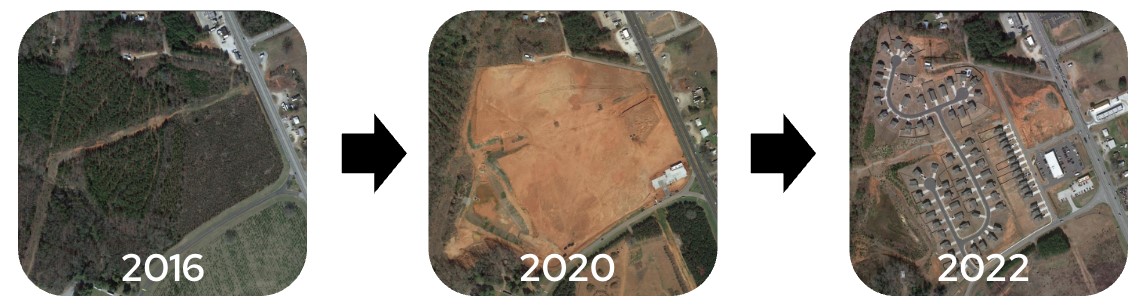
Figure 4: Forest replaced with new housing in Pickens County, SC, adjacent to the Clemson University Forest. (Images courtesy of Google, figure created by the authors).
- What is that greenness worth?
How much do we pay for healthcare? The most recent data (circa 2020, so this is a conservative estimate relative to today) reports that South Carolina spends $8,766 per resident on personal health care services and products (hospital care, physician services, nursing home care, prescription drugs, etc.) across all payers. Meanwhile, everyone in a household shares the same neighborhood, so the benefit scales with household size, and households in Pickens County average 2.41 people. Multiplying the 3.56% in reduced spending by the $8,766 in annual costs, and you get $312 in cost savings per person per year from the Forest. Then multiply $312 by the average household size (2.41) to get $752 per employee household. Across 2,900 employee households living near the Forest, that comes to about $2.18 million a year in healthcare costs not spent as a result of the Forest.
These avoided costs are shared between the State Health Plan budget and employees’ own costs (e.g., deductibles, copays, medications). For scale, the state contributes $6,618 per year toward covering a single Clemson University employee, and the Forest offsets roughly 5% of those per-person costs. (Note that a less cautious comparison, such as the third decile to the tenth, would put the figure closer to $1,400 per household, but we report the more conservative estimate here.)
- Financial benefits of the Forest beyond the medical bills
Avoided healthcare costs are not the entire story of the Forest’s contributions to the University’s benefits package. In recent faculty and staff surveys, which received 388 and 491 responses, respectively, 83% of faculty members have visited the Forest, and 79% have used it for something personal. Meanwhile, among staff, 95% knew the
Forest existed, and 73% have visited it. Among past-year visitors, 70% had visited more than five times. Thus, the Forest is not an occasional destination but something baked into the routines of thousands of employees (and their households, given that 73% of staff who visited went with family).
More than that, the Forest is a major reason employees do not leave. Across both staff and faculty, the Forest matters twice as much to people deciding whether to stay as it does to those deciding whether to come (see Table below for full results).
Table 1. University faculty and staff believe that the Forest contributes to recruitment and retention
| Forest is reason to come | Forest is reason to stay | Ratio | |
| Faculty (n = 388) | 10.1% | 20.9% | 2.08x |
| Staff (n = 489) | 4.3% | 8.0% | 1.86x |
Percentages are the share of respondents who answered “a great deal” or “a lot,” though these figures likely run high because employees who value the Forest were more likely to complete the survey.
This doubling of the valuation of the Forest as a reason to stay makes sense. A job candidate flying in for two days sees campus, a department, a salary, and a start-up package. Ten years later, the same person has a favorite trail. The value of the Forest accrues after their arrival, which is exactly why losing it would be expensive. The cost would not show up as a line item. It would arrive as departures. Replacing one faculty member costs roughly a year’s salary once you count the search, the start-up package and the lost momentum, and Clemson’s average faculty salary is $109,516. Twenty departures would erase the entire annual healthcare savings we just calculated.
This also lines up with the testimonial in the Inside Higher Ed commentary by our colleagues: “I would not be here as a faculty member if the forest were not available.” That is a quote from a single employee, but across both faculty and staff surveys, roughly 750 Clemson employees feel the same way.
Nothing above counts what else the Forest does. It does not account for clean drinking water, flood buffering, or the difference between a street with a canopy and one without in July. It does not count the courses taught there or the hundreds of papers it has produced. And it does not count every ride, hike and cast by people who do not work here, even though the same $312 per person applies to anyone living in Clemson, Central, Pendleton or Six Mile.
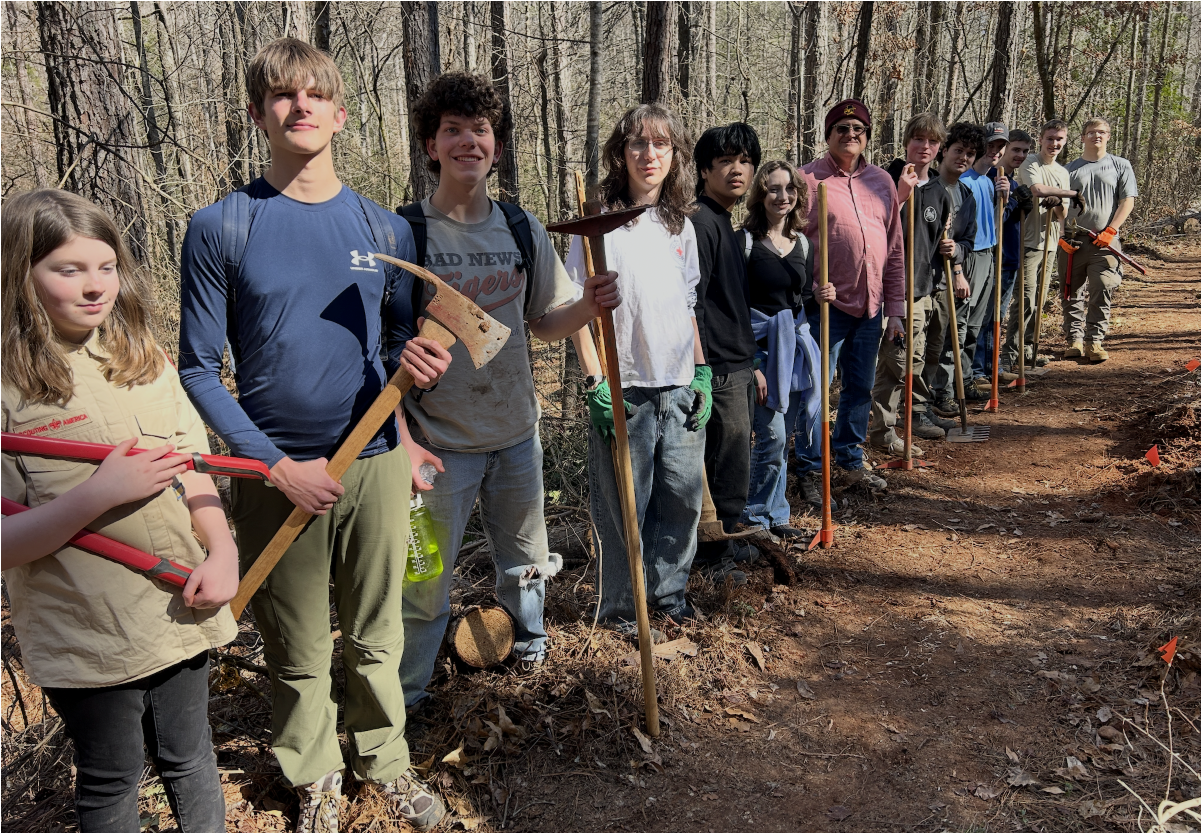
Image Caption: Community volunteers performing trail work in the Clemson University Forest. (Image courtesy of Daniel Hanks).
Every Clemson employee receives a total compensation statement listing salary, retirement, health, dental, and life insurance. The Forest is not on it. Nobody has ever put a number in that row, so here are two. The first is $752 a year for each household living near the Forest. The second is the 750 employees who say it is a large part of why they stay. Every other line on that statement gets reviewed and renegotiated annually. This one just quietly keeps paying, for as long as it is there.
