What is EFNEP?
The Expanded Food and Nutrition Education Program (EFNEP) offered by the USDA National Institute of Food and Agriculture and Clemson University Cooperative Extension Service is aimed at providing practical, hands-on nutrition education. The mission of EFNEP is to assist limited-resource audiences in acquiring the knowledge, skills, attitudes, and changed behavior necessary for nutritionally sound diets and to contribute to their personal development and the improvement of the total family diet and nutritional well-being.
Defining the Problem:
Obesity, poor nutrition, and limited physical activity are significant health concerns. Poor health disproportionately affects minority and low-income populations. Educational opportunities and resources are limited.
Investing In The Solution:
EFNEP brings together federal, state, and local resources to target two primary audiences: low-income families with young children and low-income youth. In 2020, EFNEP served 20 counties and delivered both youth and adult programs to diverse audiences. Although the year 2020 was quite a challenge for recruitment and retention due to the COVID-19 pandemic, EFNEP adapted to reach participants virtually by utilizing different platforms (Zoom, Facebook Live private group). EFNEP reached 306 adults directly and 946 family members indirectly. Also, EFNEP reached 2,326 children and youth with a graduation rate of 82%.
Demonstrating Results:
The 24 hours Food recall report showed overall 95% of EFNEP adult Participants improved their dietary intake according to ‘My Plate’ guidelines.
EFNEP Adult Food and Physical Activity Behavior Changes report showed:
• 92% improved Nutrition practices
• 81% improved Food Resource Management practices
• 77% improved Physical Activity practices
• 75% improved Food Safety practices
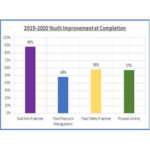
EFNEP Youth Made a Difference:
• 88% of children & youth improved Nutrition practices
• 58% of children & youth improved Food Safety practices
• 57% of children & improved Physical Activity practices
• 48% of children and youth improved Food Resource Management practices
Why it works?
EFNEP Nutrition Educators follow a research-based learning model that allows them to effectively reach and educate program participants. Educators are:
• Members of the communities they support
• Trained/Supervised by State and County-based faculty
• Skilled in using hands-on interactive teaching methods
• Committed to delivering sounds instructions
• Able to influence changes in behavior and impact the lives of those they teach
• Dedicated to reaching diverse, low-income populations.

Click here to visit the full impact statement with graphics.
Submitted by: Tarana Khan, State Program Coordinator, EFNEP
