Extension Employee News

Horticulture – Team Highlight

Horticulture agents that work with commercial fruit and vegetable producers throughout SC have been busy at work over the last few months creating and delivering production workshops and creating an online presence. SCGrower.com is a weekly blog in which agents post crops, pests, and weather updates. Agents decided that this was a great place to begin building an online presence to direct traffic. Kerrie Roach has been diligently creating marketing materials for the team. On the site, agents decided that an Upcoming Events tab needed to be created by which all meetings would be marketed and branded in the same manner. Consistent marketing and branding allow the team to keep a unified look and feel to their programs throughout the state.

In a typical year, many in-person meetings are held at the regional level for growers. This year, agents decided to have a series of statewide virtual programs focused on a specific crop or family of crops for each event. The meetings are marketed as ‘Food Crop Production Meetings’. Doing this allowed for a more in-depth dive into topics and crop issues. To date, agents have hosted virtual trainings on Strawberry Production, Organic and Small Farm Production, Tomato and Pepper Production, and Cucurbit Production. Because of the online format, the agents have been able to reach producers and audiences that had not previously been involved with Extension Programming. As of February, 381 growers have participated in these meetings. With five more production meetings scheduled in the next month that number will continue to grow.

Agents have also begun having one production meeting per month that explores a timely topic. These meetings are marketed as ‘CU’ltivating SC Growers and are shorter in length than the 2-3 hour production meetings. In January, 54 growers learned about Organic Fertility with Dr. Brian Ward before they started preparing their fields. In February, Strawberry Tissue Sampling and Fertility will be discussed before growers begin fertilizing for the spring season. Having regular meetings during the production season will give growers a chance to manage crops and pests and make better management decisions in-season.

Our newest virtual endeavor is weekly chats with the agents marketed as ‘SC Growers Exchange’. Each Tuesday at 11:30 A.M., all agents working with food crops jump on a Zoom call and invite growers to ask questions during these 30-minute sessions. Agents and growers share information, resources, and what they saw in the field that previous week. The team hopes to turn these recordings into weekly podcasts for their next endeavor.

Not having in-person meetings has been hard for the horticulture team as we know it has been for other teams, but the current COVID situation has allowed time and energy to be devoted to creating an online presence. The team has worked extremely hard and came together to create an outstanding offering to the growers we serve.

Submitted by: Zack Snipes, Area Horticulture Agent

Extension Program Team Highlights – 2020

While 2020 brought new challenges that we have not faced in our lifetimes, Extension did not falter in its mission. Here is a glance at some of the accomplishments for the previous calendar year.

Horticulture:
March-December: Horticulture Agents delivered 164 virtual programs engaging 7,544 total participants.

Master Gardener Mondays – Horticulture Team created a new virtual series called Master Gardener Mondays. Agents delivered one-hour advanced training topics on Monday afternoons for Master Gardener Volunteers that averaged nearly 100 participants per session.

Virtual Master Gardener Training: this is a new, statewide program in which local Master Gardener coordinators and others will deliver content to a statewide audience in live, synchronous sessions. It was developed in response to COVID-19 and is separate and different from our asynchronous Online Master Gardener Class. The program will begin on Wednesday, January 13, 2021, with 81 registered participants.

SC Certified Landscape Professional – This Clemson Online program is designed to teach landscapers basic horticultural skills launched (as scheduled) in Spring 2020. It has received great interest and participation and the timing was fortunate. 127 participants completed the 9-module, self-paced course and 114 completed the requirements to become Certified. Nearly 60 participants are registered for the upcoming Spring 2021 cohort.

Home and Garden Information Center:
HGIC website page views – 109.7% increase
2019: 2,835,949 page views
2020: 5,945,945 page views

HGIC phone calls – 58.2% increase
2019: 6,416 calls
2020: 10,151 calls

HGIC email – 99.4% increase
2019: 4,253 emails
2020: 8,479 emails

4-H Youth Development:
4-H @ Home – 4-H at Home – 4-H Agents in the Midlands combined efforts to release SC 4-H@Home as a supplemental opportunity for students. This program provided 2,500 participants with a free lesson via email each weekday. This program made its way into homes in all 46 counties in South Carolina, 46 states, one U.S. Territory, and eight countries across four different continents.

4-H Kits – i.e. Journey to Mars – Journey to Mars – South Carolina 4-H Youth Development is giving young people a chance to take their own “Journey to Mars” through a program aimed at enhancing computational thinking skills and promoting computer science literacy. Agents provided 700 kits statewide.

Pinckney Leadership program had more than 600 youth participants.

Agricultural Education:
Established a resource page on the Ag Ed website to assist teachers in virtual learning activities. While there are currently 153 Ag Teachers in SC, the site has had 535 hits.

Held twenty-eight virtual events for FFA members attended by 4,045 attendees, including a virtual FFA State Convention, attended by over 800 FFA members.

Held sixteen virtual Ag Teacher workshops with a total attendance of 753.

South Carolina Agriculture programs attended both the Virtual FFA National Convention and the Virtual National Young Farmer Education Association National Institute.

Creation of six new Agricultural Education Teaching positions.

Livestock and Forages
Over sixty-five virtual webinars were hosted.

Had more than 2,000 youth participants in the Youth Academy of Livestock Learning.

Facilitated the sales of 2,267 head of cattle and increased revenue across the state by over $630,000.

Agronomy:
Grower Diagnostic Support– As a means to provide plant/pest diagnostic support while limiting personal contact, agents have utilized mobile technologies (smartphone mapping, spatial analysis, GIS, Google Earth and Maps) that enable growers to highlight specific (geolocated) problem areas and conveys location information to the agent via smartphone.

Virtual Programs- 74, attendance of 225.

One-on-one farm visits- 3,811 (Field/Producer visits, phone consultations, etc).

Virtual Production Meetings – Clemson Extension Agents Jonathan Croft and Joe Varn will host a virtual Peanut Production Program via Zoom on February 18, 2021. Speakers include Dr. Dan Anco, Dr. Mike Marshall, Dr. Nathan Smith, and Dr. Kendal Kirk.

Agribusiness:
Virtual Agribusiness – Agribusiness Agents have hosted 75+ virtual programs/trainings reaching 4,400 participants including training across the Southern Region (14 states) for economic coronavirus relief programs and provided South Carolina producers with assistance for loan applications totaling over $5.3 million.

Water Resources:
Extension Water Resources Team offered 45 webinars to a total of 1,822 individual participants.

Offered numerous different multi-day in-depth trainings to more than 1,280 participants.

Food Systems:
Agents have hosted more than 20 virtual programs with more than 450 participants while converting a number of programs to virtual platforms including Home Canning Workshops and FSMA – Preventive Controls for Human Food and Preventive Controls for Animal Food.

More than 300 phone/email contacts.
More than 250 lab tests.
Assisted more than 90 food entrepreneurs.
Three videos with more than 7,000 views.

Rural Health and Nutrition:
Converted six traditional, face-to-face programs to virtual, online programs including the Expanded Food and Nutrition Education Programs for both adults and youth.

WalkSC went virtual and brought in over 600 people.

Forestry and Natural Resources:
Women Owning Woodlands (four-part series in October and November).
Videos being created as part of the program:
Using a Consulting Forester.
Conducting a Timber Sale.
Cycle of Pine Forest.
Prescribed Fire.

Virtual Forestry Association Meetings:
Fall Wildlife Food Plots.
Privet Control.
Practices to Enhance Water Quality.
Our Forests and Forest Industry.

Conducted a Tractor and Equipment Safety Webinar.


Submitted by: Program Team Directors

Rural Health and Nutrition – Team Highlight – 2

What is EFNEP?
The Expanded Food and Nutrition Education Program (EFNEP) offered by the USDA National Institute of Food and Agriculture and Clemson University Cooperative Extension Service is aimed at providing practical, hands-on nutrition education. The mission of EFNEP is to assist limited-resource audiences in acquiring the knowledge, skills, attitudes, and changed behavior necessary for nutritionally sound diets and to contribute to their personal development and the improvement of the total family diet and nutritional well-being.

Defining the Problem:
Obesity, poor nutrition, and limited physical activity are significant health concerns. Poor health disproportionately affects minority and low-income populations. Educational opportunities and resources are limited.

Investing In The Solution:
EFNEP brings together federal, state, and local resources to target two primary audiences: low-income families with young children and low-income youth. In 2020, EFNEP served 20 counties and delivered both youth and adult programs to diverse audiences. Although the year 2020 was quite a challenge for recruitment and retention due to the COVID-19 pandemic, EFNEP adapted to reach participants virtually by utilizing different platforms (Zoom, Facebook Live private group). EFNEP reached 306 adults directly and 946 family members indirectly. Also, EFNEP reached 2,326 children and youth with a graduation rate of 82%.

Demonstrating Results:
The 24 hours Food recall report showed overall 95% of EFNEP adult Participants improved their dietary intake according to ‘My Plate’ guidelines.
EFNEP Adult Food and Physical Activity Behavior Changes report showed:
• 92% improved Nutrition practices
• 81% improved Food Resource Management practices
• 77% improved Physical Activity practices
• 75% improved Food Safety practices

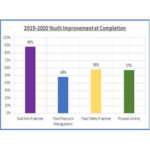
EFNEP Youth Made a Difference:
• 88% of children & youth improved Nutrition practices
• 58% of children & youth improved Food Safety practices
• 57% of children & improved Physical Activity practices
• 48% of children and youth improved Food Resource Management practices

Why it works?
EFNEP Nutrition Educators follow a research-based learning model that allows them to effectively reach and educate program participants. Educators are:
• Members of the communities they support
• Trained/Supervised by State and County-based faculty
• Skilled in using hands-on interactive teaching methods
• Committed to delivering sounds instructions
• Able to influence changes in behavior and impact the lives of those they teach
• Dedicated to reaching diverse, low-income populations.

Adult Improvement at Competition Graph.
Adult Improvement at Competition.
Youth Improvement at Competition Graph.
Youth Improvement at Competition.


Click here to visit the full impact statement with graphics.

Submitted by: Tarana Khan, State Program Coordinator, EFNEP

Agribusiness – Team Highlight

37th Annual SE Ag Lenders School
The room was overflowing with ag lenders, farm consultants, extension agents, and farmers for the 37th SE Ag Lenders School (SEALS). There were no COVID-19 worries as the school was held in Cyberville for three days of learning how to make informed financing decisions for both farmers and ag lenders. Eighty-five people from SC, NC, GA, TN, KY, IN, and OH participated in the school to hear from Dr. David Kohl (Virginia Tech/Ag Finance), Dr. Steve Isaacs (University of Kentucky/Farm Management & Leadership), Scott Mickey (Clemson University/Farm Finance), Eric Snodgrass (Nutrien Principal Meteorologist), and Dr. Joe Outlaw (Texas A&M University/2020 Election Analysis).

The 2020 SEALS was the first ag lenders schools in the country to have a cross-section of lenders, producers, and others involved in agriculture, which enabled farmers to see a lender’s perspective and gave lenders a view from the farmer’s side. Emily Duckworth of Farm Credit Mid-America said, “Having attended the SEALS conference in person in 2019, I was excited to participate in the virtual session being offered this year. It can be difficult to stay focused on Web-Ex meetings, but the team of presenters did a great job engaging the participants with relevant topics, chat sessions, polls, and case studies. Each presenter demonstrated their passion and knowledge for the topics they covered and provided tangible information that I can use as a financial officer.”

The SEALS mission is geared to educating ag lenders on the factors impacting farm production in the southeast. Topics covered included a 2021 economic and weather outlook, financial ratio to monitor, management skills that lead to higher performance, 2020 Election influences, as well as mental health and motivation. The school concluded with a Q/A session moderated by Patrick Kerrigan of Farmer Mac.

Submitted by: Scott Mickey, Clemson Agribusiness Extension Associate

Rural Health and Nutrition – Highlight 1

Situation:
The onset of the COVID-19 pandemic in March 2020 presented pragmatic and logistic challenges to conduct traditional face-to-face, hands-on, and interactive Expanded Food and Nutrition Education Program (EFNEP) workforce training. In order to reduce the spread of COVID-19 and overcome the hindrance of social distance, the EFNEP management team developed a creative and strategic plan to transition face-to-face training to virtual learning for our EFNEP staff and EFNEP participants. Since 1969, EFNEP remains devoted to reaching low-income citizens where they are and embracing best practices for (virtual) learning. Clemson University’s EFNEP team utilized the EFNEP National Guidelines for Social Media and best practices for effective online teaching to develop EFNEP virtual online learning workforce development training.

Educational Response:
From March to the present, Marlyne Walker, Registered Dietitian and EFNEP Training Coordinator/State Specialist, has conducted and facilitated five different virtual workforce development trainings. Some of the trainings were multiple-day trainings totaling over 40 hours. The EFNEP workforce trainings are designed for EFNEP nutrition educators to teach EFNEP participants, youth, and adults. All the EFNEP interactive trainings were held via Zoom. The initial training consisted of Tips to Reach and Teach EFNEP participants/online classes. It was a collaborative effort conducted with the EFNEP management team along with an EFNEP agent. Also, Walker trained nine newly hired EFNEP nutrition educators on the adult curriculum and middle/high school curriculum. In addition, Walker planned quarterly EFNEP Check-In. She has facilitated two EFNEP Check-In for all EFNEP team members. The purpose of the EFNEP Check-In is to promote team building, review nutrition concepts, and/or demonstrate ways to engage and interact with EFNEP participants online.

Outcome/ Impact:
After attending the EFNEP training, 100% of EFNEP nutrition educators reported being able to use some, most, or all of the content/ strategies in their county program. EFNEP nutrition educators were able to reach 306 adults with 100% graduation (completing series of nine lessons) and changes in decrease consumption of solid fat and added sugar (SoFAS) and 81% improvement in food resource management. In addition, EFNEP nutrition educators reached 2,326 youth (130 groups) with 82% graduation that is completing a series of six lessons. The end of year report revealed 82% of youth improved diet quality and 57% improved physical activity.

Submitted by: Marlyne Walker, State EFNEP Specialist, Senior Extension Agent

Horticulture – Team Highlight

Master Gardener Mondays: A Virtual Learning Series for SC Master Gardeners

Situation: South Carolina Master Gardeners play a vital role in assisting Extension Agents with meeting the public’s demand for reliable horticulture/gardening information. Master Gardeners must complete ten hours of continuing education annually to stay current with the latest gardening topics and research. As a result of precautions associated with the COVID-19 pandemic, traditional in-person continuing opportunities were non-existent.

Response: In response to the lack of continuing education opportunities, the South Carolina Master Gardener Program created a virtual series. Coined “Master Gardener Mondays,” the series provided weekly one-hour presentations delivered by Extension staff utilizing Zoom. A total of 1,135 Master Gardeners participated in the twelve sessions, which took place from August through October. Participants received a follow-up email after each session that contained the session’s recording, evaluation, and additional resources.

Impact: 578 of the 1,135 participants completed the evaluations with an average weekly response rate of 53%. 97% of survey respondents indicated gaining knowledge. 88% indicated plans to take action as a result of participating in Master Gardener Mondays. Implementing practices is evidence of behavior change, but even more powerful is sharing that information with others. 79% of survey respondents indicated feeling more comfortable with assisting others concerning a particular topic. This quote from a participant in the “How To Diagnose Turf” session exemplifies how a Master Gardener can apply the information learned in a way that will assist those seeking assistance from Clemson Extension, “I’m impressed with how much information I gained from this webinar. I have a concrete list of techniques I can use to potentially diagnose turf problems.”

Submitted by: Terasa Lott, State Coordinator SC Master Gardener Program and Cory Tanner, Horticulture Program Team Director

Water Resources – Team Highlight

The Clemson Extension Water Resources Team launched a new statewide effort, Be Well Informed, in 2020. The program was developed and offered in partnership with the SC Department of Health and Environmental Control and the SC Department of Natural Resources to address residential and private drinking water well concerns from clients. The program includes two components:

  • Water quality screening process for pH, total dissolved solids, nitrates, and the presence of bacteria.
  • Educational component to discuss impacts to wells, groundwater and surface water exchange, and common maintenance for contaminants.

The workshop will be offered throughout the state through its mobile laboratory and operates on a reduced fee schedule, an opportunity that can assist in meeting the needs of communities on private well systems.

The planning for this program began in 2019, with an intended launch date of July 2020. However, restrictions due to COVID-19 forced Water Resources Agents to adapt Be Well Informed to a virtual format. A preview of the statewide program was offered on September 24, and included an abbreviated version of the program with a live question and answer session. Attendees from ten different counties across the state participated in this program. A follow-up survey was administered via email with results showing that 100% of respondents felt the program was either “useful” or “very useful.” Additionally, 40% responded that it had been more than five years since their well water had been tested or screened, indicating the need for further education on the topic. When asked for comments on the presentation, responses indicated that the low-cost screening was important for those with lower household incomes and that 90% of participants would return for the in-person session once COVID restrictions were reduced. Other comments included “well organized, polished, and great.” Additional information is available on the Be Well Informed program website.

Submitted by: Kim Morganello, Water Resources Assistant Program Team Leader, on behalf of Water Resources Program Team

Forestry and Wildlife – Team Highlight

The Forestry and Wildlife team continues to meet the needs of our landowners and natural resource professionals across the state. Over the last couple of months, they have focused on conducting site visits, expanding their virtual programming, and producing the quarterly CU in the Woods newsletter. The team is in the second year of publishing its quarterly newsletter. The newsletter goes out across the state to their statewide distribution list and agents share it with their local landowners and forestry association groups. Here is a link to the newsletters: https://www.clemson.edu/extension/forestry/newsletter/index.html

The team continues to develop online content that is being delivered in a virtual format. Some of these programs are designed to target landowners and other natural resources professionals. All of their workshops for natural resources professionals have continuing education hours associated with them. A list of a few programs they have been offering:

  • Women Owning Woodlands (four-part series in October and November)
    • Videos being created as part of the program:
      • Using a Consulting Forester
      • Conducting a Timber Sale
      • Cycle of Pine Forest
      • Prescribed Fire
  •  Virtual Forestry Association Meetings
    • Fall Wildlife Food Plots
    • Privet Control
    • Practices to Enhance Water Quality
    • Our Forests and Forest Industry
  • Flora and Fauna of the Longleaf Pine Ecosystem (two-part webinar)
  • Pine Straw Management Webinar Series (four-part series)
  • Food Plots for Fall Webinar
  • Tractor and Equipment Safety Webinar
  • Videos:
    • Understory Species ID of Longleaf Ecosystem
    • Bobwhite Quail Habitat
  •  South Carolina Solar Habitat collaboration between Clemson University, SCDNR, and SC Audubon Society

The team has worked with the College of Agriculture, Forestry and Life Sciences, and Horry-Georgetown Technical College to develop virtual wildlife labs for the students. These labs have focused on the field characteristics of Northern Bobwhite Habitat. Agents have also been working with Horry-Georgetown Technical College with a wetland invertebrate sampling lab, and with the SC Governor’s School for Agriculture at John de la Howe to establish some herbicide demos.

Submitted by: Derrick Phinney, Natural Resources Program Team Director on behalf of the Forestry and Wildlife Team

Livestock and Forages – Team Highlight

The calendar year 2019-2020 has been a new year and a challenging one for 4-H. Our youth livestock programs across the state had to come up with creative and new ways to engage our members. The Youth Academy of Livestock Learning (YALL) was created by our Livestock Steering Committee to provide our 4-H livestock members across the state a way to continue their educational growth with their livestock project(s).

It was designed as an educational event that would keep our dairy, livestock, and poultry youth engaged during a time when most of their in-person opportunities had been canceled or postponed as a result of the COVID-19 pandemic. Agents from the 4-H and Livestock and Forages teams, along with volunteers, came together to produce five educational modules for six species; beef, dairy, poultry, rabbit, small ruminant (sheep and meat goats), and swine. In addition to the modules, webinars were offered for the participants to learn more or ask questions. After the educational modules, participants elected to take age-appropriate skillathon tests designed to assess their knowledge of their species of interest. The project wrapped up with two weeks of virtual barn tours and sales talk contests. These virtual events allowed the participants an opportunity to showcase their projects, their daily routines, and their ability to promote their project animal(s).

YALL had an overwhelming response, with an estimated 2,000 participants registered for the series. Participants included individuals and school agriculture programs. YALL participants were not limited to the state of South Carolina. In addition to South Carolina participants, YALL drew participants from more than twenty states, as well as several foreign countries.

Submitted by: Dr. Brian Bolt, Clemson Extension Livestock Specialist

4-H – Team Highlight

Greenville County 4-H had their first meeting of the 4-H Forest Explorers Zoom Club. Twenty youth (ages 5-9) will meet via Zoom every Tuesday at 10 a.m. to explore the Clemson Experimental Forest with Patricia Whitener and Jaime Pohlman. Patricia streams live from the forest and Jaime manages the Zoom room and the technology side of things. The youth participants get to help direct Patricia while seeing what she sees and where she goes. Each meeting will highlight an aspect of education, research, management, recreation, and careers associated with forestry and natural resources.

The club will meet weekly and follow the seasonal changes in the Experimental Forest while learning about geology, entomology, botany, ecosystems, food webs, animals, habitats (aquatic and terrestrial), and forestry practices.

“We loved your lesson and followed up today with a nature hike and stopped in a clearing between two forests, and you would have been SO PROUD!!! I asked the children, what kind of habitat are we in right now? Do you remember what Mrs. Patricia called it? Emerson shot his hand up and said, “Successional habitat.” I about fainted! See, you are making a difference, and they are GETTING IT!! We have new nature journals to practice observations with and did that today as well. ”
Penny D. Singer
Lower Elementary Teacher
Montessori School of Mauldin

Submitted by: Patricia Whitener, Greenville County 4-H Agent