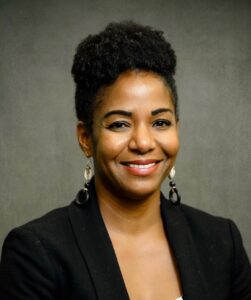
 This month, we feature Dr. Aby Sène-Harper, Assistant Professor (recently promoted) in Parks and Conservation Area Management. Dr. Aby Sène-Harper holds a B.S. from Warren-Wilson College (2005), a M.S. from University of South Carolina (2008), and a Ph.D. Texas A&M University (2016). She is a trained interdisciplinary environmental social researcher whose work advances socially and ecologically just approaches to managing public lands, natural and cultural resources. Her research lies at the intersections of parks and protected area governance, livelihoods, nature-based tourism. For over a decade, Dr. Sène-Harper has worked closely with government agencies in the US and Africa to inform and design integrated management plans for large scale conservation areas of international importance for biodiversity and socio-economic development (i.e., RAMSAR designated Wetlands; World Heritage Sites, National Parks). She has published multiple academic articles and technical reports on several topics including, community-based natural resource management, sustainable livelihoods, protected area management, ecotourism, and relevancy.
How long have you been at Clemson?
Since June 2018, so it’s been 7 years now. I graduated from Texas A&M University in 2016 and went on to do a postdoc at North Carolina State University. After which I started at Clemson as a Pathway Postdoctoral Fellow which transferred to a tenure track position. Clemson University was also a place that was of personal interest to me because of the family both my husband and I have in this part of the country. Additionally, I saw Clemson as a place where I could build on some of the work, I did for my master’s thesis on tourism development and the displacement of African American communities on Hilton Head Island. I wanted to continue to work on topics related to conservation and tourism policies in relation to African American communities in South Carolina.
What else can you tell us about your work?
I have one foot in the US and one foot on the African continent, West Africa specifically working on topics related to parks and protected areas. I look at integrated conservation and development approaches, learning how to manage protected areas in ways that are inclusive and economically and socially beneficial to communities around them. In addition, I explore the relations (social, cultural, economic and political) that communities have with those protected resources. There is a long history of human rights violations around the establishment of protected areas, as these resources also sustain the livelihood of many of those communities. In short, I see my research as trying to address some of those issues and then building the bridge between protected areas and communities living around them.
My current sites are Francis Marion National Forest and Cape Romain National Wildlife Refuge. These areas used to be rice plantations during the slavery era and later were significantly impacted by the lumbering industry. These eras of extractive industries transformed the ecologies of those places. Yet these areas have a cultural and historical significance to the African American communities who still maintain an ancestral connection to those places. During the reconstruction Era African Americans families bought lands, which were then considered of low value, and settled in the forest that is now Francis Marion. So not only did enslaved Africans worked that land right to what it’s become now and its biodiversity, they also owned lands in the forest and marshlands where they sustained their livelihoods and maintained cultural practices. Despite that connection, they no longer have access to sites now designated wilderness areas. My work seeks to propose evidence-based management approaches that would allow them to maintain the rich connection they have with those sites, rather than restricting their engagements to only recreational activities.
What is that you do in terms of research?
I consider myself a political ecologist or a social ecologist. I apply the political and the social lens to ecology, ecological processes and natural resources management. We don’t just look at natural resources through their ecological elements, but we also consider the political, social and political economic elements and how they shape environmental issues.
I was trained as a conservation social scientist through an NSF-IGERT Fellowship at Texas A&M University called Applied Biodiversity Science (ABS). That program allowed natural scientists and social scientists to work together on conservation issues. Participants had a home department but were expected to follow the ABS curriculum. The program was for social scientists like me and for ecologists and conservation biologists. I worked with a fisheries ecologist from Brazil. She was a great partner for me because of the work I was doing in Senegal on social issues related to protected wetlands and freshwater fisheries. In Brazil, she was looking at the ecological side of freshwater fisheries and I was looking at governance institutions of fisheries in Brazil. It was a very interdisciplinary program.
How do you manage your time to balance your personal life, teaching, research, service, and all the other things you do?
In terms of family time, I really have to set boundaries. I know this is a cliche response, but it’s so important. When I’m home out of regular working hours, I check e-mail but only respond to emergency, nothing mentally draining. If I have to do more intensive work during weekends, I do it in the morning so I can have the rest of day off. I block time to write and do research and force myself to do it by putting that time on my calendar. It took me some time to get there and be disciplined about it. But once I started adhering to it is when I made a lot more progress in terms of my publication and grant writing.
It is also important to note that I have been able to find great collaborators. Finding those collaborators that you can actually work with well and share the burden of carrying an entire research agenda is as important as declining collaborations that may not be good for you. Sometimes it’s important to recognize those things that are simply beyond your bandwidth even when you consider the potential impact in the projects and the students involved.
What advice would you give to your self-first year assistant professor?
Mentoring students takes a long time and often that time comes from research productivity. As much as possible, I would advise myself to space things out a little more, having a longer-term plan in terms of grants and graduate student mentoring.
How do you see your research, program, department, the college and/or university evolving in the next five years?
I would love to delve deeper into my work. As an ethnographer, I want to go into the community and spend time there. I wish to be able to do the quality of research that I really want to do, rather than just doing interviews and then close out the project and move on to something new. I want to build the pieces that allow me to just be in a space and do justice to the community, not just being a helicopter scientist who comes in, extracts and then disappears. I’m interested in building that relationship with the community, pursue research that is more collaborative, a co-production of knowledge one that will ultimately serve the community and not just my career.
More information about Dr. Sène-Harper
Want to know more?
Please use this form to provide feedback, propose stories, or nominate a colleague to be featured (including self-nominations).
