by: Xiao Yang, Steven Jeffers, Caroline Oatley, Allison Guggenheimer Bower
There are no known reports of beech leaf disease (BLD) in South Carolina at present, but it is an emerging threat of regulatory concern that has recently been confirmed in Watauga County, North Carolina (Borden et al. 2026). BLD is caused by the foliar nematode Litylenchus crenatae, which was first detected in the United States in 2012 in Lake County, Ohio. Since its discovery, the nematode has rapidly spread to numerous other states across the northeast and mid-Atlantic regions and to parts of Canada. Most recently, it has been reported in two southeastern states: Virginia in 2021 and North Carolina in 2025. BLD is a potentially lethal problem affecting American beech trees (Fagus grandifolia) in forests and landscapes. It causes leaf distortion, bud abortion, and, eventually, canopy thinning and tree death. Mortality on smaller and younger trees (less than 5 inches in diameter at breast height) is more common and can occur as early as two years after infection (Martin & McIntire 2026).
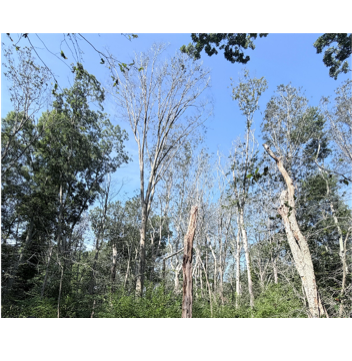
(Severe canopy thinning and mortality of American beech trees in an urban forest in Rhode Island. Photo source: Xiao Yang)
As shown in the photos below, symptoms include dark green, yellowish, to brownish stripes and bands running parallel between leaf veins—a distinctive symptom that is readily recognizable to the naked eye without special tools. Severely infected leaves may appear smaller and distorted and have a leathery texture (Martin & McIntire 2026).
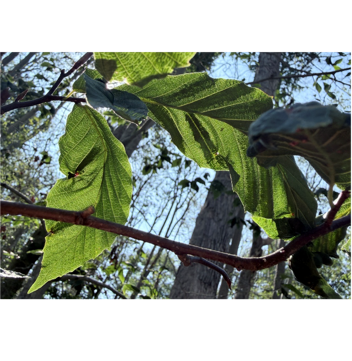
(The characteristic banding or striping symptoms of beech leaf disease. Hold infected leaves up to the sunlight or look up through the canopy toward the sky for better observation of this characteristic symptom. Photo credit: Xiao Yang)
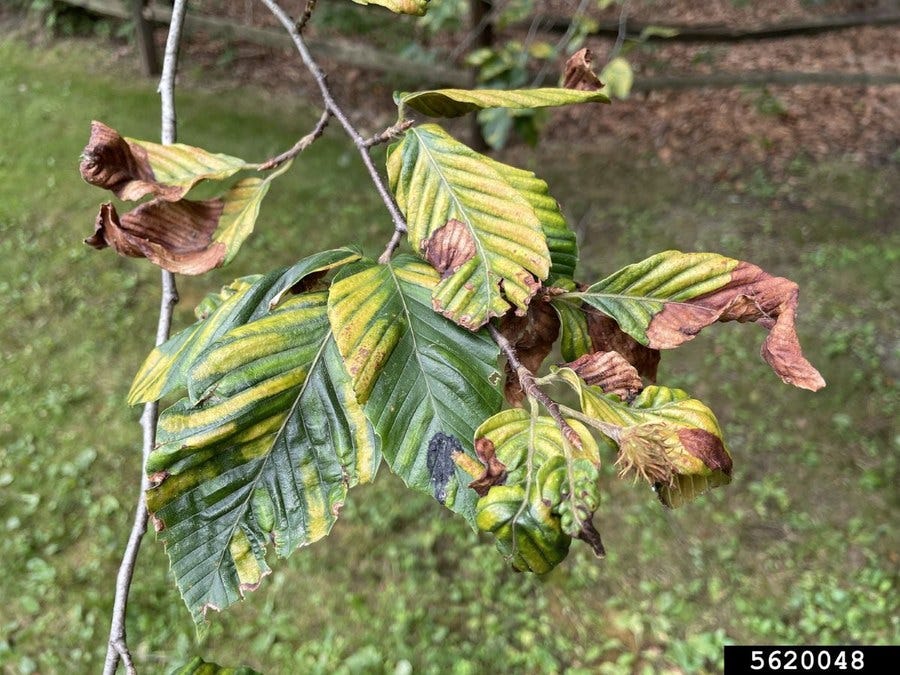
(Leaves at later stages of infection with progressive BLD symptoms such as curling of margins, a thick, leathery texture, and yellow banding between veins. Photo credit: Matthew Borden at Bartlett Tree Experts)
Potential BLD sightings and reports in South Carolina are warranted from first responders – including citizen scientists, rangers, and residents in and near forests with American beech populations. However, to avoid false sightings, first responders should learn to distinguish true BLD symptoms from those of a few “look-alike” pests and diseases as shown below.

(Woolly aphid damage that may be misidentified as the banding symptom of beech leaf disease. Photo credit: Andrejs Brolis at U.S. National Park Service)
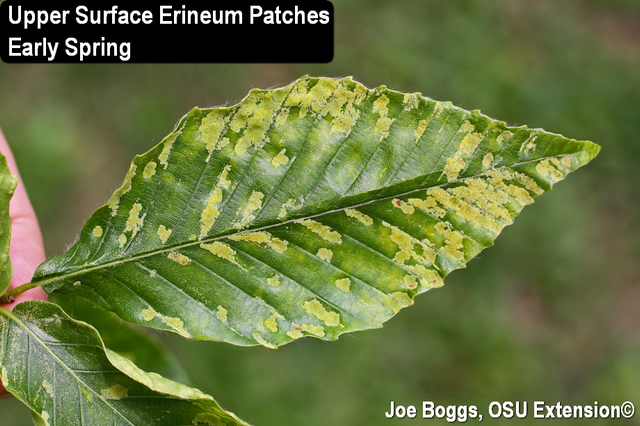
(Light green patches between veins, caused by microscopic eriophyid mites [beech erineum mites], could be confused with beech leaf disease. Photo credit: Joe Boggs at The Ohio State University)
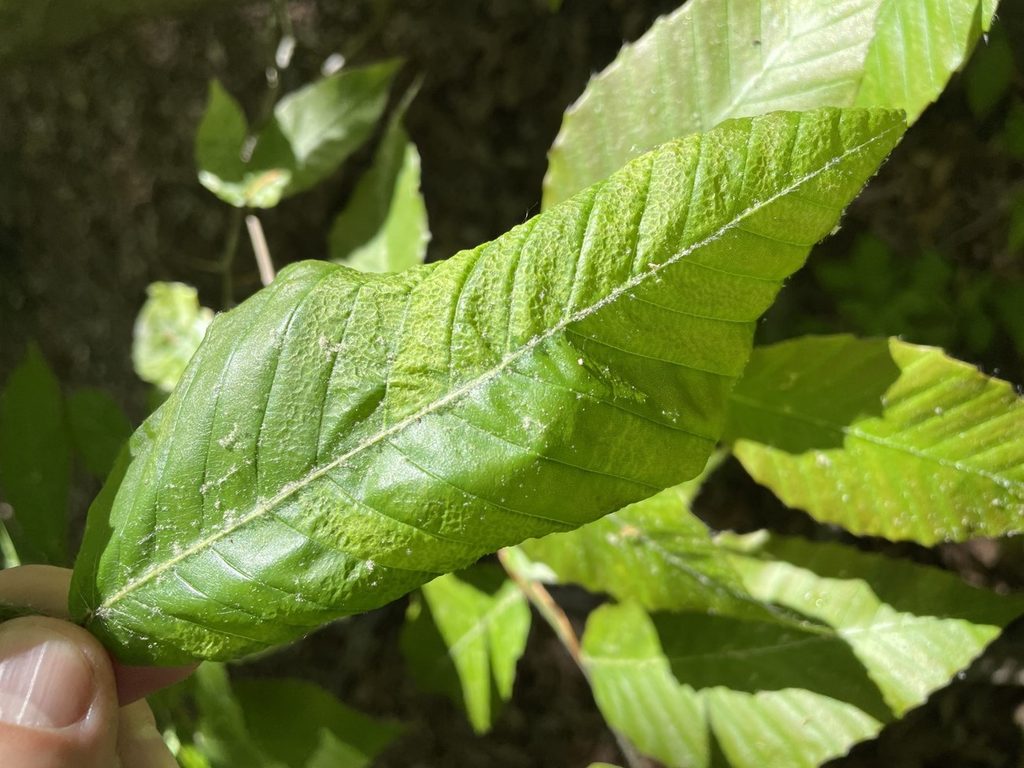
(Damage from leaf curling aphids that may be misidentified as symptoms of beech leaf disease. Photo credit: Andrejs Brolis at U.S. National Park Service)
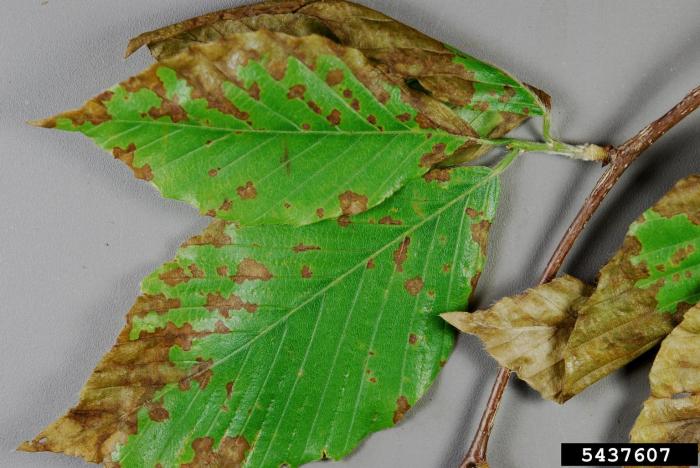
(Beech anthracnose causes leaf spots and necrotic lesions that may be confused with the symptoms of beech leaf disease. Photo credit: Nancy Gregory at University of Delaware)
If suspicious symptoms of BLD are observed in our state, the public is encouraged to report the sighting to the Clemson University Department of Plant Industry at invasives@clemson.edu. Please include the following information in the email.
- Location of the sighting (e.g., exact location – longitude and latitude, or address – street number and name, city, and zip code)
- At least one photo clearly showing BLD symptoms
- Contact information (e.g., name and phone number)
References:
Borden et al. 2026. First report of beech leaf disease caused by the foliar nematode Litylenchus crenatae on American beech in North Carolina. https://doi.org/10.1094/PDIS-07-26-1354-PDN
Martin, D. K., and McIntire, C. 2026. Pest alert: Beech leaf disease. Publication no. R9-PR-016-24. USDA Forest Service, Eastern Region. Milwaukee, WI. https://usfs-public.app.box.com/v/EasternRegionPublications/file/787426913431?sb=/details
