Introduction
Our goal is to keep you informed about the Yellow-legged Hornet (YLH) infestation in South Carolina. Supportive community relationships are essential to the success of detecting, tracking, and removing this pest. This update is being issued to collaborators, communities, and stakeholders, and we invite you to share this information with anyone who may be affected by our operations.


Background
What happened? In August 2023, Vespa velutina, Yellow-Legged Hornet (YLH) was detected in the United States for the first time near Savannah, GA, less than five miles from the South Carolina-Georgia border. In Spring 2024, several YLH queens and one embryo nest were found in Beaufort County; worker detections continued through summer.
Why do we care? Yellow-Legged Hornets prey on honeybees, causing reduced foraging and colony failure. This impact would result in reduced honey and other honeybee products and reduced crop production due to decreased pollination by honeybees and native pollinators.
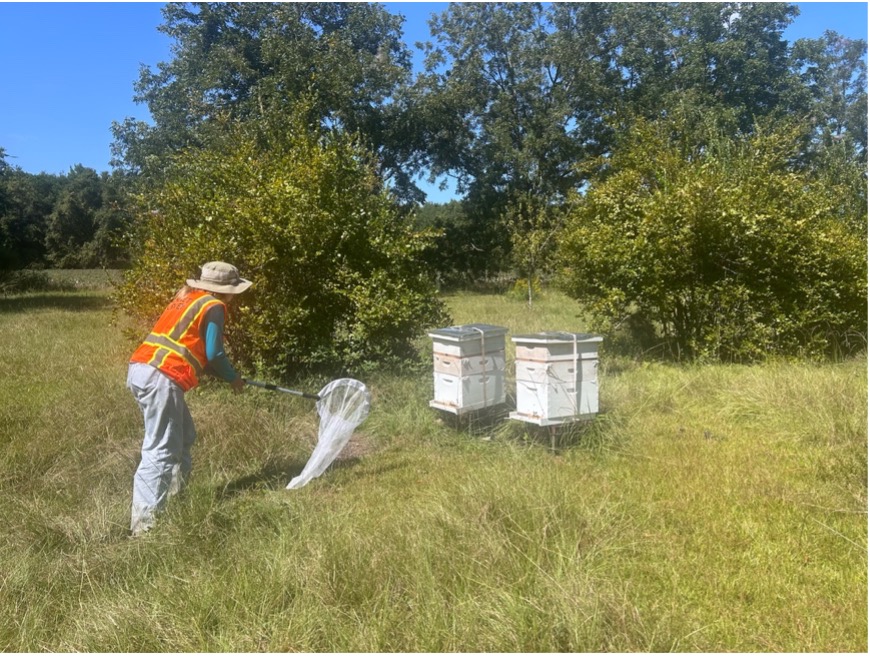
What are we doing? With the Support of USDA APHIS, Clemson’s Honeybee Protection Program is surveying for YLH focusing on detecting workers and finding nests within a wide area around the initial detections. Baited traps are used to initially detect hornets, followed by tracking live hornets to narrow down the nest search area. Eradication focuses on locating and destroying nests including queens. Nests should ideally be destroyed by late summer or very early fall before new queens are actively mating and dispersing. Nest destruction will continue throughout the fall and early winter.
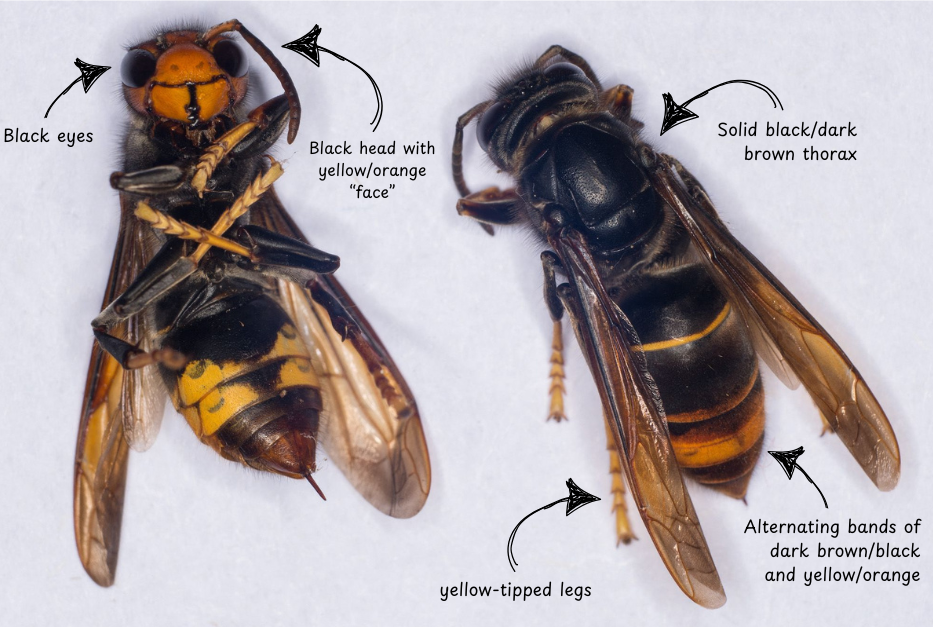
What does it look like?
- Body length: Ranges from 0.7 – 1.0 inches
- Colorations:
- Head: Mostly black with some front-facing yellow/orange; Black eyes
- Thorax: Mostly solid black/dark brown
- Abdomen: Alternating bands of dark brown/black and yellow/orange
- Legs: Brown or black near the body, ending in yellow segments
Life Cycle

YLH By the Numbers – 2026 Stats as of 09/16/2026
- 4,259 traps are set in Allendale, Beaufort, Berkeley, Charleston, Cherokee, Chester, Colleton, Dorchester, Jasper, Hampton, Lancaster, Union, and York Counties
- 52,472 trap services have been completed
- 2,848 traps are currently in the Low-Country District
- 1,410 traps are currently in the York District
- 217 Embryo nests have been removed in the Low-Country
- 279 Primary nests have been removed in the Low-Country
- 67 Secondary nests have been removed or scheduled for removal in the Low-Country
- 2 Embryo nests have been removed in the Up-Country
- 1 Primary nest has been removed in the Up-Country
The SC Yellow-legged Hornet Nest Map Update: reflects nests found and hornet activity. Overlap both maps or hide one in layers by clicking the eye icon to view them separately. Interactive applications allow you to enter a specific address to focus your view on an area of interest. Each point, when selected, also provides you with additional information, such as the nest stage.
Latest Buzz
The Clemson Department of Plant Industry (DPI) inspectors and USDA personnel in South Carolina have YLH traps placed throughout Allendale, Beaufort, Berkeley, Colleton, Charleston, Cherokee, Chester,Dorchester, Hampton, Jasper, Lancaster, Union, and York Counties of South Carolina. These traps are monitored regularly for hornet activity. The locations have been established near known YLH detections and, where possible, near known honeybee colonies.
It can not be overstated that beekeepers should be familiar with the activity of YLH hawking and report any sightings immediately to the Clemson YLH Reporting Tool.
In the late summer season, the colony grows and workers will begin building the “Secondary Nest.” The “Primary Nest” will be abandoned as the colony moves into this larger nest and continues to expand it.
DPI is currently monitoring traps and removing YLH nests when discovered. Expanding trapping locations and continuing public outreach efforts are also a major component. The public should survey around structures, shrubs, and trees and report nests in any stage. If you believe you have identified a YLH nest, do not attempt to remove it yourself. Please report at the Clemson® DPI’s reporting tool.



We’re hiring!
Are you or someone you know a good fit for our team? See our open positions and descriptions below and apply at www.clemson.edu/careers
Look-a-like of the Month
Eastern Cicada Killer, (Sphecius speciosus)
Appearance:
- Adults are typically 1.5–2 inches long
- They have a black body with broken yellow bands on the abdomen and reddish-brown wings
- Their large size and loud flight make them very noticeable during summer
Life Cycle
- Adult females emerge in summer
- They mate and begin hunting cicadas
- A paralyzed cicada is placed in a chamber with an egg
- The larva feeds on the cicada and overwinters underground
- New adults emerge the following summer
Nest Description:
- Nests are dug into sandy or loose soil, often in:
- lawns
- garden beds
- sidewalk edges
- bare ground or banks
- The entrance is usually marked by a large mound of loose dirt resembling a small gopher hole
- Each female creates her own tunnel with several chambers underground
Behavior:
- Solitary wasps, meaning they do not live in colonies like Yellow Jackets or hornets
- Females hunt and paralyze cicadas, which they carry back to underground burrows as food for their developing larvae
- Males patrol territories and may aggressively fly near people, but they cannot sting
- Females can sting but rarely do unless handled or threatened


What you can do
- Beekeepers: Beekeepers play a vital role in monitoring apiaries and colonies for YLH activity and reporting YLH sightings to Clemson® DPI’s reporting tool. Reporting activity helps DPI deploy traps if needed and attempt to identify the nest location in a timely manner. Keep an eye out for hawking behavior on honeybee colonies.
- Citizens: All South Carolina citizens can familiarize themselves with hornet and nest identification and assist with reporting. A citizen trapping program for the YLH is now live. The program includes instructions & videos on constructing traps, baits, and reporting YLH findings.
- The Yellow-legged hornet is an invasive species that will move to new areas primarily through human activities such as trade, travel, and tourism, often hitching rides on vehicles and cargo, so please be careful and inspect your items prior to travel especially if you live in a YLH infested area.
- DO NOT attempt to remove a nest on your own. Report it to the YLH Reporting Tool. Someone from the YLH Response Team will contact you and arrange the removal. We will make sure to remove the nest and queen; this will ensure the queen does not fly off and start a new nest location.
- ALL REPORTS ARE REQUIRED TO SUBMIT A PHOTO WITH THE REPORT. AN IDENTIFICATION CANNOT BE MADE OR VERIFIED WITHOUT A PHOTO.
Closing
The mission of Clemson University Department of Plant Industry (DPI) is to protect South Carolina’s agricultural resources and natural ecosystems from the introduction and spread of invasive species and to enhance the efficiency of South Carolina’s agriculture. South Carolina faces major concerns from biosecurity issues and exotic pests. Without federal assistance, South Carolina would not be able to maintain early detection, provide maximum affordable laboratory capability, and maintain a field force to conduct surveys and identify, quarantine, and dispose of introduced pests at effective levels.
Clemson DPI would like to recognize the funding and support received from the USDA, without which YLH trapping efforts would not be possible. We would also like to thank the GA Department of Agriculture for their invaluable expertise and collaboration on YLH eradication in SC.
Helpful Links
- Clemson® DPI Resources
- USDA APHIS on YLH
- Georgia Department of Agriculture on YLH
- Clemson Extension’s Apiculture and Pollinator Program
- Article on Exotic Hornet Threats to Apiculture
- York County Detection Article
- New York Times Article
- NPR Feature
- MakingItGrow
Want to stay in the loop?
Tune in for our monthly newsletter! Get the newsletter to your inbox each month. To subscribe scan this QR code or follow the instructions below:

1. Create a new email message to listserv@lists.clemson.edu
2. In the body of the message, type the following: subscribe listname First Last
Example: subscribe SCYLHNEWSLETTER Jane Doe
3. If there is an email signature in the body of the message, you must remove it so it does not interfere with Listserv reading the subscription command.
4. Send the email.
5. Subscriber should receive an email confirmation it was successful.
