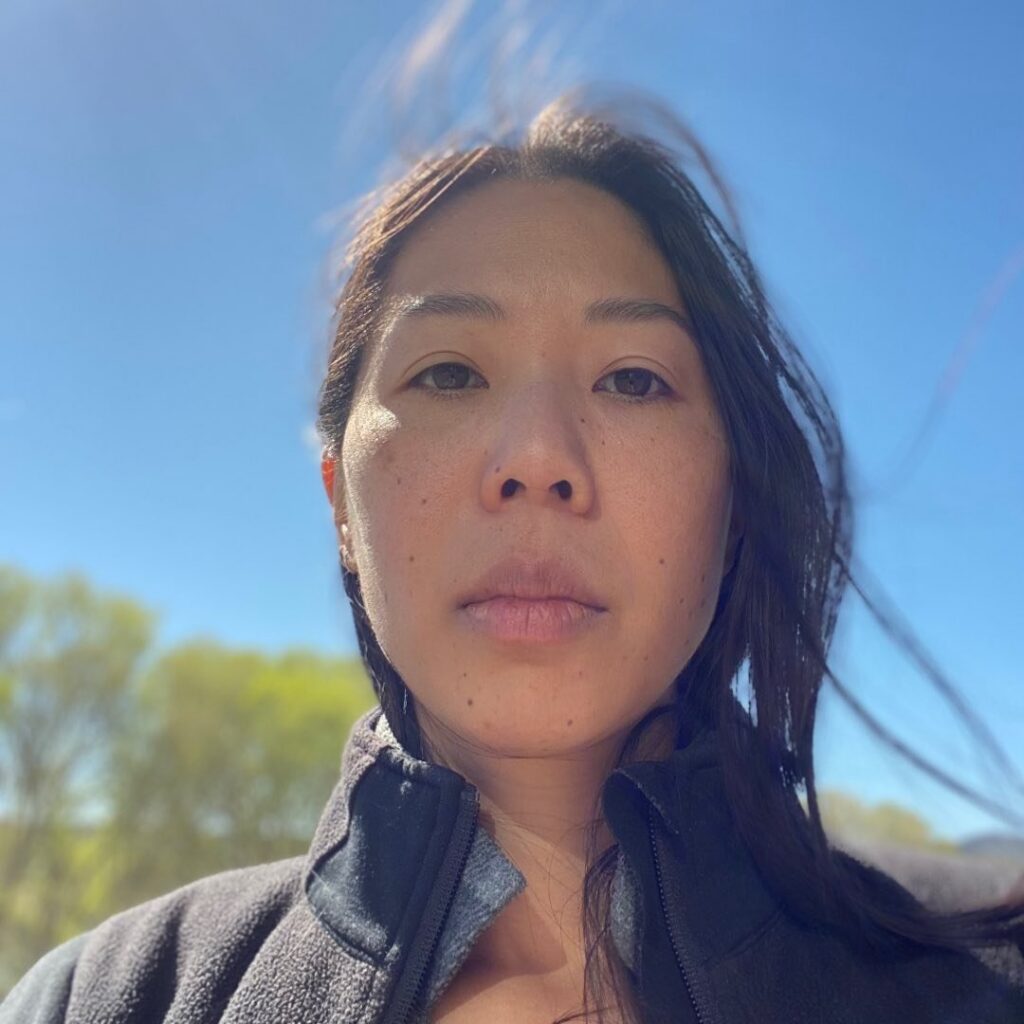
Cyn Nooney’s story “Sterling Recruit” was the recipient of the Ronald Moran Prize in Fiction for SCR Volume 58. Here, she’s interviewed by Sage Short, former SCR assistant editor and current poetry editor of Greensboro Review.
Sage Short: “Sterling Recruit” opens with “It was an empowering feeling being selected, especially out of the blue like that.” Where did the idea for “Sterling Recruit” come from? Did a character come to mind? An image? Did you start with the first statement or did that come later?
Cyn Nooney: I love these questions, as I often wonder about the genesis of work by other writers. It’s an ongoing fascination of mine, and I’m always down to discuss process. Usually when I begin writing a story, the igniting spark is an image that I can’t shake, or a character whose voice or behavior interests me, especially those unaware they’re ripe for the stage. I’m continuously fascinated by the human condition and our spectrum of foibles, so entering a story isn’t the hard part for me. It’s the rest that often feels insurmountable. (My partially-written story count is ridiculously high.) As for “Sterling Recruit,” the first sentence is how I began—my openings don’t change nearly as much as the rest of my stories do. This story is very loosely based on a weekend experience as a newcomer to Los Angeles and was absurdly long in the making—it took over twenty years. I made countless failed attempts to write it, and nothing worked until I finally landed on a satirical approach. Once that happened, I was able to find the tone and POV I’d been seeking, and guileless Keeley won the lead.
SS: How do you know when a story is finished?
CN: When I’ve worn down another molar. Kidding aside, this is tricky to answer because it can feel impossible to know when a story is finished. But revision is key. Revision. Revision. And more revision. Feedback from trusted readers helps too. And dogged persistence. A grad school advisor, Valerie Laken, once advised me to read my work out loud and as much as I hate hearing my own voice, this technique has helped tremendously. You catch typos that way as well as where the hitches might be, including any false notes. Once you’ve addressed those, you can turn an eye toward finishing. For me, endings take forever to get right, and I often write the final paragraph dozens and dozens of different ways. Sometimes it’s just a matter of reordering a few words or sentences, sometimes it’s heavy addition or subtraction, but intuition along with reading aloud usually lets you know when the story is done. That, and not fooling yourself. I believe most seasoned writers know when something isn’t quite ready, hard as it might be to admit. I’ve found it helpful to put stories that I’m struggling with away for a bit and usually when I return to them later, clarity is more accessible. With any luck, the ending, or whatever needs fixing, will reveal itself. Or at least raise a middle finger in a halfhearted hello.
SS: There are moments throughout “Sterling Recruit” where I found myself laughing or feeling in conversation with the narrator, like early on in the story where you wrote, “Were the deputies attractive, you might ask. It’s a natural question. It’s how we’ve been raised.” I’d love to hear your take on the importance of incorporating humor in stories like “Sterling Recruit.”
CN: I believe humor is critical to surviving this experiment called life. Especially in dark times, such as we’re currently facing. Among its many attributes, fiction can offer welcome reprieves from terror and muck, and therefore when a story has the capacity to unnerve, I’ll sprinkle in occasional levity. That might be an act of self-preservation or group-preservation, but I figure why not amuse ourselves while circling the drain. A great teacher in this regard is Kurt Vonnegut and the way he approached writing about WWII. Slaughterhouse-Five is a book I have on annual repeat, and every time I re-read the line about Billy Pilgrim being “tall and weak, and shaped like a bottle of Coca Cola” my day becomes infinitely better. Or the way Billy’s pilfered frozen overcoat is described as “so small, that it appeared to be not a coat but a sort of large black, three-cornered hat.” Humor can hold a reader’s attention while also grabbing the heart. And makes the tough stuff go down easier.
SS: Do you approach your screenplays similarly to your fiction? Additionally, do you see stories cinematically while you’re writing?
CN: Character-first is how I approach any kind of writing, however when it comes to screenplays it’s prudent to know the entire plot ahead of time, including the ending. But that’s difficult for me, and I often resist. One of my favorite things about fiction is discovering the character in real time, and not knowing the ending, let alone other components. Fiction allows the writer to surprise herself, and in turn, hopefully the reader. So, while the approaches are somewhat different, I do see stories cinematically while in the act of creating. It took me a while to get there, though, and I credit a writing instructor who offered invaluable critique several years ago about a story I wrote involving a woman who drives to the beach then stares at the water while mulling over a hard decision. “What can you have your character do at the ocean that shows what she’s thinking?” the instructor wrote. “A character can’t just look at the water. Think cinematically.”
That changed a lot for me. At the time I wasn’t yet writing screenplays but incorporating the instructor’s advice into my fiction prepared me well once I later tried my hand at scripts. The latter wasn’t anything I ever planned to do but after winning a cinematic short story contest hosted by a screenwriting platform, I challenged myself to try. Dabbling in that medium is a lot of fun and provides useful exercises for any writer—you can’t rely on interiority because characters can only be revealed through dialogue and action. Limitations like that can be instructive.
Although I enjoy hopping back and forth between mediums, fiction will always be my everlasting love and is primarily where I devote most of my writing time.
SS: How does your background as a media executive influence your writing? Do you ever find yourself pulling inspiration for content from that time in your life?
CN: Hmm, this makes me ponder. I wouldn’t say my media career influenced my writing per se, as I’ve wanted to be a writer ever since I can remember—as a child I would climb a bur oak tree with my purple lockable diary, eager for a quiet place to stow away and scribble— but I do think my cumulative experiences inform and shape my writing, like I imagine they do for any author. Most days my mind feels overstuffed but when I take the time to sift through the files, then yes, absolutely, a lot of content originates from that period in my life. Much more so than what’s occurring in the present. And while I haven’t yet wholly excavated my childhood, I concur with Flannery O’Connor’s statement, “Anyone who has survived his childhood has enough information about life to last him the rest of his days.” Within each of us is a dearth of storytelling material and for me, it’s about what bubbles up the loudest.
My former jobs offer plenty of fruit for the picking. During the early part of my career, I worked for a regional sports network that televised the Texas Rangers, Houston Astros, Dallas Mavericks, Houston Rockets and San Antonio Spurs, and my time in Dallas has served as a backdrop for many of my stories. The same can be said for Los Angeles, where I spent subsequent years in the media entertainment business as a marketing executive for E! Entertainment Television and the Style Network. Per your question, those experiences have greatly contributed to my writing, so I should probably amend my answer! Either that or get around to setting stories in Colorado, where I was raised, or the San Francisco Bay Area, where I currently live. But there’s only so much time, isn’t there? I believe influences and inspirations are there for the taking, all around us.
SS: What’s up next for you?
CN: I wish it would be a large tax return, but since that’s not going to happen, I’ll just keep pecking away. (I’ll keep pecking regardless, as I can’t not write despite the anguish I sometimes feel about this wacky passion.) As writers, the only thing we have control over is our productivity. Mine tends to ebb and flow, the former being the case too often! but I plan to always create—as much for my sanity as anything else. A frequent and common question I receive from well-intentioned family members and friends is, “Are you still writing?” I’ve yet to locate the perfect response so I’m all ears if anyone has one beyond, “Yes, and can you please quit asking that!”
Multiple unfinished stories are currently clamoring for my attention and meanwhile I’m assembling a collection, plus making notes for a potential novel. Hopefully I’ll somehow manage to get published every now and again in fine publications such as South Carolina Review. I’ll be forever grateful to the team at SCR for publishing and honoring my work. Thank you endlessly!