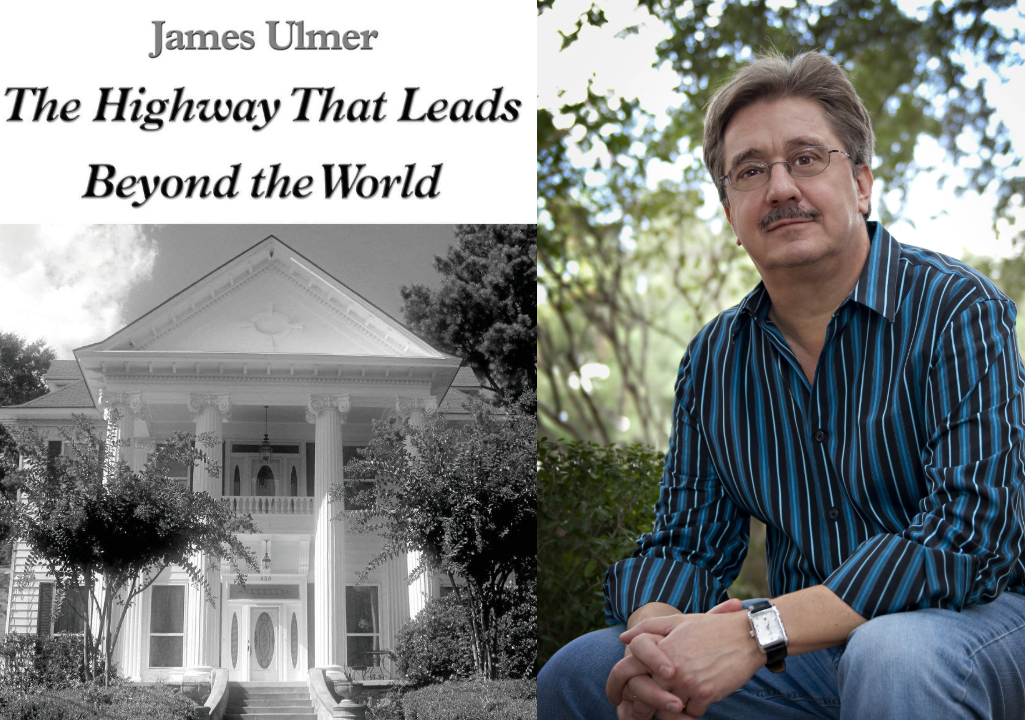
South Carolina Review author James Ulmer’s new book of ghost stories, The Highway That Leads Beyond the World, was published in June by Bridge House Publications, a British press specializing in dark literary fiction and mystery. The lead-off story in the collection, “The Far Hill,” first appeared in The South Carolina Review in the Spring 2020 issue.
Ulmer’s previous collection, The Fire Doll, was awarded the George Garrett Fiction Prize from Texas Review Press. Recent stories have appeared in The South Carolina Review, The Saturday Evening Post, Arkansas Review, Descant, and elsewhere. Ulmer is Professor of English at Southern Arkansas University.
The house in the cover photo, the Maud Crawford House in Camden, Arkansas, is the scene of an unexplained disappearance well known in Arkansas lore and is the setting of the story “Dietrich’s Witness” in The Highway That Leads Beyond the World.
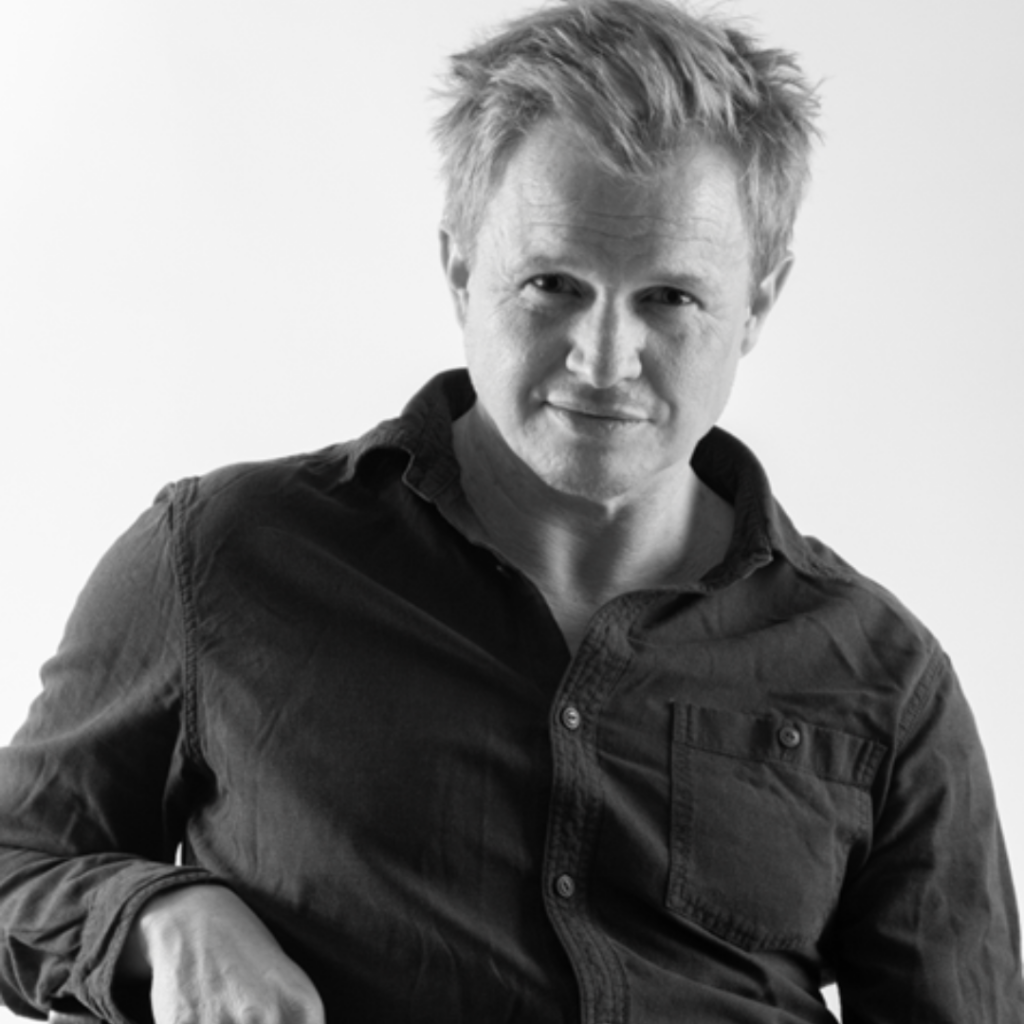
SCR Associate Editor Will Cathcart graduated from Clemson University with an English major in 2005 and then quickly moved into the world of journalism, becoming one of the first American journalists to interview the president of the Republic of Georgia following Russia’s invasion of the country in 2008. Will stayed on in Georgia as media advisor to President Mikheil Saakashvili, at the same time contributing news and feature stories to such news outlets as CNN and The Daily Beast. He contributed reporting from Ukraine following the Russian invasion in 2022. Born with cystic fibrosis, Will has also written about the healthcare system and the availability of life-saving prescription drugs.
All of these experiences, plus a lot more (such as the theft of Frederic Chopin’s heart) have worked their way into his first novel, This is How People Die, now available from Evening Post Books. SCR Assistant Editor Rylee Cowan interviewed him via email about his entrance into the world of fiction and other topics.
Rylee Cowan: As someone with a journalism background, how do you navigate the line between factual responsibility and creative freedom when writing a novel?
Will Cathcart: No matter what I’m reporting on, the best way to get readers to engage is to tell a story. As a journalist, I hope to tell the story, and those kind of deep dives are what I have always found most compelling. The best stories are the kind where I go in thinking it’s going to be one thing, and the world gets turned upside down and reverses all my preconceptions. What is most important is following the facts wherever they lead you, whether your editor or readers will like it or not. The story is there, and you have to find it and then dig deeper. Sometimes, when you get close enough, the story finds you.
Though journalists are not meant to become part of the story, when reporting on a conflict, often the best way to tell that story is from your own point of view. To pull this off, you have to understand the situation and the facts, seeing the thing from all angles. Even then, you are taking a risk by telling your experience of it. And yet, this is often the most powerful way to tell a story if your readers trust you and if you respect their intelligence. The reason this kind of storytelling has always interested me is because I was a writer long before I became a journalist. I think journalism needs all types: investigators, scientists, lawyers, financial specialists, programmers, data analysts, and so forth. I’m a writer. While a lot of things can be learned, the writing is obviously fundamental to journalism, and that goes for most mediums.
So for me, the transition to fiction has been natural. Instead of following the story, you begin with that story, or at least an idea or something you have no choice but to say. I’m also fascinated by creative nonfiction which subverts that binary when the story is told so well it transcends nonfiction while remaining true. I’m thinking of Benjamín Labatut’s When We Cease to Understand the World. Candice Millard’s work comes to mind. Also, Merlin Sheldrake’s absolutely brilliant book on fungi, Entangled Life, and The Book of Eels by Patrik Svensson, both of which read more like poetry than scientific literature. And then there’s Karl Ove Knausgård, though he is his own can of worms. To go back to your original question, I guess the best journalism tells a story that defies belief and the best fiction is a story that is true, though the facts aren’t.
RC: You chose to publish through an independent press in Charleston—what does that allow you to do with your story that a larger publisher might not?
WC: I was very lucky to find Evening Post Books when I did. They had hired some really bright people who are more interested in fiction and stories that might come from the region but speak to everyone. Honestly, I can’t believe they allowed me to publish certain sections of This Is How People Die. Because they understood what I was doing and were willing to take a risk on this book, I wasn’t forced to compromise my vision. I don’t think that would have happened with a larger publisher for a number of reasons, but mainly a lack of appetite for risk, especially in a debut novel. An indie press in a place like Charleston with a very dark history—and modern Charleston is a reaction to that history—offers a unique “literary home” for stories that are deeply rooted in place but global in their themes.
Not only does the novel feature George Sand delivering 19th-century narration, the book is full of sex, drugs, and Chopin. Entire sections are devoted to Bob Flanagan, a subversive sadomasochism performance artist who explored living with cystic fibrosis and became well known in LA in the 1980s and 1990s. Bob and his partner, the artist Sheree Rose, put his own self mutilation and various flavors of BDSM on display. The Nine Inch Nails video for the song “Happiness in Slavery” is just Bob strapped nude to a table being mutilated by a machine.
And yet, none of his work was for shock value. Bob was born in 1952 with CF. Both of his sisters died from it. Somehow he lived to the age of 43, which was almost impossible for the time. His body put him through hell and he saw sadomasochism as a way of fighting back and subverting his own pain. Because of this, he lived decades longer than he should have. It wasn’t just about pain; it was his art that kept him going as a way to reclaim agency, perhaps even over his own death.
I was born in 1982, and growing up with CF, there were no role models with the disease. No one had survived it and done anything except for Bob. He was part of the story I wanted to tell, and the characters I wanted to show who attempt to claw back their agency by stealing Chopin’s heart and defying not just the modern world, but centuries of horrible men who attempted to appropriate Chopin’s music by stealing his heart. Evening Post Books let me tell that story. And I still can’t believe they let me do it. But don’t tell them that. I think of that Nick Lowe song that Wilco covered, “I Love My Label.” Well, I love my publisher.
RC: While working in Georgia, what surprised you most about how communication functions between government, media, and public perception?
WC: Honestly, the whole system is a disaster. For me, Georgia has always been a highly focused microcosm of where the US might end up politically. Russia has been invading this land since long before Georgia existed. Russia’s entire national identity was forged by invasions of smaller territories and then countries. Georgia has defined itself by resisting not just those Russian invasions, but Ottoman, Persian, and so forth. The Georgian people are fiercely independent. The Georgian government is not. It wasn’t always this way, but in the last decade, an oligarch with pro-Kremlin sympathies and Russian financial holdings came into power on a wave of populism and has been dismantling the courts, the culture, the history taught in schools, the rule of law, freedom of the press, and, as of 2024, free and fair elections. Sound familiar?
I first came to Georgia in 2008 with a theory that Russia would invade. A lot of very intelligent people were telling me it was going to happen, but the world would not listen. Three weeks later Russia invaded Georgia. A year or so later I moved here, and this country has been a lens into trends in the region, into how Vladimir Putin’s Kremlin operates, and, unfortunately, into how democracy is disassembled. What surprised me is how quickly and comprehensively those in power can hijack a narrative, take over TV channels, and wage war on the press without consequences, even while more than half of the country still thinks it is living in a democracy and wants to be part of both the EU and NATO.
Democracy is a fragile thing and I fear we in the US took it for granted for far too long by voting for perceived financial benefit over the strengthening of institutions. That doesn’t end well. A lot of my Georgian friends in the opposition are now in prison simply for demonstrating against the ruling party and its far right populist agenda. Their political party is now illegal. The recent Hungarian election that booted out Viktor Orbán gives me some hope, but Hungary is a European country with EU guard rails. Georgia is not. And the United States is not. Here in Georgia, all of this began with demonizing the press.
RC: Was there a specific experience in Georgia that changed how you think about diplomacy or institutional trust? Does this impact your narrative view in any way?
WC: The Russian invasion of Georgia in 2008 changed my life. I was thrust into the midst of Russia’s evolving geopolitical statecraft that led to the 2013 Euromaidan protests in Kyiv and culminated with the re-invasion of Ukraine in 2022. Now, Putin’s Russia may end on a Ukrainian battlefield. But what changed everything was the choice of the Ukrainian people to fight back.
The US didn’t provide enough support for them to win, and, ironically, Ukraine became stronger for it. Soon they won’t need certain prominent republicans who are blaming Ukraine for Russia’s invasion. The future of Europe will be made or broken on a Ukrainian battlefield in the coming months. If Ukraine prevails, it could lead to democracy here in Georgia, strengthen Europe, and possibly prevent a much larger conflict. If Russia prevails, which now seems unlikely, it will be the beginning of a very dark period at a time when the US is turning its back on European allies.
RC: How has living with CF shaped the way you think? Was there a moment during treatment or recovery where you felt your understanding of your own body fundamentally shift?
WC: Like the protagonists of my novel, I was diagnosed with the genetic condition cystic fibrosis at a very young age. I wasn’t supposed to live past 10 years old. I got lucky and made it to my late 20s. I had a very carpe diem approach to life and, as a result, I recklessly covered armed conflicts and took absurd risks. Just when the disease was catching up with me, a miracle drug with a price from hell ($360k a year) developed by Vertex Pharmaceuticals changed everything. In a matter of days, I went from dying to coming back alive. My symptoms began to reverse.
I suddenly came to terms with the fact that I have a life ahead of me, and that fellow CF patients I had known and loved, children who deserved to be alive, would be left behind. Meanwhile, I, who had never been too hung up on survival and hence felt at home in war zones, didn’t deserve to be here. And yet here I was.
I suppose this survivor’s guilt made the novel and its characters haunt me. The book would have been much easier not to write. But that’s not how it works. Instead, I set out to write the book that I would have wanted to read when my health was at its worst and when gritty, dark literature kept me going. There were so many moments when I thought this book would not happen, and there’s nothing new there. But I either needed to end this book, or it was going to end me. A lot of stuff happened while I was writing it. I covered wars and became a father, but the novel was always there demanding to be told. This Is How People Die is me telling it.
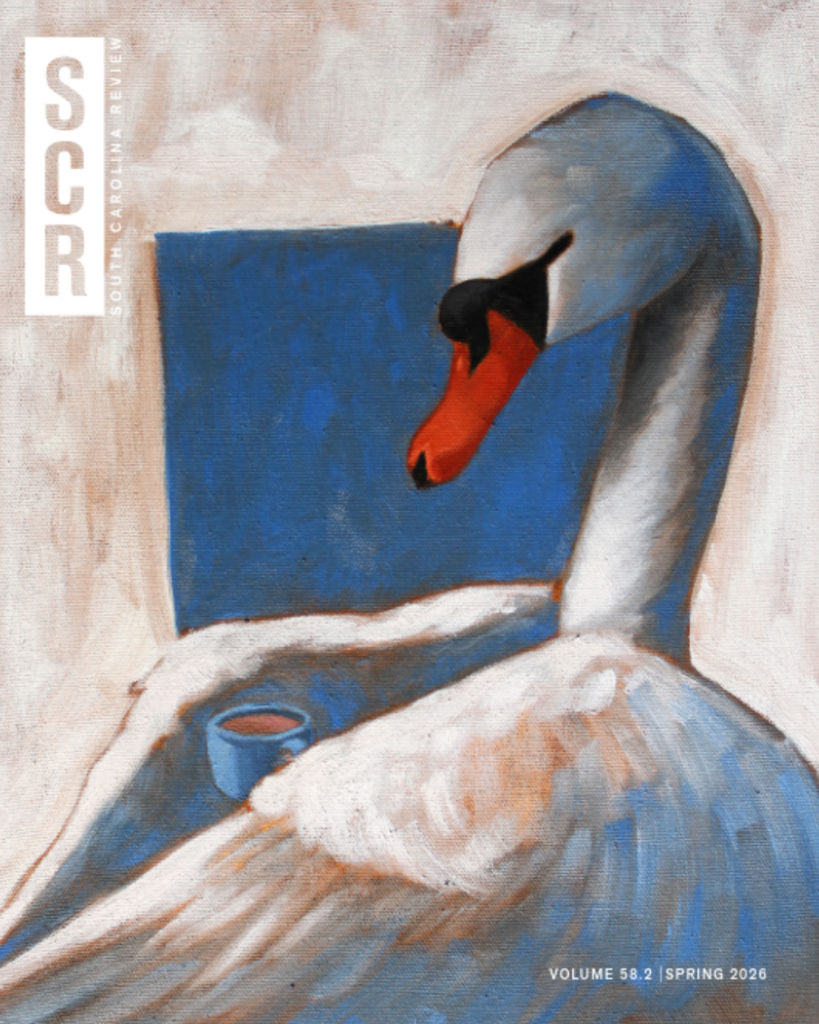
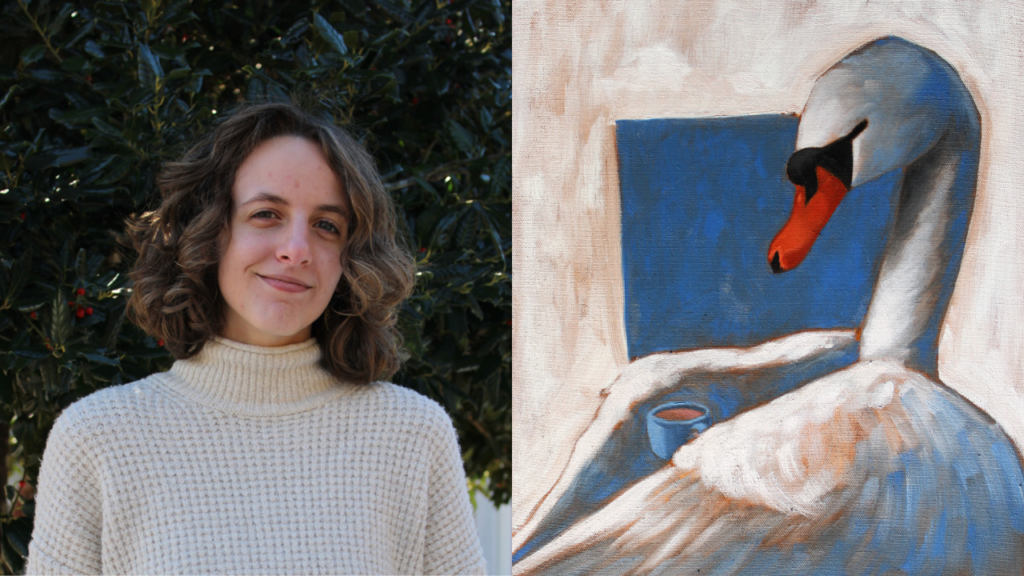
We were thrilled to show you SCR 58.2’s cover art “Morning Coffee” by Megan Ingerslew, which was created to evoke the nostalgia of American illustration and paintings from the 1950s with an unconventional subject.
“The piece drew heavily on J. C. Leyendecker, a prolific commercial artist whose work became the pinnacle of early-1900s advertising and illustration,” says Megan. “His signature style includes textured applications of oil paint, limited color palettes, and dynamic compositions, all of which were emulated in Morning Coffee.”
Using thick paint strokes for the wings and background to create the illusion of feathers establish strong visual lines that guide the eye down the length of the painting while the limited color palette contrasts against the bright orange of the swan’s beak, emphasizing the swan’s face as the primary focal point. The colors used creates an inviting atmosphere, invoking the warmth of a fresh cup of coffee and the quiet solitude of a peaceful morning.
“Morning Coffee”was painted to create something beautiful and pensive, exploring the use of texture and color to invoke a pleasant mood.”
Megan Ingerslew is currently a junior at Clemson pursuing a Bachelor of Arts in Art and Mathematical Sciences where she enjoys using a variety of media in her practice, such as oil paint, watercolor, graphite and digital illustration and animation. Megan’s work is typically character-driven, exploring the stories or lives of the subjects she depicts, with a heavy emphasis on quieter moments usually overlooked.
South Carolina Review Associate Editor Will Cathcart’s debut, genre-defying novel This Is How People Die will be published by Evening Post Books on Tuesday, April 28.
A Charleston native and international journalist, Will Cathcart sets This Is How People Die between a modern sanitarium in downtown Charleston and the shadowed edges of Europe and the Republic of Georgia. The novel follows Scoot and Hannah—cystic fibrosis patients who have outlived their expiration dates and every expectation that comes with being alive.
Will Cathcart will celebrate the publication of This Is How People Die with a public launch event at the Charleston Library Society on May 14, 2026. Tickets and additional details are available at charlestonlibrarysociety.org.
Cyn Nooney’s story “Sterling Recruit” was the recipient of the Ronald Moran Prize in Fiction for SCR Volume 58. Here, she’s interviewed by Sage Short, former SCR assistant editor and current poetry editor of Greensboro Review.
Sage Short: “Sterling Recruit” opens with “It was an empowering feeling being selected, especially out of the blue like that.” Where did the idea for “Sterling Recruit” come from? Did a character come to mind? An image? Did you start with the first statement or did that come later?
Cyn Nooney: I love these questions, as I often wonder about the genesis of work by other writers. It’s an ongoing fascination of mine, and I’m always down to discuss process. Usually when I begin writing a story, the igniting spark is an image that I can’t shake, or a character whose voice or behavior interests me, especially those unaware they’re ripe for the stage. I’m continuously fascinated by the human condition and our spectrum of foibles, so entering a story isn’t the hard part for me. It’s the rest that often feels insurmountable. (My partially-written story count is ridiculously high.) As for “Sterling Recruit,” the first sentence is how I began—my openings don’t change nearly as much as the rest of my stories do. This story is very loosely based on a weekend experience as a newcomer to Los Angeles and was absurdly long in the making—it took over twenty years. I made countless failed attempts to write it, and nothing worked until I finally landed on a satirical approach. Once that happened, I was able to find the tone and POV I’d been seeking, and guileless Keeley won the lead.
SS: How do you know when a story is finished?
CN: When I’ve worn down another molar. Kidding aside, this is tricky to answer because it can feel impossible to know when a story is finished. But revision is key. Revision. Revision. And more revision. Feedback from trusted readers helps too. And dogged persistence. A grad school advisor, Valerie Laken, once advised me to read my work out loud and as much as I hate hearing my own voice, this technique has helped tremendously. You catch typos that way as well as where the hitches might be, including any false notes. Once you’ve addressed those, you can turn an eye toward finishing. For me, endings take forever to get right, and I often write the final paragraph dozens and dozens of different ways. Sometimes it’s just a matter of reordering a few words or sentences, sometimes it’s heavy addition or subtraction, but intuition along with reading aloud usually lets you know when the story is done. That, and not fooling yourself. I believe most seasoned writers know when something isn’t quite ready, hard as it might be to admit. I’ve found it helpful to put stories that I’m struggling with away for a bit and usually when I return to them later, clarity is more accessible. With any luck, the ending, or whatever needs fixing, will reveal itself. Or at least raise a middle finger in a halfhearted hello.
SS: There are moments throughout “Sterling Recruit” where I found myself laughing or feeling in conversation with the narrator, like early on in the story where you wrote, “Were the deputies attractive, you might ask. It’s a natural question. It’s how we’ve been raised.” I’d love to hear your take on the importance of incorporating humor in stories like “Sterling Recruit.”
CN: I believe humor is critical to surviving this experiment called life. Especially in dark times, such as we’re currently facing. Among its many attributes, fiction can offer welcome reprieves from terror and muck, and therefore when a story has the capacity to unnerve, I’ll sprinkle in occasional levity. That might be an act of self-preservation or group-preservation, but I figure why not amuse ourselves while circling the drain. A great teacher in this regard is Kurt Vonnegut and the way he approached writing about WWII. Slaughterhouse-Five is a book I have on annual repeat, and every time I re-read the line about Billy Pilgrim being “tall and weak, and shaped like a bottle of Coca Cola” my day becomes infinitely better. Or the way Billy’s pilfered frozen overcoat is described as “so small, that it appeared to be not a coat but a sort of large black, three-cornered hat.” Humor can hold a reader’s attention while also grabbing the heart. And makes the tough stuff go down easier.
SS: Do you approach your screenplays similarly to your fiction? Additionally, do you see stories cinematically while you’re writing?
CN: Character-first is how I approach any kind of writing, however when it comes to screenplays it’s prudent to know the entire plot ahead of time, including the ending. But that’s difficult for me, and I often resist. One of my favorite things about fiction is discovering the character in real time, and not knowing the ending, let alone other components. Fiction allows the writer to surprise herself, and in turn, hopefully the reader. So, while the approaches are somewhat different, I do see stories cinematically while in the act of creating. It took me a while to get there, though, and I credit a writing instructor who offered invaluable critique several years ago about a story I wrote involving a woman who drives to the beach then stares at the water while mulling over a hard decision. “What can you have your character do at the ocean that shows what she’s thinking?” the instructor wrote. “A character can’t just look at the water. Think cinematically.”
That changed a lot for me. At the time I wasn’t yet writing screenplays but incorporating the instructor’s advice into my fiction prepared me well once I later tried my hand at scripts. The latter wasn’t anything I ever planned to do but after winning a cinematic short story contest hosted by a screenwriting platform, I challenged myself to try. Dabbling in that medium is a lot of fun and provides useful exercises for any writer—you can’t rely on interiority because characters can only be revealed through dialogue and action. Limitations like that can be instructive.
Although I enjoy hopping back and forth between mediums, fiction will always be my everlasting love and is primarily where I devote most of my writing time.
SS: How does your background as a media executive influence your writing? Do you ever find yourself pulling inspiration for content from that time in your life?
CN: Hmm, this makes me ponder. I wouldn’t say my media career influenced my writing per se, as I’ve wanted to be a writer ever since I can remember—as a child I would climb a bur oak tree with my purple lockable diary, eager for a quiet place to stow away and scribble— but I do think my cumulative experiences inform and shape my writing, like I imagine they do for any author. Most days my mind feels overstuffed but when I take the time to sift through the files, then yes, absolutely, a lot of content originates from that period in my life. Much more so than what’s occurring in the present. And while I haven’t yet wholly excavated my childhood, I concur with Flannery O’Connor’s statement, “Anyone who has survived his childhood has enough information about life to last him the rest of his days.” Within each of us is a dearth of storytelling material and for me, it’s about what bubbles up the loudest.
My former jobs offer plenty of fruit for the picking. During the early part of my career, I worked for a regional sports network that televised the Texas Rangers, Houston Astros, Dallas Mavericks, Houston Rockets and San Antonio Spurs, and my time in Dallas has served as a backdrop for many of my stories. The same can be said for Los Angeles, where I spent subsequent years in the media entertainment business as a marketing executive for E! Entertainment Television and the Style Network. Per your question, those experiences have greatly contributed to my writing, so I should probably amend my answer! Either that or get around to setting stories in Colorado, where I was raised, or the San Francisco Bay Area, where I currently live. But there’s only so much time, isn’t there? I believe influences and inspirations are there for the taking, all around us.
SS: What’s up next for you?
CN: I wish it would be a large tax return, but since that’s not going to happen, I’ll just keep pecking away. (I’ll keep pecking regardless, as I can’t not write despite the anguish I sometimes feel about this wacky passion.) As writers, the only thing we have control over is our productivity. Mine tends to ebb and flow, the former being the case too often! but I plan to always create—as much for my sanity as anything else. A frequent and common question I receive from well-intentioned family members and friends is, “Are you still writing?” I’ve yet to locate the perfect response so I’m all ears if anyone has one beyond, “Yes, and can you please quit asking that!”
Multiple unfinished stories are currently clamoring for my attention and meanwhile I’m assembling a collection, plus making notes for a potential novel. Hopefully I’ll somehow manage to get published every now and again in fine publications such as South Carolina Review. I’ll be forever grateful to the team at SCR for publishing and honoring my work. Thank you endlessly!
This interview was conducted by Assistant Editor Nell Kriegel with Dominique Ahkong, recipient of the Ronald Moran Prize in Poetry for her poem “A Man Who Looks Like Your Best Friend’s Father,” featured in SCR Volume 57.
Nell Kriegel: In addition to your work as a poet, you serve as an editor for Shō Poetry Journal—how do you navigate the balance between your editorial mindset and your creative work? Do you find it challenging to “turn off” the editor while you’re writing?
Dominique Ahkong: This was a problem for me in my 20s and 30s; pulling all-nighters before a deadline was the only way I could squeeze past my inner editor. As an editor now, I try to approach work with curiosity, and I often read poems intuitively.
Since reading submissions as well as producing and promoting the journal takes up much of my time and energy, most of my writing happens between reading periods. I tend to write in bursts and often get so caught up in the excitement that I sometimes over-edit poems as they form. I’ve learned to avoid revisiting my own poems in the evening and know when I need to leave them alone for a while.
NK: In your poem “A Man Who Looks Like Your Best Friend’s Father” the form is a long block of text; how do you decide which poems are suited for line breaks and which ones lean into prose? What’s the motivator behind this form?
DA: I originally composed “A Man Who Looks Like Your Best Friend’s Father” in free verse. I was working on a group of poems that each began with the title “Times I Said Nothing.” The poems sat for ten years before I took them up again, and “A Man Who Looks Like Your Best Friend’s Father” was the first to take shape. I remember trying to write it as a duplex: the form helped me voice lines that felt true to the experience, but I was also taking broad liberties with variations on the repeated lines, and the syllabic count was off—maybe not a duplex, I thought.
When I’m feeling stuck with a poem, I sometimes box it up as a prose poem to see what’s going on. I read my poems aloud as I compose and revise; musicality is important to me. Over time, my memory of this incident has solidified into a block. On one hand, there’s a long-haul flight and the heaviness of feeling drugged, and on the other hand, there’s the active mind pushing doubt back and forth. When I changed the title, things clicked into place for me.
NK: “When I Met You” closes with the line, “I will become whatever I become.” Do you see poetry as a mode of becoming? More broadly, how intertwined is writing with your sense of identity—and how necessary is it to you?
DA: In college I had a poetry professor who championed my work but gave me very little feedback. He said: 1) You have to go deeper; and 2) You should be reading more contemporary poetry. That was it. Looking back on it now, that was exactly right. I’ve been a reader for most of my life, but at the time, I was so burnt out that I stopped reading books for a few years. I was steeped in film/video, interactive media, and photography, where my work could be personal but less vulnerable. But I missed paper, the physical page.
At some point I took an interest in book arts, which brought me back to poetry. I also left the tropics and found myself, for the first time, surrounded by space, and quiet, with a study of my own. It’s taken about 20 years for me to inhabit the practice, but yes, I consider poetry my life work—both reading/studying contemporary poetry and writing poetry.
NK: There’s a line of yours that is just so stunning— “I begged to be useful, knowing nothing is too small to be useful: brackets in a sum or a decimal point or a stub still wagging.” The attention to small details feels so essential to the poem’s impact. How do you scale in your writing, balancing both expansive ideas and those precise, intimate details?
DA: This poem came together very quickly for me. I was already in the writing zone and remember sitting down with the title to meditate on an experience. Instead, I ended up with this poem. I don’t really think about scope when I’m writing—I might think about that sort of thing if a poem isn’t working and I’m trying to approach it from a different angle, but for the most part, I write intuitively. I’d been listening to Alice Coltrane’s Ptah the El Daoud and ended up following the current.
NK: What themes do you find moving right now?
DA: I’ve been trying to carve out space to work towards my first collection. Secrecy, silence, and shame are key themes, along with migration, inheritance, and ritual. Faith and caretaking are other layers beneath that.
Our South Carolina Review writers and friends are scattered across the map, but AWP is where we come together. Below, we’re highlighting and celebrating our writers’ events in Baltimore this week — and we’ll keep updating the list as details arrive.
Stevie Edwards
Poetry editor, Stevie Edwards hits the scene Wednesday night in Baltimore and will be all over AWP until it ends on Saturday. Want to know where she’ll be? See below!
Wednesday, March 4, 6:30 – 10:30pm: Wednesday Night Poetry at Creative Alliance
Friday, March 6, 1:30 – 2:30pm: Book Signing at University of Arkansas Press, Booth #731
Friday, March 6, 7:00 – 10:00pm: Button Poetry Live at Baltimore Unity Hall
Saturday, March 7, 9:00 – 10:15am: (Panel) Childfree & Childless Women Writers: Writing Against Gender Norms, Room 324
Saturday, March 7,10:35 – 11:50am: (Panel) I Could Not Stop for Death: Poets on Addition & Substance Abuse, Room 320
Lana Spendl
Lana is moderating a panel called “Memory as Borderland in Immigrant Narratives: The Refuge and Burden of Remembering” on Friday March 6 from 10:35 – 11:50 at the Baltimore Convention Center, Level 300, Room 329. Lana will also be participating in a reading of Eastern European writers, which also serves as a fundraiser for Ukraine on Friday, March 6 from 7:00 – 9:30pm.
Dean Tuck
Dean will be at the AWP Awards Reception & Celebration Wednesday, March 4 from 6:30 – 8:00pm at the Watertable Ballroom, fifth floor. In addition, you can find Dean at the University of Nebraska Press book (booth 1069) signing his newest novel, Twinless Twin, Friday, March 6 form 10:30 – 11:00am.
Dominique Ahkong
Dominique Ahkong will be participating in an offsite reading titled “Anti-Fascist Love Poem Reading” on March 7 from 7:00 – 9:00pm at 1640 Thames Street in Fells Point (use entrance 1636).
Ella Kindt
Former SCR assistant editor Ella Kindt will be participating in an offsite reading sponsored by the University of North Texas on Saturday, March 7 from 10:00am – 12:00pm at Vinyl and Pages, 301 Light Street, Pavillion.
Stella Wong
SCR contributor Stella Wong will be featured in a number of readings and book signings at the AWP conference this week. See below.
Thursday, March 5 | 12:00 – 12:30 pm: Book Signing- AWP Baltimore – Booth 619
Thursday, March 5 | 7:00 – 9:00 pm: Reading (Split Lip) – Baltimore Unity Hall
Friday, March 6 | 1:00 – 2:00 pm: Book Signing – AWP Baltimore: Booth T411
Jane Zwart
Jane will be reading offsite on Friday, March 6 at Max’s Taphouse from 7:00 – 9:00pm and will also be “Poet of the Hour” (!!!!!) at Only Poem’s booth (446) beginning at 2:00pm on Saturday, March 7, which may just begin with a poem published in OUR pages!
Leslie Pietrzyk
The 804 Lit Salon Reading Series will be at Section 771 on Saturday, March 7 at 5pm where Leslie will be participating in a reading.
Adriano Beltrano
Adriano will be representing the Baltimore Review at the “It’s Kind of a Big Dill” reading on Thursday, March 5 from 5:00 – 8:00pm at the iconic Pickles Pub right across from the convention center. Adriano will also be reading at the Read the Room: Celebrating Literary Baltimore a AWP Wrap Party on Saturday, March 7 from 5:30 – 10:30pm at 2640 Space, 2640 St. Paul St.
Chiagoziem will be reading at AWP Poetics of Liberation, an annual, intersectional feminist, and anti-fascist poetry event celebrating literature that inspires social change on Thursday, March 5, from 7:00 – 10:00PM.
Mickie Kennedy
Mickie will be reading at the offsite event Serious Poets, Playful Poems at The American Visionary Art Museum starting at 6:00PM on Friday March 6.
Kasey Peters
Kasey is a panelist on the AWP Game Changer: Literary Queer Sports Writing panel on Friday, March 6 from 10:35 – 11:50AM at the Baltimore Convention Center: Room 323, Level 300.
Sarah Brockhaus
Sarah will be reading at the Print is Dead: An AWP offsite Small Press Reading event with Birdcoat Quarterly, Fine Print Press, and Ghost Peach Press on Saturday March 7, from 6:30 – 10:00PM at Old Major.
Congratulations to three SCR contributors who have released publications in the new year: Matt Cashion with his collection of 12 short stories titled How we Do Things Here, Sarah Domet publishing her second novel, Everything Lost Returns, and Jane Zwart exploring unlikely connections in her newest poetry collection, Oddest & Oldest & Saddest & Best.
Read more below!
Matt Cashion – How We Do Things Here
How We Do Things Here is a collection of 12 short stories that explores the lives of “slow learners” across the backdrops of Wisconsin, Florida and Georgia. A finalist for the Flannery O’Connor Award for Short Fiction, How We Do Things Here, uses humor, honest absurdity and empathy as the characters try, fail and retry. Cashion’s “Reunions, Atrocious Manners, the Atlanta Airport,” was published in our 2024 Fall Issue.
Stretching across decades, Sarah Domet’s second novel, Everything Lost Returns, is a stardust-laced historical fiction shared between two women who dare to stand tall and shift history in their own ways. Domet’s short fiction piece, “What My Sister Took”, appeared in issue Spring 2019, and we’ve been dazzled ever since.
Jane Zwart’s newest poetry collection Oddest & Oldest & Saddest & Best explores connections between unlikely comparisons, ultimately suggesting that it is the power of language that unites us all. Oddest & Oldest & Saddest & Best uses rich detail and vivid language to transform the ordinary into something profound. Zwart was featured in our Spring 2022 issue for her poem “Poem with a Hole in It,” and will also be featured in our upcoming Spring 2026 issue for her poem “Valentines.”
SCR 58.1 Fall 2025 Issue’s cover art, titled A New View, is by artist Jessica Downs and reflects the intricate connection between humans and nature. For Jessica, A New View was brought on by both the public and personal the effects of Hurricane Helene, specifically the damage to the tree line behind her home, which was once a cherished location.
Jessica says that that treasured spot “is now complicated with the lingering memory of unsettled feelings and fear,” due to the national disaster. As you see in our cover art A New View, there are themes of ambiguity, conflict and instability.
However, Jessica was able to use the loss and create what we would later use as our cover. “I rendered the tree line in an idealized manner, using softened light and romanticized color to attract the viewer’s gaze, making it a wanted destination,” she says.
A physical viewpoint from her own bedroom window, curtain-like shapes shift towards root and body-like qualities in the piece.
“In the wake of that experience, I am left with the many realities that nature can engender, both beauty and danger, peace and destruction, as well as the fleeting space that harbors simultaneous feelings of a connection with, and a removal from, nature.”
Jessica Downs received a Bachelor of Fine Arts degree in Painting and Drawing from Utah Valley University in 2024 and is currently an MFA candidate at Clemson University, with an expected graduation date of May 2026. Her work has been exhibited nationally, with recent shows in the Clara M. Lovett Art Museum, the Gertrude Institute of Art and the Utah Valley University Museum of Art. Downs has been the recipient of multiple awards, including Utah Valley University’s Outstanding Student Award for the entire Art and Design Department, was selected as an inaugural participant of the V. Douglas Snow Arts Mentorship Program in Torrey, Utah and was the recipient of the Penland/Clemson University HEPP Scholarship.