Clemson Visual Arts

The Clemson University Center for Visual Arts hit the ground running in 2017

Media Release

Center for Visual ArtsCLEMSON — The Center for Visual Arts (CVA) at Clemson University has hit the ground running in 2017, having already opened four new exhibits, hosted an artist talk and celebrated the sale of the spring 2017 shares of Community Supported Art (CSArt) student-created work.

The CVA’s calendar continues to unfold and reveal more events to attend, including new artists and innovative workshops. From visiting artists to student exhibitions and seminars, the CVA calendar has unique and transformative experiences for all. Thanks to generous supporters, the vast majority of CVA events remain free for the public. Check out the ongoing and upcoming opportunities the CVA is offering this spring. For more information and to access the full calendar of events, visit clemson.edu/cva.

Clemson National Print and Drawing Exhibition
Feb. 15–March 15 • 9 a.m.-4:30 p.m. Monday-Thursday • Lee Gallery
Artist Reception • Feb. 7, 3:30–4:30 p.m. • Lee Gallery
Exhibition • Feb. 15–March 15 • 9 a.m.–4:30 p.m. Monday-Thursday • Lee Gallery

Since the beginning of our time on Earth, we have responded to the impact of change in every aspect of our human experience. In the ever-expanding social, technological, biological and digital era, change is taking place at unprecedented speeds while the world is becoming a much smaller place. The 2017 Clemson National Print and Drawing exhibition explores change in a wide range of approaches to unpacking this idea.

Passport to the Arts
March 3 • 6-9:30 p.m. •  Order tickets now at clemsonpassport.org

Now in its seventh year, the “Passport to the Arts” continues to be an exciting “town and gown” event. Join the Lee Gallery at Clemson University and The Arts Center of Clemson for an evening of fine art, entertainers, live music, drinks and exceptional food showcased at four different locations.

The Clemson Area Transit (CAT) shuttle will take you on a visual arts tour of Clemson for a fun-filled evening. All shuttles feature entertainment, making your ride to each venue even more enjoyable. Our locations this year include The Arts Center, the CATBus Terminal, the Lee Gallery at Clemson University and Cox Hall at Clemson Little Theatre in Pendleton.

Tickets are $40 per person and can be purchased at clemsonpassport.org.

Jeff Beekman artist talk
March 2, 5:30–6:30 p.m. • 2-301 Lee Hall

Jeff Beekman is a multidisciplinary artist whose artwork since early 2000 has explored the interrelationships between land, memory and human activity.  His work has been exhibited at venues across the U.S., as well as New Zealand, Australia, China, Vietnam, England, Hungary and South Korea.

Ink Travels
March 31–Oct. 4 • 8 a.m.–4:30 p.m. Monday-Friday
Sikes Hall Showcase, ground floor

“Ink travels” refers to the constant challenge of keeping an active print shop clean.  In the context of this exhibition, the term also refers to the wide-reaching influence of Professor Sydney A. Cross’s teaching and mentoring. Similar to how “ink travels” this exhibition showcases Cross’s legacy as an educator and illustrates the positive impact she has had on artists across the nation.  The exhibition is a thoughtful tribute to the quality of Cross’s teaching and a reflection on the Clemson family in the visual arts.

Sense of Place: Picturing West Greenville Exhibit
April 3 – July 28 • 8 a.m.–5 p.m. Monday-Friday
Center for Visual Arts-Greenville, fifth floor, 1 N. Main St., Greenville

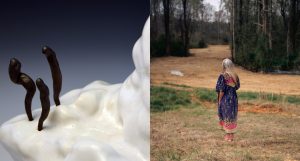
This exhibition examines the people, places and the cultural life of West Greenville in a project organized by the Center for Visual Arts- Greenville. Artists invited to participate in the project demonstrate relevant experience in creating a collection of works using environmental portraiture or storytelling. The goal of the project was to build community, convey and bring together a significant exhibit meant to honor West Greenville residents and the surrounding community. The artists selected to participate in the project and exhibit are Dawn Roe of Asheville, North Carolina, and Winter Park, Florida; Dustin Chambers of Atlanta; Kathleen Robbins of Columbia; and Leon Alesi of Asheville and Austin, Texas. Works in this exhibition are not for sale as they are part of the CVA Art Collection. No lectures or receptions are planned for this exhibition.

SmART Series Seminar 7 with Jeffrey Baykal-Rollins
April 3 • 5:30–6:30 p.m.
1-100 Lee Hall

Jeffrey Baykal-Rollins is an American multimedia artist and educator now based in the greater New York City area after living in Istanbul for more than a decade. His “art as social practice,” combines drawing with performance, alternative education, institutional critique and cultural studies.

Two Cents: BFA Senior Exhibit
April 17–26 • 9 a.m.–4:30 p.m. Monday-Friday • Lee Gallery
Reception: April 21, 6-8 p.m. • Lee Gallery
Artist talks: April 21, 6:30–7 p.m. • Lee Gallery

Artists explore how humans relate to themselves, experience the world, and examine their history. Two Cents is an exhibit of works by graduating Bachelor of Fine Arts students in the disciplines of drawing, painting and photography.

A Sense of Place: Clemson • Drawings and Watercolors by James F. Barker
April 24–Oct. 11 • 8 a.m.-4:30 p.m. Monday-Friday
College of Architecture, Arts and Humanities Dean’s Gallery • 101 Strode Tower

As an architecture student, alumnus, dean, president emeritus and now professor of architecture, James F. Barker gives a unique perspective. His exhibit captures a sense of community that portrays a richness, depth and love for the Clemson campus. Reception to be announced at a later date.

Spring Ceramics Studio Sale and CSArt Share Pick Up
April 26, 10 a.m.–5 p.m. • Lee Gallery Hallway

Student ceramic work will be on sale in the Lee Gallery Hallway for purchase. In addition, Community Support Art (CSArt) spring 2017 shareholders are invited to the annual CSArt Pick Up to receive their shares and celebrate another successful semester of student artwork.

CURRENTLY ON DISPLAY

Pliable Instance: Paintings by Todd McDonald
On view until March 28
8 a.m.–4:30 p.m. Monday-Friday
Center for Visual Arts–Greenville, fifth floor, 1 N. Main St.

Through abstractions of architectural structures, Todd McDonald’s images explore the contemporary visual rhetoric where the virtual and material collide. Throughout history, painting is used as a vehicle to describe spaces and locations that do not actually exist. Now society is confronted with new digital tools that are shaping the character of visual culture.

Foundations I: Department of Art Student Exhibit
On view until April 17 • 8 a.m.–4:30 p.m. Monday-Friday • CAAH Dean’s Gallery
101 Strode Tower

The Foundations exhibit features students who have completed the Foundation level studio courses in the department of art at Clemson. The showcase is a reflection of explorations with visual expression and problem-solving.

Gathering Lines: Drawings by Kathleen Thum
On view until April 27 • 1–5 p.m. Monday-Friday • Brooks Center Lobby Showcase

Kathleen Thum’s exhibition of drawings, paintings, collages and large-scale wall installations abstractly reference pipeline infrastructures to bring awareness and a visual presence of our society’s dependence on petroleum.

END

Thin Ice: Art professor saves National Park glaciers as woodcut prints, work acquired by national galleries

Media Release

Todd Anderson, assistant professor of art and printmaking at Clemson University, displays one of his reductive woodblock prints in “The Last Glacier”, an artist book of 23 image plates of glaciers in Glacier National Park, Montana, by him, Bruce Crownover and Ian van Coller.

Todd Anderson, assistant professor of art and printmaking at Clemson University, displays one of his reductive woodblock prints in “The Last Glacier”, an artist book of 23 image plates of glaciers in Glacier National Park, Montana, by him, Bruce Crownover and Ian van Coller.
Image Credit: Ken Scar / Clemson University

CLEMSON — With a heavy mug of coffee in one hand, Todd Anderson moves through his personal studio like a chef moving through a four-star kitchen: fluidly, efficiently, among the tools of his trade: neatly stacked cans of paint sorted by color, saws and drills tucked away without a hint of sawdust, brushes hanging neatly, chisels gleaming. Every label of every can and jar and bottle faces outward, lest confusion disrupt the rhythm of his work.

Anderson, an assistant professor of art at Clemson University, is a printmaker, skilled at transferring beauty and wonder from landscapes onto paper to share his experiences with the public.

When guests arrive at his studio, which used to be his garage, Anderson slips on a pair of shoes, turns off a stream of classical jazz and begins to tell a story about his latest project, which recently gained national attention.

“I think we all understand that the world is changing in sweeping and dramatic ways,” Anderson says, his voice quiet and earnest. “My belief is that those places need to be seen, they need to be experienced and they need to be creatively documented.” It’s a holy trinity that guides his work.

Since its founding 100 years ago, Glacier National Park has lost more than 80 percent of its glaciers. Over the past six years, Anderson says, he hiked more than 500 miles through that park for a project called “The Last Glacier.” He and two collaborators, painter Bruce Crownover and photographer Ian van Coller, recently finished the project, resulting in original artwork that includes 15 specially bound 25- by 38-inch books with Anderson’s original prints, Crownover’s paintings and van Coller’s photos.

“My intent as an artist is to share the beauty of a changing world,” Anderson says.

In demand

The Metropolitan Museum of Art in New York and the New York Public Library are sharing the work; they each bought a book on the spot. The Library of Congress bought another. Clemson’s Emery A. Gunnin Architecture Library, the University of Wisconsin-Madison, Yale, and several private collectors have also invested in the artistic, historical records.

The Last Glacier quickly garnered the kind of attention artists dream of. But Anderson couldn’t look lighter, more carefree. He says he spent a great deal of his life camping, hiking and climbing his way through the Rocky Mountains, sleeping with the stars overhead. It’s easy to picture him on a mountain in a three-day beard and a worn flannel shirt, accidentally hip.

On being outside, Anderson says, “If you’ve felt frost on a sleeping bag, or seen dew on cobwebs in the woods, you can understand the value of that experience.”

Rock climbing shaped his arms and hands; they’re strong, purposeful. His blue eyes sparkle with an infinite appreciation for wonder, reflecting a scientist’s curiosity and exacting patience. There are stories in those hands and eyes, and a quiet urgency to tell them.

Image from above of a glacier, mostly white but with a large area of blue water.

An Anderson woodcut print of the Grinnell glacier in Glacier National Park.

In the late oughts, Anderson heard the Rockies’ glaciers were melting. “My first thought was, this is the environment that I love, these alpine environments, the beauty of these places. I felt sad, first and foremost. And then I thought, ‘Well, who is documenting these places?’”


When months of searching for someone recording the glacial recession turned up empty, Anderson decided to do it himself. “It was really out of a sense of responsibility,” he says.

The three collaborators are currently wrapping up a second project, documenting glaciers in Rocky Mountain National Park. Anderson is also waiting to hear about a grant from the National Science Foundation that would send him to Antarctica.

The Last Glacier is a compelling and invaluable work, said Gary Machlis, the University Professor of Environmental Sustainability and scientific adviser to the director of the National Park Service for eight years until early January 2017. “Climate change is the environmental challenge of our age, and responding to this challenge requires a constellation of voices — including those of artists like Todd.

“Art can be a portal for understanding in a visceral, emotional way what science attempts to demonstrate through theory, data and analysis,” Machlis said. “Todd’s work is powerful, and his collaborative team is unique and so committed to their task. Viewing the images in ‘The Last Glacier’ is a reminder of what is at risk and what might be lost if we do not act.”

In 1910, there were 150 glaciers within the new 1 million-acre Glacier National Park in Montana’s Rocky Mountains. When Anderson started his work, in 2010, all but 25 had melted.

Glaciers, the marvelous remnants of the last ice age, are made from the bottom up by layer upon layer of snow that melts into ice, the accumulating weight pressing the earth, picking up and setting down boulders as they slide incrementally. For the past 7,000 years, the glaciers in the park have stretched for miles, like giant beached whales caught between mountains and frozen by time.

Melting ice, rising seas 

In a valley once filled by a glacier, there now are three lakes.

Lakes dot a valley in Glacier National Park that a glacier once filled. Photo courtesy Todd Anderson. When glaciers melt they don’t simply disappear, they become water. Increasingly, they’re adding to rising sea levels.

Melt from all the glaciers and ice sheets in the world are responsible for two-thirds of global sea level rise (the rest is attributed to warming seas), according to Andrew Fountain a glaciologist at Portland State University in Portland, Oregon, who agreed to write a scientific note about the next project by Anderson and his colleagues.

Twenty years ago, Fountain said, alpine glaciers, like the ones in Glacier National Park, were the first to melt. “Now Greenland is beginning to melt,” he said.

By 2040, with a 2-degree Celsius increase in global temperature, sea levels will rise significantly along 90 percent of the world’s coastlines, affecting hundreds of millions of people, according to a study in the Proceedings of the National Academy of Sciences.

Fountain has introduced many artists to the wilderness in Antarctica, where he conducts some of his research. When Anderson asked him, out of the blue, to contribute to an artistic project, Fountain considered it a way to tell more people about the melting glaciers.

“Getting this information out to people is super important,” said Fountain. “It’s a gateway to science. I might be attracted to the subject by graphs and plots, but others might be attracted by art.”

It’s a symbiotic relationship, Anderson said, as scientists wrap the art in a scientific context.

“Working with scientists is very critical to my projects. We’re trying to bridge gaps and we’re trying to connect with as many folks as we can,” Anderson said. “What the scientists provide is things that we can’t provide – analytical analysis and whole, unique perspectives of what’s going on with the landscape.”

There is also common ground among artists and scientists, and aficionados of each. Science, Fountain said, can be incredibly creative, like when it’s time to choose the right approach to finding a solution. And when looking at Anderson’s art, the glaciologist sees clues to the glacier’s life, such as whether it’s advancing or retreating.


 Democratic medium

After graduating from the University of Wisconsin-Madison, Anderson found work at Tandem Press, an international printing house affiliated with UW’s School of Education. Tandem has a tradition of attracting famous artists to experiment and print in its studio. David Lynch, Chuck Close, Art Spiegelman and Judy Pfaff are among its alumni.

Essentially, Anderson worked with artists accustomed to producing singular pieces of art and helped them create prints that “would be totally and wholly unique, but you could make 20 or 30 of these things and more people could have it.”

Printmaking, he said, “is an inherently democratic medium, and for me that was really what grabbed me.” “The Last Glacier” project is similarly intended to be shared with the masses, Anderson said. “Our mission is to get the work into the public sphere,” he said.

And he wants future masses to experience the work, which makes acquisitions by the Met, the New York Public Library and the Library of Congress special.

“One of the things I want to do as an artist is to talk about the immediacy of things going on in the world. But art, as I understand it and the way I approach it, it’s a multigenerational conversation,” Anderson said.

In museums, “when we look at a painting from the 1800s it helps us understand what people’s values were, what people thought about.

“It’s just as important when future generations who go to museums and get to see this work. It’s not just saying, ‘Oh, there used to be a glacier here,’ but it’s also saying, ‘This is a little bit about us.’ In a very, very small way. Of what we valued as a society and what we thought about, the challenges we were trying to face and engage.”

Working with collaborators also amplifies the message and grows the audience. Anderson initially planned to work alone, but the glaciers were so vast and distant – 10 to 15 miles from an access road – that he enlisted Crownover and van Coller to help cover the territory.

The result, Anderson said, is “three very unique artistic visions of essentially the same thing. The hope is that by presenting the viewer with three different versions of three different artists, that folks might be able to latch on. If they don’t like my work, maybe they’ll really like Bruce’s. Or if they don’t like Bruce’s, maybe they’ll like Ian’s.”

An artist uses a small chisel to slowly carve the image of a glacier.

Todd Anderson, assistant professor of art and printmaking at Clemson University, carves out a “stamp” to create a reductive woodcut print of a glacier for “The Last Glacier”. (Photo by Ken Scar)

Mirroring the glaciers 

If you’ve stood on a glacier, or on a mountain two miles high, standing in front of Anderson’s finished prints will stir a familiar chill in the air, as if someone opened a window 10,000 feet up. The prints reveal scars from the violent upheaval, subduction and collision of the Earth’s crust. You’ll feel the cool blues of the ice, the ancient gray of the rock and yellow, purple, pink and blue of sunrises and sunsets seen through thin air.

Anderson spent weeks each summer working in situ, researching the glaciers – which ones to document, how to access them, seeing them at different times of day as the sun shifted shadows and revealed new details. He hiked, sketched and photographed, getting to know each one before it ceased to exist.

Back in his studio, where the prints come to life, a mixture of fluorescent bulbs balance the blues, reds and greens to shine as white as possible.

In the middle of the space sits a printing press, perched atop tiny feet, perfectly level. The press is new; at least it’s new to Anderson. It arrived recently by freight to his home in one of Clemson’s leafy neighborhoods. The press is his six-burner gas range, where the ingredients of his art – science, nature, light and the wonder of the Rocky Mountains — mingle and fuse.

Slowly, they develop as reductive woodcut prints in a process involving time, pressure and the deliberate carving of a landscape until nothing is left but a picture, a life cycle that mimics his subjects. Anderson chose to recreate the glaciers as woodcut prints because, he says, he wanted “an organic, visual language,” and woodcuts, by their nature, provide a “visual texture.”

Both glaciers and prints are constructed of layers, but  while glaciers are built from the bottom, prints begin at the top. They require the artist to complete the piece in his mind, then work backward.

Anderson transfers a sketch to a rectangular block of basswood, imported from Japan, then begins working in negative space – using fingers and hands that once routinely clung to rock to slowly, expertly, carve away wood, creating an image by removing what he doesn’t want in the print. The first layer he carves away, from the top of the block, will be the first image on the paper, the bottom layer of color.

“I might do that 10, 15 or 20 times. So I’ll have 15 or 20 sheets of paper that look the same,” he says. “Once I’m done doing that, I’ll take that same block of wood, clean it off, carve it out a little bit more, I’ll ink it up with a new color this time, then I’ll print it on top of what I printed before.”

He has to print light colors first, and he’s constantly calculating “the value of the color and the opacity of my ink, so that I can make a whole image look right. At least in my mind how it looks right.”

One layer, one carving, one color, one pressing at a time, all the while thinking backwards, or upside down, removing negative space from the top that becomes the bottom. Eventually, the full image appears. But, at a cost.

“By the time I get done making these artworks, the blocks themselves are really exhausted, and there’s no way of going back and remaking the artwork,” Anderson says. “The process is mirroring the fate of the glaciers themselves.”

Anderson said he doesn’t create “message” art. He’s not delivering a political statement. Not directly, anyway.

“There’s a complexity to these ideas” of art, experience, climate change, he said. “What I’m trying to present as an artist is visual complexity. But there’s moments where, when it works right, you can get lost in these things and you start seeing the cobwebs. You start seeing things. There’s an experience that art can give you, which is just wonder, and that’s what I’m trying to do.”

Anderson received funding from the South Carolina Arts Commission, the Sustainable Arts Foundation and the National Endowment for the Arts for this work.

For more information, and to see the work by Crownover and van Coller, go to TheLastGlacier.com.

Anderson's print of Salamander Glacier in Glacier National Park.

Anderson’s print of Salamander Glacier in Glacier National Park.
Image Credit: Todd Anderson


Department of art’s annual fall Ceramic Bowl Sale to be held November 16

Media ReleaseThe department of art will hold the annual Fall Ceramics Bowl Sale from noon to 5 p.m. Wednesday, Nov. 16.

CLEMSON — The ceramics studio in the department of art at Clemson University will hold the annual Fall Ceramics Bowl Sale from noon to 5 p.m. Wednesday, Nov. 16, in the hallway in front of the Lee Gallery in Lee Hall.

This popular annual sale is a fundraiser that supports student travel to the upcoming National Council on Education for the Ceramic Arts conference as well as other professional activities that help further student research and collaboration.

A selection of bowls and other functional works by ceramics undergraduate and graduate students and faculty will be available in a variety of price points. The Clemson Ceramics Association’s homemade soup will be served free with the purchase of a bowl between noon and 1 p.m. The annual Spring Ceramic Sale will be held April 26, 2017.

For additional information, contact the department of art’s associate professor of ceramics, Valerie Zimany, vzimany@clemson.edu.

Master’s candidates display final thesis via a ‘solastalgia’ exhibition

Media Release

Solastagia CU CalendarCLEMSON – “Solastalgia,” an exhibition by Clemson University Master of Fine Arts candidates Deighton Abrams and Haley Floyd opened this week and will run until Nov. 11 at the Center for Visual Arts-Lee Gallery. The public is invited to a reception with artist talks beginning at 6:30 p.m. Nov. 11.

Through the sculptural work of ceramist Abrams and photographs by Floyd, “Solastalgia” explores the physical, psychological and emotional relationship between the environment and human identity. Connected to the concepts of solace and desolation, solastalgia is used by environmental philosophers to describe the human distress associated with environmental sickness regarding home. Both artists reflect on this relationship through their personal experiences of home.

This final research thesis exhibit showcases a culmination of research in which students go through a series of critiques as master’s candidates helping build a body of work of the students’ choosing.

The Center for Visual Arts – Lee Gallery at Clemson University will be open for this exhibit 9 a.m.–4:30 p.m. Mondays-Fridays. It is located in 1-101 Lee Hall, 323 Fernow St. The exhibition, artist talks and reception are free to the public because of the generous support given to the Center for Visual Arts. For more information about exhibitions in the Lee Gallery, as well as other Center for Visual Arts galleries and venues, visit www.clemson.edu/cva.

Art Students Gain Valuable Experience Through Lee Gallery Internship

Lee Gallery Intern, Hannah CarteeThe Center for Visual Arts – Lee Gallery at Clemson University is known to be a catalyst for showcasing the research of art students, faculty, national and international artists. What is not commonly known is that it also offers an internship opportunities to Bachelor of Fine Arts (BFA) students. The program is run by the gallery director, Denise Woodward-Detrich. Student interns gain hands on experience and professional development by working on real life projects. Students also receive custom course credit based on hours not to mention valuable experience to put on their resume.
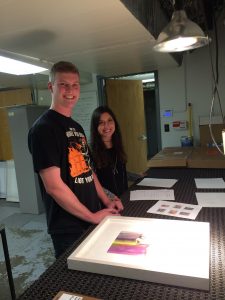
The program involves students researching and writing about artists and events, handling artwork, welcoming guests, and preparing interviews for artist visits. This semester, 11 student interns have worked on a variety of projects on campus in addition to traveling to art lectures and artist studios. One visit even included Skype meeting with the Director of the Andy Warhol Museum.

Earlier this semester, interns learned to hang frames for the installation of the most recent student juried show, Connections and Conversations. This exhibit is currently on display in the College of Architecture, Arts and Humanities Dean’s office. They also drafted questions for a studio visit with David Detrich after representing Clemson in a forum on public art at the Anderson Arts Center the previous week.

Lee Gallery Interns - Making FramesInterns, Hannah Cartee and Leah Brazell developed and delivered a gallery talk with interactive activities to almost 50 middle school students. Activities took place at a permanent art installation in Hardin Hall and at MFA alumnus, Richard Lou’s,  Stories On My Back installation in the Lee Gallery. Additional projects include introducing visiting artist, Richard Lou at his artist talk and writing an article for the Master of Fine Arts (MFA) thesis exhibition, Solastalgia, which is scheduled to open in the Lee Gallery later this month on Monday, Oct, 31.
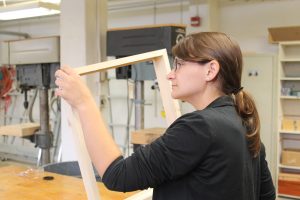
Most recently, student interns, Johnny Murphy and Caroline Herring prepared condition reports for the Foundations exhibit. In addition, Hannah Cartee and Leah Brazell worked in the woodshop to make frames for an upcoming photography exhibit in the spring.

Interns not only execute tasks for the Lee Gallery, but also learn by preparing future projects which is an essential practice of gallery work. Reliability, efficiency, and knowledge of art are all characteristics displayed by good interns. Lee Gallery functions with the contribution of the student interns, who in turn, benefit by gaining rich professional skills of hands on activities and communications as undergraduates.


Visual Arts Students Travel Around the World Thanks to Awarded Scholarships

Each year, the Department of Art hosts a potluck dinner for all of Clemson’s BFA and MFA students. At the potluck, students have the opportunity to enjoy a meal, talk with their classmates and hear exciting and crucial information regarding internship, scholarship, research and travel opportunities. This year’s potluck was full exciting presentations highlighting the Clemson Fine Arts students working and learning around the world.

Casey Bunda, BFA, traveled to London, United Kingdom for an internship she obtained through City Internships, a third-party internship placement organization. Bunda landed the perfect job as a social media and photography intern at a co-working creative space in the heart of London. Bunda researched and interviewed for the position via Skype. After receiving her offer, Bunda worked with the Dept. of Art to receive course credit for her internship.

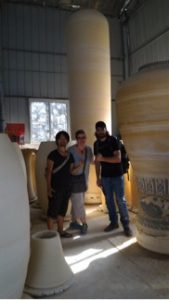
potluck, deighton 2Deighton Abrams, MFA (Ceramics), was the recipient of the Jeanette S. Dreskin Award, general Department of Art Fellowship and a Professional Enrichment Grant (PEG). These scholarships and awards are obtained through Clemson University. They are awarded based upon the hard work and merit of the applicant. Deighton’s graduate thesis project won him these awards. He chose to use his scholarships to attend the International Society for Ceramic Art Education and Exchange (ISCAEE) Symposium in China. Deighton also traveled to Iceland for further graduate thesis research.

potluck, dalia 1

Dalia Delanuez, MFA (Sculpture), received a Department of Art scholarship to travel to Italy and Honduras for graduate research. She applied for this scholarship through the Department of Art and worked with faculty to best utilize her time and scholarship during these two separate excursions.

potluck, Hannah 1Hannah Gardner, BFA, obtained a scholarship from the Calhoun Honors College. She used this award to supplement a three-week art program excursion to Tanzania, Africa. While in Tanzania, she was exposed to numerous art careers, including shadowing art therapists and teaching art classes to neighboring villages.

Megan Hueble, BFA
, was a summer intern at the Museum of Fine Arts in Boston, Massachusetts. During her time as an intern, Megan shadowed several teachers to learn about the numerous studios and options within art education. Additionally, she was able to take full advantage of her unlimited access to the entire museum. This internship was made possible by an award she received Department of Art scholarship committee.potluck, Lacey

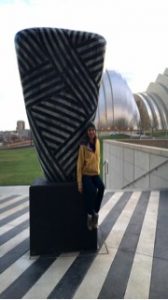
Lacey Miller, MFA was able to use her Department of Art scholarship to attend the National Council on Education for the Ceramic Arts (NCECA ) annual conference in Kansas City, Missouri. While at the conference, she experienced numerous ceramic lectures, demonstrations and artwork.

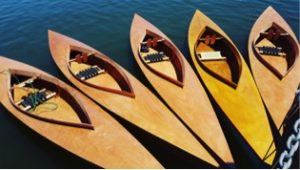
potluck, CareyCarey Morton, MFA (Sculpture), spent his summer at the Penland School of Crafts in Spruce Pine, North Carolina. While at Penland, he was a part of a team hand carved Fox Canoes. Morton acquired unique building technique skills and expanded his artistic knowledge with this special opportunity.

Teisha Holloway, BFA
, worked as an intern at The Bascom, an art gallery and visual arts center in Highlands, North Carolina. Holloway learned how to run a gallery space. She also helped to design exhibitions and displays, worked in the community with partners and learned about several forms of art professionalism.

potluck, TeishaWe are so proud of all of the impressive things our students were able to experience and accomplish over the past few months. The Department of Art is committed to continue to provide scholarship, internship and travel opportunities to students who have shown dedication to their work in and out of the classroom.
An artist returns to his roots: Clemson’s Center for Visual Arts hosts “Stories on My Back”

Media Release

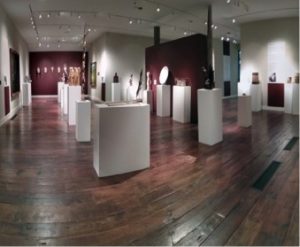
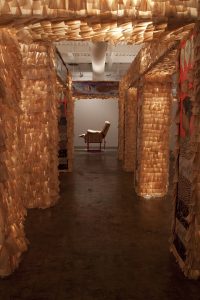
“Stories on My Back,” an installation by Clemson Master of Fine Arts (MFA) alumnus Richard Alexander Lou, ’86 will open the 2016-17 season in the Center for Visual Arts – Lee Gallery on Aug. 22 and run until Oct. 13.  On Friday, Sept. 23 at 5:30 p.m., the artist will give an artist talk about his work with a reception to follow in the gallery.

Lou was born and grew up in San Diego, CA with a biracial family, which was spiritually and intellectually guided by an anti-colonialist Chinese father and a culturally affirming Mexicana mother. After earning his bachelor’s degree in San Diego, CA, Lou continued his education at Clemson University, citing a handwritten note from the Chair of the Department of Art, a tradition that is still practiced today, as the decisive factor that led him to choose Clemson out of almost one hundred potential graduate schools. Lou has exhibited internationally and has over 30 years’ experience teaching in higher education, 20 years as an arts administrator most recently serving as Chair of the Department of Art at University of Memphis in Memphis, TN.

He has been invited back to campus to showcase his traveling multimedia installation that combines photography, found objects and sound walls of tamale husks. The artist writes, “As a contemporary image-maker I am interested in collecting dissonant ideas and narratives, allowing them to bump into each other, to coax new meanings and possibilities that dismantle the hierarchy of images. The work serves as an ideological, social, political and cultural matrix from which I understand my place in this world and to make a simple marking of the cultural shifts of my community.”

“Stories on My Back” art installation was featured in the recently released book, The Routledge Companion to Latina/o Popular Culture by Guisela Latorre, PhD, as a reference to the increasing proliferation of Lantina/o culture in modern American popular culture.

This innovative art collaboration with Richard A. Lou, ’86 is part of the Center for Visual Art’s commitment to support the 2020 ClemsonForward strategic plan to provide educational activities to attract and retain outstanding students by “providing an exceptional educational experience grounded in engagement.” In addition, Richard collaborated with four other artists, three of whom are Clemson University alumni: Chere Labbe Doiron, Jo Carol Mitchell-Rogers ’87, Robert Spencer ’86 and Chris Wallace ’86.

The Center for Visual Arts-Lee Gallery at Clemson University will be open for this exhibit 9 a.m.–4:30 p.m. Mondays-Thursdays. It is located in 1-101 Lee Hall, 323 Fernow St. The exhibition, artist talks and reception are free to the public because of the generous support given to the Center for Visual Arts. For more information about exhibitions in the Lee Gallery, as well as other Center for Visual Arts galleries and venues, visit www.clemson.edu/cva.

Clemson Arts shine throughout Artisphere 2016

27099529830_075810ce79_o


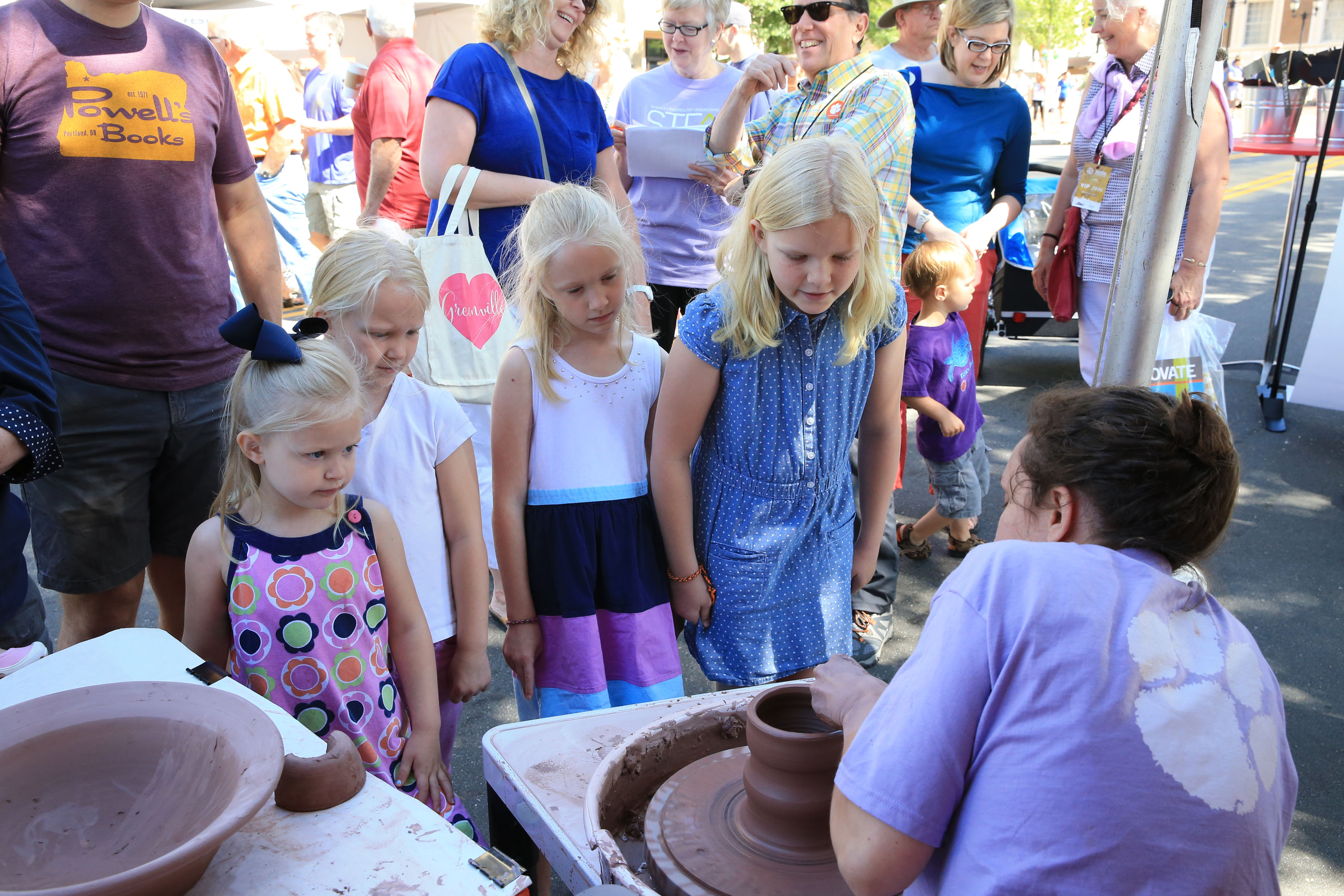
GREENVILLE — During the second weekend of May, connections to Clemson University’s visual art program were on full display at Artisphere, Downtown Greenville’s annual arts and crafts festival. Beyond the orange splendor of Clemson’s festival tents, STEAM and the Art Department demonstration, there were numerous more connections to Tigertown to be found by looking a little harder at the other displays that lined Main Street. We are proud to announce the orange ties for those who may have missed them.

  • Syd Cross, Visual Art Professor Emerita, Contemporary Print Collective
  • Tom Dimond, Visual Art Professor Emeritus, Artists of the Upstate Exhibit
  • Marty Epp-Carter, MFA, OpenStudios Retrospective
  • Michael Marks, MFA alumnus, Artists of the Upstate Exhibit
  • Jo Carol Mitchell-Rogers, MFA, OpenStudios Retrospective
  • Carey Morton, MFA candidate, metalworking demonstration
  • Alexia Timberlake-Boyd, MFA, OpenStudios Retrospective
  • Ryan Roth, MFA alumnus, Artists of the Upstate Exhibit
  • Kathleen Thum, Visual Art Faculty, Artists of the Upstate Juror
  • Mike Vatalaro, Visual Art Professor Emeritus, OpenStudios Retrospective

We were inspired by all of the work of our former and current students and faculty. It is always encouraging to see Clemson’s innovative spirit on full display. Greenville, Clemson’s ‘Home City,’ certainly got a taste for the excellent and talented people who represent the Visual Arts at Clemson University. Thank you and congratulations!

To see photos from the Clemson exhibits at Artisphere 2016, click here.

Center for Visual Arts creates ‘Out of the Park 2: Bases Loaded’ exhibit from S.C. Arts Commission grant

Media Release

Meredith Mims McTigue, Center for Visual Arts
GREENVILLE — The Center for Visual Arts at Clemson University was recently awarded an over $7,000 Arts Education Project (AEP) grant by the South Carolina Arts Commission (SCAC) for creating an art exhibition collaborating with more than 300 students throughout the Upstate. The juried exhibition, “Out of the Park 2: Bases Loaded” features more than 144 artists who submitted over 400 works of student artwork is one of two exhibitions that SCAC has supported at Clemson in efforts to foster a thriving visual arts environment in the Greenville area.
Out of the Park Exhibit

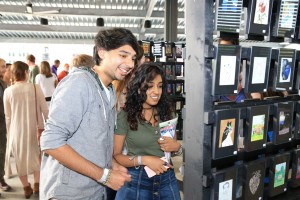
Participating artists were charged to create Artist’s Trading Cards, which are miniature works of art about the same size as contemporary baseball trading cards. The CVA offered workshops and guidance to assist art students from the different schools develop original works of art.

The exhibit was unveiled at a reception at Fluor Field’s 500 Club sponsored by the Greenville Drive. The occasion marks the second Out of the Park event the baseball organization has hosted helping to bring together arts and athletics. This type of engagement is part of the Drive’s unique approach to community outreach, contributing to the cultural richness of the Upstate.

The first Out of the Park event highlighted the juried Sense of Place exhibit. The showcase was created by the first grant received by the CVA from SCAC. Art photographers were invited to create a collection of works using environmental portraiture or storytelling. The experience helped to convey and bring together a significant exhibit meant to honor its residents and surrounding community of the Village of West Greenville. Sense of Place is part of the CVA’s permanent art collection and will be on display in Sikes Hall later this summer.

The “Out of the Park 2: Bases Loaded” exhibit was juried and awards will be presented at a special reception held in the Center for Visual Arts – Lee Gallery at Clemson University at 6 p.m. today. Participating artists from the department of art at Clemson University, Daniel High School, the Fine Arts Center of Greenville, Greenville Center for Creative Arts, Greenville Senior High School, Legacy Charter School and the University of South Carolina Upstate, as well as family, friends and the public are encouraged to attend.

After the artists’ reception is held  the “Out of the Park 2: Bases Loaded” exhibit will spend some time on display at the CVA-Greenville’s new location on the fifth floor of Greenville ONE building thanks in part to the partnership with the Clemson MBA Program and additional on campus gallery and art showcased locations managed by the CVA.

This innovative art collaboration is part of the CVA’s commitment to support the institutions 2020 ClemsonForward strategic plan to provide educational activities that strengthen recruitment efforts for the Art Department in efforts to attract and retain outstanding students by “providing an exceptional educational experience grounded in engagement.”

Photos from the “Out of the Park 2: Bases Loaded” reception are posted online and click here for video.

Exhibitions, artist talks and receptions are free to the public thanks in part to the generous support given to the Center for Visual Arts. To belong to the Friends of the Center for Visual Arts, click here.

END

The Center for Visual Arts
The Center for Visual Arts (CVA) at Clemson University is where students, visitors and scholars explore contemporary perspectives in art and culture through research, outreach programming and studio practice. With a mission to engage and render visible the creative process, the CVA is a dynamic intellectual and physical environment where art is created, exhibited and interpreted. It educates through academic research and practice with art at its core, drawing upon varied disciplines to examine critically cultural issues and artistic concerns.

The Center for Visual Arts-Greenville is a satellite gallery space located on the fifth floor of Greenville ONE building at One Main Street, Greenville, SC. The Center for Visual Arts at Clemson University, serves as the umbrella for all visual art activities at the university. Though there is not a physical building for this center, the majority of the activities for the Center of Visual Arts are generated out of Lee Hall on the Clemson University campus. For more information, visit clemson.edu/cva.

South Carolina Arts Commission
The South Carolina Arts Commission is the state agency charged with creating a thriving arts environment that benefits all South Carolinians, regardless of their location or circumstances. Created by the South Carolina General Assembly in 1967, the Arts Commission works to increase public participation in the arts by providing services, grants and leadership initiatives in three areas: arts education, community arts development and artist development. Headquartered in Columbia, SC, the Arts Commission is funded by the state of South Carolina, by the federal government through the National Endowment for the Arts and other sources. For more information, visit SouthCarolinaArts.com.

Art Students Reflect Through End of the Year Exhibition

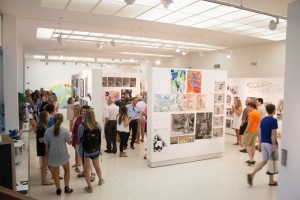
Art FoundationsAs the spring semester came to a close, Art Foundations students at Clemson University installed pieces in the Center for Visual Arts – Lee Gallery and a reception drew faculty, staff, friends and family to enjoy the wide range of unique student art. This exciting event celebrating the hard work of these students is invaluable to the creative growth process.

The Art Foundations end of the year visual review provides art students the opportunity to achieve preparing and organizing a display of artwork in a professional manner. It also allows students time to reflect upon the work created in the first few years as an art major in order to prepare for moving forward through the department of art curriculum.

Any undergraduate art student who has completed all four studio foundation courses is invited to participate. The department of art classifies Art Foundations I, Art Foundations II, Foundation Drawing I and Foundation Drawing II to be the four classes required to complete this fundamental phase. Every student submits eight to ten works of art of their choosing, keeping in mind the idea of displaying a cohesive collection of the best work to date. The students also submit a written statement analyzing their collections.

View video

View photos

About The Center for Visual Arts
The Center for Visual Arts (CVA) at Clemson University is where students, visitors and scholars explore contemporary perspectives in art and culture through research, outreach programming and studio practice. With a mission to engage and render visible the creative process, the CVA is a dynamic intellectual and physical environment where art is created, exhibited and interpreted. It educates through academic research and practice with art at its core, drawing upon varied disciplines to examine critically cultural issues and artistic concerns.

Student art in bloom this spring at Center for Visual Arts

Media Release

Student Art in Bloom

CLEMSON — Clemson University visual art students will be on full display this spring in the Clemson University Center for Visual Art’s (CVA) gallery spaces.

The second half of the semester features a calendar full of student exhibitions. Both Bachelor of Fine Arts (BFA) and Master of Fine Arts (MFA) graduating students present a comprehensive show of work weeks prior to graduation. These exhibits are a special time for visual art students, allowing them to reflect on the transformational experience Clemson has provided and choose pieces that best personify the student’s creative achievements.

BFA senior exhibits and MFA thesis exhibits showcase the culmination of year-long research endeavors. Visual Arts students go through a series of critiques aimed at helping build a body of work of the students’ choosing. The public is invited to join the conversation by attending the artist talks, followed by the artists’ receptions. Join the CVA this spring to see the next generation of art in bloom.

Diminishing Connections (MFA)
March 25, 9 a.m.–4:30 p.m.,Lee Gallery

Our existence is experienced through the container of the body and how that relates to others and the world around us. M.J. King investigates this existence through one’s physical embodiment, studying surface of skin and relationships. Looking to the state of being or having been, the body becomes a vessel and a need to preserve that memory and connection emerges. Mary Cooke examines the relationship between humans and nature experienced within the domestic realm. Her labyrinthine amalgamation of manufactured nature and domestic signifiers leads viewers on a circuitous journey through the familiar but unnatural.

Artist Talks and Reception
March 25, 6–8 p.m.

On the Way/Far and Away (MFA)
March 28–April 1, 9 a.m.–4:30 p.m., Lee Gallery

This solo exhibition of MFA thesis work by En Iwamura features a walk-in installation of large-scale ceramic sculptures and drawings that explore interrelated themes of an epic journey. Layered elements of Japanese gardens and theater, as well as Manga and popular culture, combine to heighten the impression of a distant and vast unfamiliar world.

Artist Talks and Reception
April 1, 6-8 p.m.

Inside Out (BFA)
April 4–8, 9 a.m.–4:30 p.m., Lee Gallery

Daily we explore the balance of our inner and outward selves. We interact with our outer surroundings and come in touch with our inner presence. These relationships draw oneself in to explore the intimacy and harmony between interactions, nature and our own. Through drawing, painting, ceramics and photo we have chosen to research these relationships and what type of imprint they will make. Exhibiting artists include Laddie Neil, Alisha Petersen, Summer Stanley, Emily Tucker and Simone Wilson.

Artist Talks and Reception
April 8, 6–8 p.m.

Sempiternal Flesh (BFA)
April 11–15, 9 a.m.–4:30 p.m., Lee Gallery

Flesh is finite, lacking and conditional by nature, though it desires preservation. Human beings share a longing to know what might change if we experience our own flesh in a state of divine sempiternity. As we search for this existence, we encounter the barriers of our temporal flesh and natural tendencies to alleviate realities in perverse behaviors. We, as artists, intend to translate these ideologies to viewers in a way that is relatable, but not necessarily comforting. Allowing the viewer to concoct an individual conclusion is where beauty begins incubation. Exhibiting artists include Libby Davis, Jessie Helmrich, David Lamm, Lexi Mathis.

Artist Talks and Reception
April 15, 6–8 p.m.

Turn it Up to Eleven (BFA)
April 11–15, 9 a.m.–4:30 p.m., Acorn Gallery

An alternative approach to storytelling, Turn it Up to Eleven combines narrative with a critique of contemporary culture. Through a nuanced cast of characters in a fictional setting, the collection offers voyeuristic insight into the grit and glamour of the music industry. A look into the world of these imaginary musicians reveals a lifestyle that has only three rules: Make it passionate. Make it heavy. Turn it up to 11. Work by Victoria Watkins.

Artist Talks, April 15, 6–6:30 p.m., Lee Gallery
Reception, April 15, 6:30–8 p.m., Acorn Gallery

Embrace.Exchange.Connect. (BFA)
April 18–22, 9 a.m.–4:30 p.m., Lee Gallery

As artists we are embracing the simplest aspects of life, exchanging ideas across cultures and communities, and connecting people through our work. By taking forgotten moments into our studio practices and elevating them, we are directing focus to the overlooked; embracing the mundane and bringing it to the forefront of the mind. Through an array of disciplines, we encompass these concepts and individually interpret them. Participating artists include Parker Barfield, Caitlin Gurley-Cullen, Rachel Rinker, Torrean Smith and Ella Wesly.

Artist Talks and Reception
April 22, 6–8 p.m.

The exhibition, artist talks and reception are free to the public because of the support given to the Center for Visual Arts.

END

The Center for Visual Arts
The Center for Visual Arts (CVA) at Clemson University is where students, visitors and scholars explore contemporary perspectives in art and culture through research, outreach programming and studio practice. With a mission to engage and render visible the creative process, the CVA is a dynamic intellectual and physical environment where art is created, exhibited and interpreted. It educates through academic research and practice with art at its core, drawing upon varied disciplines to examine critically cultural issues and artistic concerns.

Clemson Center for Visual Arts opens new exhibition venue at Greenville ONE

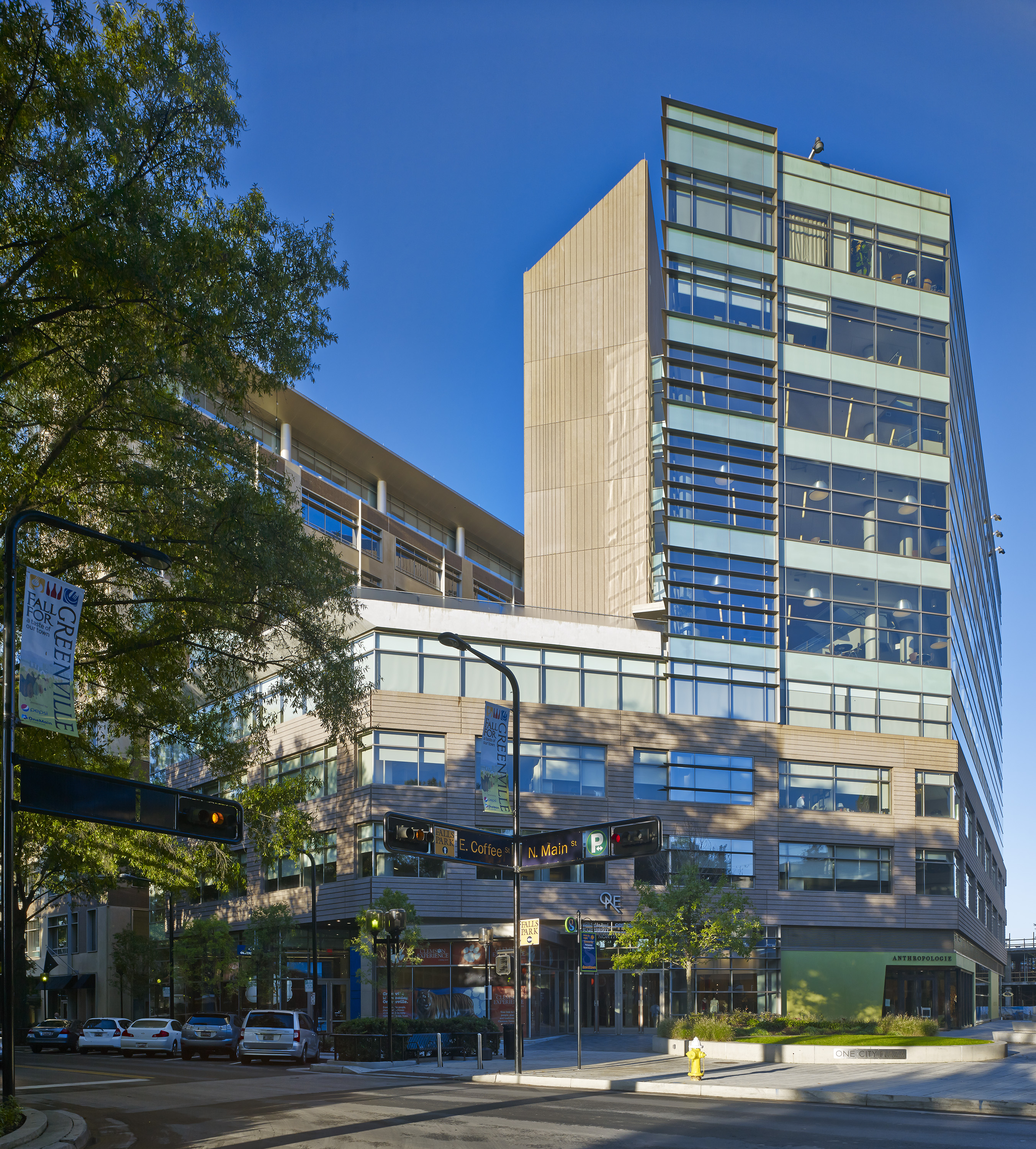
Greenville ONEGREENVILLE — The Clemson University Center for Visual Arts in Greenville will open the Southeast Regional Juried Photographic Exhibit Oct. 2 on the fifth floor of the Greenville ONE building. The show is the first exhibition in the ONE building and launches a new venue for the center.

The Southeast Regional Juried Photographic Exhibit also launches a new partnership between the Center for Visual Arts in Greenville and Clemson’s Master of Business Administration program to bring the center’s art outreach activities into the heart of downtown Greenville.

“It is with great enthusiasm that we embrace this new exhibition space in Greenville ONE and we’re grateful to the folks in the MBA program for their interests and their collaborative spirit in opening their doors to this partnership,” said Greg Shelnutt, chair of the Clemson University art department. “Having a place to grow our presence in Greenville where Clemson students interact with the arts community is a welcomed opportunity.”

The new agreement also allows the Center for Visual Arts in Greenville an opportunity to hold artist talks, workshops and receptions related to the current and future exhibits in the ONE building.

“The MBA program is very excited to partner with the Center for Visual Arts to share Clemson’s facility at Greenville ONE with a wider audience,” said Greg Pickett, senior associate dean in the College of Business and Behavioral Science. “I’m looking forward to experiencing the various exhibits and I think they are going to add a new life to our already vibrant location and provide a wonderful way for Clemson to engage with downtown Greenville.”

For the past two years, the Center for Visual Arts has operated a satellite facility in Greenville in leased space in the Village of West Greenville.

“We are grateful to Richard and Gwen Heusel for leasing us space for two years in the Village of West Greenville,” said Richard Goodstein, dean of the College of Architecture, Arts and Humanities. “It was a great experience to be part of — and contribute to — that vibrant emerging arts community. We are also extremely grateful to the Community Foundation of Greenville for the $100,000 grant that made it possible for us to consider bringing Clemson Art to Greenville.”

Earlier this month, the Center for Visual Arts in Greenville announced a five-part SmART Series at five venues in the Village of West Greenville.

“The goal of the SmART Series is to celebrate art and business expertise to the community at large,” said Shelnutt. Moving the series to five different venues in the Village of West Greenville not only showcases the Village but is representative of a more nimble approach to exhibition and programming for the Center for Visual Arts.”