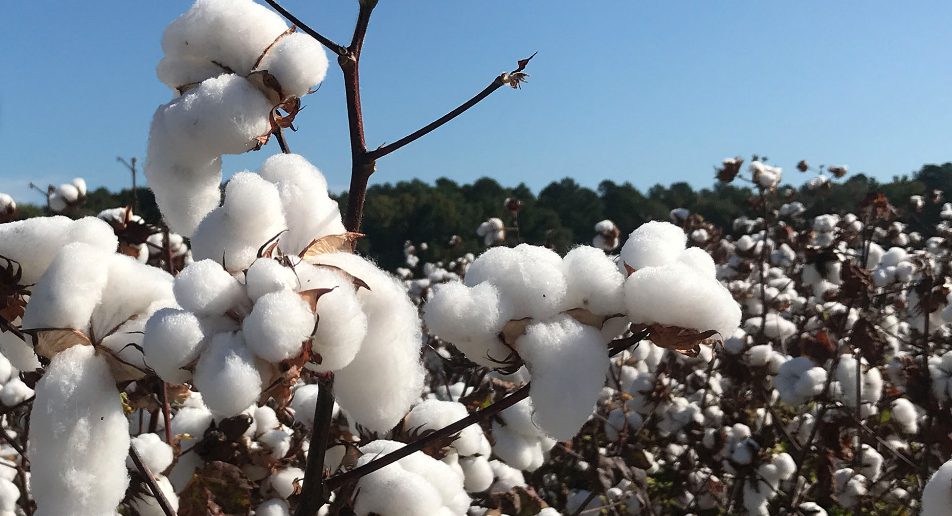
When most people think about cotton, they picture the fluffy white fiber harvested from fields across the South. Clemson University researchers are looking beneath the surface to uncover how cotton roots can help farmers grow more productive, water-efficient crops in an increasingly unpredictable climate.
A Clemson University-led research team has been awarded an $800,000 grant from the U.S. Department of Agriculture’s National Institute of Food and Agriculture (USDA-NIFA) to develop innovative breeding tools aimed at improving water-use efficiency in cotton. The project will focus on identifying beneficial root traits and the genes that regulate them, providing plant breeders with new resources to develop cotton varieties better adapted to water-limited growing conditions.
The project, New Breeding Tools for Reinventing the Root System and Improving Water Use Efficiency in Cotton, brings together scientists from Clemson, NC State University and the USDA Agricultural Research Service (ARS) to accelerate development of climate-resilient cotton varieties.
The multidisciplinary team is led by Sruthi Narayanan, associate professor of crop physiology in Clemson’s College of Agriculture, Forestry and Life Sciences. Clemson collaborators include Christopher Saski, systems geneticist, and Michael Jones, Extension cotton specialist. Additional partners are cotton breeder Vasu Kuraparthy of NC State and geneticist Todd Campbell of the USDA-ARS.
“Developing cotton varieties that can produce more fiber with the same amount of water is essential for the future of the industry,” Narayanan said. “Our goal is to provide breeders with the tools they need to identify and select plants that naturally use water more efficiently.”
The study builds on more than a decade of collaborative research supported by the cotton industry and USDA-ARS, focused on understanding how root systems contribute to drought tolerance and crop performance.
Addressing a growing challenge
Water availability is one of agriculture’s most pressing sustainability concerns. Approximately 64% of U.S. cotton production depends entirely on rainfall, leaving crops vulnerable to drought and increasingly variable weather patterns.
The cotton industry has committed to improving water stewardship through initiatives such as the U.S. Cotton Trust Protocol.
While cotton breeding has traditionally focused on above-ground traits such as yield, boll production and fiber quality, root systems have received less attention despite their central role in water and nutrient uptake.
“Roots are often called the hidden half of the plant,” Narayanan said. “Yet they are fundamental to how crops respond to drought and other environmental stresses. We believe they hold enormous potential for improving cotton productivity and sustainability.”
Looking below the surface
The team has already demonstrated that root architecture, including size, structure and distribution of roots in the soil, plays a critical role in water-use efficiency.
Using specialized greenhouse systems, the scientists grew cotton plants in tall columns filled with Turface, a clay rooting medium that enables the recovery and analysis of entire root systems. Scientists measured root length, surface area, volume, biomass and water use across genetically diverse cotton lines.
Their findings showed that plants with larger, more extensive root systems used water more efficiently. Traits such as total root length, root surface area, fine-root development and root biomass were associated with improved water-use efficiency.
Field studies revealed that root depth is an additional advantage.
During dry growing seasons, the highest-performing cotton varieties were often those that developed more roots deeper in the soil profile, where moisture remained available long after surface soils had dried.
“We observed that some genotypes were particularly effective at placing roots deeper in the soil,” Narayanan said. “Those plants were better able to access water during drought periods and maintain growth, water-use efficiency and yield.”
The researchers identified two contrasting root-system strategies. One had deeper roots and captured water more effectively, while the other had shallower roots and lower productivity under water-limited conditions.
Connecting roots and genetics
Understanding which root traits improve water-use efficiency is only part of the challenge. The next step is helping breeders identify those traits quickly and reliably.
The research team will evaluate 200 genetically diverse cotton accessions and connect root characteristics with high-density genomic data. Using genome-wide association studies, researchers will identify DNA markers linked to beneficial root traits and water-use efficiency.
These markers can serve as molecular tools for breeders.
“Instead of waiting until plants are fully grown to evaluate drought-related traits, breeders could use genetic markers to identify promising plants much earlier,” Saski said. “This greatly increases efficiency and accelerates the development of improved varieties.”
The project will also test whether specific genetic markers are reliably linked to water-use efficiency. In addition, the scientists will use advanced DNA analysis to identify the genes and biological processes that help plants use water more efficiently.
Researchers will use several advanced genetic tools to understand how plants develop root systems that help them grow better and use water more efficiently. The results could help breeders develop improved crop varieties more quickly and may eventually support technologies such as gene editing.
Building the next generation of cotton
The project’s goal is to deliver practical tools that public and private cotton breeding programs can immediately adopt.
The scientists expect to develop a comprehensive database of cotton germplasm characterized for root traits and water-use efficiency, along with molecular markers that breeders can use to screen breeding populations more effectively.
The possibilities extend beyond cotton.
As drought pressure increases across agricultural regions worldwide, many crop scientists view root architecture as one of the most promising frontiers in crop improvement.
“This project is about helping agriculture adapt to future challenges,” Narayanan said. “If we can understand the root traits and genes that allow plants to use water more efficiently, we can develop varieties that remain productive under more variable environmental conditions.”
For cotton growers, this could mean stronger yields, greater resilience and more sustainable use of one of agriculture’s most valuable resources: water.
Research is being conducted at the Clemson Pee Dee Research and Education Center near Florence, South Carolina, as well as in laboratories and greenhouses on Clemson’s main campus and at NC State.
-END-
Funding: USDA National Institute of Food and Agriculture Award No. 2026-67014-45820.
