Each spring, students in Christopher Saski’s Introduction to Plant Breeding classes, Plant and Environmental Sciences (PES) 4050 and PES 6050, are treated to guest lecturers who showcase their programs to connect the fundamentals with applications.
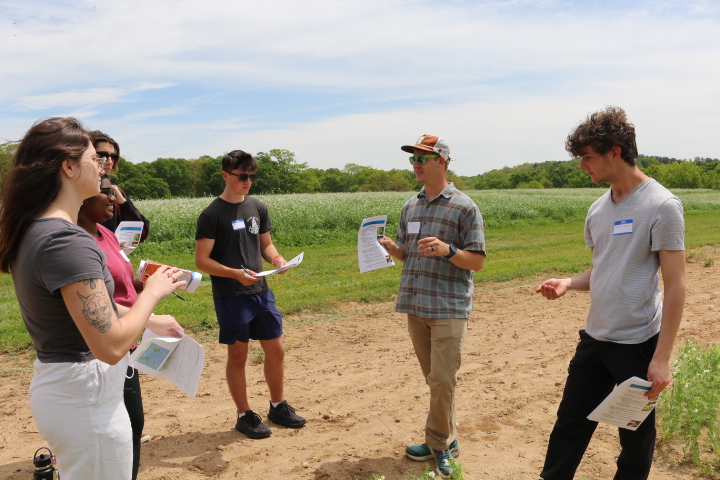
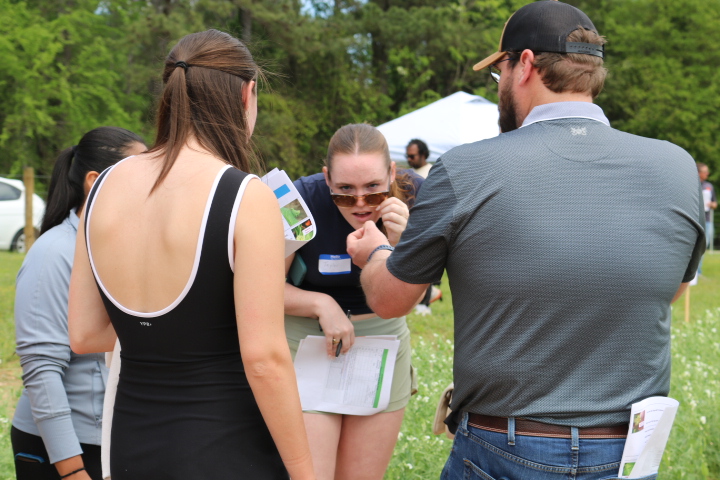
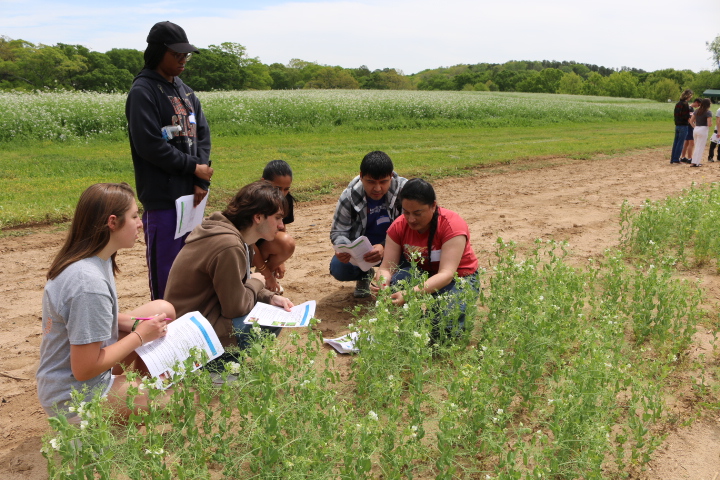
As the final guest lecturer for this spring, Dil Thavarajah invited the students to visit her organic pulse breeding trial at Cherry Farm. While at the trial, the students learned about breeding objectives, the USDA-certified organic platform for breeding and the genetic principles of dry pea.
“This class is designed to teach the students the genetic principles of plant breeding and cultivar development,” Saski said. “Students learn the sources of genetic variation in plants, they explore the various modes of plant reproduction, selection and cultivar development.
“They also learn breeding objectives, breeding schemes and different approaches to improve plant genetic potential. In the field, Dr. Thavarajah and her amazing team showed us firsthand differences in plant traits that are controlled by genetics. Students got to see flower morphology, make a cross between two plants and see firsthand the organization of a field trial.”
This is Saski’s first time bringing his classes to the field, but it won’t be the last.
“Demonstration of the application of knowledge and experiential learning activities really brings concepts full circle for many students,” he said. “I love teaching this class and enjoy seeing students become more interested in plant science and how the integration of various disciplines from genetics, engineering, pathology and even evolutionary biology can interface to essentially create the world we want to live in.”
In addition to Thavarajah, other guest lecturers for the Spring 2025 semester were: Ksenija Gasic, who presented information about tree fruit breeding and talked about how new peach varieties become marketable. Richard Boyles talked about small grains breeding and how his program is leading efforts in a public varietal release of winter wheat and grain sorghum. And, Sandra Branham gave a captivating overview of her program to develop vegetable varieties and how her program is organized to solve grower problems.
Guest lecturers also included Trevor Rife, who showcased how the intersection of technology and new abilities to measure plant traits has improved humans’ ability to understand and discover the underlying genetics. Jagger Harvey lectured on global hunger and how Clemson and his program are leading in feeding the future.
PES 4050, Introduction to Plant Breeding, looks at applying genetic principles to develop improved crop plants. Principal topics include the genetic and cytogenetic basis of plant breeding, mode of reproduction, techniques in selfing and crossing, methods of breeding, inheritance in the major crops and biometrical methods.
This class is just offered during spring semesters. Genetics 3000 is the prerequisite. PES 4051, Plant Breeding Laboratory, must be taken in the same semester as PES 4050.
Students should contact the graduate school for the 6000-level description and requirements.
Clemson is a land-grant university. This exercise is just one example of the many experiential learning experiences afforded students as part of the land-grant mission to extend access to higher education, cultivating practical fields like agriculture and engineering and contributing to economic development.
The land-grant concept was established to offer advanced instruction to the working class, to educate farmers and assist with the success and growth of agriculture as well as to educate future engineers to assist industry and encourage economic development through scientific research.
Clemson University was founded in 1889 through a bequest from Thomas Green Clemson, a longtime advocate for an agricultural college in the Upstate. Clemson left his home and fortune to the state of South Carolina to create the institution that bears his name.
-END-
Pictures from a visit to Dil Thavarajah’s organic pulse breeding trial at Cherry Farm in Spring 2025.