The Parks, Recreation and Tourism Management (PRTM) Blog

Learn from the best in the community recreation business: meet Tom O’Rourke

“When you are a student in the PRTM Master’s program, you have me for life.”
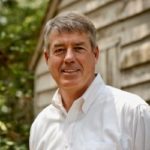
Clemson PRTM Online MS faculty member Tom O'Rourke.
Clemson PRTM Online MS faculty member Tom O’Rourke.

Over the past 40 years, Tom O’Rourke has spent every day of his working career in the management or administration of parks, recreation and tourism in the Charleston, South Carolina region. Between directing two large park systems and his service as a Board Member of the Charleston Convention and Visitors Bureau, he’s seen and managed it all.

Tom applies that on-the-ground knowledge and expertise to two classes in the Clemson University Master of Science in Parks, Recreation, and Tourism Management (PRTM) program: Innovative and Creative Funding Strategies in PRTM (PRTM 8210) and Enterprise Development in the Public and Nonprofit Sectors (PRTM 8240). He also provides strategic planning support to the department.

Tom recently answered a few questions for us about the program, his experiences in the community recreation field and the future of the profession.

Tell us a bit about what you see as your most significant contribution to the online MS program.

As Executive Director of the Charleston County Park and Recreation Commission I oversaw the agency through its most significant growth. What separated CCPRC’s growth from most others is that we accomplished this with very little reliance on tax subsidies. As our profession advances into the future, it is clear that we will need to create entrepreneurial opportunities and business management principles that will ensure its sustainability. My contribution to the master’s degree program is to work with the students and other faculty members to institute programs and services that can financially sustain themselves into the future.

What knowledge and skills do you feel are most important for our MS students to have in order to advance in the field?

The skills necessary to advance the field of parks, recreation and tourism into the future will be grounded in creativity. A department’s end goal of making communities and the people in them better doesn’t change. What will be completely different is how we do it. Graduates should leave our program understanding how to fund their parks and programs without relying on the government to fund their operations.

The future leaders in parks and recreation will be managing more than doing. Our students learn the contractual skills necessary to protect their community, while controlling the activities that take place in their department.

Our program also focuses on innovation. Government is changing, parks and recreation is changing, and so are people and society. Our students will learn through innovation the skills necessary to lead our profession into the future.

What do you enjoy most about teaching in the MS online program? 

What I enjoy most is my relationship with the students. Most of our MS students are currently working in the field. The personal relationship I have with the students extends far beyond the learning outcomes of each class.

I want to be the type of professor that is always there for the students not only in class, but beyond the class and even after they graduate. Education does not stop after the student leaves Clemson. When they contact me, I don’t want to give answers, I want to ask questions so that the student can reach the answers themselves. When you are a student in the PRTM Master’s program, you have me for life.

What advice do you have for potential students who will be taking this program while working full-time?

I actually think it is better to enroll in the program while working full-time. The advantage is that you have faculty resources for the problems that you are undertaking at your immediate disposal.

Our current method of teaching is designed to consist of discussion topics and group work. This forces students to get to know each other. The other students provide a professional network that will last well beyond graduation. When we discuss current issues, students that are currently working full-time always offer the best and most current examples.

How is this program a good value for students? Or who do you think would benefit most from this credential in your field of expertise?

The knowledge gained in the MS program will benefit a student even if they choose to switch fields. Gaining knowledge in strategic planning, funding and working in political environments is essential, whatever you are doing. Most advanced senior management positions currently require a master’s degree. Having one with an emphasis in innovation, creativity and entrepreneurship separates our program from any other.

###

About the Master of Science in Parks, Recreation and Tourism Management

Clemson University is among the nation’s top universities in graduate education in the fields of parks, recreation, tourism and related disciplines. Research shows that the average annual salary of a person holding a M.S. in the PRTM field is $16,000 more annually or $480,000 more over a 30-year career. The top 25% of people in the field with a M.S. make $88,000 or more annually.

Students learn from a mix of leading university faculty and world-class practitioners and take 10 classes over two years (one class at a time), meeting online in the evening once a week with faculty and fellow graduate students – making sure you can continue to work full-time while earning your Master’s degree.

Visit Clemson Online to learn more about the MS Online (non-thesis) program in Parks, Recreation and Tourism Management, including how to apply for either a spring or fall program start.
 

Clemson Master of Public Administration Program Ranked Among the Nation’s Best

Clemson’s Master of Public Administration Program (MPA) has a lot to celebrate! The program was recently ranked 10thof the 50 best online Master in Public Administration degree coursesby TheBestSchools.org.

Clemson’s MPA program ranking was based on its program quality, including the types of courses offered, faculty, rankings, awards and reputation, compared to all other accredited online MPA Programs in the United States.Best online master in public administration program badge

“We’re proud of this designation, which recognizes our program’s ability to provide the advanced training our students need to assume leadership roles in the public sector,” says Lori Dickes, Program Director of the MPA program and Associate Chair of Clemson’s Parks, Recreation and Tourism Management department. “Over the past several years, we’ve grown this program from a regional offering to a national program that draws students from across the country.”

MPA students can choose to specialize their training in emergency management, homeland defense and security, local and state government, nonprofit management or regional sustainability – ensuring the program meets the needs of a diverse range of public administration and non-profit professionals. Before they earn their credential, students take a comprehensive exam or complete a capstone research project to either demonstrate or expand on the knowledge they’ve gained.

The MPA program is also working to expand its specialized training options through a partnership with the Federal Emergency Management Agency (FEMA). Starting this fall, students can also further develop their professional and academic knowledge in two new certificate programs focused on Emergency Management and Homeland Defense and Security.

Although the program ranking confirms the quality of learning in the program, Dickes feels the real strength of Clemson’s MPA students rest in its people.

“This ranking confirms what we and our students already know – that our program, faculty and students are among the best of the best,” says Dickes. “What makes our program really special, however, are the relationships that come from this online program. Our students form close bonds with our faculty and one another and truly become part of the Clemson family, even though they only actually set foot on campus a few times.”

Learn more about Clemson’s online MPA program from its students and faculty:

A New Clemson Ph.D. Leads the Way

Haley Griffiths Earns First-Ever Recreational Therapy Ph.D. through Clemson University’s Parks, Recreation and Tourism Management department

Haley Griffiths, the first student to earn a Ph.D. through Clemson University’s new online recreational therapy cognate area doctoral program, doesn’t appear to be able to slow down. She only recently found the time to really look back on her studies during a long overdue family holiday just after she defended her dissertation.

Picture of Haley Griffiths, Ph.D., posing with the Clemson tiger and her mother.
Posing with the Clemson tiger after the hooding ceremony.

Like many students in online graduate programs, Haley worked full-time while she studied. She spent her days working with psychologists, social workers, counsellors and inmates as the only recreational therapist at a nearby prison, and spent many of her evenings, weekends and summers in the air, keeping up with her required flying hours with the National Guard. All National Guard pilots are required to get in 48 hours of flight time every six months, whether or not they’re on active duty.

Haley decided to pursue her Ph.D. after working as an adjunct professor for the University of Tennessee, and realizing she wanted more. “Although I was already teaching with my master’s degree, I wanted to work in academia full-time,” Haley says. “To do that, I needed a Ph.D.”

The online format worked well for Haley, who says that keeping to a schedule, working on assignments early and taking advantage of the support of her fellow students was key. “I didn’t want to miss a deadline because I was called in [by the Guard],” Haley explains. “Planning and organization helped me be able to look ahead, so if I was helping to fight fires, I didn’t fall too far behind.”

Marieke Van Puymbroeck, Ph.D. and program coordinator for the recreational therapy program, says Haley was well equipped to take on so many different responsibilities at once. “The best way to describe Haley is steadfast. She has nerves of steel,” Van Puymbroeck says. “Working as a recreational therapist in a prison, and flying for a medical evaluation unit, require grit and resilience. She has those qualities in abundance.”

Resilience is also a central focus of Haley’s research, which explored how summer camps targeting military youth and families influence their resilience and development. Camp experiences targeting youth in military families have long been seen as promising interventions for building healthier families and resilience in their youth participants, but rigorous research into these experiences was limited.

Haley sought to fill this research gap. She found that bringing youth in military families together into a camp environment was beneficial, though their resilience remained unchanged – findings she wants to explore in greater detail.

“Although their resilience remained constant, we also found that bringing together campers with shared experiences helped them experience a sense of belonging – or relatedness – that may not have been possible back home, where they are likely the only kids in their school with deployed parents,” says Haley. “I would like to understand and unpack more about resilience, and what it means, especially to this group of people.”

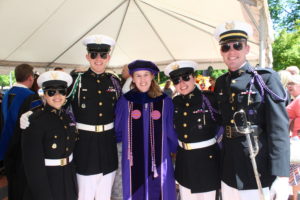
Picture of Haley Griffiths with members of Clemson's Pershing Rifles Company C-4.
Photo courtesy of Clemson University’s Pershing Rifles Company C-4.

Haley’s resilience is about to be put to the test, as she heads to Kosovo this summer to fly a Blackhawk helicopter for a medical evacuation unit. When she’s completed her deployment, she plans to look for a faculty position in the recreational therapy field, while continuing to serve.

“Serving in the National Guard, and being able to serve my community, is something I really love,” says Haley. “It’s challenging and exciting, but also really rewarding.”