Yesterday, Nov. 8, was election day across the United States, and as the polls closed and results started to roll in voters across the country reacted to the results. The team here at the Social Media Listening Center followed along in real-time with the digital and news media traffic surrounding candidates in South Carolina, North Carolina, and Georgia:
https://twitter.com/ClemsonSMLC/status/1590141515388817408?s=20&t=AFWMmLetQUWbIeHAApWPSQ
Now let’s take a quick glance at the results and numbers from South Carolina’s elections now that a majority of them have been called and the results are more official. All voting numbers and election results have been sourced from Ballotpedia.
Governor: Henry McMaster (R – Incumbent) def. Joe Cunningham (D) and Bruce Reeves (Libertarian)
McMaster and his running-mate Pamela Evette held onto their positions in the governor’s office for another term, defeating opponents Cunningham and Reeves. McMaster earned 57.2% of the votes across South Carolina, totaling 711,862 ballots, compared to Cunningham’s 41.6% of votes and Reeves’ 1.2%. This victory means another four years of Republican leadership in South Carolina, even though many posts across social media indicate negative sentiment toward McMaster. McMaster himself has not yet posted anything on his Twitter account since the race was called.
Read our article about the gubernatorial candidates here.
Senator: Tim Scott (R – Incumbent) def. Krystle Matthews (D)
The race for this Senate seat was one of the very first called across the entire country last night, with Scott easily defeating Matthews to retain his spot in Washington D.C. Scott earned a solid 68% of the vote (742,616 ballots) compared to 38% (455,066 ballots) for Matthews, and write-in candidate Jesse Harper sadly earning not a single vote. Scott first took office in 2013 and continues his tenure for this next term.
Incumbent senator Lindsey Graham (R) was not up for re-election this cycle.
Read our article about the Senate candidates here.
House of Representatives
District 1: Nancy Mace (R – Incumbent) def. Annie Andrews (D) and Joseph Oddo (Alliance)
Mace was yet another Republican candidate who was re-elected. District 1 includes Charleston and much of the surrounding coastal area of the state. Mace earned 56.4% of the vote, compared to Andrews’ 42.5% and Oddo’s 1%.
District 2: Joe Wilson (R – Incumbent) def. Judd Larkins (D)
Wilson earned 59.4% of the vote compared to Clemson University alumnus Larkins, who earned 40.6%. District 2 includes the city of Columbia.
District 3: Jeff Duncan (R – Incumbent) won
Duncan ran unopposed in District 3, which is home to us here in Clemson.
District 4: William Timmons (R – Incumbent) def. Lee Turner (Independent write-in)
Timmons also maintained his hold in District 4, which houses Greenville.
District 5: Ralph Norman (R – Incumbent) def. Evangeline Hundley (D) and Larry Gaither (Green)
The strong run for incumbent Republican candidates continued as Norman also held onto District 5, winning with 64.5% of the vote compared to 34% for Hundley and 1.5% for Gaither.
District 6: James Clybern (D – Incumbent) def. Duke Buckner (R)
However, the luck of the incumbent was not only limited to Republicans. Democratic representative James Clybern also kept ahold of his seat for District 6, defeating Buckner by nabbing 61.5% of the vote.
District 7: Russell Fry (R) def. Daryl Scott (D)
The incumbent representative for District 7, Tom Rice, did not make the final ballot in the general election. Instead, Russell Fry advanced as the Republican candidate, and he ultimately took the district over Scott with 63.7% of the vote.
Read our article about the House of Representatives candidates here.
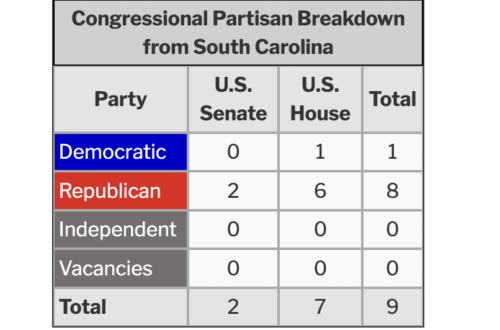
At the end of the day, of the nine South Carolina politicians in Congress (eight of whom were on the Nov. 8 general election ballot), only one is a Democrat, James Clybern of District 6 in the House of Representatives. The others are all members of the Republican party:
Author: Kayleigh Jackson
