MIRIAM MCEWEN

I can’t pinpoint the exact moment I met fiction associate editor Miriam McEwen, but I do remember always feeling a little embarrassed, impressed and motivated by her intelligence and talent—and lucky to be around it. Even more than ten years later, I still remember her love of Flannery O’Connor, the mountains and her habit of stealing people’s cardigans in the middle of the night.
Today, Miriam writes about disability and bodily autonomy. Her work has appeared in Wigleaf, Best Small Fictions, HAD, Black Warrior Review, and other publications. She received her BA from Clemson University and her MFA from the Vermont College of Fine Arts, and she now lives in the foothills of South Carolina.
– SCR Social Media Advisor
- What is one piece of art—music, literature, film, painting—that has spiritually, mentally and emotionally inspired you?
- So many pieces of art, so little time! May I give you two? Because Joanna Hogg’s The Souvenir, parts one and two, is foundational. Those films are my Godfather, really. You get to witness the very raw and grainy and romantic and desperately sad and hopeful becoming of an artist in what is essentially Hogg’s film-memoir. I’m never not moved by that work, always reminded in watching it that I don’t need to try and suffer because suffering will arrive no matter what. And all I can do is respond beautifully. Which is not to say cleanly or inspirationally.
- What’s the strangest place an idea for a story has come from?
- My life, she said drolly. No but, in earnest, I think I have a gift for strangeness. I have to check myself constantly, to not be too reckless, because I do have a mentality of, “Wow if I live through this, it has all the unrefined materials for compelling fiction.” Which is to say, stories come from anywhere and everywhere so long as you are looking for the story.
- How has being a disabled author impacted/altered your work and what has it taught you about yourself?
- Sometimes disability for me is like a gnat that insists on flying too close to my face. Sometimes disability is a bear. And I’m there wrestling with it, pleading for it to go elsewhere. More often, though, disability is revolutionary and darkly funny and intimate. I’ve had to be okay with so many different people touching my body. And then there are people you want to touch your body, yes? And people you don’t. So the writing I do becomes an expression of those multiplicities. The writing is a way of knowing the unknowable, embodying the ephemeral.
- (Knowing the answer to this question,) What writer(s) do you return to when you feel stuck?
- You know I love Flannery O’Connor! What a delightfully odd bird. Flawed. Gripping. Disabled writers so deep in the zeitgeist are hard to come by. I’ve been to her farm in Milledgeville, Georgia twice now. The house is not wheelchair accessible. That’s a fun fact. And you can feel the surreal irony in her work arising from that very real place. Her cadences are basically part of me at this point. But also Kendrick Lamar, Cormac McCarthy, Ross Gay, Donna Tartt, Eminem, Virginia Woolf, Sharon Olds, Bob Dylan, Joyce Carol Oates, Princess Nokia, Joan Didion, Tierra Whack, Johnny Cash, Langston Hughes, to name a few. The influence of rappers/emcees and country singers on whatever craft I have cannot be overstated.
- Which of your stories would you like to see illustrated or filmed?
- I love this story that got picked up by Black Warrior Review a couple years ago, called “Internet Brain.” It’s set during the dissolution of a relationship, and you stay very tight with the narrator as they contend with AI and music culture and sex addiction and disability and loneliness. Cinematic. Essentially an erotic thriller. I think both Claire Denis and Lynne Ramsay could each make stunning adaptations of that piece. But I am currently playing hard to get with the film rights, thank you very much.
- As someone who has known you for over a decade, how has your writing evolved over the years?
- I love that we’ve known each other for over a decade, first of all, Kate. I treasure you. As for my writing, as in myself, I know I’ve improved. Everything I am as a person, I am as a writer, only more so. Being concise matters to me more now. Taking care not to waste the space but taking all the space I need to tell the story. I want the work to be air-tight. And timeless. And perhaps unlike ten years ago, I want to be humble, like my mother and Kendrick Lamar taught me.
STEVE CALDES
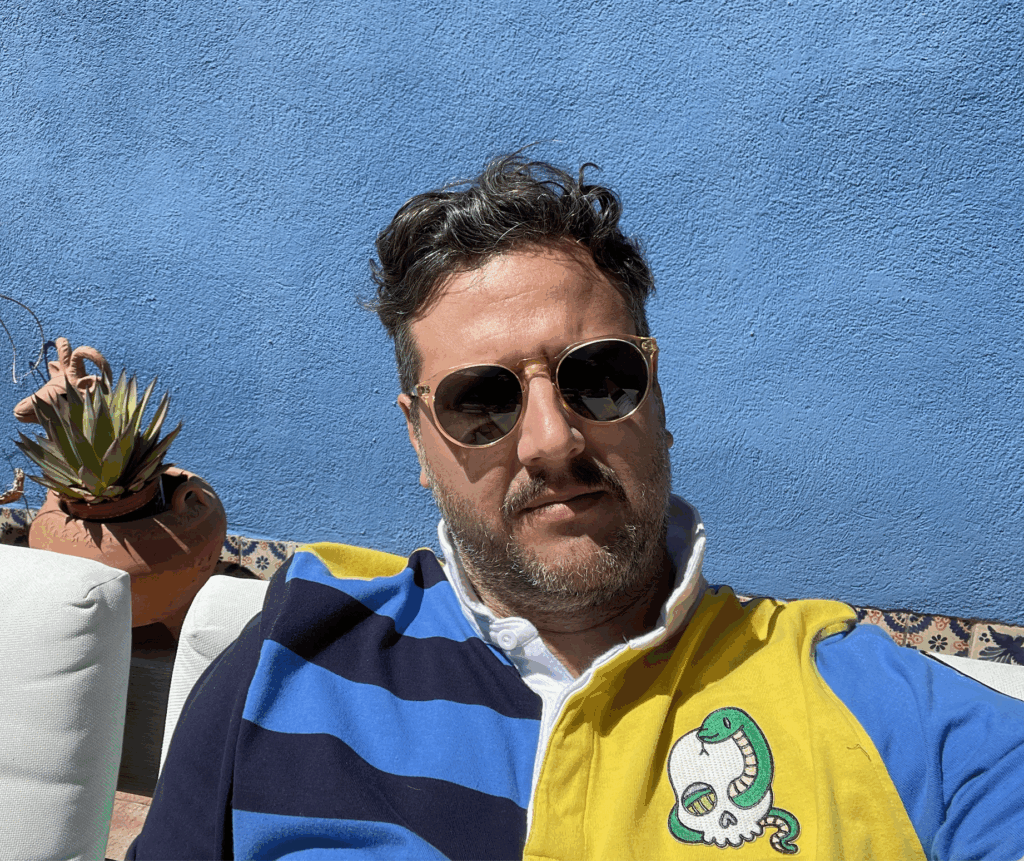
Steve Caldes, father, foodie, freelancer and our creative non-fiction editor teaches journalism at California State Univ,ersity, Chico, where his wife is also a professor. If you play your cards right, he might just tell you the secret to his famous BBQ sauce he learned while an undergraduate at Clemson University.
- Tell us a little bit about you and your life right now.
- Welp, I’m a father of two (six year old Elka and two year old Wells), a partner to one (Dr. Jenny Malkowski who teaches at the same university), and an Associate Professor in the Journalism Department at California State University, Chico (aka Chico State). Academically, I’ve been writing a bit lately about mis-/dis-information and how (in this post-truth, emotional-propaganda-laden world) well-told (often false) stories have become more powerful than facts, and how there’s now more than ever a need for increased literacy around how stories are told (sold) and function so we can stop being so easily manipulated by this form of compelling propaganda. Like, if we can get people to better see the gears at work they might not be so susceptible to the machine.) But I also write a lot about food for some local magazines. I’m sorta food obsessed – it’s history and influence on culture and politics, but also just like, how great cooking food for family and friends is and how cooking is the most delicious way of telling someone you love and care about them. The vinegar-based BBQ sauce my friends pine for regularly, I first learned (from my then girlfriend’s father) when I was at Clemson.
- How was your undergraduate experience as a Clemson student
- Clemson holds very fond memories for me. I made friends there that I still talk to (well, text with) daily! And some of the professors I met there’s ones like Keith Lee Morris! – literally changed my life, and I’m proud to count them as friends, too. (I wrote a lot about how integral Clemson in general and the English Dept in particular were to me/my professional life in an old issue of the alumni magazine Clemson World. It was called “The Yes that Changed My LIfe” if you’re interested.
- It was at Clemson where I learned I loved…learning. High school felt like a place where I had to memorize information regardless of if I was interested in it or not. But at Clemson, even in my GEs to some extent, I was encouraged to follow my curiosities. One of the reasons I graduated with two minors was simply because I just could not stop taking History classes. Every semester in the last few years I’d tack on a History class just because. I was never disappointed. And this mindset – be curious! Quench that curiosity with reading and class and more questions – helped me flourish as both a person (curiosity makes people more interesting!) and a student. In high school I was a “fine” student, but from Clemson on I always graduated with honors. There were people–friends and faculty–that believed in me at Clemson. They helped me believe more in myself, and any success I’ve had (which might seem miniature to most, but means a lot to me) stems from these integral years in western SC.
- How did you end up in the New Mexico State MFA program and how did that expand your craft?
- I ended up at NMSU because – yup, you guessed it – because of Clemson. I believe it was fall of my senior year and the English Dept was hosting a writing series that brought the author Antonya Nelson to campus. Nelson was a big deal to me at the time; I was reading and writing and studying short stories and she was one of the top practitioners. I remember I was even doing a report on one of her short stories for a project in my Philosophy of Death and Dying class I was taking when I learned of her visit. I remember she gave a reading – that eentranced – came to our creative writing workshop–where knowledge was dropped – and then a few of us got invited to have lunch with her. I was my usual energetic ball of joy and was just excited at how lucky I felt. This author I spent all year reading was suddenly, like, eating a sandwich with me! It just felt so…cool. Then, a few days or so later, either Keith or his former ENGL colleague Brock Clarke told me that Nelson suggested I apply to the NMSU MFA program. She hadn’t read my writing that weekend–not that I remember, anyway – but had (at least this is the story I got) mentioned that the faculty at NMSU was as interested in young writers’ motivation and attitude as much as they were writing chops. I guess she thought I might be a good person to have in a cohort. A year later, when I was applying for MFAs, I completed quick a few applications, but there was only one I was truly interested in: NMSU.
- NMSU was everything. The sheer talent at the time I was there: Nelson, Robert Boswell, Kevin McIlvoy, Chris Bachelder, and Connie Voisine to name a few. The effort they put into my work and writing instruction. I remember once I turned a ≈15-pg story in to a Robert Boswell workshop and received over 20-pgs in notes! And Nelson dropped so many little tips – one I still think about and “use” today. Chris Bachelder was a rising star at the time – his satire is on par with anyone working today, George Saunders included! – but what I got most from his was how personable and hard-working he was. In my mind he was who I wanted to be, but also someone I got to have a lunch burrito on campus with. It was also here that I started writing more creative nonfiction/literary journalism. Monica Torres taught a CNF course that opened my eyes to the power of true-story-telling.
- McSweeney’s was a big part of your start in getting your name out there, how was that experience?
- Yeah, in the early 2000s, when the internet was mostly full of hope and connection, McSweeney’s were the funny, semi-dorks in the corner poking fun and punching up. At Clemson I read Dave Eggers’ A Heartbreaking Work of Staggering Genius (which kinda blew my head off for a minute there; I believe he was also one of the original founders of McSweeney’s) and started going to the website daily. The way they messed with form, took big swings in the area of meta-fiction, and just wanted to make some high-minded cracks really spoke to my inner silliness. It was like a Harvard Lampoon, but for the whole world. Smart and funny, funny and smart…that was my wheelhouse. My first few publications with them felt like an airplane taking off. I’m sure a few beers were had in celebration
- Switching topics to SCR, as our Creative Non-Fiction Editor, what makes a piece interesting for you? What current or older trends excite you in a non-fiction piece?
- This is such a huge question. I’ve been thinking about…and writing about…this a lot these days. I think I’ve come up with something short that sums it up. At the SCR, we’re looking for CNF pieces OF CONSEQUENCE. I know, I know, super vague. (Isn’t all writing supposed to be important?) I guess I might venture to say that quality CNF pieces are equally of consequence to the writer AND the reader. To accomplish this, good CNF should be about TWO THINGS…the personal story, of course, but also something bigger, more universal, something connected to, er…humanity. It’s gotta SAY something bigger, something connected to the story but also outside of it. I don’t care about YOUR time at, say, cheerleading camp, UNLESS it’s teaching me about the world I live in also! If that makes sense. That said, I’m uninterested in being lectured to. I need room to breathe and make up my own mind – as any reader wants – but I need to believe that the author is USING this one story to tell us something that’s more…difficult, abstract, etc.
- But also, sometimes, there’s just a voice or an energy that grabs me. We have a piece coming out next fall I think that, at first, read a bit like the blogging of a woman at the end of her rope, just barely hanging on to mind in this increasingly superficial world. There were so many times reading this where I was like, Where is this going? But I couldn’t put it down…the voice just kept me hooked. And soon enough, at about the 8,000 word mark, I started to see that more “universal theme” rise. I’m so happy I kept reading…
- So yes, the story can be about you and your life, but it shouldn’t be FOR you. Write for the reader. Write to help them. Life is complex and lonely and so fully of the unknown. Try to give them some small sliver of truth they can hang their hat on.
- Is there any advice you would give a creative fiction writer wanting to dip their toes into creative non-fiction?
- I’m pretty sure everything in life is about DOING IT! I was someone–perhaps I still am – who is so busy figuring out why I’m NOT the guy, why this WON’T work, why I haven’t read enough, learned enough, done enough, etc. – that I talk myself (or at least did) so much. I watch my kids now…they complain about not being able to ride a bike. And I ask, Well, have you tried? “Not really,” they answer. Well then there’s your problem! 🙂 Seriously, though, just do it. And also read the stuff you want to write. I finally picked up the collected nonfiction of John Gregory Dunne and of all the things I like about it, the way it inspires me to write is perhaps my favorite!
