Campus Recreation is offering several opportunities this spring for staff to become certified in First Aid and CPR. No Campus Rec membership is required.
Upcoming February sessions are scheduled for February 26-27, with more class dates available in March and April. These courses equip participants with the knowledge and confidence to respond appropriately during a wide range of medical emergencies, including cardiac arrest, choking, and other life‑threatening situations. Learning how to recognize an emergency, provide immediate care, and coordinate with first responders can make a critical difference in the outcome.
All full CPR certification courses use a blended learning format, which combines online and in‑person training. Participants must complete the assigned online learning modules before the start of the in‑person session at Fike. This allows the classroom portion to focus on hands‑on practice, skill application, and real‑time instructor feedback.
All sessions are held at Fike Recreation Center, making it convenient for staff across campus to attend. You can also book a custom course for your own group, whether it be your office or a team you may be on. For those inquiries, contact Nicole Taylor. Her email is linked below.
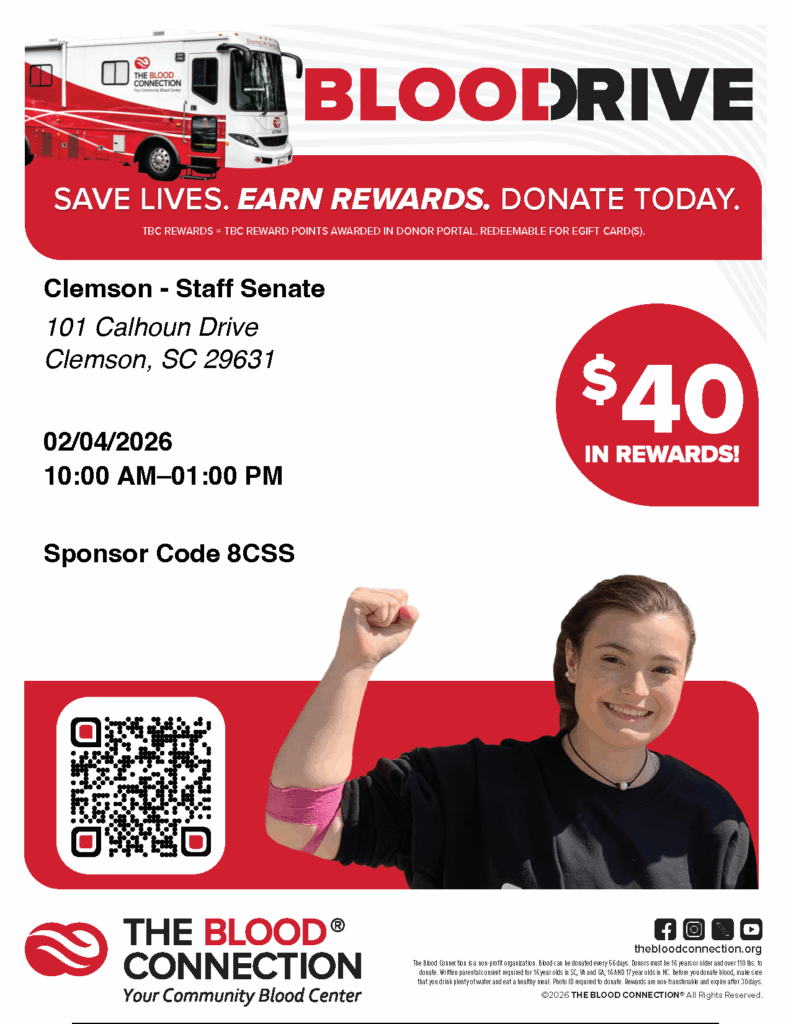
Clemson – Staff Senate is proud to host a community blood drive on Wednesday, February 4th, from 10:00 AM to 1:00 PM. This event is a vital part of our commitment to supporting and enhancing the health and well-being of our community.
As a token of our appreciation for your time and support, each donor will receive a $40 eGift card from TBC. It’s our way of saying thank you for joining us in this crucial mission to save lives. We could not do it without you!
This is more than just a blood drive—it’s a community effort to provide essential help to those in need right here in our area. Every pint of blood collected can save up to three lives, making a profound impact. See how your donation goes on to impact a life in your community here!
Click this link to sign up and reserve your spot to donate. Your participation is crucial, and together, we can achieve something remarkable. Thank you for considering joining us in this life-saving initiative. Your support not only contributes to the health of our community but also strengthens the bonds that make our community great.
Good Morning! In today’s newsletter, Staff Senate President Stacey Miller provides her latest report. Fike Recreation Center introduces a new training class, the Ombuds Office shares its latest insights and more.
Happy New Year! I hope you had a wonderful holiday break and are recharged for an exciting new year.
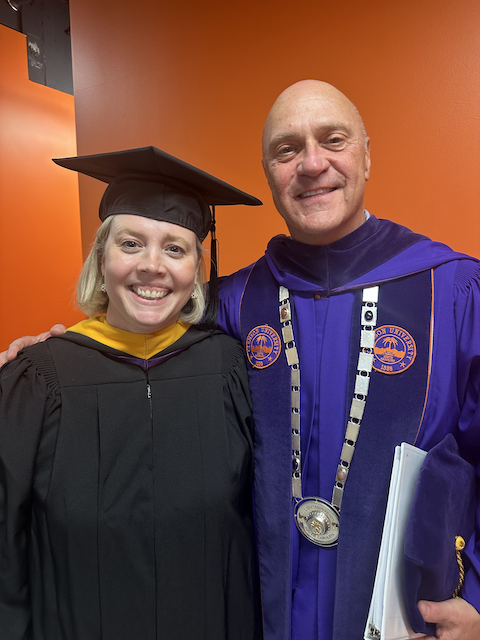
In mid-December, I had the opportunity to attend and celebrate with our Clemson University graduates. There are many Staff who play vital roles in students’ lives. Thank you for all that you do for our students.
We also had multiple staff who earned degrees. Congratulations! I would also like to give a shout-out to one of our very own Senators, who earned his master’s degree, Levi Roach.
A couple of updates: We have received concerns about Staff representation for the Presidential search. The Staff Senate Executive Team will meet with a couple of B.O.T. members who are part of the search committee to gain insight into the needs of the staff and their expectations of a Presidential candidate for Clemson University. Staff Senate and I will remain engaged during the search process and continue to advocate for all Staff across the University. Thank you to Chair Kim Wilkerson for including Staff Senate during these important and exciting next steps at Clemson University.
This year is an election year, so our holiday schedule will not include an optional holiday. This is a requirement by law to ensure that all employees can vote during a major election. Please see the Clemson University Holiday Schedule for 2026. CU HR Website: https://www.clemson.edu/human-resources/benefits/leave-and-holidays/holiday.html
Staff Senate Strategic Priorities:
We Champion– Recognize the impact of current challenges and model leadership and service.
We Empower – Promote feedback and maintain regular communication with constituents.
We Uplift – Listen actively, report concerns, and ensure timely responses.
Please let me know if you ever have a question or concerns by reaching out to me via email: smille3@clemson.edu
Or, by contacting your local senator, who can be found via the website below:
Again, thank you for all that you do. We appreciate each one of you.
We hope you can attend our next meeting, scheduled for Thursday, January 7, 2026, from 2:30 to 4:00 PM at the Watt Center Auditorium. Reminder: If you would like to ask a question, please request to speak during the open comment period by contacting our office or relaying your questions to your senators.
As always, stay kind, Tigers, and take care of yourself and those around you.
We all know the traditional picture of a leader: someone with a corner office, a fancy title, and the final say, but the most dynamic and successful teams aren’t led by just one person at the top. They thrive because leadership is distributed at all levels of the organization. As leadership expert John C. Maxwell states, “Leadership is a choice you make, not a place you sit” (Maxwell, 2006).
No matter where you sit within your organization, you have the ability to influence those around you. Here at Clemson, where innovation and collaboration are a significant part of the strategic plan, mastering the art of leading your peers is essential. This is how we amplify our impact, solve tough problems, and build a workplace where everyone feels empowered to contribute.
So, how do we do this? It comes down to three fundamental strategies:
1. Build Trust and Empathy
Trust is what holds teams together, especially when you’re leading your peers and teammates without formal authority. Empathetic trust is built through your efforts to be a genuine, consistent and reliable teammate—someone who is honest with others and creates psychological safety for others to be honest too.
Imagine a co-worker needs help with a difficult report. Be a teammate who doesn’t just offer advice but instead devotes their time, being willing to step in to assist if needed. Ask them: What can you take off their plate? What can you do to help? Is there something you can take on, so they can focus on this project? Offering assistance isn’t just about being helpful; it creates trust and acknowledges the human element of office interactions.
When your peers know you’re reliable, dependable, selfless, and trustworthy, they will begin to look to you as a leader. [TB1] When an informal leader shows they care and are willing to step in to help others, they elevate the entire team. When others feel like you care, they’re more likely to consider your ideas, which opens the door for you to guide and influence.
2. Find the Best Solutions
Since good ideas are the building block of innovation within an organization, it is important to invest time and energy generating and fostering ideas. It is also natural to fight for your own ideas because of this investment, but a peer leader is more focused on the success of their team than their own personal agenda. Maxwell urges us to remember that “we aren’t perfect and maybe we don’t have the best ideas, but we should cherish and protect the creative people on our teams and their ideas, even if that means your idea gets refined, or even replaced, by someone else’s” (Maxwell, 2006).
Now imagine that you spent the last month brainstorming, developing and preparing a proposal presentation for an important stakeholder. Two weeks before this meeting, you and a colleague separately present your ideas to the rest of the team. After hearing your colleague’s proposal, you can see how some of their ideas are better than your own. As a peer leader, you decide to collaborate with your colleague to develop the best proposal, sharing the praise and credit, instead of pushing forward with your own and taking the praise for yourself.
The mindset where you actively solicit, value, and integrate input from your peers fosters an environment of psychological safety and shared ownership. When your peers feel their voices are heard and their contributions genuinely valued, they become more invested in the outcome and more willing to follow where the collective best interest leads. It’s a mindset where we can build something better together than we can on our own.
3. Create a Shared Destination
Even without a formal title, you have the ability to provide direction by helping your team visualize the shared destination. Leading your peers is often about providing the context and rationale that connect your daily tasks to the broader organizational mission, such as Clemson Elevate. When a team understands the bigger picture behind their daily work, they move with greater purpose and alignment. As Doug Thorpe describes, “Leading your peers is about becoming a reliable source of insight, solutions, and clarity allowing others to understand the bigger picture, positioning yourself as the beacon who connects daily work to the ultimate organizational mission” (Thorpe, 2025).
Imagine you have a co-worker who is frustrated with your department’s new tracking system and is struggling to see the value in moving away from the old system. As a peer leader, you don’t just focus on the technical execution; instead, you help your co-worker see the purpose behind the change. You take the time to explain how the change supports the strategic plan of the University and how their specific role is vital to that success. By serving as a beacon of clarity, you help your colleagues find meaning in the mission. When everyone can see the ultimate destination, they are more motivated and more likely to respect the informal guidance that helps the team reach its goals.
Unleashing Our Collective Potential
Peer leadership isn’t just a theory; it’s something you can put into practice today. By focusing on trust, finding the best solutions, and creating a shared destination, we unlock a dynamic that elevates ourselves, our departments, and Clemson University to new heights.
Sources
Maxwell, J. C. (2006). The 360 degree leader: Developing your influence from anywhere in the organization. Thomas Nelson.
The Ombuds Office is a confidential, independent, neutral, and informal space for staff to process concerns, get information, and develop options for how to move forward in a difficult situation. I can provide education, conflict coaching, mediation, and facilitation as well as referrals to other resources across Clemson. If you are unsure how to move forward in any way, I can help you work through it.
Michael Scott
Phone: 864-656-6353
Email: mesctt@clemson.edu Address: 135 Old Greenville Hwy, Ste. 203 (Next to Esso!)
Save the date for upcoming trainings offered by the Ombuds Office: