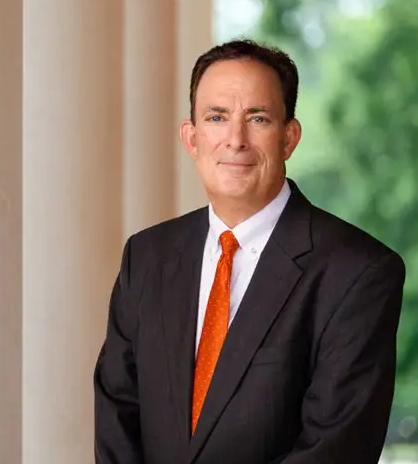
As we look forward to President Ayers joining us for our upcoming Staff Senate meeting, we encourage staff to watch the recently recorded Conversation with President Ayers. The conversation covers a variety of topics and provides an opportunity to hear directly from President Ayers about his vision and priorities for Clemson.
During the Staff Senate meeting, we will ask President Ayers several questions submitted by staff and Senators. While we will not be able to address every question, some of the topics submitted have already been discussed during the recorded conversation.
One of the things I appreciate most about Clemson is the way our community comes together during both moments of remembrance and celebration. September gives us the chance to do both, as we honor the past and embrace time-honored Clemson traditions.
Each year, September 11 provides a chance to reflect on the unity that emerged during one of our nation’s most challenging times. While many members of our campus community have personal memories of that day, others know it only through the stories shared over the past 25 years.
Participating in campus remembrance events offers an opportunity not only to honor those we lost, but also to reflect on the values that continue to bring us together: service, compassion, and a commitment to supporting one another. In a world that often feels divided, these moments remind us of the strength and resilience we find in community.
This year, Clemson will honor the 25th anniversary of 9/11 through several events. On September 11, Military & Veteran Engagement will host the 9/11 Memorial Stair Climb at Littlejohn Coliseum, a tribute honoring those who lost their lives and the first responders who answered the call that day. Participants will climb the equivalent of the 110 floors of the World Trade Center towers, symbolizing the courage, sacrifice, and determination displayed all those years ago. If you’re interested in joining this event, you can register online through Eventbrite. If you cannot make it to the MVE Stair Climb but still want an opportunity to pay tribute, Campus Recreation is hosting a partnership stair climb on the Stairmasters inside of Fike Recreation Center. This partnership event is open to all Campus Recreation members, who can register on their website.
On September 10 and 14 Clemson will host its inaugural Tigers Meal Pack for 9/11 Day, bringing together the Clemson community to pack and distribute meals for local families facing food insecurity. The event is part of the nationally recognized September 11 Day of Service and Remembrance and reflects the idea that one of the most meaningful ways to honor those we lost is through giving back. If you’d like to help pack meals or deliver them in the community, you can sign up online through Eventbrite.
These events remind us that the Clemson family is built not only through celebration, but also through shared acts of service and support for one another. In a world that can often feel divided, these moments bring us together and remind us of the values that unite us.
That same sense of connection can also be found in the traditions that bring us together throughout the year. This month some of the traditions that make Clemson such a special place are back! From the First Friday Parade to the excitement of our first home football game against Georgia Southern, these events serve as reminders of the spirit and pride that connect generations of Tigers. This year, Staff Senate will be walking in the parade, to promote awareness of the Employee Emergency Fund and Endowment and invite members of the community to contribute. If you can’t make it to the parade but would like to donate to the fund or endowment, you can do so by signing up for a one-time gift or a recurring gift through payroll deduction.
Whether you’re lining the parade route, cheering on our Tigers in Death Valley, or simply enjoying the excitement across campus this month, these traditions create lasting memories. They remind us that Clemson is more than just a workplace or a university; it is a community built on shared experiences, traditions, and relationships.
To continue fostering those relationships, I encourage you to start a new tradition for yourself and join us for our monthly Staff Senate meetings. This month will feature remarks from President Ayers, an introduction to Clemson’s new Chief of Staff Alton Standifer, and exciting information from our HR partners on staff performance in Workday, updates on open enrollment, and a general Q&A.
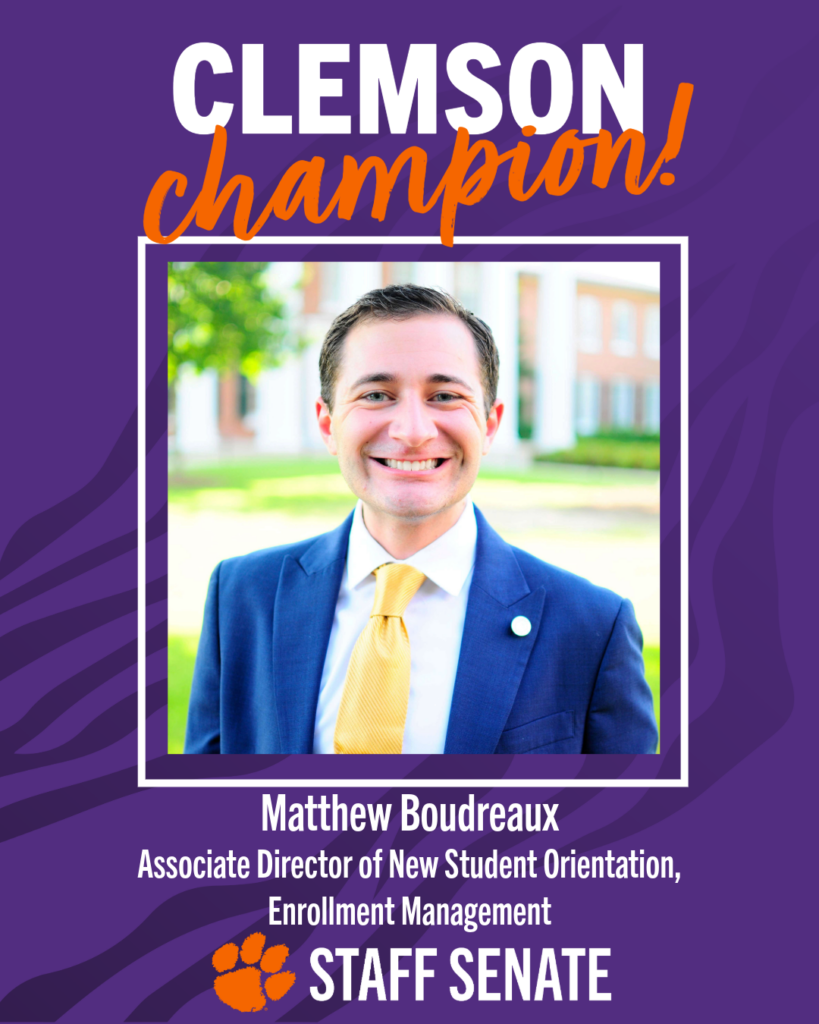
Meet Matthew Boudreaux, Associate Director of New Student Orientation l Projects
Can you tell us about your role here at Clemson?
I manage and oversee the design, implementation and assessment of new student orientation initiatives, inclusive of our in-person experience Ready, Set, Roar! as well as the virtual components of New Student Orientation. Along with the Assistant Director, I work closely with the Orientation Ambassadors and help out with other initiatives from our office, including our campus visit experience and Admitted Students Day (Tiger Town Takeover).
What is something fun we might not know about you?
I love Broadway – I’ve seen 66 shows! You can catch me at Thursday Nights at the Peace Center & and any local Theatre in the Upstate!
What brought you to Clemson?
I knew I wanted to work in Orientation after grad school and the search landed me here! I knew the people were special back then and that continues to be the reason why I stay.
Is there anything you would like for people to know about your department?
Visits, Events, and Orientation is still such a young office since its inception, but we have produced SO MUCH! We are growing quickly and want to work with all campus departments and community partners to show how special Clemson is to all of our prospective and admitted students and families.
The Clemson Champion is Staff Senate’s spotlight for exceptional staff and teams at Clemson. Stay tuned and meet more Clemson Champions in future posts.
Omnium: A Bold New Circus is a world-renowned, welcoming and spectacular non-profit Circus company. We assure everyone can participate together in joy, laughter, thrills, chills and connection through representation, comprehensive access and shared wonder. By spotlighting and supporting disability in the arts, we showcase the extraordinary feats that highlight the astounding potential of the human spirit.
American Patchwork Quartet
Thursday, September 24, at 7:30 p.m.
Tickets from $25
American Patchwork Quartet (APQ)—founded by multi-GRAMMY® Award-winning guitarist and vocalist Clay Ross and shaped in collaboration with an ensemble of internationally celebrated musicians—binds timeless American folk songs with jazz sophistication, country twang, West African hypnotics, and East Asian ornamentation. Their debut album was recently nominated for “Best Folk Album” at the 67th GRAMMY® Awards.
A dance theatre adaptation of the #1 New York Times bestseller, What Do You Do With a Problem?—a powerful story for all ages about a child facing a persistent problem. At first, the problem feels overwhelming, growing larger the more it’s ignored. But when the child bravely confronts it, the problem reveals unexpected possibilities. This moving production invites audiences to see challenges in a new light—reminding us that within every problem may lie a hidden opportunity…and a chance to discover something meaningful about ourselves.
Chamber Music Society of Lincoln Center
American Soundscapes
Utsey Chamber Music Series
Tuesday, October 6, at 7:30 p.m.
FREE, ticket required
Celebrating the rich voices of American composers, 13 musicians in the CMS explore a range of musical expressions that define the nation’s cultural landscape. William Bolcom’s lively Rag infuses playful energy into the string quartet, while Amy Beach’s Piano Quintet, a cornerstone of American chamber music, blends lyrical vibrancy with innovative harmonies. Bernard Herrmann’s Psycho Suite, performed in its original instrumentation for strings, brings the suspense of his iconic film score into the concert hall with gripping intensity and dark beauty. The concert concludes with Aaron Copland’s Appalachian Spring Suite, a quintessentially American work that captures the hope and optimism of life on the frontier.
The Music Man
Tuesday, October 13, at 7:30 p.m.
Tickets from $45
Meredith Willson’s timeless, six-time Tony Award®-winning musical comedy, The Music Man, follows a notorious, fast-talking traveling salesman as he cons the people of River City, Iowa, into buying instruments and uniforms for a boys’ band that he vows to organize – despite the fact that he doesn’t know a trombone from a treble clef. His plans to skip town with the cash are foiled when he falls for Marian Paroo, the local librarian. A true musical theater gem, the story’s relevance transcends generations with unforgettable songs including “Seventy-Six Trombones,” “Trouble,” ‘Till There Was You,” “Pickalittle,” and “Gary, Indiana.”
Charlotte Ballet
Whispers, Echoes, Voices
Thursday, October 29, at 7:30 p.m.
Tickets from $25
Charlotte Ballet presents a mixed repertory, contemporary program featuring choreographers Jiří Kylián, Crystal Pite, and Mthuthuzeli November. Jiří Kylián’s Petite Mort wields fencing foils and fabric in a euphoric exploration of tension and release, reflecting the delicate balance between vulnerability and strength while capturing the essence of life’s nature to the melody of Mozart. Crystal Pite’s Solo Echo sweeps through like a winter wind, its poetry etched in motion, resilience, and the echo of remembrance — a profound narrative of connection and emotional endurance. Resident Choreographer Mthuthuzeli November’s As I Am breathes life into ancestral voices, honoring the past, embracing the strength of the future, and the quiet freedom of truly arriving as oneself.
Tickets available at clemson.edu/brooks. Clemson University staff members receive 10% off tickets on all Boni Belle and Family Series shows.
September 1 marked the start of the new 4-H Youth Development club year. Youth ages 5 to 18 can join their local 4-H club(s) through 4-H online for $15 a year. If they register before October 1, they will receive a free T-shirt! 4-H is a nationwide program. In fact, it is the nation’s largest youth development program with approximately 6 million youth and over 35 million alumni of the program. Head, Heart, Hands and Health make up the four H’s. Youth who participate in 4-H have been found to be twice as likely to make healthier choices and four times more likely to make a positive contribution to their communities! How does this program run in South Carolina? Through Extension!
The Clemson University Cooperative Extension 4-H Youth Development uses a learn-by-doing approach to help youth gain the knowledge and skills to be responsible, productive and contributing members of society. This mission is accomplished by creating safe and welcoming learning environments, the involvement of caring adults, and utilizing the expertise and resources of Clemson University and the nationwide land-grant university system.
State specific upcoming events or highlights of the past?
Our Clemson Cooperative Extension 4-H Youth Development Agents work with local adult volunteers to form clubs that meet the interests and needs of their community. Over 122,000 youth statewide benefited from 4-H this past year. Counties offer a variety of 4-H programs from clubs, day camps, independent-study work, competitions, and in-school enrichment across areas of agriculture and animals, civic engagement, healthy living, natural resources, and STEM. From supporting AI and digital literacy and competing in bridge-building challenges to learning about our watersheds and how to care for animals, 4-H has something to spark every youth’s imagination and equips young people with the real-world skills, resilience, and confidence needed for future life and career challenges. For every dollar invested in a 4-H’er, there’s a $40 return in economic benefit to the youth, their family, and the community. You can learn about local clubs or become an adult volunteer by contacting your local 4-H Youth Development Agent, as well as see what is offered statewide online. Come see 4-H in action at the following upcoming events:
Tractor Supply Co. Paper Clover Campaign (November 27-December 13) – Support 4-H by donating a dollar at checkout in any local store to support 4-H programming!
South Carolina State Fair (October 15-25) – Check us out at our booth in the Ellison Building or visit the animal shows and exhibits! Members and volunteers get in free on 4-H Day on Saturday, October 17th.
CAFLS Tailgate and Youth Day (November 14) – All 4-H and FFA groups are invited to participate in annual Clemson experience. Registration is available and packages are $75 each which include a ticket to the football game against Georgia Tech, a meal ticket, and a T-shirt.
We are excited to welcome a regular contribution to the Staff Senate Newsletter from the Extension Senate President, Charley Maxwell. Visit the Extension Senate blog at https://blogs.clemson.edu/ces/.
Vulnerability is a popular concept. We praise when someone shares their personal struggles; we crave leaders to show us they are “real people.” We appreciate and trust people who are willing to admit they make mistakes and do not have it all together. At the same time, vulnerability carries real risks. What are the consequences of sharing so much? What will people think, say, and do after your show of vulnerability? The answers to these questions vary based on who we are and the environment we are in. As much as I believe in vulnerability, it is not so simple to encourage everyone to be vulnerable about everything at all times.
This concept came to me when someone—we’ll call her Susie—recently expressed frustration about her colleague—Johnny. Susie told Johnny about a tough situation she encountered with her parents, and she felt like he was empathetic and helpful. However, after working together for a few months, Susie was growing frustrated that she did not know anything about Johnny’s life. She would ask about his wife and kids, and he remained very generic. She wanted him to open up to her like she had to him, and he wasn’t budging.
On the other side of that situation, Johnny understood what Susie wanted from him, but it was not something he was willing to give (way to go setting boundaries, Johnny!). He was a private person, but even beyond that, he felt like working together for a few months did not earn Susie his entire life story and struggles. He felt like she needed to earn his vulnerability and had not done that yet.
This conundrum highlights some stylistic differences. Some people are going to be naturally vulnerable with anyone. When my grandmother was near the end of her life, my mom would process it with friends, family, coworkers, strangers, and even the person checking her out at Publix. Others only share with their core group of people. The challenge is when the Susies and Johnnys put expectations on each other that they do not agree to meet (see the August newsletter about separating hopes and expectations!).
Creating a space where vulnerability does not feel threatening requires psychological safety. In a psychologically safe environment, you can admit mistakes, failures, and challenges. You can question each other, suggest alternate solutions, and express doubts. You can admit what you are going through and what you struggle with, and you do not have to fear the other person’s reaction to all of that. We can foster psychological safety by responding productively to other’s admissions, by not getting defensive, and by being willing to admit that we do not have it all figured out. But even when we feel psychologically safe, that doesn’t ensure others will.
In some relationships, we have to earn someone else’s vulnerability. Maybe after a few years of cooperation and friendship, Johnny will begin to share with Susie. In other relationships, we’ll never get the vulnerability we crave. We can choose our own level of vulnerability, but we can only do so much to invite others to open up. They get to accept or decline that invitation.
Next month, I will cover a situation where we need to be vulnerable whether we feel psychologically safe or not. In the meantime, weigh the benefits and consequences of being vulnerable, brainstorm some ways to strengthen psychological safety in your area, and move on if you are not met with the same vulnerability you want to offer. ns? Have you been putting your hopes onto people who do not even know what it is you want to happen? When we are clear about what we expect, we are more equipped to respond to unmet expectations. When we separate our hopes, we are not putting something unreasonable onto someone else that they never agreed to achieve. (But side note—there’s no way my kids won’t want to be my friend, right?) Enjoy the last days of summer!
What is the Ombuds Office? The Ombuds Office is a confidential, independent, neutral, and informal space for staff to process concerns, get information, and develop options for how to move forward in a difficult situation. I can provide education, conflict coaching, mediation, and facilitation as well as referrals to other resources across Clemson. If you are unsure how to move forward in any way, I can help you work through it.
Tessa Byer Phone: 864-656-5353 Email: tbyer@clemson.edu Address: 135 Old Greenville Hwy, Ste. 203 (Next to Esso!)
Save the date for upcoming trainings offered by the Ombuds Office:
CCIT Research Computing and Data and ReDCAT are pleased to announce the second annual High Performance Computing (HPC) Day event to showcase HPC research and education on Friday, September 18, 2026, from 7:30 a.m. to 5:15 p.m. in Hendrix Student Center. This event is a fantastic opportunity to network with other HPC researchers, learn new skills and information and elevate cutting-edge research. Registration for the free event is open for Clemson staff, employees and students (graduate and undergraduate).
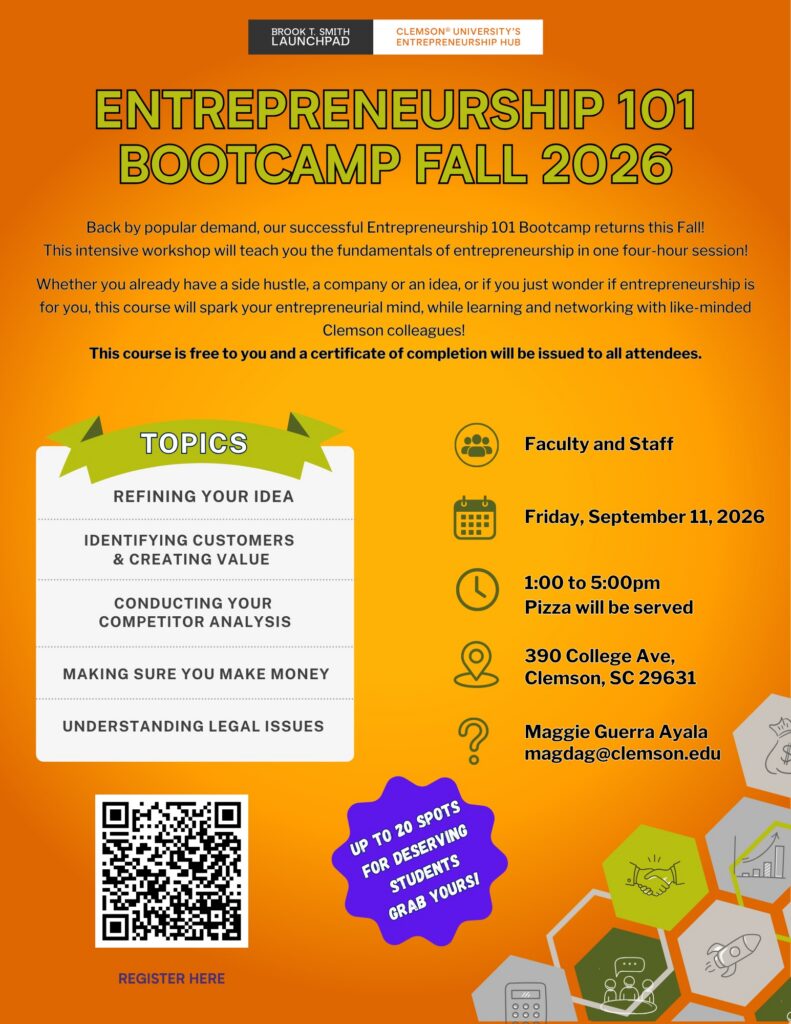
By popular demand our Entrepreneurship 101 Bootcamp returns this Fall to the Launchpad! This intensive workshop for Faculty and Staff will teach you the fundamentals of entrepreneurship in one four-hour session!
Whether you already have a side hustle, a company or an idea, or if you just wonder if entrepreneurship is for you, this course will spark your entrepreneurial mind, while learning and networking with like-minded Clemson colleagues! A certificate of completion will be issued to all attendees.
Join us on Friday, September 11, 2026 starting at 1:00 pm at the Brook T. Smith Launchpad, for a course of empowering learning, insightful discussions, skill enhancement, and personal growth. The session will feature the following modules: Refining your idea; Identifying customers & creating value; Conducting your competitor analysis; Making sure you make money and, Understanding legal issues. A certificate of completion will be issued to all attendees.
Register by September 10 using this link! This course is free, but seats will fill up fast!
Questions? Email Maggie Guerra-Ayala, Operations Manager at magdag@clemson.edu
Looking for a fun way to stay active, reduce stress, and connect with others on campus? Fike Recreation Center offers a variety of group fitness classes throughout the week that are open to all members.
Whether you’re new to fitness or have years of experience, our instructors create a welcoming environment for participants of all fitness levels. Every exercise can be modified to meet individual needs and abilities, allowing you to work at a pace that feels right for you.
For employees seeking lower-impact options, Pilates, yoga, barre, and cycling offer excellent opportunities to improve strength, flexibility, balance, and cardiovascular health while minimizing impact on the joints. These classes are especially adaptable and can accommodate a wide range of fitness levels.
If you’re looking for a higher-energy workout, Fike also offers dance-based classes that combine fitness and fun. Classes such as Werk It, Cardio Dance, and HIIT the Dancefloor provide an upbeat atmosphere and a great way to get your heart rate up while enjoying music and movement.
We encourage Clemson employees to take advantage of these opportunities to prioritize wellness, increase physical activity, and experience the supportive community that group fitness provides.
Here’s a link to our updated class schedule. Classes held at Fike are orange. This schedule will be kept updated online. Group Fitness Schedule Link Take the first step toward a healthier, more active lifestyle by joining a class this week. Whether you prefer mindful movement, strength-building exercises, energizing cycling sessions, or dance-focused workouts, Fike Recreation Center has something for everyone. We look forward to seeing you in class!
Interested in earning an MBA? We’d love to connect with you! For a one-on-one conversation with Admissions, email mbaprogram@clemson.edu.
Planning to start in January? Spring enrollment deadlines for the Part-Time Corporate and Online programs are right around the corner, October 1 for priority consideration and November 15 for the final deadline.
Join our virtual information session on October 8th to learn how Clemson’s MBA programs can help you reach your goals and how to use your employee tuition assistance benefit.