The Office of Military and Veteran Engagement is hosting a Green Zone Training opportunity Tuesday, July 15, from 11:30 a.m. to 1 p.m. Green Zone Training provides faculty, staff, and graduate assistants with an understanding of the military experience of veterans and military-connected students as they transition from the military to campus life.
Through Green Zone training, participants will learn:
Facts and figures related to military students.
What it means to be a student veteran.
About military and veteran experiences.
Myths and stigmas associated with student veterans.
On- and off-campus resources and support services for veterans and military connected students.
Green Zone Training is held regularly throughout the year. Participants may register for Green Zone Training via Tiger Training. For additional questions or details, contact Emily DaBruzzi or Scott Cook.
The Clemson University Staff Senate is extending a huge thank you to the sponsors and participants who helped make the Staff Senate Golf Tournament a major success. Thanks to both sponsors and participants of the Golf Tournament, Staff Senate raised over $15,000 for the Employee Emergency Fund.
Golf Tournament Sponsors
Kim, Lahey & Killough Law Firm (Title Sponsor – $5,000)
Juneau Construction Company (Paw Sponsor – $1,000)
Clements Electrical (Paw Sponsor – $1,000)
CoTransCo of SC, LLC (Paw Sponsor – $1,000)
Diamond T Promotional Gear (Donated all the banners/signs)
Home Outlet (Hole Sponsor – $500)
Bermuda Triangle Dive Shop (Hole Sponsor – $500)
South Carolina State Credit Union (Hole Sponsor – $500)
The Comfort Cause (Sponsored a team of four to play – $500)
There is a free concert in the amphitheater on Friday, May 16. The 3-piece alternative blues and rock band @modern_mammals are from Walhalla, SC. They will perform original music that provides a unique listening experience. Enjoy free live music in the prettiest venue in the Upstate! Visit the calendar for more information.
It is time again to celebrate the thousands of faculty and staff members who make Clemson truly special.
The annual Employee Appreciation Luncheons bring together team members from across the University for an afternoon of celebration and recognition.
Main Campus Luncheon
The main campus luncheon will take place on Wednesday, May 14, from 11:30 a.m. to 1:30 p.m. at The Dish at McAlister Dining Hall. The Office of Human Resources plans the event with support from Clemson Home.
The event is free to all Clemson employees and features a buffet-style lunch including barbecue, hot dogs, veggie burgers, coleslaw, salads and more!
Employees should bring their CUIDs to enter the dining hall.
Clemson University Livestock Poultry Health will host a luncheon for employees in their office (500 Clemson Road, Columbia) on Wednesday, May 14, at 11:30 a.m.
Charleston Innovation Campus
The Charleston Innovation Campus, consisting of the Zucker Family Graduate Education Center, the Warren Lasch Conservation Center, and the Dominion Energy Innovation Center, will host a luncheon at the Graduate Education Center (1240 Supply Street, North Charleston) on May 7.
Interested in learning more about Clemson’s MBA Options and the Employee Tuition Assistance Program (ETAP) benefits available to you as a Clemson employee? Please join our Admissions Team during our upcoming Virtual Info Session on Tuesday, June 10 at noon. Register for the information session to reserve your spot.
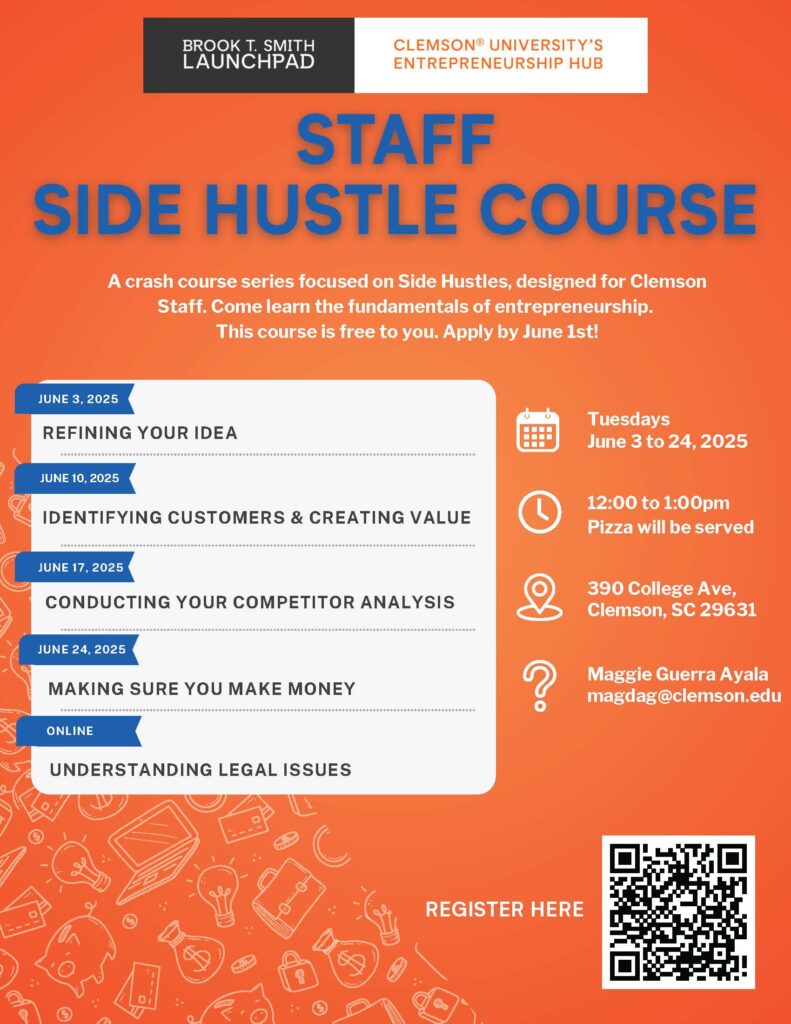
We’re excited to invite you to the 2025 Summer Side Hustle Course for Clemson Staff! This 4-week crash course is designed to teach you the fundamentals of entrepreneurship while empowering and inspiring personal growth.
Join us weekly, starting Tuesday, June 3rd at 12:00 pm at the Brook T. Smith Launchpad, for a course of insightful discussions with like-minded staff peers and instructors, practical learning and skill enhancement. Modules and general information are on the flyer! Register by June 1st using this link! This course is free, but seats will fill up fast!
Contact Maggie Guerra Ayala, magdag@clemson.edu, for more information.
The 2024-2025 academic year is almost over, and we have a new cohort of staff senators, ready to drive lasting change for their constituents. As we prepare for the challenges ahead, we might ask ourselves, “How do we do that?” or “How can I advocate for myself and others?” During the April Staff Senator Training, we’ll delve deeper into these questions. But for now, let’s focus on preparing to advocate, channeling that Tiger Spirit. Let’s face it: advocacy isn’t just about roaring louder. It’s a high-stakes game of emotional chess, a delicate dance of persuasion, and a test of your inner fortitude. Think of it as constructing your own personal “Inner Fortress,” a mental and emotional stronghold that allows you to navigate the tricky terrain of advocating for yourself or others.
Forget the image of a medieval castle with moats and drawbridges. We’re talking about a fortress built on solid foundations: self-awareness, emotional regulation, cognitive resilience, and strategic communication. It’s less about brute force and more about nuanced finesse, a blend of vulnerability and strategic savvy.
Know Thyself (Really Know Thyself).
This isn’t your casual “I like long walks on the shores of Lake Hartwell” self-awareness. We’re talking digging deep into your values, triggers, and biases, with the same intensity as a student preparing for finals in Cooper Library. Authentic advocacy demands this level of introspection. Consider detailed journaling, producing a narrative analysis, and honestly confronting those moments that make you cringe.
Ever notice you get defensive when your actions are questioned? Journal it! Reflect on it! Recognizing our flaws isn’t weakness; it’s the key to authentic connection. Question your assumptions. Are you listening to understand, or just waiting to pounce? Tools like 360-degree feedback, which gathers input from peers, supervisors, and subordinates, and models like the Johari Window, which maps self-awareness and awareness by others, can provide crucial external perspectives. These tools help illuminate blind spots and create a more complete picture of your impact.
Master Your Emotional Weather.
Advocacy is an emotional rollercoaster. You’ll encounter resistance, frustration, and maybe even a few tears. Emotional regulation is your seatbelt. Empathy and vulnerability are your airbags, cushioning those emotional bumps. Practice active listening. Learn to recognize those emotional triggers and develop strategies to manage them. Maintaining dignity, both for ourselves and others, is a moral imperative. Consider it maintaining a calm, clear head even when the room is spinning.
Build Cognitive Resilience: Your Mental Bungee Cord.
Challenges are inevitable. How you bounce back defines your success. Reframe requests as collaborative opportunities, shifting from “me vs them” to “us vs. the problem.”
Setbacks aren’t failures; they’re learning curves. Conflict can be a catalyst for innovation. See it as turning lemons into lemonade, but with more strategic planning and less sugar.
Communicate Like a Pro (Not a Politician).
This is where your inner fortress translates into outward impact. Speak with clarity, conviction, and honesty. Courageous communication, even when difficult, builds trust. Understand the other person’s perspective. Focus on speaking their language, not just your own.
Influence with Integrity.
Advocacy isn’t about manipulation; it’s about building genuine relationships and fostering collaboration. Align your requests with the values of your audience. Articulate your worth and challenge limiting assumptions. Build trust and psychological safety. Focus on interests rather than positions to find common ground. Conceive of it as finding collaborative solutions, not just winning the argument.
Develop Strategic Harmony
Picture advocacy as crafting elegant bridges, not dramatic bonfires. Advocacy is about influencing from within, not upending from without. Think well-researched proposals over amplified demands. It’s the art of strategic harmony, where lasting change flows from understanding and engaging with existing structures.
What is your toolkit? Solutions, not just critiques. An advocate cultivates alliances, even across differing viewpoints, armed with solid evidence and unwavering professionalism. Aim to navigate policies with finesse, presenting your case with clarity and conviction. The aim is tangible impact, achieved through nuanced dialogue, not disruptive noise.
The Ongoing Journey.
Building your inner fortress is an ongoing process. It requires constant self-reflection, learning, and adaptation. It’s about embracing vulnerability, fostering empathy, and cultivating a growth mindset.
Remember, advocacy isn’t just a skill; it’s a crucial component of ethical leadership and social change. So, build your fortress strong, and go out there and make a difference.
Sources
Brown, Brené. Dare to Lead: Brave Work. Tough Conversations. Whole Hearts. Random House, 2018.
Cabral, Amber. Say More About That: …and Other Ways to Speak Up, Push Back, and Advocate for Yourself and Others. Berrett-Koehler Publishers, 2023.
Cialdini, Robert B. Influence: The Psychology of Persuasion. William Morrow, 1984.
Davey, Liane. The Good Fight: Use Productive Conflict to Get Your Team and Organization Back on Track. Bibliomotion, Inc., 2017.
Dweck, Carol S. Mindset: The New Psychology of Success. Random House, 2006.
Fisher, Roger, William Ury, and Bruce Patton. Getting to Yes: Negotiating Agreement Without Giving In. Penguin Books, 1991.
Gross, James J. “The Emerging Field of Emotion Regulation: An Integrative Review.” Review of General Psychology, vol. 2, no. 3, 1998, pp. 271–99.
Hansen, Heather. Advocate to Win: 10 Tools to Ask for What You Want and Get It. McGraw-Hill Education, 2013.
Hicks, Donna. Dignity: Its Essential Role in Resolving Conflict. Yale University Press, 2011.
Petty, Richard E., and John T. Cacioppo. Communication and Persuasion: Central and Peripheral Routes to Attitude Change. Springer-Verlag, 1986.
Pink, Daniel H. To Sell Is Human: The Surprising Truth About Moving Others. Riverhead Books, 2012.
Schein, Edgar H., and Peter A. Schein. Humble Inquiry: The Gentle Art of Asking Instead of Telling. Berrett-Koehler Publishers, 2013.
Tannen, Deborah. You Just Don’t Understand: Women and Men in Conversation. William Morrow, 1990.
What is the Ombuds Office?
The Ombuds Office is a confidential,
independent, neutral, and informal space for staff to process concerns, get
information, and develop options for how to move forward in a difficult
situation. I can provide education,
conflict coaching, mediation, and facilitation as well as referrals to other
resources across Clemson. If you are
unsure how to move forward in any way, I can help you work through it.
Michael Scott Phone: 864-656-6353 Email: mesctt@clemson.edu Address: 135 Old Greenville Hwy, Ste. 203 (Next to Esso!)
Save the date for upcoming training offered by the Ombuds:
Introduction to Meditation April 26, 2025 from 9a.m.-12 p.m. At University Facilities Center, sign up via Tiger Training.
Staff Senate is excited to announce your Staff Senators for the 2025-28 term! The Staff Senate would like to send a huge thank you to everyone who was nominated or voted during this year’s election process, with 670 votes cast across eight elections and vacancies in 16 budget centers.
Staff Senators
Jay Cooley – Student Affairs
Cory Tanner – College of Forestry, Agriculture and Life Sciences
Mallory Maher – College of Forestry, Agriculture and Life Sciences
Bryson Toole – College of Arts and Humanities
Connor Stephens – College of Behavioral, Social and Health Sciences
Helen Diamond-Steele – Division of Community, Engagement, Belonging and Access
Aubrey Baldwin – College of Engineering, Computing and Applied Sciences
Staci Koonce – College of Education
Rob Seay – Clemson University Restoration Institute
Anthony Herrera – University Facilities
John Chorazak – University Facilities
Obryan Machado – Finance and Operations
Nicci Hanewald – Office of the President & Board of Trustees
Alison Fecher – Office of the Provost
Allison Bower – Public Service Activities
Meredith Williams – Research & Economic Development
Lynn Tumblin – Harvey S. Peeler Jr. College of Veterinary Medicine
Are you interested in learning more about Clemson’s MBA Options and the ETAP benefits available to you as a Clemson employee? Join us for our upcoming Admissions events to learn more!
Clemson MBA Open House
Join us for our Spring Open House and meet with MBA staff, tour our beautiful Greenville ONE campus, and meet with a member of our Admissions team.
To streamline the new hire process and support departments across campus, the Office of Human Resources has transitioned to electronic I-9 forms through PeopleSoft for newly hired faculty, staff and students.
Federal law requires all new hires verify their identity and eligibility to work in the United States by completing the I-9 form by their third day of employment. Completing the form electronically maintains the privacy of personal information, enables digital record-keeping, reduces errors and allows for faster processing.
Moving forward, employees should be directed to complete Section 1 of the I-9 form through Employee Self-Service. A Tiger Training module is available to walk employees through the necessary steps. Employees cannot complete the form until their hire is entered in PeopleSoft.
Once submitted, the appropriate Clemson representative who reviewed the employee’s identification documents should review the form and complete Section 2 in PeopleSoft. A Tiger Training module for University representatives is also available for those reviewing the form and the employee’s documentation.
International employees cannot use the electronic I-9 form and must complete a paper form with the International Employment Unit during the hiring approval process. Refer to the International Employee Hiring Instructions for more details.
Are you thinking about retirement but don’t know where to start?
“Navigating Your Retirement” is a hands-on group session designed for faculty and staff who plan to retire within three months to a year. The course covers how to begin the retirement process, an employee’s role and responsibilities, and the required steps to retire from Clemson University.
Sessions are hosted by the Office of Human Resources’ Workforce Benefits and Well-Being Unit, with in-person and online courses available. All sessions are from 3 – 4:30 p.m. Interested participants should register through Tiger Training.
In-Person Sessions
Thursday, March 13
Thursday, April 17
Virtual Sessions
Wednesday, March 19
Thursday, May 22
Summer and Fall session dates and availability will be released at a later date.
Questions?
PEBA offers appointments for one-hour phone consultations and one-hour video consultations. Faculty and staff can schedule an appointment online or learn more on PEBA’s website.
Supervising for Success
The Supervising for Success training series has been paused while OHR trains new instructors and updates training materials. The program is expected to relaunch in the fall of 2025. Tiger Training has updated the training modules’ due date for individuals currently enrolled in the program.
New supervisors are still required to complete the New Supervisor Orientation and Kronos Training courses in Tiger Training within 30 days of their transition to their new role.
New Employee Orientation
New Faculty and Staff Orientation will now be held once per month to reflect the needs of the University community. Sessions will be held every third Tuesday. New employees or supervisors looking to enroll new hires should visit Tiger Training to find a suitable session.