General Education Re-Envisioning

Science, Technology, Society – Featured Week Jan 29-Feb 2

Overview for all featured weeks

Although we are thinking about content subject matter and skills, general education also involves a broader vision.

Clemson’s current STS competency statement

Demonstrate an understanding of issues created by the complex interactions among science, technology, and society.

Clemson’s current rubric for assessing STS

Key questions for in-person and virtual discussions
  • What is valuable for students to know and do in this area?
  • How do we know they have achieved it?
  • In what ways might we develop engaged learning opportunities for our students in this area – service-learning, internships or co-ops, collaborative assignments & projects, student-faculty research, study abroad, diversity/global learning, etc.?
  • How can courses in this area help students with evidence-based civil discourse? With ethical thinking?
  • In what ways is this area already interdisciplinary? In what ways could we use the themes to connect to other curricular offerings?
Resources and other models for this general education student learning outcome: 

Examples_Tech_Society

Please come to an in-person discussion and/or provide your responses and feedback and thoughts in the comments feature of this post.

Natural Sciences – Featured Week Jan 29-Feb 2

Overview for all featured weeks

Although we are thinking about content subject matter and skills, general education also involves a broader vision.

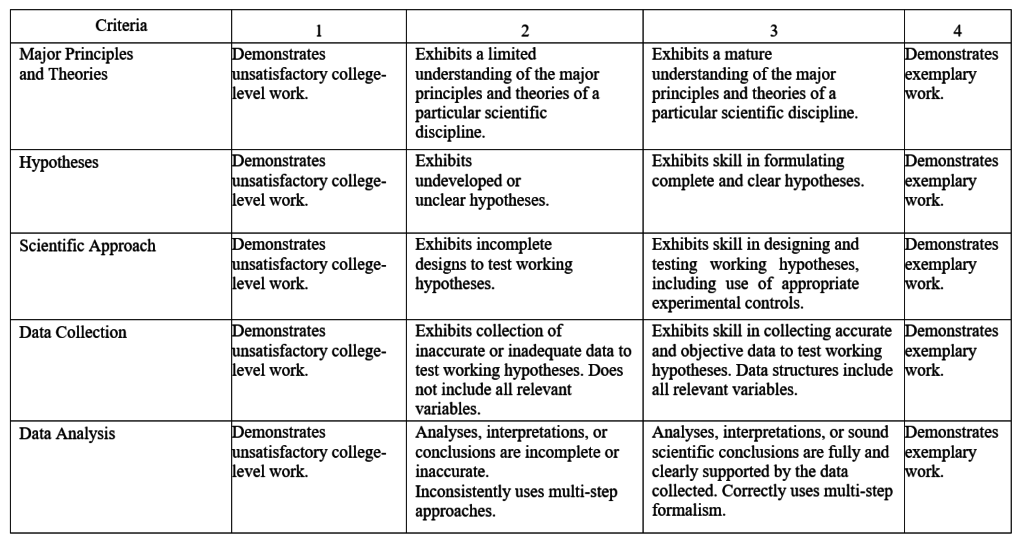
Clemson’s current natural science competency statement

Demonstrate the process of scientific reasoning by performing an experiment and thoroughly discussing the results with reference to the scientific literature, or by studying a question through critical analysis of the evidence in the scientific literature.

Clemson’s current rubric for assessing natural science

Key questions for in-person and virtual discussions
  • What is valuable for students to know and do in this domain of knowledge?
  • How do we know they have achieved it?
  • What might a student learning outcome for natural science look like in the community? In an internship or co-op? Through student-faculty research?
  • How can courses in this area help students with evidence-based civil discourse? With ethical thinking?
Resources and other models for this general education student learning outcome: 

NaturalSciences_Examples

Please come to an in-person discussion and/or provide your responses and feedback and thoughts in the comments feature of this post.

Social Sciences – Featured Week: Jan 22-26

Overview for all featured weeks

Although we are thinking about content subject matter and skills, general education also involves a broader vision.

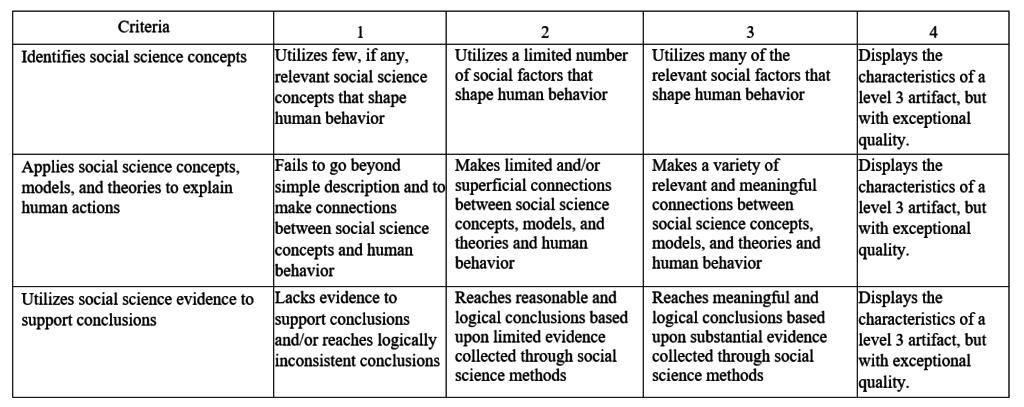
Clemson’s current social science competency statement

Describe and explain human actions using social science concepts and evidence.

Clemson’s current rubric for assessing social science

Key questions for in-person and virtual discussions
  • What is valuable for students to know and do in this domain of knowledge?
  • How do we know they have achieved it?
  • What might a student learning outcome for social science look like in the community? In an internship or co-op?
  • How can courses in this area help students with evidence-based civil discourse? With ethical thinking?
Resources and other models for this general education student learning outcome: 

SocialSciences_Examples

Please come to an in-person discussion and/or provide your responses and feedback and thoughts in the comments feature of this post.

Potential Topics for Student Learning Outcomes – Jan 2018

Phase 1: Collaborative sorting and shaping needed!
Background:

Our open discussions in November were attended by over one hundred faculty and staff colleagues who spent time engaging in dialogue about what we want our students to be able to know and do, regardless of major. They generated much raw material that we can continue to shape and sort during the spring semester to arrive at a set of common student learning outcomes for all Clemson undergraduate students.

Action step:

Our January 18 collaborative workshop provided an opportunity for colleagues to work on this sorting and shaping task.

For those who could not attend the workshop in person, we have an online survey that will allow you to sort and categorize the ideas related to student learning outcomes. The link is here (link expired), and colleagues are asked to complete the task prior to January 24 at 5 p.m.

[Copies of the materials from the January 18 collaborative workshop are available by contacting Trogden@Clemson.edu.]

How this fits into plans for the semester:

The qualitative data generated will be used by the general education task force to shape our featured weeks on potential student learning outcomes in Phase 3 this semester.

The general education task force looks forward to receiving your responses, your comments (via the comment feature below), and guiding this collaborative process of delivering an excellent foundational education to our students.

~Bridget Trogden, Associate Dean of Undergraduate Studies, Trogden@Clemson.edu

General Education Open Discussions – Nov 2017

What knowledge and skills should an educated person have, regardless of major?

The above is the major question that we – the Clemson faculty and staff – need to address at the onset of our discussions on general education revision. The General Education Task Force has scheduled a set of open discussions on Nov 6 (8:30-10 am) or Nov 9 (12-1:30 pm) in The Great Hall at the Honors Center of Core Campus. All faculty, instructors, student support services coordinators, GTAs, library faculty, and anyone else interested in productive and collaborative discussions on this topic are invited. RSVPs are requested (link expired), as food will be served.

As the discussions commence, the General Education Task Force will provide some summaries and additional questions to this blog.

All interested parties are welcome to provide comments and discussion points below throughout the entire process, including one’s own thoughts on the key question above.

Further comments or concerns can be addressed to Dr. Bridget Trogden, Associate Dean in Division of Undergraduate Studies – trogden@clemson.edu

Improving the Quality of Education & Curricular Coherence

Recent blog posts from Derek Bok  and Loni Bordoloi Pazich, via Inside Higher Ed, bring to mind many issues related to the quality and coherence of undergraduate education. Some questions for thought:

  • Do we explicitly tell our students the larger aims of our courses and why they should matter?
  • If it is the responsibility of the faculty to create and sustain a cohesive curriculum, how are we doing? What can we do to have a better sense of a unified curriculum – both in theory and in practice?
  • Do the formative and summative assessments in our classes test students on what we most want them to know and do?
  • Does the feedback we provide our students give them a sense of their progress and how to continue to improve?

2017-2018 Updates

Welcome to the updates page for the general education task force!

During this 2017-2018 academic year, the members of the task force will be working to guide broad conversations to elicit input on general education and learning outcomes. We will be soliciting perspectives from a range of stakeholders while also helping make our campus more conversant with the ways that general education contributes to student growth and success.

Information coming from these conversations will be used to shape any future plans. Transparency is important, and this page will be used for sharing information and soliciting feedback.

Stay tuned!